
SMB AI Visibility
Benchmark Report 2026
The average U.S. service business scores just 30 out of 100 on AI visibility leaving ~70% of the opportunity unclaimed. Here's what the data says, and how to win.
Winning AI visibility is execution, not budget. Fast Hippo Media makes it easier.
How prepared are U.S service businesses for AI-powered discovery?
The average service SMB scores 30 out of 100.
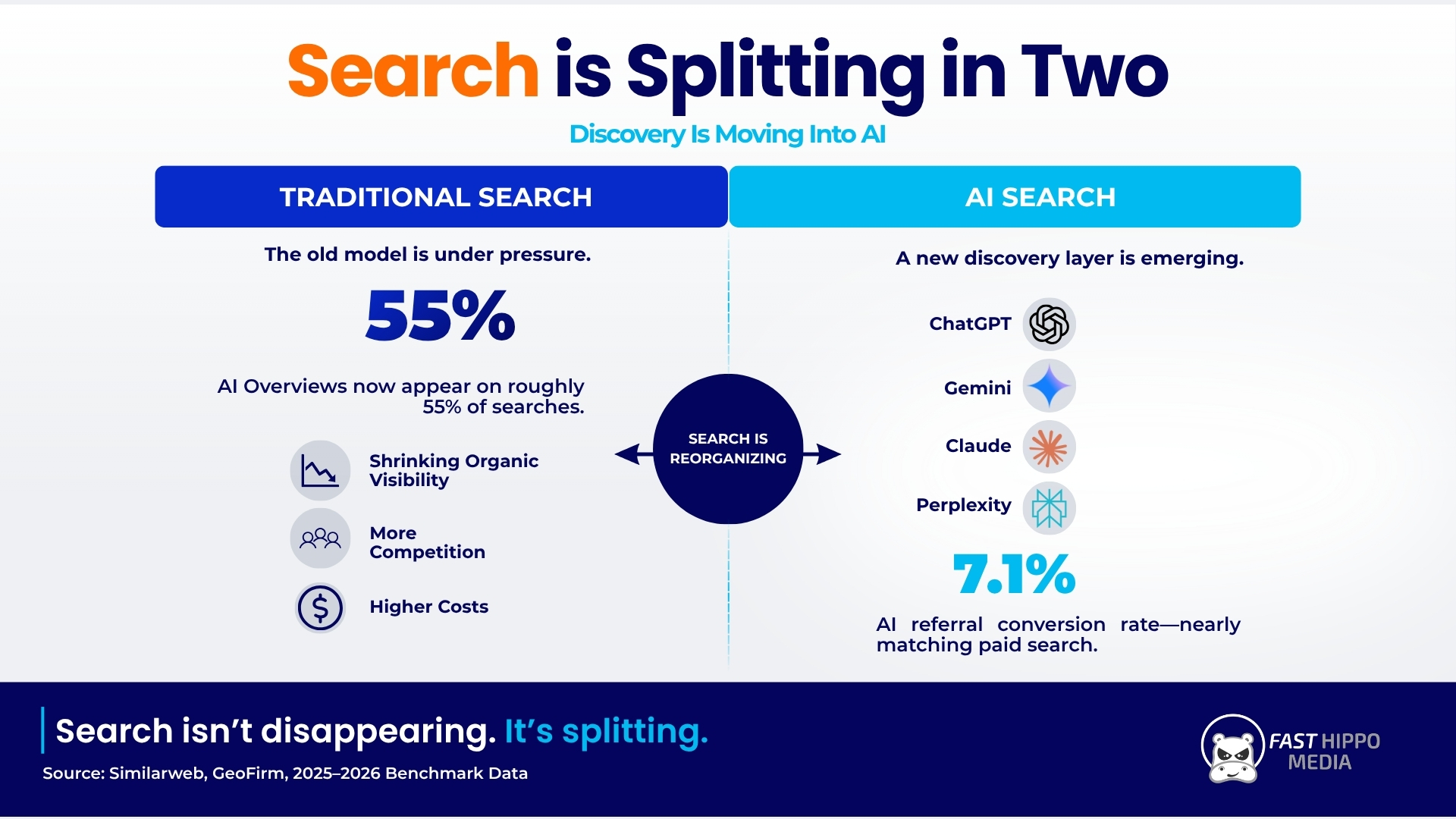
Search is reorganizing faster than most businesses are adapting to it. Traditional results are increasingly compressed beneath AI-generated answers, while a parallel discovery layer has formed inside ChatGPT, Gemini, Perplexity, Claude, and Google’s AI Overviews. Buyers are no longer simply scanning links and clicking; they are asking questions and acting on the recommendations they receive.
The shift is not theoretical. AI Overviews grew 58% year over year and now trigger on roughly half of all tracked Google searches as of early 2026, and AI platforms generated 1.13 billion referral visits in June 2025, a 357% increase over the prior year. Critically, that traffic converts: Similarweb’s 2025 analysis found AI referrals to transactional sites converting at roughly 7%, on par with paid search. The channel is already producing revenue, not just impressions.
To measure how prepared small and mid-sized service businesses are for this transition, Fast Hippo Media modeled more than 200 U.S. service businesses against national benchmark datasets and scored each across five pillars of AI visibility. The headline finding:
- The average U.S. service business scores 30 / 100 on AI visibility; ~70% of the opportunity is unclaimed
- AI Overviews now appear on roughly half of Google searches, up 58% year over year
- AI-referred visitors convert at ~7%; on par with paid search
- The weakest pillars are the ones that now drive AI discovery: citation presence (22) and measurement (19)
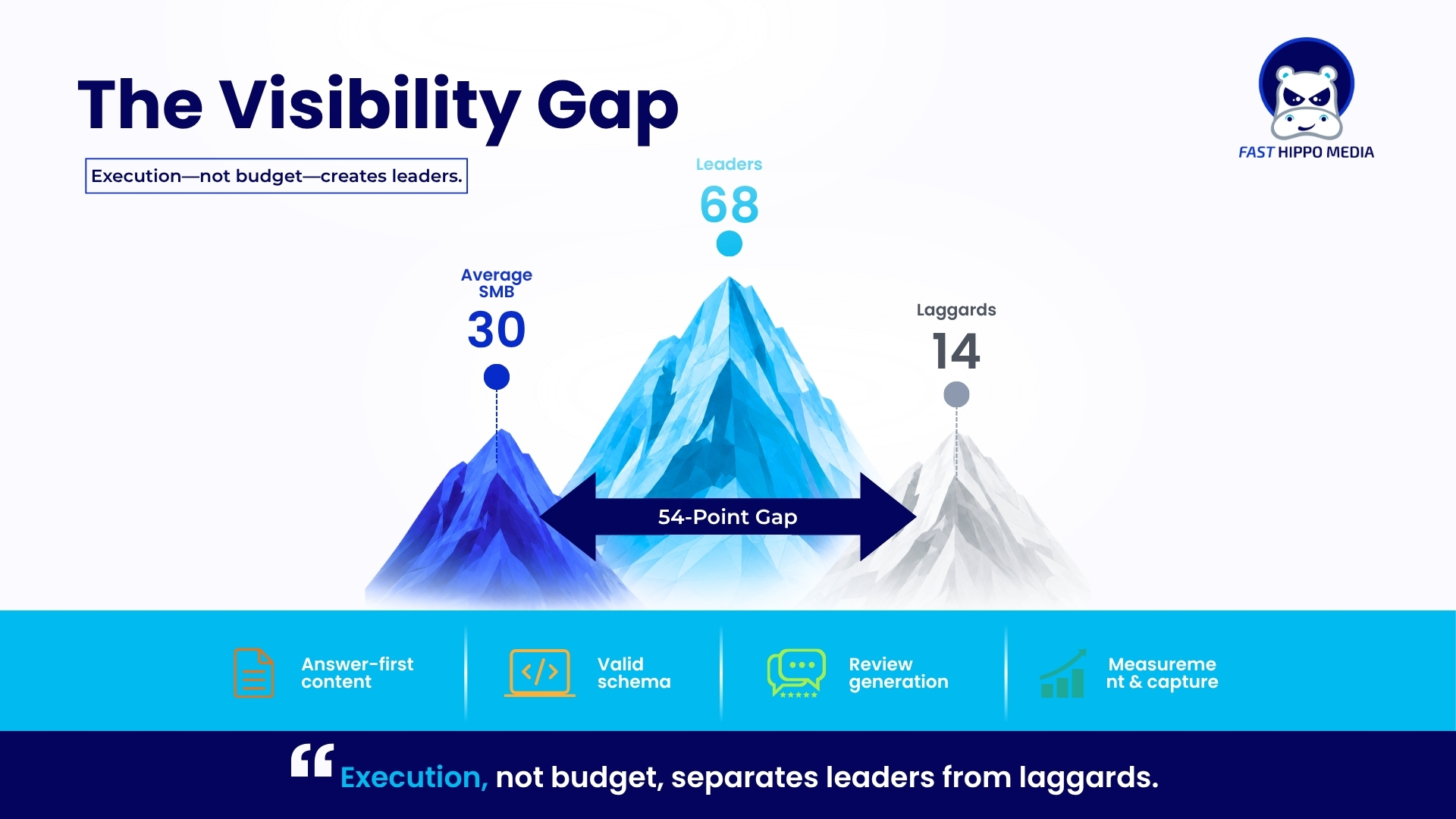
- Leaders score 68; laggards 14. The 54-point gap is built on execution, not budget
In this report, we break down the data and show you exactly where to act.
Methodology
This is a benchmark analysis and research synthesis. Fast Hippo Media constructed a composite AI Visibility Index by modeling more than 200 U.S. based small and mid-sized service businesses across five weighted pillars, then calibrating each pillar against national benchmark datasets and published industry research from 2025–2026.
The five pillars and their weightings:
whether content is structured to be extracted and cited as an answer.
presence and validity of schema markup.
how often a business is named inside AI-generated answers.
Google Business Profile completeness, review recency, and local schema.
the ability to detect, track, and attribute AI-referred traffic.
Pillar scores were normalized to a 100-point scale and combined into a single composite. Industry segment scores reflect averages within each vertical. External market statistics cited throughout are drawn from third-party providers and listed in Sources & Further Reading. Where third-party estimates vary by methodology, we report the range rather than selecting a single convenient figure.
Search is Splitting in Two
Search is not disappearing. It is dividing into two parallel discovery systems that increasingly operate on different rules.
The first is the search businesses spent fifteen years learning to win: ranked blue links, local map packs, organic click-through. That system still exists, but its economics are tightening. Seer Interactive found organic click-through dropping 61% on queries where an AI Overview appears, and Ahrefs measured a 58% CTR reduction for the top-ranked result under an Overview. By early 2026, roughly 58% of Google searches ended without a click to any website.
The second system is answer-based discovery, the domain of answer engine optimization (AEO). Inside AI engines, visibility is no longer determined by ranking position, it is determined by whether a business is named in the answer. A company cited inside an AI response captures demand its competitors never see, because the buyer never reaches a results page at all.
The implication for service businesses is direct: ranking and being recommended are now separate disciplines. Over the next decade, the businesses that win will not simply rank. They will be the answer.
For a service business, the split shows up in a single query. Someone searching “best HVAC company near me” used to see a map pack and ten links. Now they often see an AI Overview that names two or three businesses, or they skip the search box entirely and ask ChatGPT for a recommendation. If your business is not one of the names returned, you are invisible in that moment, even if you rank first in the organic results underneath.
That is the shift worth understanding: buyers increasingly treat the AI answer as a pre-vetted shortlist. It compresses the consideration set from ten options to three before the buyer has clicked anything. Traditional rankings still matter, but they now decide a different, smaller share of the outcome.
Discovery Is Moving Into AI
The old model is under pressure.
55%
AI Overviews now appear on roughly 55% of searches.
-
 Shrinking Organic Visibility
 -
 More Competition
 -
 Higher Costs
A new discovery layer is emerging.
-
 ChatGPT
 -
 Gemini
 -
 Claude
 -
 Perplexity
The SMB AI Visibility Score
Modeled against national benchmarks, the average U.S. service business scores 30 out of 100 on AI visibility.
The composite tells a consistent story across the dataset: local signals remain relatively strong, structured-data adoption is improving, but citation visibility and measurement lag badly behind. Most businesses are still optimized for the search era that is closing rather than the one opening.
The encouraging context is that no mature market has formed yet. A 30 reflects an industry-wide standing start, not individual underperformance, which means the separation between leaders and everyone else is still available to claim.
Average U.S. Service SMB
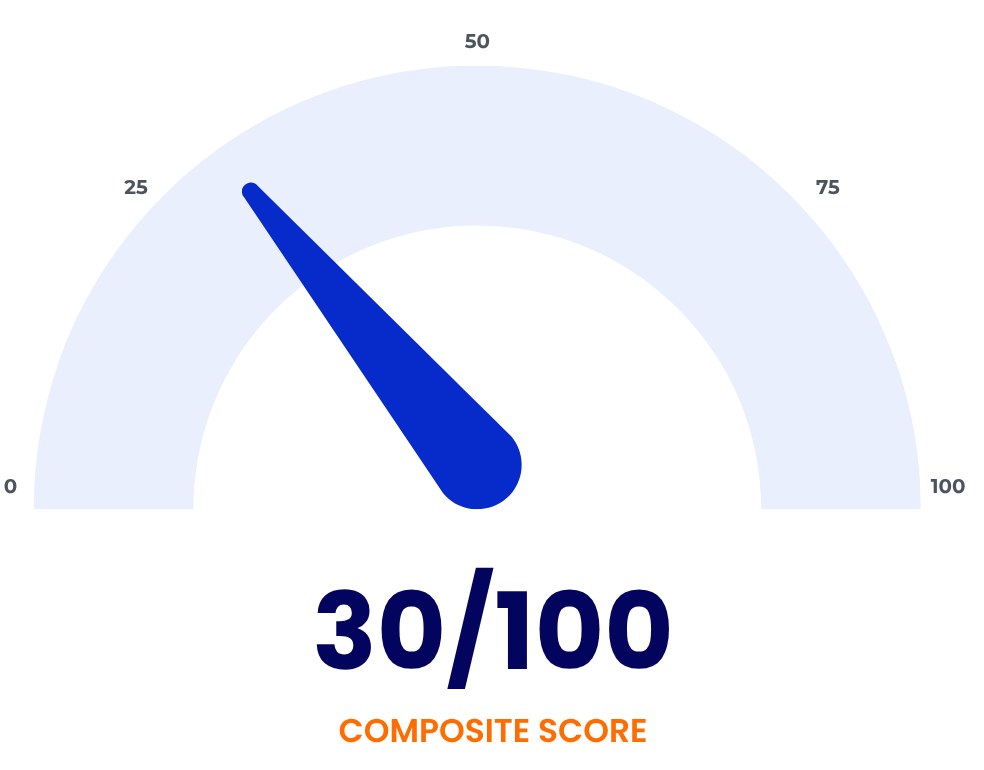


It helps to read the 30 as a composite, not a verdict. The average business is not uniformly mediocre. It is strong in one place (local signals at 48) and near the floor in two others (citations at 22, measurement at 19), and the weak pillars drag the whole score down. That structure is good news. Because the score is an average of five parts, the fastest way to move it is to lift the two lowest pillars, and those happen to be the least competitive.
It is also worth remembering that 30 is the midpoint, which means half of the businesses modeled scored below it. The leaders at 68 are working from the same tools and the same platforms as everyone else. Nothing about a 68 requires a bigger company. It requires the work to have been done.
Takeaway
A 30 is not a grade on your business. It is a map, and the lowest pillars are where the fastest, least contested gains sit.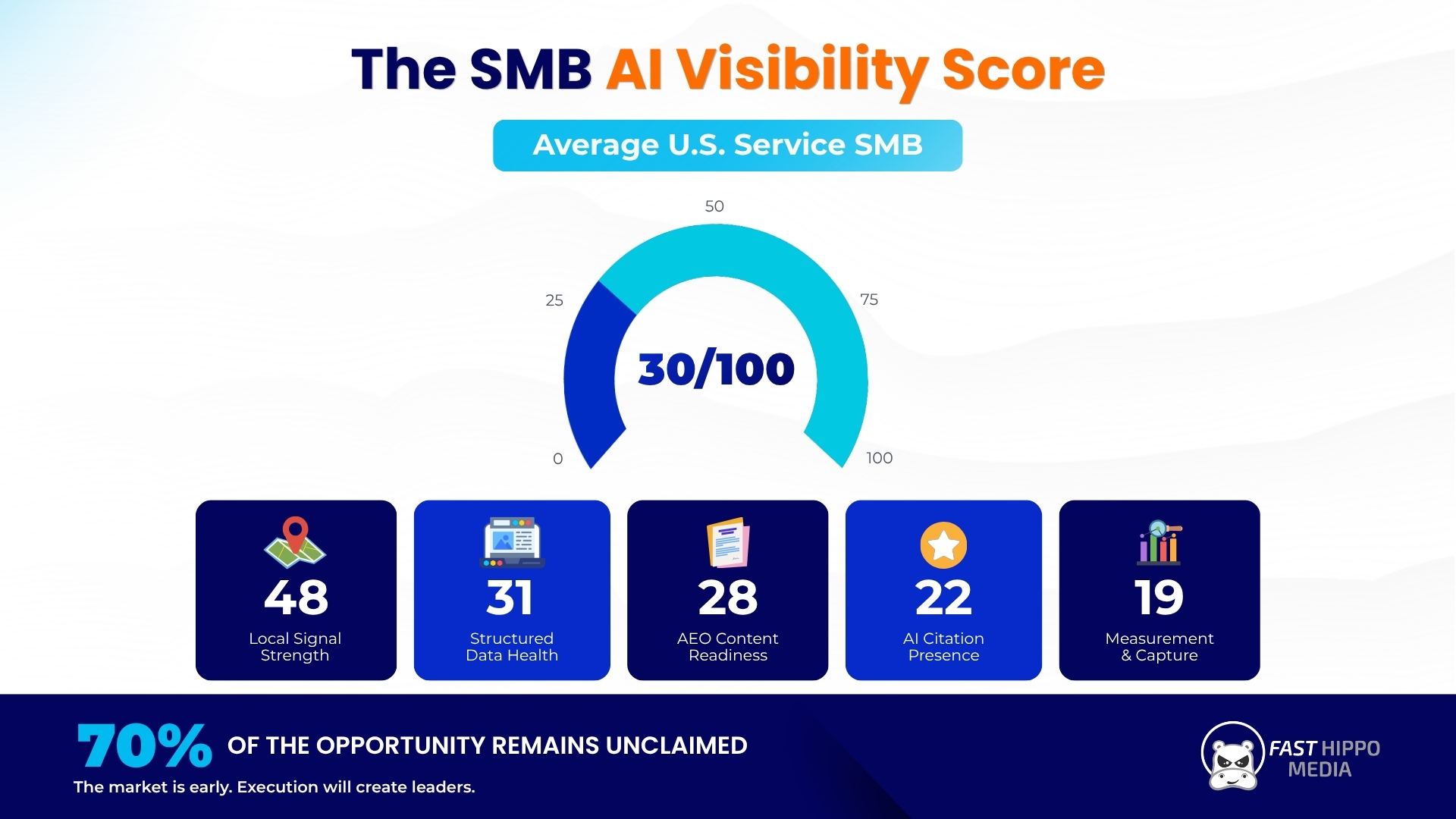
Where SMBs Are Falling Behind
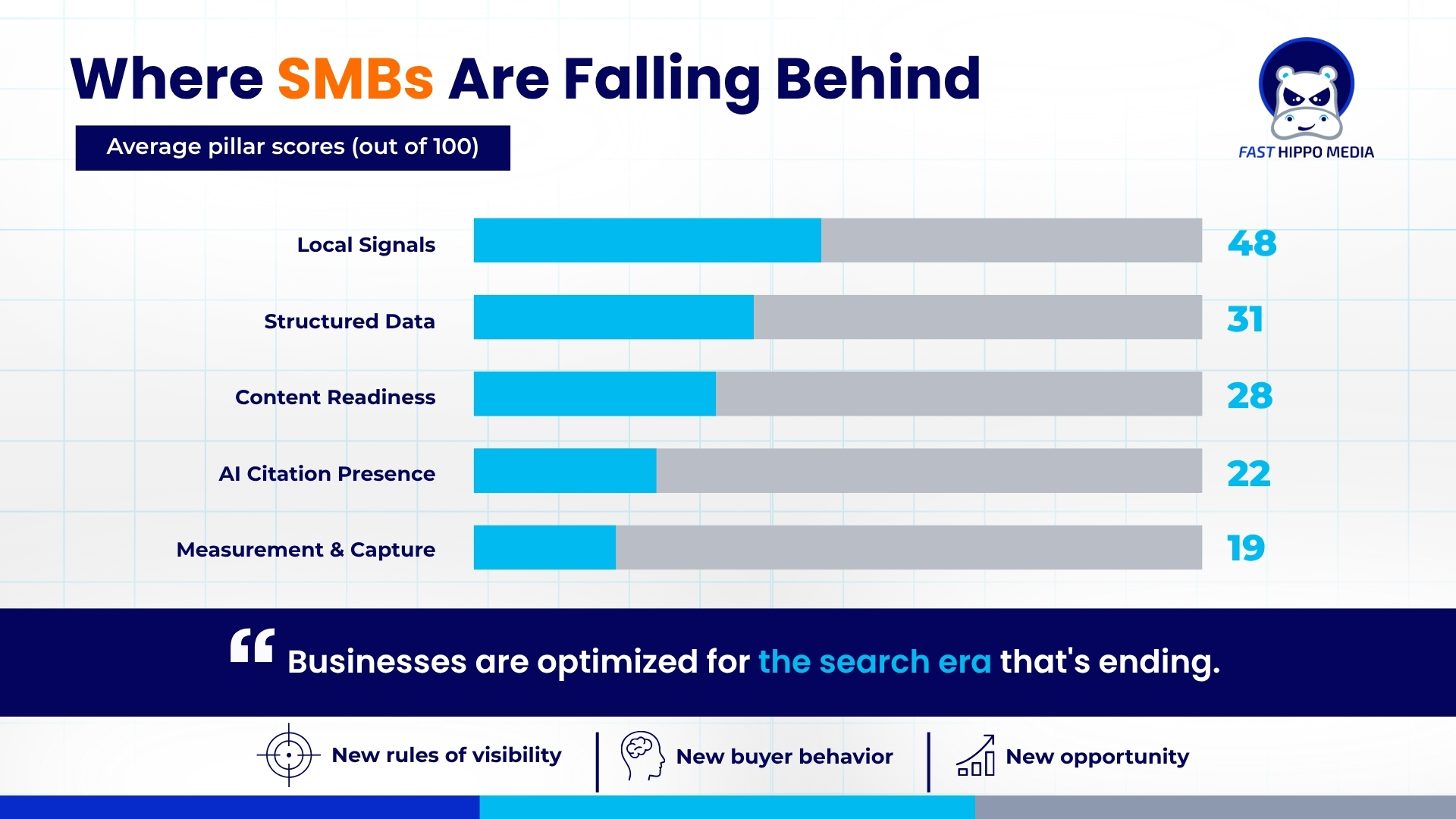
The five-pillar breakdown exposes a structural mismatch. Businesses are strongest in exactly the areas that mattered most for the old search model, and weakest in the areas that increasingly determine AI visibility.
Average pillar scores (out of 100)
Local signals lead at 48, the dividend of fifteen years of local SEO investment. But citation presence (22) and measurement (19) trail far behind, and these are the pillars now driving discovery inside AI engines. Many businesses are already receiving AI-referred traffic without realizing it, because they have no mechanism to detect it. The pattern is clear: organizations are well-built for a search era that is ending. Where competitors are weakest, early movers can build the most separation.
The mismatch is really a muscle-memory problem. Fifteen years of SEO trained businesses to chase keywords, backlinks, and rankings. Those skills built the 48 in local signals. They do not automatically produce a citation inside an AI answer, which depends on being structured, quotable, and validated in ways the old playbook never asked for.
Measurement at 19 is the quiet driver behind all of it. When an owner cannot answer “how much of my traffic came from AI,” they cannot value the channel, so they underinvest in something that is already sending them customers. The businesses that pull ahead are usually the ones that simply started looking.
Takeaway
Your competitors are weakest exactly where AI discovery is strongest. Those gaps are unguarded, which is what makes them the opening.Five Findings From the Report
Most businesses cannot see the AI traffic they are already receiving. With ChatGPT alone driving roughly 87% of AI referral traffic, these visits frequently collapse into “direct” traffic in standard analytics, rendering the channel effectively invisible.
A business cannot benefit from AI recommendations if it is never named. Citation visibility is the single weakest growth lever in the dataset.
Structured-data adoption is high, but validation is not. Invalid or misconfigured schema fails silently; pages show no error, but they also earn no rich results or AI citations. Most businesses believe they are covered when they are not.
Local remains the strongest pillar, but the advantage is increasingly contingent on review recency and cadence. AI Overviews and “near me” AI queries now lean heavily on LocalBusiness schema and live review signals, so stale profiles lose ground quickly.
The distance between leaders and laggards is a function of discipline, not spend. Leaders average 68; laggards 14. The differentiators are ordinary, repeatable practices, and that is precisely why they compound.
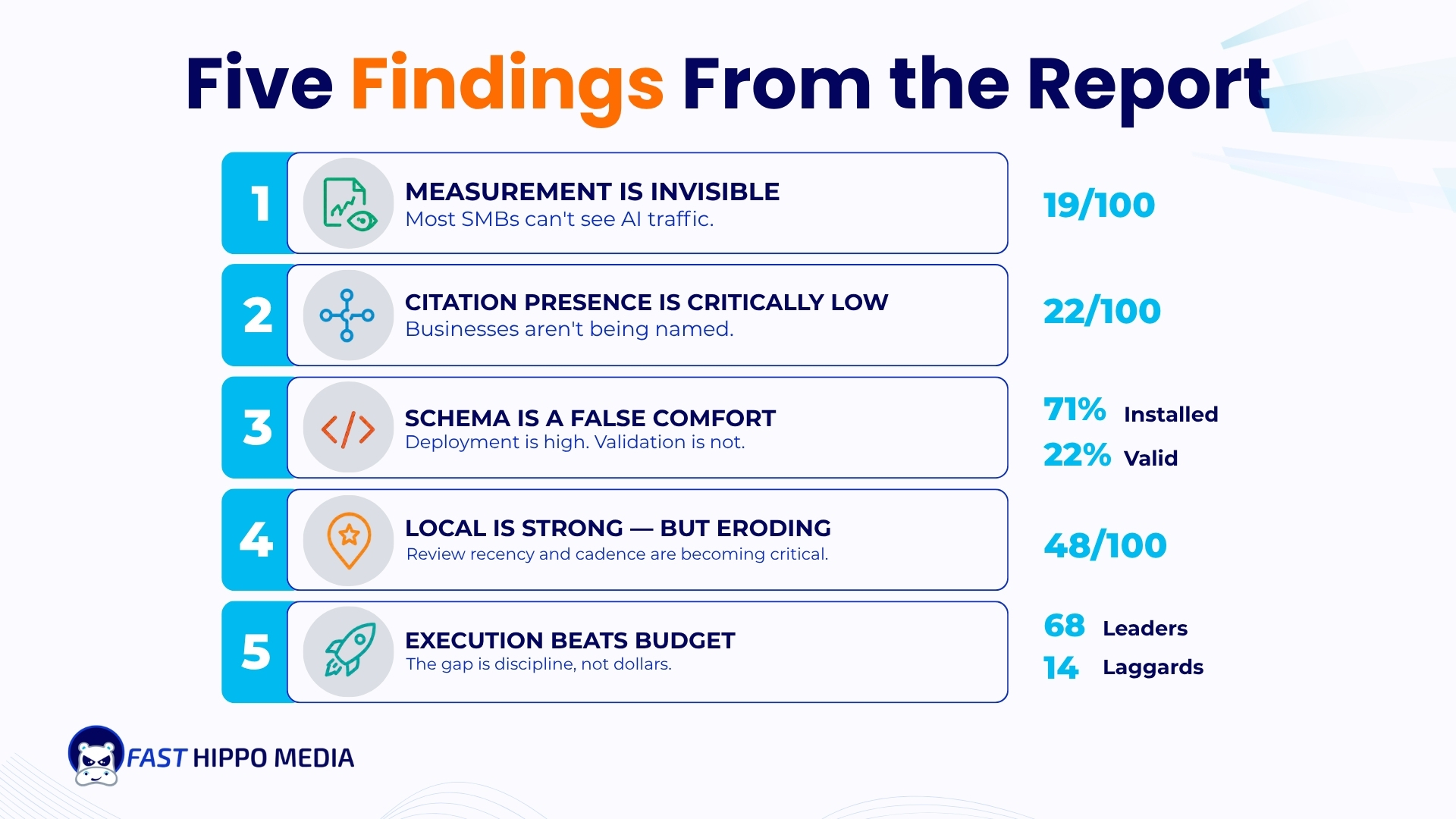
Read together, these are not five separate problems. They are one story told five ways: businesses are optimized for a search era that is closing. That framing matters because it changes the response. You are not patching five unrelated holes. You are updating one operating model.
It also sorts the work. The schema finding is the most fixable of the five. Structured data that is installed but invalid can often be recovered with a validation pass, no new content required, which makes it one of the highest-return, lowest-effort moves in the entire report. Local erosion is different. It is a maintenance issue, a matter of keeping reviews and profiles current, not a rebuild.
Takeaway
These are not five problems. They are one, and the fixes are ordinary and repeatable, which is exactly why they compound.The Fast Hippo Media AI Visibility Index
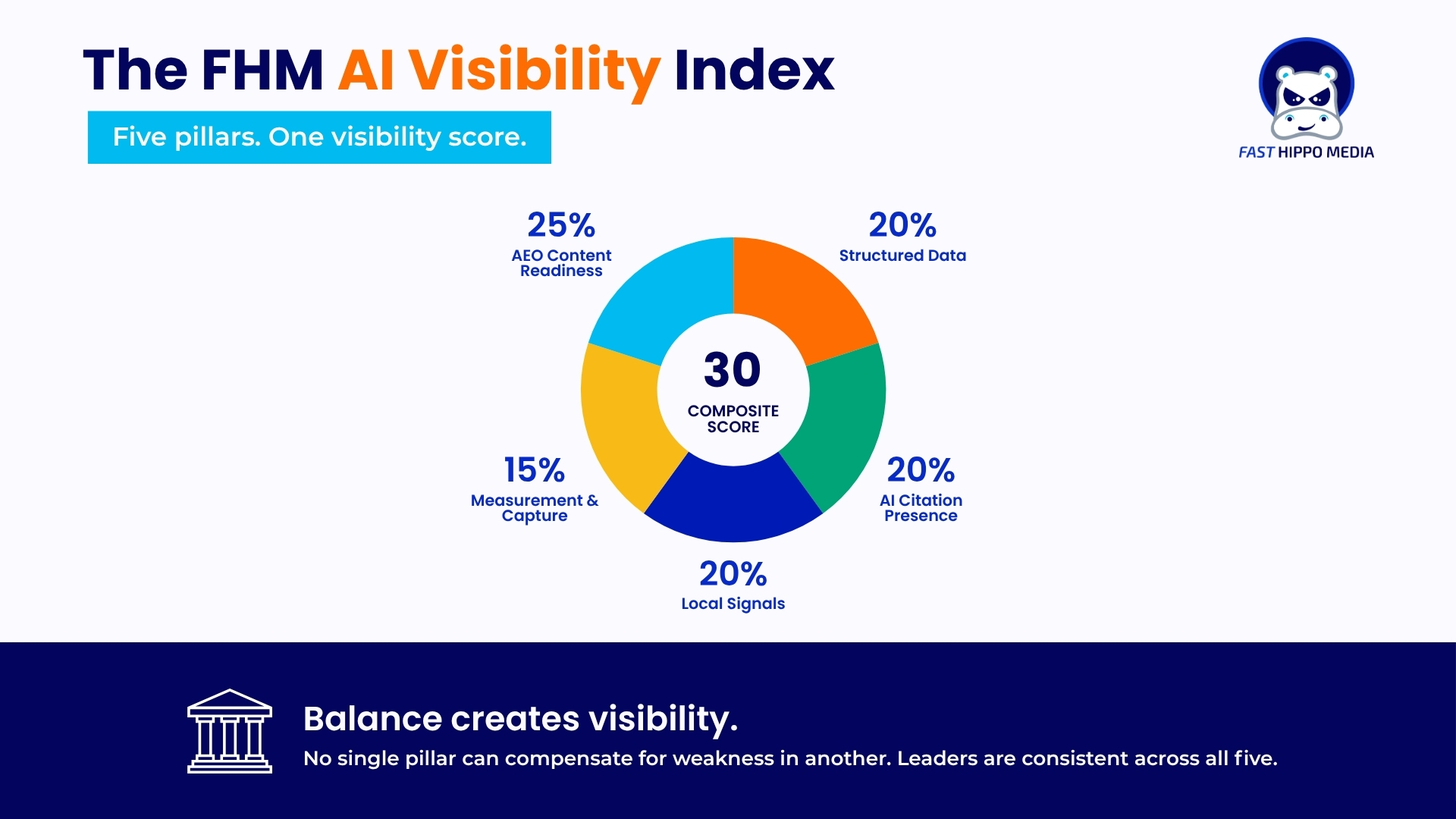
Visibility in the AI era is not the product of any single ranking factor. It is the result of five disciplines, the core of answer engine optimization (AEO) and generative engine optimization (GEO) working in balance:
The five pillars and their weightings:
- Content Readiness — content written to be the answer, not just to rank near it.
- Structured Data Health — schema that is present and validated.
- Citation Presence — being named inside AI answers.
- Local Signal Strength — complete profiles, fresh reviews, local schema.
- Measurement and Capture — detecting and attributing AI-referred demand.
The weightings are deliberate. Content readiness carries the most (25%) because being extractable is the precondition for everything else. An engine cannot cite what it cannot cleanly pull. Measurement carries the least on paper (15%) but functions as the foundation, because it is how you know whether any of the other four are working.
The pillars behave more like a chain than a checklist. A business with flawless schema but no answer-first content still will not get cited, because one strong link cannot carry a broken one. That is why balance beats brilliance here, and it is the exact framework we use when we run an AI Audit: score the five pillars, then start with whichever is dragging hardest.
No single pillar compensates for weakness in the others. The businesses pulling ahead are not exceptional in one category; they are consistently competent across all five. Balance, not perfection, is what creates durable visibility.
Which Industries Are Winning?
The most instructive finding is what is not present: no one has pulled away.
Local retail leads at 34 and legal follows at 33, but no category clears 35. There are no mature verticals, no dominant incumbents, and no defensible moats. That parity is unusual, and it will not last. Industry-level AI exposure is already moving fast; data shows AI Overview presence in some verticals climbing from 18% to 83% (education) and 10% to 78% (restaurants) in a single year. Categories that look wide open today will crowd quickly. Businesses that build now can establish separation before their segment consolidates.
Average AI visibility by industry (out of 100)


The reason parity will not last is mechanical. AI Overview coverage is expanding one vertical at a time, and when it arrives in a category, the businesses that are already structured to be cited absorb the visibility first. AI engines tend to favor sources that are established, consistent, and validated, so early movers do not just get a head start. They get a position that becomes harder to displace as the category fills in.
Put concretely: a home-services business scoring 40 today would lead its category outright, because the leader in home services currently sits at 29. The bar to lead is unusually low right now. It rises every month that the category matures.
Takeaway
No category has a winner yet, which means the bar to lead is the lowest it will ever be. Every month you wait, that bar goes up.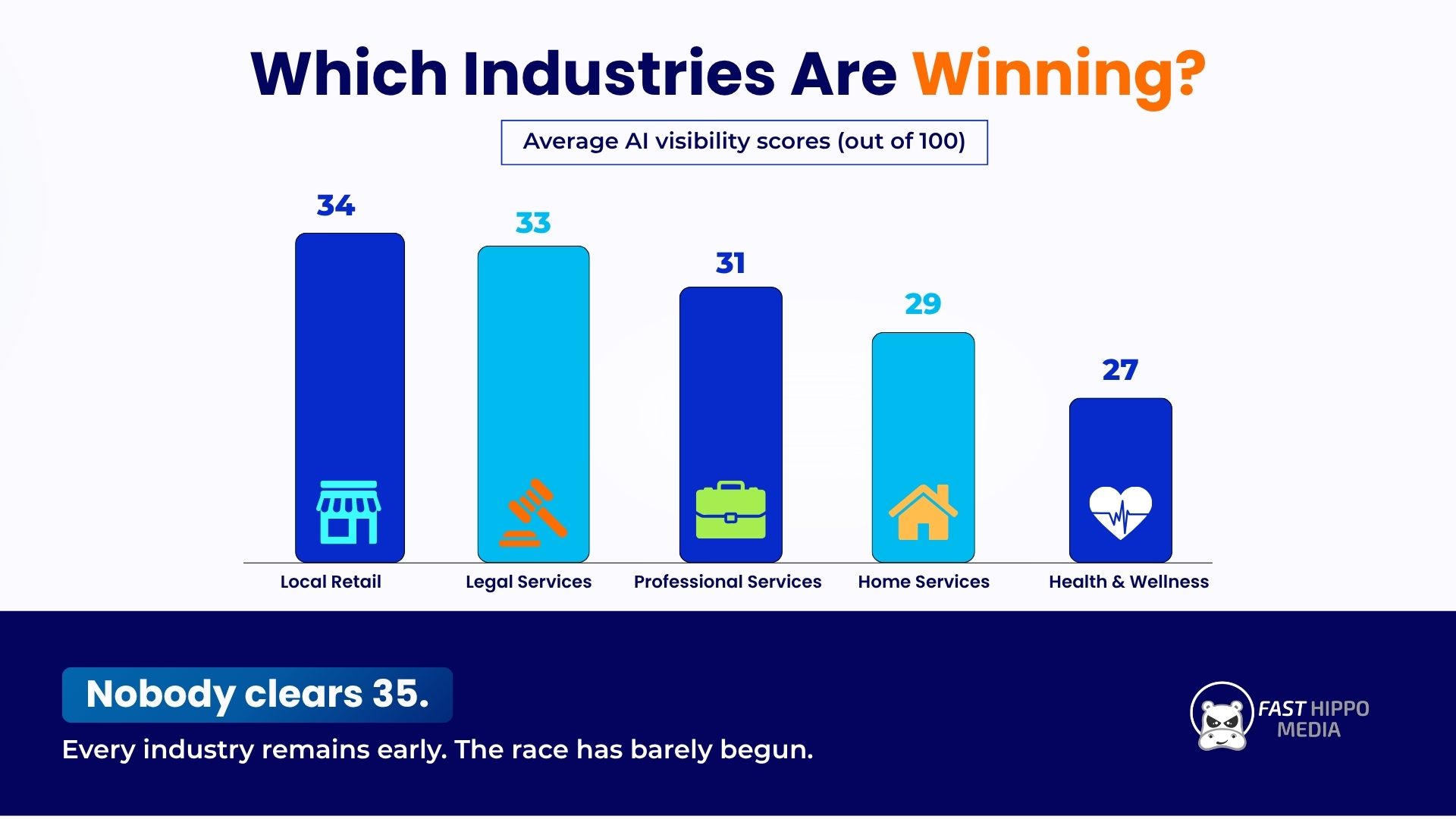
The Visibility Gap
The leaders are separated by five ordinary practices: answer-first content, valid schema, an active review engine, consistent measurement, and ongoing content freshness. None requires a larger budget; each requires consistent execution. That is the central thesis of this report: in AI search, execution matters. Victory will not be determined solely by budget. The opportunities, for now, are wide open for all players.
-
 Answer-First Content
 -
 Valid Schema
 -
 Review Generation
 -
 Measurement & Capture
 -
 Content Refresh
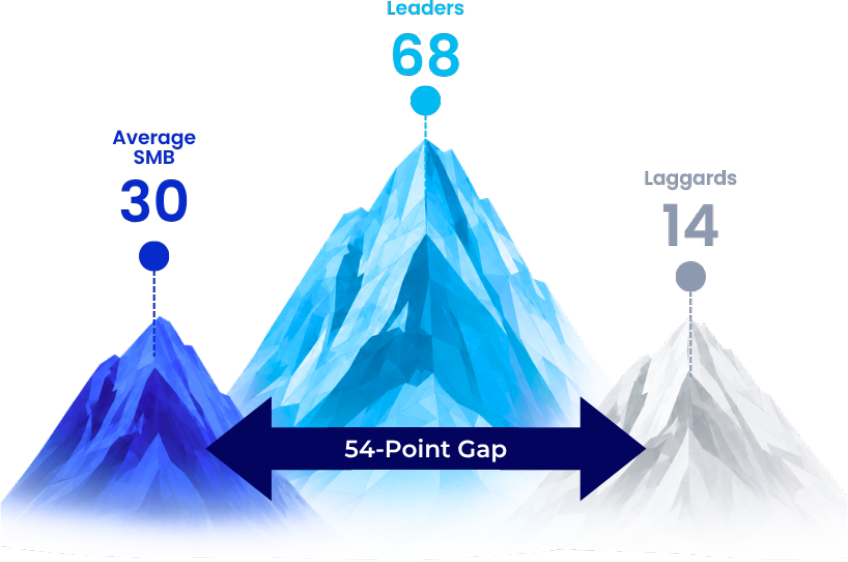
The 54 points are not one big advantage. They are the compounding of five small, consistent habits. Laggards are rarely doing something wrong. They are doing nothing consistently, and in a channel that rewards recency and repetition, inconsistency is the whole gap.
This is also why the gap is unstable in both directions. A leader who lets reviews go stale and stops refreshing content slides toward the middle. A laggard who commits to the fundamentals climbs faster than the point spread suggests, because the inputs are available to anyone. It is worth saying plainly: a well-funded business that does not execute lands closer to 14 than to 68. The money does not buy the position.
Takeaway
In AI search execution, not spend, separates leaders from laggards. And because the advantages are available to any business willing to commit, the gap is closable from either side.Five Moves to Win AI Search
Winning AI visibility does not require rebuilding everything. It requires consistency in five places,
Get in the loop: your action plan
Make the channel visible. Identify, track, and attribute traffic from AI platforms before optimizing anything else; you cannot improve what you cannot see.
Create content that directly answers the questions buyers are already asking, in the format AI engines extract.
Confirm that the structured data you have already installed actually passes validation. Most of the work is verification, not creation.
Protect local authority with a sustainable, recurring review process; recency and cadence now carry as much weight as volume.
Treat content as a compounding asset. Keep it accurate, current, and worth citing.
The order is not arbitrary. Measurement comes first because everything after it is guesswork until you can see the channel. Once you can see it, the build work (answer-first content and validated schema) fixes your two weakest pillars directly. Then the recurring habits (a review engine and monthly refreshes) protect and compound the gains.
Notice that each move maps to a specific low score from the benchmark: measure attacks the 19, write attacks the 28, validate attacks the 31, reviews defend the 48, and refresh keeps citations alive. None of them is a one-time project. They are habits, and the advantage accrues month over month. That sequence, applied to one specific business, is exactly what an AI Audit prioritizes.
Takeaway
Start with measurement, because everything else is guesswork until you can see the channel. From there the moves are small, monthly, and cumulative.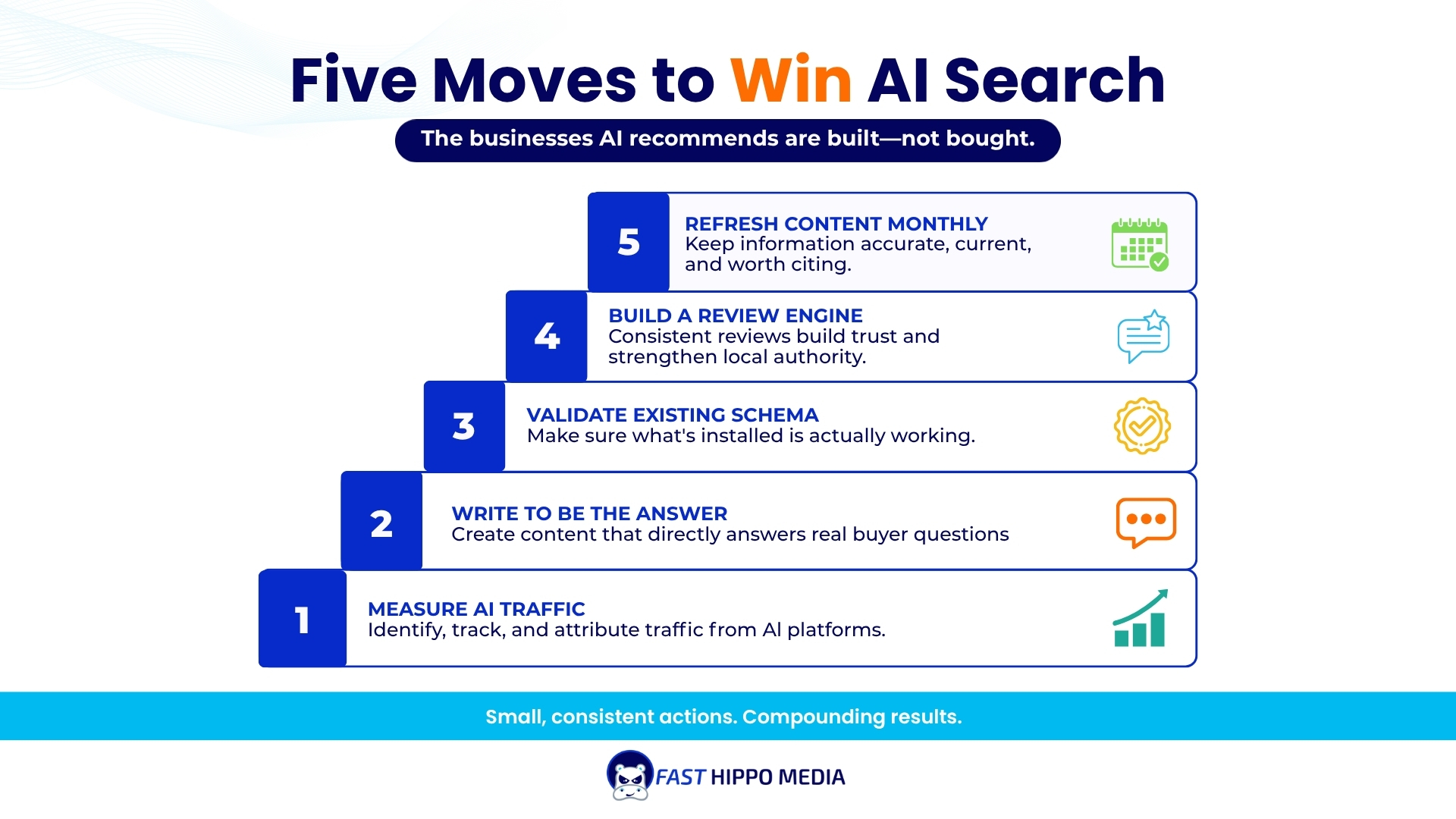
Where this is Headed
None of these is revolutionary. Together, they compound, and compounding is how visibility advantages are built. The businesses AI recommends are built, not bought.
The businesses that win the next decade will not necessarily outspend their competitors. They will become the businesses answer engines recommend when a buyer asks who to trust because in the age of AI search, the recommendation is what closes.
Get found everywhere your customers search
Buyers now ask ChatGPT, Gemini, and Google’s AI before they ever scroll a list of links. Fast Hippo Media helps small and mid-sized businesses show up in those answers and get chosen. Start with an AI Audit to see where you stand.

Show up in AI search
Our Content Everywhere℠ methodology and AEO expertise help your business get named when customers ask AI who to trust across content, structured data, citations, local signals, and measurement.

Turn visibility into leads
Being found is only half of it. We connect the work to results, capturing the AI and search traffic most businesses can’t even see, and turning it into qualified inquiries.

Work with a team that executes
A Google Partner agency rated 4.9/5 stars, pairing cutting-edge AI search technology with old-school client service. Clear strategy, honest reporting, and the work actually done.
Sources & Further Reading
External market statistics referenced in this report are drawn from the following 2025–2026 industry sources. FHM-modeled figures (composite score, pillar scores, industry scores, and the leader-laggard gap) are proprietary to this benchmark analysis.
BrightEdge: AI Overview growth and vertical-level presence (2025–2026), reported via ALM Corp.
Similarweb: AI referral conversion benchmarks (2025), reported via Demand Local.
AI referral traffic growth (1.13B visits, June 2025; +357% YoY): Exposure Ninja, AI Search Statistics 2026.
Conductor: AI referral share and ChatGPT dominance of AI traffic, reported via Superlines.
SparkToro / Semrush: zero-click search behavior (2026), reported via Search Engine Land.
Schema validation and silent-failure principles: Stackmatix, Schema Validation for AI Search.
LocalBusiness schema and local AI citation behavior: InstantPress, Structured Data for AI Search.
AI Overviews prevalence overview and methodology variance: SQ Magazine, AI Overviews Statistics 2026.