(214) 272-7034
  info@fasthippomedia.com



TL;DR
An enterprise SEO consultant works on the systems that generate your pages, not the pages themselves: templates, crawl budget, internal linking, structured data, and governance. The hiring trigger is structural, not size. When several teams touch the site, output keeps rising, and traffic does not, page-by-page SEO has stopped working. Success is measured in page groups and index coverage, not single keywords.
An enterprise SEO consultant fixes search at the system level for large sites, working on templates, crawl budget, internal linking, structured data, and content governance rather than tuning pages one at a time. On a site of tens of thousands of URLs, a single template change touches more pages in an afternoon than a content team edits in a year. That leverage is the whole reason the role exists, and it is why the hiring signal is structural: several teams publishing, page count climbing, and traffic flat.
Most people picture an SEO as someone who edits title tags and writes blog posts. On a large site, that person would be underwater in a week. The work that moves the numbers on a site of tens of thousands of pages is different in kind, not just in scale, and that is what an enterprise SEO consultant is hired to run. This is the same work behind our engagements, so here is an honest look at what the role covers and when it pays for itself.
What the Role Actually Covers
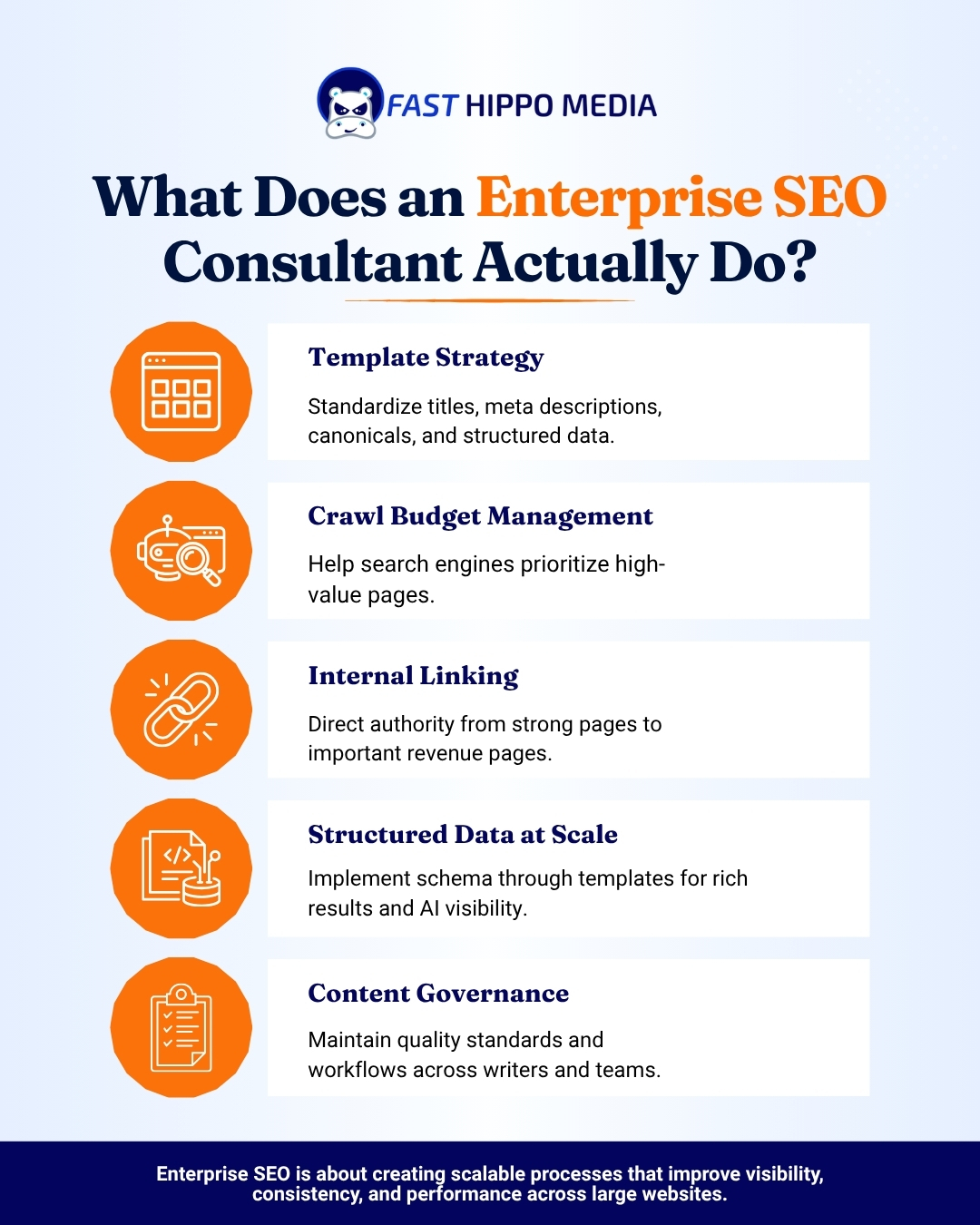
An enterprise SEO consultant spends very little time on individual pages. The real work is upstream, in the systems that produce thousands of pages at once, so it sits in a handful of areas.
- Template strategy: deciding how titles, meta descriptions, canonicals, and structured data are generated so every page is correct the moment it is created.
- Crawl budget management: making sure Googlebot spends its time on the pages that earn revenue instead of parameters, filters, and duplicates.
- Internal linking architecture: routing authority from strong hubs to the money pages, which is usually where a large site is quietly losing.
- Structured data at scale: shipping schema through templates so the site qualifies for rich results and keeps entity data consistent across every page group. Worth being precise here, because the industry is not: Google states plainly that We ship schema for rich results and consistency, and we let clean technical structure do the AI work. Any consultant selling you schema as an AI citation lever is selling you something Google has already denied exists.
- Content governance: setting the standards and workflows that keep quality consistent across many writers and teams.
None of that shows up as a single edited page. It shows up as thousands of pages improving together after one upstream change, which is exactly why the role exists.
How It Differs From an In-House SEO or a Small Agency
An in-house SEO manager does real work and is often overloaded. They know the business, the CMS, and the politics, but they are usually running day-to-day operations and rarely have the room to rebuild the template layer or fight for crawl budget across engineering priorities. A consultant comes in with the specific job of fixing the system and the authority to push the changes a busy internal team cannot get to.
A small local agency is a different mismatch. The tactics that win for a 30-page service business, more location pages and steady blogging, do not fix a 40,000-page site with a broken template and pooled authority. Enterprise work is closer to systems engineering than to content marketing. The right consultant reads server logs, works with your developers, and thinks in page groups rather than individual URLs.
The Signs You Actually Need One
You do not need an enterprise consultant just because your company is large. You need one when the symptoms are structural.
Google draws a useful line here. Its is aimed at sites above roughly one million pages that change weekly or above ten thousand pages that change daily. Below that, Google says most sites do not need to think about crawl budget at all. We repeat that because plenty of businesses get sold enterprise SEO before they need it, and a consultant who will not tell you that is not worth hiring.
Past that threshold, these are the clearest tells:
- You keep publishing, but organic traffic has been flat or declining for two or more quarters.
- Your homepage ranks well while your important category and product pages sit on page three.
- Google indexes far fewer of your pages than you have published, or far more low-value ones than you expected.
- Several teams publish content, and you have no consistent title format, schema, or internal linking standard.
- You are invisible in AI answers even though you have deep, authoritative content on the topic.
If two or more of those describe your site, the problem is almost always in the system, and the system is what a consultant is there to fix.
What the Engagement Looks Like
A serious engagement does not start with tactics. It starts with a diagnosis, because on a large site the wrong first move wastes months.
We open with a technical and content audit that looks at index coverage, crawl distribution, template health, internal link flow, and citation readiness. That produces a prioritized roadmap: template fixes first because they repair the most pages for the least effort, then crawl and internal linking, then the content and AI citation work. From there, the consultant either implements directly with your developers or hands your team a clear specification and validates the results in Search Console over the following weeks.
The point of that order is momentum. Early wins come from structural fixes that move whole-page groups at once, which funds the patience the slower authority work requires. If you want the full picture of how we sequence this, it is laid out in our guide to enterprise SEO in 2026.
The First 90 Days of an Engagement
The opening months set the tone, and a good consultant front-loads the audit rather than jumping to tactics. In the first few weeks, the work is diagnosis: pulling server logs to see where Googlebot actually spends its time, mapping index coverage against what has been published, checking the templates that generate your titles and structured data, and tracing how internal authority flows through the site. This is unglamorous, and it is where the real problems surface.
By the end of the first month, the deliverable is a prioritized roadmap, not a pile of observations. Template fixes come first, then crawl budget, then internal linking, then the content and AI citation work. The second and third months are execution, usually shipping template and CMS changes with your developers and validating each one in Search Console before moving on. Early wins from the structural fixes fund the patience the slower authority work needs, which is why the order matters as much as the tasks.
A consultant who skips the diagnosis and opens with a content calendar is guessing, and on a large site, guessing is expensive. The 90-day arc should always move from understanding the system to fixing it, in that order.
How We Measure a Consultant’s Impact
Measuring an enterprise engagement by a single keyword ranking misses the point, because the work operates on page groups rather than individual URLs. We track impact at the level the changes actually happen.
Four numbers carry the scoreboard. Index coverage tells us whether Google now holds the pages that earn and has let go of the ones that do not. Page-group rankings tell us whether whole templates of category or product pages moved together after a structural fix, which is the signal a single-keyword report cannot show you. Organic revenue or qualified lead volume is the number the business actually answers to. Citation presence tracks whether the brand now appears in AI answers where it was previously absent.
That fourth one has to be measured on its own, and recently that stopped being optional. Ahrefs found that only 38% of pages cited in AI Overviews also rank in the top 10 for the same query, down from 76% earlier in the year. BrightEdge put the figure closer to 17%. Whichever number you take, a ranking report no longer tells you whether you are being cited, so we track the two separately, or we are not measuring the second one at all.
What we deliberately avoid is vanity reporting. A rising count of indexed pages is not a win if those pages do not earn, and one keyword climbing means little across forty thousand URLs. If a consultant cannot tie their work to page groups, revenue, and citations, be skeptical of the engagement.
The AI Search Layer a Good Consultant Now Owns
In 2026, the role expanded, and the data explains why. SparkToro and Similarweb found that 68.01% of US Google searches ended without a click between January and April 2026, up from 60.45% two years earlier. Only 276 of every 1,000 searches now reach the open web at all. AI overviews appear on more than a fifth of searches, and where they appear, click-through rates fall by roughly 60%.
What makes this a systems problem rather than a content problem is where the citations come from. Two in three AI Overview citations come from pages a searcher would never see on page one of that query’s results. Ranking and being cited have come apart, and an enterprise site has to be built to win both.
In practice, that means structuring your best content so a language model can lift a clean, factual passage, keeping entity data consistent across the whole domain, and tracking whether the brand actually gets cited across the AI platforms. This overlaps heavily with answer engine optimization, and on an enterprise site the two are the same project rather than two separate ones. It is also why we built Content Everywhere℠ around search, AI, voice, and local visibility as one program instead of four line items. A consultant who treats AI search as a side initiative is working from a 2023 playbook.
Which Model Fits?
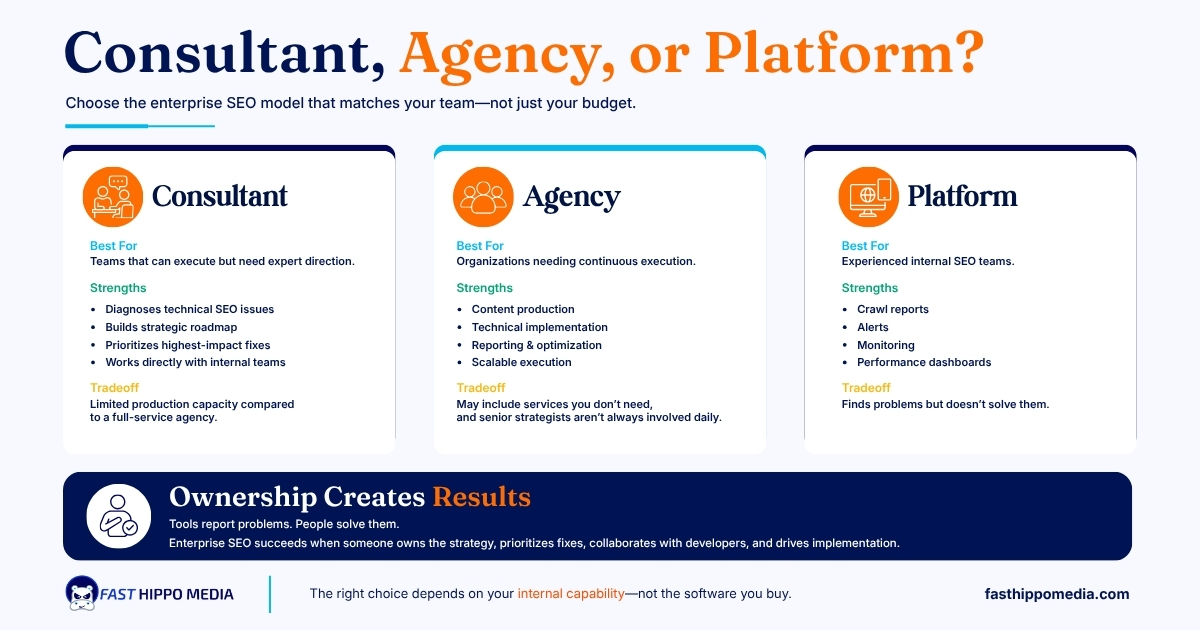
Enterprise SEO gets sold in three shapes, and they are not interchangeable. Understanding the difference saves you from buying the wrong one.
A software platform gives your team dashboards, crawl reports, and alerts. It is useful once you have the know-how to act on what it surfaces, but a tool does not decide your template strategy or negotiate crawl budget changes with engineering. On its own, a platform tells you the house is on fire without putting it out.
A full agency brings a team, which suits a business that needs ongoing production across content, technical work, and reporting at volume. The tradeoff is that you can end up paying for breadth you do not need, and the senior strategist who won you the account is not always the person doing your work day to day.
A consultant is the concentrated version: a senior specialist who diagnoses the system, sets the roadmap, and either implements the highest-impact fixes or directs your team to. For most enterprise sites, the fastest path is a consultant to fix the structure, then a smaller ongoing arrangement to maintain it.
The right model depends on how much internal capability you already have. If you have a capable team that lacks direction, a consultant is enough. If you have neither the team nor the time, an agency that assigns real senior attention is the safer choice. What rarely works is buying a tool and hoping the skill to use it comes along for free. A dashboard reports the problem. A person has to own the fix, work with your developers, and make the calls that move whole page groups. That ownership is the thing you are actually paying for, whichever model you choose.
What to Look For When Hiring
Titles are cheap, and plenty of generalists now call themselves enterprise consultants. A few questions separate the real ones.
Ask how they would find and fix crawl budget waste on a large site, and listen for log files and index coverage, not keyword tools. Ask how they route internal authority to money pages. Ask how they would get the site cited in AI answers and whether they measure citations separately from rankings. If they claim a schema template will earn AI citations, hand them Google’s documentation and watch what happens. Ask for an example where an upstream change moved thousands of pages at once. The answers reveal whether someone thinks in systems or in single pages.
You should also expect them to work closely with engineering, because most enterprise fixes ship as a template and CMS changes rather than content edits. A consultant who cannot talk to your developers will stall on the exact changes that matter most.
The Takeaway
An enterprise SEO consultant is not a more expensive blogger. The role is to fix search at the system level: templates, crawl budget, internal linking, structured data, governance, and now AI citation, so a large site turns its size into an advantage instead of a liability.
With 68% of searches ending without a click and two in three AI citations going to pages that do not rank on page one, the gap between publishing more and earning more has never been wider. If your traffic has plateaued while your page count keeps climbing, that gap is the signal, and it is exactly what our enterprise SEO services are built to close. The first step is always the audit, because it turns a vague sense that something is wrong into a ranked list of fixes you can work through, with the highest-return moves at the top and a way to measure each one as it lands.
Frequently Asked Questions
A regular SEO optimizes individual pages. An enterprise consultant fixes the systems that produce thousands of pages at once, so the work lives in templates, crawl budget, internal linking, and governance rather than page-by-page edits.
Google’s own crawl budget guidance targets sites above roughly one million pages changing weekly, or ten thousand pages changing daily. Below that, raw page count matters less than whether the site is managed by systems rather than by hand.
Sometimes, if they have the time and the authority to rebuild the template layer and push engineering changes. Most in-house teams are stretched across daily operations, which is why a focused consultant gets the structural work done.
A current one does. Only 38% of pages cited in AI Overviews rank in the top 10 for that query, so ranking well no longer guarantees being cited. Both have to be measured and worked separately.
No. Google states that structured data is not required for generative AI search and that no special markup exists for it. Schema earns rich results and keeps entity data consistent. Clean technical structure and genuinely useful content are what AI engines draw from.