(214) 272-7034
  info@fasthippomedia.com


TL;DR
Ranking in the Google Maps 3-pack and being named by an AI assistant are two different contests with two different judges. Maps rewards relevance, distance, and prominence. AI assistants recommend far fewer businesses, and they weigh reputation, consistent entity data, and whether the wider web already trusts you. Winning the map pack qualifies you, but it does not guarantee the AI mention.
We hear the same frustration from local businesses all the time: “We are in the 3-pack, so why does ChatGPT recommend our competitor and not us?” It is a fair question, and the answer is not that your local SEO is broken. It is that a second, stricter contest now sits on top of the map pack, and most businesses have never optimized for it. This is where our local SEO and AI-search work meet, so here is exactly why the gap happens and what closes it.
The Gap Is Real, and It Is Wide
This is not a hunch. SOCi’s 2026 Local Visibility Index, published in March 2026, measured how often brand locations appear across Google and AI assistants, and the difference is stark.
| Where | How often local brands appear |
| Google’s local 3-pack | about 36% |
| Google Gemini | about 11% |
| AI recommendations overall | about 6.5% |
Read that again. A business appears in the map pack roughly a third of the time, and in AI answers only about one time in fifteen (SOCi 2026 Local Visibility Index). AI assistants recommend a much shorter list than Google does, which means the bar to make that list is far higher. Being visible on Maps is table stakes now, not the finish line.
Why the Two Systems Disagree
The map pack and the AI answer are judged on different criteria, which is the whole reason a business can win one and lose the other.
Google Maps ranks the local pack on three published factors: relevance, distance, and prominence (Google, how local results are ranked). Distance matters a great deal, so being close to the searcher can carry you into the pack even if your reputation is thin.
AI assistants do not weigh distance the same way. They lean on reputation, the consistency of the facts about your business, and whether the broader web already treats you as a trustworthy answer. That is why an assistant will sometimes recommend a business that is not the closest option: it is answering “who is genuinely the best choice here,” not “what is nearby.” The two questions produce two different lists, and only the businesses that satisfy both appear in both.
Reason 1: AI Recommends Who the Web Already Trusts
The map pack can be won on proximity and a well-optimized Google Business Profile. AI recommendations cannot. An assistant is assembling an answer from everything it has read about your category and your area, and it favors the businesses that the wider web already presents as credible.
That means reputation and authority do heavier lifting in the AI contest than they do in the pack. A business with strong reviews, coverage on the sites that matter in its field, and consistent mentions across the web reads to an assistant as a safe recommendation. A business that is technically ranking on Maps but has almost no footprint beyond its own listing does not give the assistant enough to trust. Proximity got you the pin on the map; it does not get you named in the answer.
Reason 2: Your Entity Data Has to Be Airtight
Gemini is grounded in Google Maps data, and the other assistants lean on the same structured facts about your business. That makes consistency a ranking factor in a way many owners underestimate.
Inconsistent hours, an old suite number, a mismatched category, or a name that appears three slightly different ways across the web does more than look sloppy. It lowers the confidence an assistant has that it even understands your business, and low confidence means no mention. The assistant would rather stay silent about you than risk recommending a business whose basic facts it cannot pin down. This is why the unglamorous work of keeping your name, address, phone, hours, and category identical everywhere has quietly become an AI-visibility task, not just a housekeeping one. It is the same discipline behind a well-kept Google Business Profile, now with higher stakes.
Reason 3: Reviews Carry More Weight Than You Think
Reviews were always a local ranking signal. In the AI contest, they are close to a gatekeeper. SOCi found that the businesses AI assistants actually recommend tend to carry strong ratings, with ChatGPT’s picks averaging around 4.3 stars.
Two things follow from that. First, volume matters, because a business with a handful of reviews does not give an assistant enough signal to trust, while a deep, recent review history does. Second, rating matters, because the assistants skew toward well-reviewed businesses when they choose whom to name. If your Maps ranking is fine but your review profile is thin or middling, that gap alone can be why you make the pack and miss the AI answer. Steady, genuine review generation is now one of the highest-impact moves a local business can make for AI visibility, and it has to stay inside the platform rules: no incentives and no gating.
Reason 4: You Are Not Present Where the Assistants Read
The map pack reads mostly from Google’s own data. The assistants read much more widely, and if your business is absent from the sources they pull, you are absent from the answer no matter how well you rank on Maps.
Different assistants favor different mixes of directories, review platforms, and category-specific sites, and those mixes shift by query and location. The practical takeaway is that a business named consistently across the sources that matter in its field gives every assistant something to cite, while a business that lives only on its own website and its Google listing gives them almost nothing. Getting represented in the right places is the local version of answer engine optimization services, and it is the piece most local businesses have not started.
Where a Local Business Should Start
The full set of levers that earns an AI recommendation, from off-site mentions to machine-readable facts, applies to any business, and we walk through the complete set in our piece on why AI keeps recommending your competitor instead of you. For a local business specifically, two of those levers do the heaviest lifting, so they are where to start.
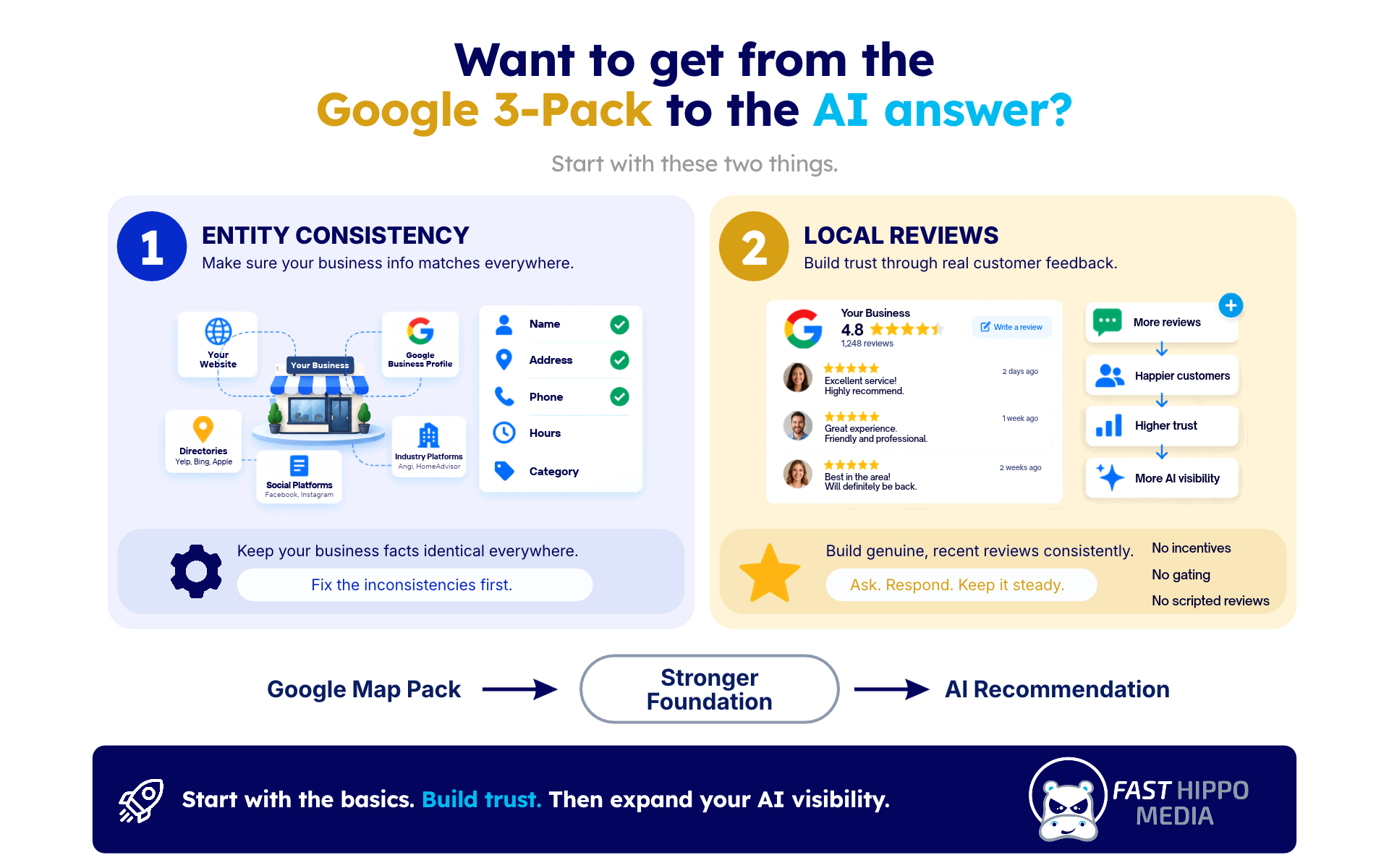
The first is entity consistency, because it is both the most common local problem and the cheapest to fix. Make your name, address, phone, hours, and category identical on your website, your Google Business Profile, and every major directory. For a local business, those facts are scattered across dozens of listings built up over years, and the mismatches are exactly what lower an assistant’s confidence. Fixing them unlocks everything else.
The second is local reviews, honestly and continuously. A local business already lives or dies on its Google reviews, and the AI contest raises the stakes, because volume and rating both feed whether an assistant will name you. Ask every satisfied customer, respond to what comes in, and keep the flow steady. Never incentivize, gate, or script a review, all of which risk your listing and feed the assistants the low-trust signal that keeps you out of the answer in the first place.
Do those two well, keep winning the map pack underneath them, and work through the rest of the playbook from there. For a local business, that is the shortest path from the 3-pack to the AI answer, and none of it is a trick. It is ordinary local marketing done properly, with AI visibility as one of the returns.
Why Distance Cuts Both Ways
The single biggest reason a local business wins the pack but loses the AI answer is distance, and it helps to see why the same factor works in opposite directions.
On Google Maps, distance is a gift. If you are close to the searcher, the pack can surface you almost regardless of how thin your reputation is, because proximity is one of the three things Maps is built to reward. Plenty of businesses sit in the 3-pack today mostly because they happen to be near the people searching.
AI assistants take that advantage away. They are not answering “what is nearby”; they are answering “who is genuinely the best choice,” so proximity earns you almost nothing. A business that coasted into the pack on location alone has little left to stand on once distance stops counting, which is precisely the business that vanishes from the AI answer. The competitor two towns over with deeper reviews and a stronger web presence takes the mention instead.
That is the uncomfortable read for a lot of local businesses: the AI answer is a truer test of reputation than the map pack, because it removes the proximity crutch. The upside is that reputation is buildable, and once built, it travels. A business that earns the AI mention on merit tends to hold it across the whole area, not only for the searchers standing closest to its front door.
Why the AI Gap Rewards Patience, Not Tricks
It is worth being honest about the timeline, because the AI contest does not respond to quick fixes the way a Google Business Profile edit sometimes does. The signals that move it- a deep review history, consistent facts across the web, genuine mentions on the sites your field trusts- all take time to build and time for the assistants to notice.
That is actually good news for a business willing to do the work. Because the bar is high and the signals are slow, the gap is defensible once you close it. A competitor cannot buy their way past a two-year review lead or fake a web footprint the assistants already trust. The businesses that start now are building an advantage that compounds and resists being copied, which is the opposite of the constant scramble that some local tactics turn into.
It also means the shortcuts are worse than useless here. Bought reviews, review gating, and scripted testimonials do not just risk your Google listing; they feed the assistants exactly the kind of inconsistent, low-trust signal that keeps you out of the answer. The mechanism that decides AI recommendations happens to reward the honest version of local marketing and punish the manipulative one. So the plan is not clever; it is patient: keep the facts clean, keep the reviews coming, keep earning real mentions, and let the trust accumulate. The businesses winning AI answers today started that work months ago, which is the strongest argument for starting yours now.
How to Check Where You Stand Today
You do not need a tool to see your own gap. Take your three highest-intent local searches, the ones a ready-to-buy customer would type, and ask ChatGPT, Google’s AI, and Gemini each one as a real person would: “who is the best [service] in [town]?” Write down who gets named and whether you appear at all.
Then compare that list to your Google Maps 3-pack for the same searches. If you are in the pack but missing from the AI answers, you have just found the exact gap this article describes, and the reasons above tell you which lever to pull first. That one page of notes is the honest starting point, and it usually points straight at reviews or entity consistency. For the bigger picture of how buyers now move between Google, Maps, and AI, our piece on where buyers actually find brands now puts this shift in context.
Win Both Contests, Starting With Facts and Reviews
Ranking on Google Maps and being recommended by AI are two contests, and the second one is stricter. AI assistants name far fewer local businesses than the map pack does, and they choose based on reputation, consistent entity data, review strength, and whether the wider web already trusts you. Keep winning the pack, then close the AI gap by locking down your facts, building genuine reviews, and getting named in the places assistants read. That combined work, winning the pack and then closing the AI gap on top of it- is what our local SEO engagements are built to deliver.
Frequently Asked Questions
AI assistants judge on different criteria than Maps. They weigh reputation, consistent business facts, and how much the wider web trusts a business, so a competitor with stronger reviews and broader mentions can be named even when you rank higher locally.
Yes, far fewer. SOCi’s 2026 index found that local brands appear about 36% of the time in Google’s 3-pack but only around 6.5% of the time in AI recommendations, so the bar to be named by AI is much higher.
The businesses’ AI assistants’ recommendations tend to carry strong, deep review profiles, with ChatGPT’s picks averaging around 4.3 stars. Steady, genuine reviews are one of the highest-impact moves for AI visibility, kept within platform rules.
No. Strong 3-pack performance qualifies you, but does not guarantee the AI mention, because assistants apply stricter criteria around reputation, entity consistency, and web trust on top of local ranking.