(214) 272-7034
  info@fasthippomedia.com



TL;DR
You can publish content at scale without a penalty, because Google does not target AI or volume by itself. It targets scaled content abuse, mass-producing pages that add little value just to game rankings. The line is human oversight: content that is reviewed, fact-checked, and made for a real audience stays inside policy, at any volume.
Every large site eventually faces the same tension. You need thousands of pages to cover the topics and locations your business serves, and modern tools make producing them fast. The fear, a fair one in 2026, is that publishing at that scale trips a spam filter and takes the whole domain down with it. That fear is worth taking seriously, and it is manageable. This is a core part of how we run enterprise SEO, so here is where the line actually sits.
What Google Actually Penalizes
The most important thing to understand is that Google does not penalize content for being made by AI. Its published guidance is explicit that quality, not production method, is what matters, and it welcomes AI use where the output is helpful. You can read this directly in Google’s guidance on AI-generated content.
What Google does target is scaled content abuse. Its spam policy defines the problem as generating many pages primarily to manipulate rankings, with little or no value for users, and it applies no matter how the content is created, whether by AI, by people, or by a mix of both. The trigger is the intent and the value, not the tool. A thousand genuinely useful pages are fine. A thousand near-identical pages built only to catch search traffic are not.
This distinction is the whole game. Once you stop asking “will AI content get penalized” and start asking “does each page add real value for a real reader,” the path to safe scale becomes clear.
Why 2026 Raised the Stakes
The risk is not theoretical. Google’s March 2026 core update named scaled content abuse as a primary target, and sites that had published large volumes of unreviewed, low-value pages saw severe traffic losses in a single, fast-moving rollout. The lesson enterprise teams took from it was not “stop publishing.” It was “stop publishing without oversight.”
That is a meaningful difference. The sites that were hit were not punished for using tools or for having many pages. They were hit for shipping content at volume that no human had shaped for a real audience. Large sites that pair scale with editorial review came through the same update intact. The dividing line held exactly where Google’s policy says it does.
The Human Oversight Test
The practical test we apply before any page ships is simple. Would a knowledgeable person consider this page genuinely useful on its own, or does it exist only to exist? If the honest answer is the second, no amount of volume makes it safe, and the fix is to raise the value of the page rather than to hide it.
Google itself points to the signals that separate real content from filler: clear author attribution, an editorial standard, accurate factual claims, and visible accountability like contact information. These are not decorative. They are the difference between a page a reader trusts and a page that reads as machine exhaust. On a large site, the way you deliver those signals is through your templates and your workflow, not page by page.
How We Scale Safely
Publishing thousands of pages responsibly is a process problem, and it is solvable. Here is the approach we use on large sites.
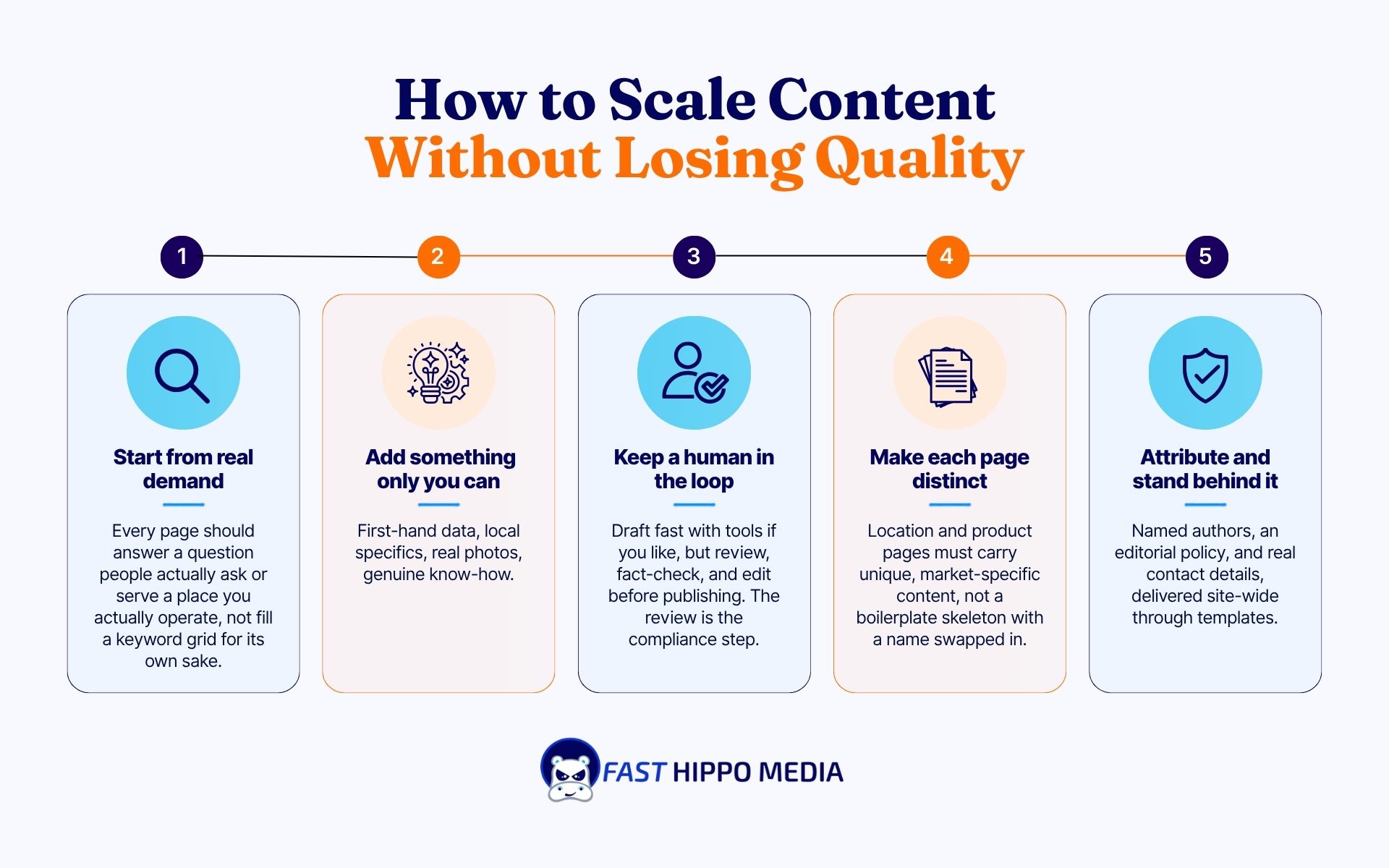
- Start from real demand. Every page should answer a question people actually ask or serve a place you actually operate, not fill a keyword grid for its own sake.
- Add something only you can. First-hand data, local specifics, real photos, genuine know-how. This is what turns a templated page into a useful one.
- Keep a human in the loop. Draft fast with tools if you like, but review, fact-check, and edit before publishing. The review is the compliance step.
- Make each page distinct. Location and product pages must carry unique, market-specific content, not a boilerplate skeleton with a name swapped in.
- Attribute and stand behind it. Named authors, an editorial policy, and real contact details, delivered site-wide through templates.
None of this slows a large site to a crawl. It changes where the effort goes, from generating raw volume to making sure the volume earns its place.
The Location Page Trap
The most common way a large site slides into scaled content abuse is through location pages. A business with a hundred service areas builds a hundred pages, and the temptation is to write one and clone it ninety-nine times with the city name replaced. That is precisely the pattern Google and AI answer engines both discount, because it adds no value the reader could not have guessed.
The fix is not fewer pages. It is genuinely unique pages: the specific services that matter in each market, local proof, real service-area detail, and content that answers what that town actually searches for. A location page earns its spot when a resident of that town would find it useful. If it would read identically to the neighboring town’s page, it has not earned it. This is the same standard we hold every page to in our enterprise SEO in 2026 work.
Building an Editorial Workflow That Scales
The way large sites stay compliant is not a heroic effort on each page. It is a workflow that bakes the standards in, so quality is the default rather than a thing someone remembers to check. On the sites we run, that workflow has a few fixed stages.
It starts with a demand check: before a page is commissioned, someone confirms there is a real question or a real service area behind it. Then a brief sets what unique value the page must carry, the local detail, the data, the specific service, so a writer or a tool is not starting from a blank keyword. Drafting can move fast, with modern tools if the team likes, because speed at this stage is fine. The stage that cannot be skipped is review, where a knowledgeable person checks the facts, adds what only a human knows, and decides whether the page earns publication. Only then does it ship, with a named author and a date attached.
The point of writing this down is that it scales. A single editor cannot hand-craft ten thousand pages, but a clear workflow lets a team produce them at volume while every page still passes through a human gate. That gate is the entire compliance story. Sites that skip it are the ones that get caught, and sites that keep it come through updates intact. The workflow is not bureaucracy; it is the thing standing between useful scale and a manual action.
Signs You Are Drifting Into Scaled Content Abuse
Most sites do not decide to violate the policy. They drift into it, one shortcut at a time, until the pattern is a problem. A few warning signs catch the drift early.
The clearest is volume climbing while review shrinks. If your publish rate is rising but the number of people actually reading pages before they go live is flat or falling, you are heading toward trouble. Another is pages that exist only for a keyword, where nobody can say what value the page adds beyond targeting a phrase. A third is location or product pages that have become near-identical, a sure sign the template swallowed the substance. And a fourth is a quiet reliance on unreviewed tool output, where drafts go straight from generation to live with no human in between.
None of these is fatal on its own, and all of them are reversible if you catch them. The fix is always the same: slow the parts that need judgment, restore the review gate, and raise the value of the thin pages rather than hiding them. Watching for these signs is cheaper than recovering from an update that finds them for you.
Where AI Content Fits Responsibly
Used well, modern tools are a legitimate part of scaling, and pretending otherwise ignores how real teams work. The safe pattern is to use them for speed on the parts that do not need a human- drafting, restructuring, first passes- and to reserve human judgment for the parts that do: the facts, the local specifics, the final shape, and the decision to publish.
That same discipline is what makes content quotable by AI answer engines, which is a growing reason to get it right. Clean, factual, well-structured pages are both safer under Google’s spam policy and more likely to be cited in AI answers, which ties this work directly to answer engine optimization. Safe scale and AI visibility turn out to demand the same thing: real value, delivered consistently.
Who Owns Compliance on a Large Team
On a big site, staying inside the policy is not one person’s job done once. It is an ownership question, and the sites that get into trouble are usually the ones where nobody owns it. Spreading the responsibility clearly is what keeps standards from eroding as teams grow and change.
In the setups that work, the template and structure sit with whoever owns the technical side, because a schema or canonical rule fixed there protects every page at once. The editorial standard, what counts as enough value, who reviews before publishing, sits with a content lead who can say no to a page that has not earned its place. And someone senior owns the overall quality bar, so that when publishing pressure rises, as it always does, there is a person accountable for not trading the standard for speed. When those three roles are named, the review gate holds. When they are vague, it quietly disappears under deadline pressure, and that is exactly when thin pages start shipping.
This is why we treat scaled-content safety as a governance problem rather than a writing problem. The writing was rarely the issue. The missing owner was. Put the ownership in place, and a large team can publish at real volume without drifting across the line, because someone is always accountable for the page being worth publishing.
The Takeaway
Scaling content is not the risk. Scaling empty content is. Google does not care whether a page was written by a person or a tool; it cares whether the page helps a real reader, and its scaled content abuse policy exists to catch pages that do not. Build from real demand, add something only you can offer, keep a human reviewing before publishing, and make every page genuinely distinct, and you can grow a site to thousands of pages without fear. That process is exactly what our enterprise SEO services put in place. The businesses that win at scale in 2026 are not the ones publishing the most pages. They are the ones whose every page a real reader would be glad to land on, produced through a workflow that makes that the default rather than the exception. Scale and quality are not opposites once the process is right, and getting that process right is the whole job.
Frequently Asked Questions
No. Google’s guidance says quality, not production method, is what matters. It penalizes low-value or manipulative content regardless of whether a person or a tool produced it.
It is generating many pages primarily to manipulate rankings while adding little or no value for users. The policy applies no matter how the pages are created, so volume plus low value is the trigger, not the tool.
There is no page-count limit. A site can have hundreds of thousands of useful pages safely. The problem is not the number; it is publishing pages at scale that no human has reviewed and that add nothing for the reader.
By being genuinely unique per market, with local services, proof, and detail that a resident would find useful, rather than one template cloned with the city name changed.