(214) 272-7034
  info@fasthippomedia.com


Plumbing demand is urgent and local, so the order of operations matters more than the channel list. Get the Google Business Profile complete, turn on Local Services Ads where you pay per lead rather than per click, and put review collection on a system. Those three produce calls in weeks. The website, Google Ads, content and email make the calls cheaper and repeatable. Budget 5% to 10% of revenue, and measure cost per booked job rather than clicks.
Why the phone rings, and why it stops
Plumbing is a demand business. Nobody browses for a plumber. They need one, usually urgently, and they choose from whatever is in front of them in the next few minutes.
The demand itself is not in doubt. The reports that household leaks waste nearly 1 trillion gallons of water a year nationwide, that the average household’s leaks account for more than 9,300 gallons annually, and that nine percent of homes have leaks wasting 50 gallons or more per day. That last figure is the interesting one for a plumber: roughly one home in eleven has a problem right now that it has not dealt with yet.
So the question is never whether the work exists. It is whether you are the name in front of someone at the moment they decide to stop ignoring it.
That is what this guide is about, and the order below matters more than the list itself.
Start where the leads are cheapest to reach
Most plumbing marketing advice hands you seven channels and lets you pick. That is how budgets get spread thin across things that take months to work.
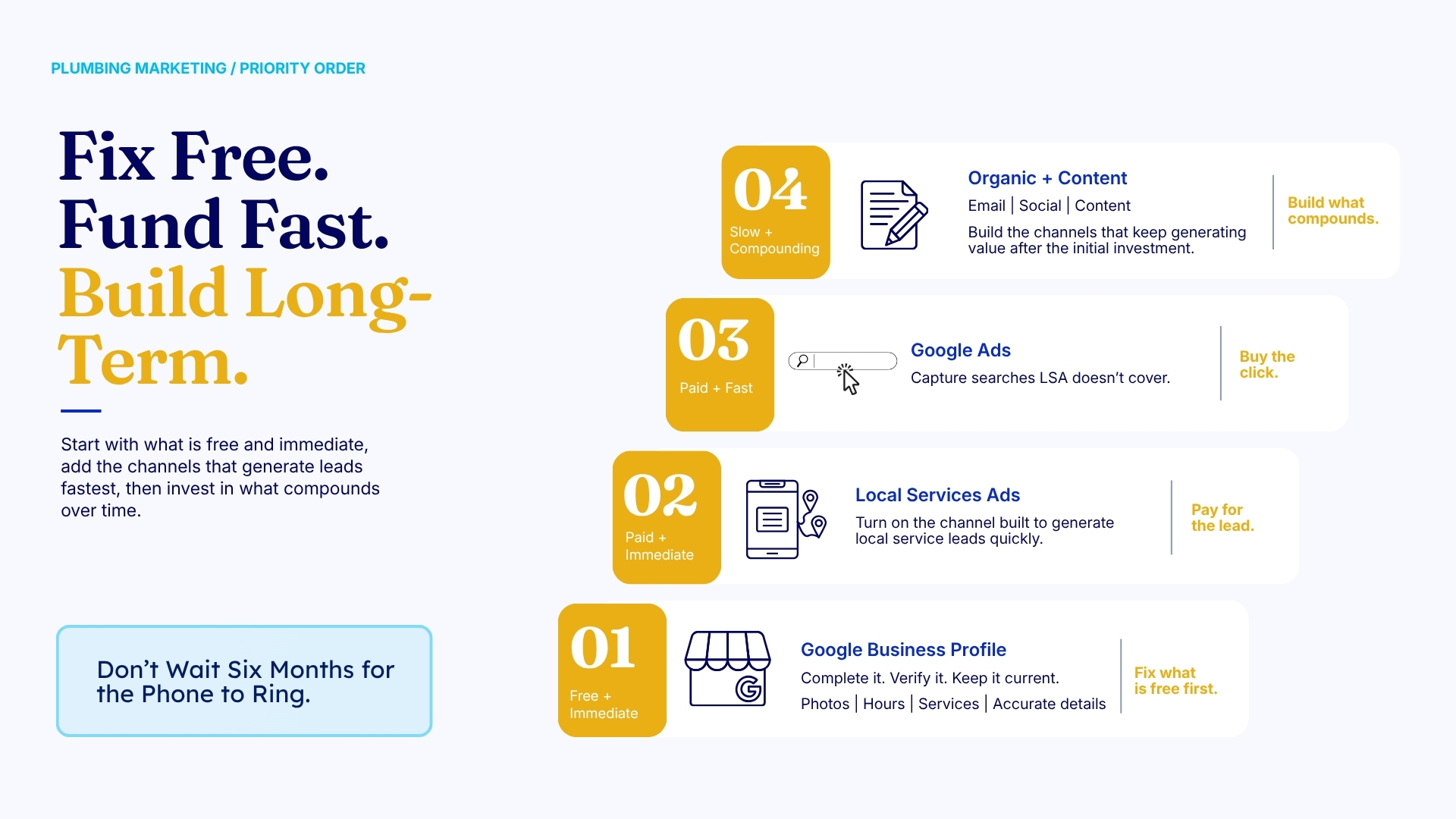
Here is the order we actually use, and the reasoning behind it: fix what is free, turn on what pays per lead, then buy what pays per click.
Free and immediate: your Google Business Profile. Complete, accurate, with photos and current hours. This is the single largest determinant of whether you appear in the map pack, and most plumbing profiles are half filled in. The mechanics are in our guide to .
Paid and immediate: Local Services Ads, covered next.
Paid and fast: Google Ads, for the searches LSA does not cover.
Slow and compounding: organic search, content, email, social.
Run them in that order and the early revenue funds the later work. Run them in reverse, which is what most plumbing companies do, and you spend six months waiting for organic while the phone stays quiet.
Local Services Ads: paying for leads instead of clicks
If you take one thing from this guide, take this. Local Services Ads sit above regular Google Ads on the results page, carry the Google Guaranteed badge, and charge you per lead rather than per click. For emergency trades that combination is difficult to beat.
The difference from Google Ads is not cosmetic. On a normal ad you pay whether or not the person calls. On an LSA you pay when a call or message arrives. That changes what a wasted budget looks like and it changes how you evaluate the channel.
How Google actually ranks LSAs
Worth taking from the source, because most articles about this get it wrong. names these factors:
Your bid: In Google’s words, “the amount you bid is the maximum amount you’re willing to pay for a lead, though you may end up paying less.” This is a ranking factor and it is the one nobody mentions. LSAs are an auction.
Your responsiveness: Google is direct: “Missed calls may negatively affect your responsiveness.” For a plumbing company with one person answering the phone between jobs, this is the factor most likely to be quietly costing you position.
Search relevance: The service being searched for, the time, the location, and how well your listed services and business description match.
Contact options: Google notes that “enabling message and/or booking leads means there are more ways for customers to reach you”, and more routes in is treated as a positive.
Profile quality: Which Google defines as “your rating, number of reviews, average response time, use of high-quality images, the verification checks you have completed, and any other information about your business that may influence user preferences.”
Read that list back and notice what it shares with your map-pack ranking: reviews, responsiveness, completeness, and photos. The same work moves both. That is the strongest argument for doing profile and review work first, because it is the only investment on this page that improves a free channel and a paid one at the same time.
Setting it up without burning budget
Complete the screening honestly: Licence and insurance checks are what earn the badge, and the badge is most of why the placement converts.
Set your service types to what you actually do: The fastest way to waste money is to receive leads for jobs you turn down. You still pay for them.
Set your hours to when someone will genuinely answer: If you list 24 hours and nobody picks up at 2am, you are paying for missed calls and damaging your responsiveness at the same time.
Dispute invalid leads promptly: Wrong number, spam, out of area. This is a few minutes a week and it is the difference between a channel that pays and one that leaks.
If you would rather have it run and monitored properly, that is what our does.
Google Ads, for everything LSA does not cover
LSAs cover the emergency service searches. Google Ads covers the rest: specific jobs, comparison searches, brand defence, and the geography or services LSA is not serving you well on.
Three things decide whether a plumbing Ads account works.
Negative keywords, aggressively: “Plumber salary”, “how to fix”, “plumbing courses”, “DIY”. Job-seekers and homeowners fixing it themselves will happily spend your budget.
Call-focused campaigns: Most plumbing conversions are phone calls, so call extensions, call-only campaigns in the right hours, and call tracking that ties a number to a booked job.
Honest geography: Bidding on a metro you cannot service in an hour produces leads you will lose. Tighten the radius before you raise the budget.
Measure at the level that matters: not cost per click, not even cost per lead, but cost per booked job. Two campaigns with identical costs per lead can differ by a factor of three once you count which leads turned into work. Our broader approach applies here, with the caveat that emergency trades behave differently from most advertisers.
Reviews are the multiplier under everything
Reviews are not a separate marketing channel. They are an input to your map-pack ranking, an input to your LSA profile quality, and the thing that decides which of the three visible options gets called.
What works is a system rather than a habit. Ask at the end of every completed job, from the person who did the work, with a link that takes two taps. Anything that depends on somebody remembering to ask later does not happen.
Two hard limits, and they are not stylistic. Never offer anything in exchange for a review, including discounts or a chance to win something, and never tell a customer what to write or ask staff to hit a review quota. Both are prohibited on Google, and in the US incentivised and fake reviews have been federal law since October 2024, not merely platform policy. A plumbing company running “review us for 10% off your next call” is exposed on both fronts.
Respond to the negative ones briefly and without arguing. The reply is written for the next person reading it.
Your website has one job
A plumbing website does not need to be impressive. It needs to convert an anxious person on a phone in under thirty seconds.
The phone number is tappable and visible without scrolling. On mobile. Check it yourself.
It loads fast on a phone signal, not on your office wifi.
Service areas are actual pages with real, specific content per town rather than the same paragraph with the name swapped. Google is explicit about thin duplicated location pages, and so are the customers who notice.
Prices, or at least how pricing works. “Call for a quote” loses to a competitor who explains their call-out fee. You do not have to publish a rate card; you have to stop being a mystery.
Proof above the fold. Licence, insurance, years in business, review count.
Organic search, which pays later
Organic is the slowest channel here and the only one that keeps working when you stop paying. Three to six months before it compounds is a realistic expectation, which is exactly why it goes after the paid channels rather than instead of them.
The work is local: the profile, consistent business details everywhere, service-area pages that are genuinely different from each other, and content answering the questions people ask before they call. We covered the search side in depth in , and the general local discipline is in our work.
Content that earns a call rather than a visit
Most plumbing blogs are written for search engines and read like it. The useful test is different: would a customer send this to a neighbour?
The material is already in your week. What a call-out actually costs and what changes it. How to tell a slow drain from a real blockage. What to do in the ten minutes before you arrive. Which repairs are worth doing and which are throwing money at a unit that needs replacing.
And there is a whole category most plumbers ignore, which is where the EPA figures above earn their keep. Nine percent of homes are wasting fifty gallons a day and their owners do not know. A page that explains how to check a meter for a hidden leak, cites the federal numbers, and tells the reader what a leak of that size costs them per month is genuinely useful, ranks, and gets quoted by AI tools because it contains verifiable specifics.
Then get it in front of people rather than waiting for search. The same explanation works as a short video, a profile post, a photo caption and an email, which is the idea behind .
Email and the customers you already have
The cheapest job you will ever book is the second one from a customer you already served.
Most plumbing companies have hundreds of past customers and no way to reach them. Start collecting addresses at the invoice, then use the list sparingly: a seasonal reminder before the first freeze, a note when a service you provide becomes relevant, an annual check-in on equipment you installed.
Two messages a quarter that are genuinely useful beat a monthly newsletter nobody opens. And unlike every other channel here, this one costs nothing per send.
Measure the thing that pays you
The most common reporting failure in this trade is measuring the wrong end of the funnel.
Track calls, not clicks: Call tracking numbers per channel, so you know whether the phone rang because of LSA, Ads, the map pack or organic.
Track booked jobs, not calls: A channel producing cheap leads that never convert is expensive.
Track cost per booked job, by channel: This single number tells you where the next dollar goes, and almost nobody in the trade has it.
Watch response rate: Google names responsiveness as an LSA ranking factor, so a missed call is not only a lost job, it lowers the ranking that produces the next one.
What we tell clients about budget
5% to 10% of revenue: That is the range we work with, weighted toward the channels you can measure per booked job.
Newer companies belong at the top of that range because they are buying visibility that does not exist yet. Established companies with a strong profile and a steady review flow can hold the bottom of it. Neither number is a law, and both are more useful than “it depends”.
The more important discipline is where it goes. In the first ninety days, most of it should sit in LSA and profile work, because those produce measurable calls while the slower channels build. After that, shift toward organic and owned channels as they start carrying their share, and let paid become the amplifier rather than the engine.
What to ask an agency, including us
We are one, so take this as what we would want you to ask us.
Ask what you will own if you leave: The website, the ad accounts, the profile, the content, the tracking numbers. If the answer is anything other than “all of it, and we will hand it over”, walk.
Ask to see cost per booked job: not leads or clicks or impressions. If the reporting cannot produce it, the reporting is not measuring the business.
Ask who answers the phone when a lead comes in at 7pm: Most plumbing marketing fails at the answering stage, not the advertising stage, and an agency that has not asked about your call handling is not paying attention.
Ask what they would do in the first thirty days: If the answer starts with a website rebuild rather than the profile and LSA, the sequencing is wrong for this trade.
Ask for the reasoning behind the retainer: A number with no logic under it is a number that will not flex when your situation changes.
You can run the basics yourself, and plenty of good plumbing companies do. The maths changes when missed calls and empty slots in the schedule cost more than the fee, or when you are spending real money on ads without reporting you can check against your own call log.
Your first thirty days
Week 1: Complete the Google Business Profile: every field, real photos, correct hours, correct service areas. Then apply for Local Services Ads, because the screening takes time.
Week 2: Put reviews on a system. One person, one link, asked at the end of every job.
Week 3: Fix the website’s phone number, mobile speed and above-the-fold proof. Nothing else.
Week 4: LSA live with honest hours and services. Start logging cost per booked job.
Everything else on this page comes after that, and it will work better because these four weeks are done.
Where to start today
Search your main service plus your town on a phone, signed out, and look at what a customer sees. Are you in the map pack? Is there an LSA above it that is not you? Does your listing show hours and a review count?
That takes two minutes and it usually settles the argument about what to fix first.
If you would rather have it run properly, is what we do, and starts with that same search and what it shows.
Frequently Asked Questions
Local visibility, in this order: a complete Google Business Profile, Local Services Ads for emergency intent, and a review system. Those three produce calls fastest. Website, content and email then make each call cheaper and more repeatable.
We work with a range of 5% to 10% of revenue, weighted toward channels you can measure per booked job. Newer companies sit at the top of that range while they build visibility; established ones can hold the bottom. Where it goes matters more than the percentage.
They sit above regular Google Ads, carry the Google Guaranteed badge, and charge per lead rather than per click. Google names bid, responsiveness to enquiries, search relevance, the contact options you enable, and profile quality, which includes your rating, review count, response time and images.
Run the basics yourself if you have the hours: profile, reviews, photos. The maths changes when missed calls and empty schedule slots cost more than the fee, or when ads are spending real money without reporting you can check against your own call log.
Local Services Ads and Google Ads can produce calls within days. Profile and review work shows over weeks. Organic search takes three to six months to compound. Run paid for immediate volume while the organic engine builds, then paid becomes a choice rather than a necessity.
Cost per booked job, by channel. Not clicks, not impressions, not even leads. Two channels with identical costs per lead can differ threefold once you count which leads became work.