(214) 272-7034
  info@fasthippomedia.com


Takeout and delivery growth comes down to three engines: a Google Business Profile carrying your own ordering link, marketplace listings treated like storefronts, and owned channels that move repeat customers to direct ordering. The reason is arithmetic. DoorDash publishes its commission at 15%, 25% or 30% per delivery order depending on plan, and 6% on pickup. Every repeat order you move off a marketplace and onto your own system is a margin increase you gave yourself.
The number that makes this urgent
The National Restaurant Association’s , published in February, projects $1.55 trillion in restaurant and foodservice sales this year.
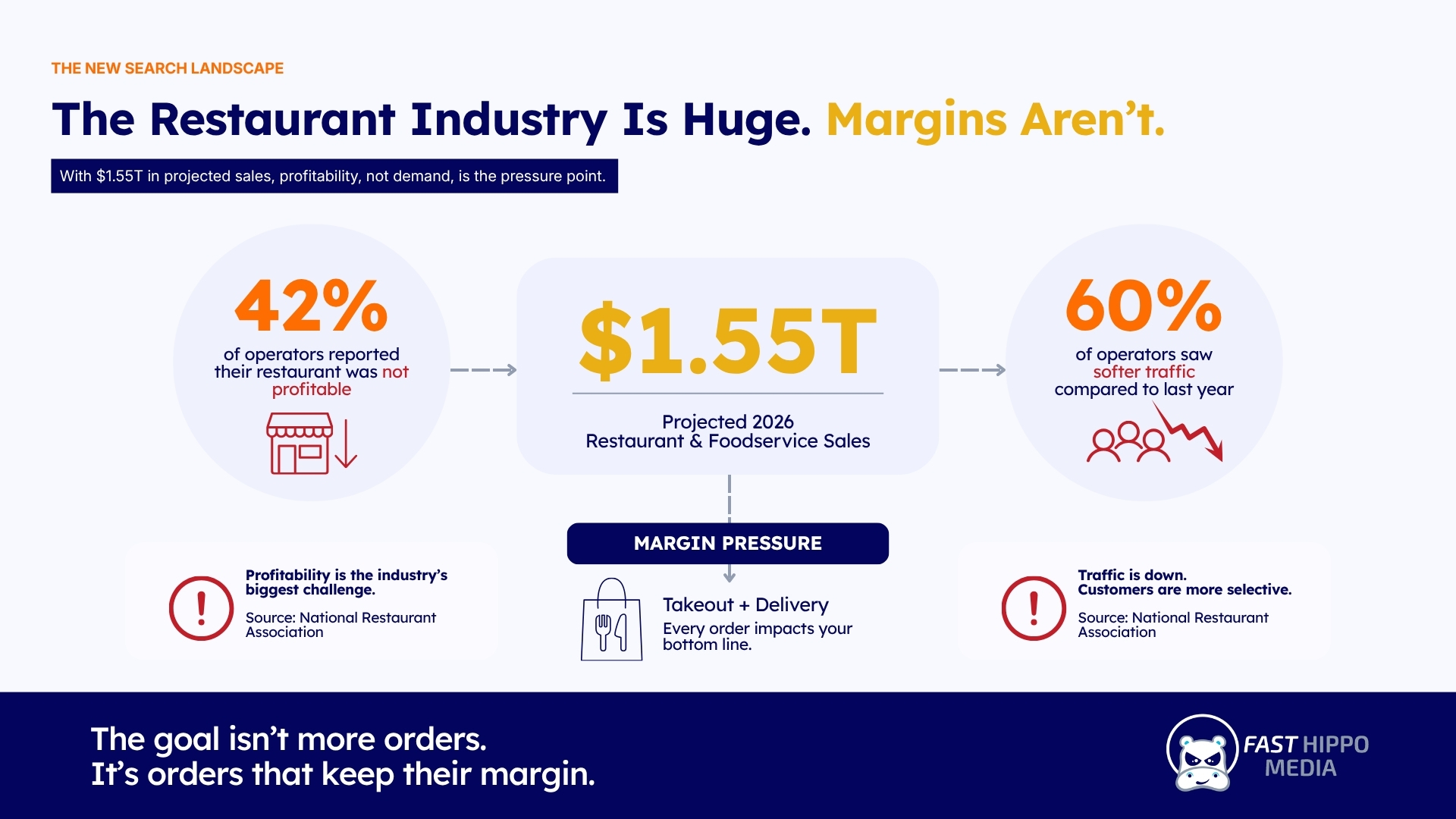
In the same release, 42% of operators reported their restaurant was not profitable in the prior year, and 60% reported softer customer traffic.
Read those together. The industry is enormous and growing, and four operators in ten are losing money inside it. Volume is not the problem. Margin is.
That is why this guide is about takeout and delivery specifically rather than restaurant marketing in general. Off-premises orders are where the margin question gets decided, because every one of them arrives through a channel that either costs you a percentage or does not. If you want the broader version covering dine-in, brand and the full marketing mix, that is our . This one is about growing orders that keep their margin.
The arithmetic nobody puts in the brochure
Delivery marketplaces publish what they charge. DoorDash’s page lists three plans:
| Plan | Delivery commission | Pickup commission |
|---|---|---|
| Basic | 15% | 6% |
| Plus | 25% | 6% |
| Premier | 30% | 6% |
No monthly fee, no signup fee, no contract. You pay when orders come in.
Two things fall out of that table, and most restaurants act on neither.
Pickup costs a quarter of delivery: Six percent versus fifteen to thirty. A customer who orders through the app and collects in person is dramatically more profitable than the same customer having it delivered, and almost nobody promotes that. If a meaningful share of your app orders come from within a mile, that is a margin opportunity sitting in your existing order data.
Your plan tier is a marketing decision, not a billing one: The higher tiers buy exposure inside the app. If your own channels are strong, you are paying a premium for discovery you could generate yourself. If they are weak, the premium is buying you customers you have no other way to reach. Which of those is true for you is answerable from your own numbers.
And the strategic version: a marketplace is a customer acquisition channel that charges per order forever. That is not a criticism. It is a description. Acquisition is genuinely valuable and the apps are genuinely good at it. What makes it expensive is paying the acquisition rate on the four hundredth order from a regular who would happily order direct if you had ever asked.
Your app listing is a second storefront
Marketplaces rank restaurants the way search engines rank pages, on signals. Ratings and how recent they are, photo quality, menu accuracy, order completion rate, preparation time, and how often you cancel.
Most restaurants set the listing up once and never revisit it. Four things move it.
Photograph your top ten items properly: Not all of them, the ten that sell. In a grid of thumbnails the photo is the entire pitch, and a dark phone snapshot next to a competitor’s lit shot loses without the customer reading a word.
Write descriptions for appetite, not inventory: “Grilled chicken, rice, salad” is a stock list. What it tastes like, how it is cooked, what comes with it, how hot it is: that is what closes.
Keep the menu accurate and prices synced: A cancelled order for an item you no longer serve damages your completion rate, which is a ranking signal, and costs you the customer, which is worse.
Protect completion rate and prep times: Marking items unavailable during a rush is better than accepting orders you cannot deliver on time. The algorithm forgives an item being off. It does not forgive cancellations.
Then start moving repeat orders direct
Discovery on the apps, loyalty on your own channels. That is the whole strategy, and here is how each piece serves it.
1. Local search, with your ordering link in it
When someone searches “thai food near me” at 6:40 on a Tuesday, the winner is the profile with an ordering link, correct hours and photos that close the sale.
Your can carry your own ordering URL, which means a search that would have gone through a marketplace can land on your system instead at zero commission. Most restaurants have never set that field, or have a marketplace link in it, which is paying a percentage for a customer who had already found you.
The rest is the usual work and it matters more for food than for almost any other category, because the searches are immediate and the radius is small. Accurate hours, current menu, real photos, and holiday hours updated before the holiday rather than after it.
2. Paid ads, at mealtimes only
Restaurant ads earn their keep in two ninety-minute windows a day. Dayparting your budget to the run-up to lunch and dinner concentrates spend on the hours when someone is deciding what to eat rather than reading about it.
The cheapest sale in the business is a past customer. Retargeting people who ordered once and have not returned costs a fraction of finding someone new, and it is where a modest budget goes furthest. Our post on covers the campaign structure.
Judge every campaign on cost per order, and compare that number to your commission rate. If an ad brings you a direct order for less than the marketplace would have taken, the ad is cheaper than the app.
3. Social, where food actually gets chosen
Food is the most visual category there is, and social search behaves like discovery rather than broadcast. People search restaurants inside Instagram and TikTok, then decide.
What works: short video of food being made, the dish arriving, the packaging opening. What does not: graphics announcing that you are open. Say your cuisine and your area out loud in the video and put it on screen, because those platforms index spoken words and on-screen text, and a beautiful clip with no words is invisible to the search box above it.
This also feeds surface one, since your profile shows up when someone searches your name after seeing you. The wider approach is in our work.
4. Email and SMS, the channel with no commission
This is the one that pays for the rest.
Every order through your own list costs you nothing but the message. The same order through a marketplace costs 15% to 30%. That is the entire business case, and it is why building the list should outrank almost everything else on this page.
How to build it without being annoying:
Put a card in the bag: A QR code and a genuine reason to scan it, usually a discount on a first direct order. You are paying the discount once instead of the commission forever.
Ask at the counter: Pickup customers are already standing there and already chose you.
Make it worth staying on: Early access to specials, a birthday offer, the new menu first. A list you never give a reason to open is a list that stops opening.
Then message around mealtimes, not at eleven in the morning, and keep it short.
5. Your own ordering system has to be better than theirs
The apps are frictionless because they spent a fortune making them frictionless. If your direct ordering takes four screens and asks for an account, every incentive you offer is fighting your own checkout.
The bar: mobile-first, guest checkout, saved details for returning customers, an accurate live menu, and a realistic time estimate. Test it yourself on a phone, at a busy hour, as a new customer. Most owners have never done this and are surprised by what they find.
6. Ratings are rankings
App ratings are not reputation in the abstract. They are a ranking input on the list your hungriest customers are scrolling, and a tenth of a star moves your position on it.
So treat Google reviews and app ratings as one job rather than two. Ask genuinely and consistently, without incentives or scripts, because paying for reviews or telling customers what to write is prohibited on every platform that matters and is federal law in the US. Respond to the bad ones in public, briefly and without arguing, because the reply is written for the next person reading it rather than for the reviewer.
The single highest-leverage habit is asking every satisfied pickup customer, in person, once. It costs nothing and it is the only channel where you get to ask a happy person face to face.
7. Content, doing the job it is actually good at
Content is not going to fill your Tuesday. What it does is answer the questions people ask before choosing, and give the search engines and AI tools something specific to work with.
Practical for a restaurant: what is actually in the dishes people ask about, which items travel well and which do not, allergen information written plainly, and how your kitchen handles the things people worry about. These are the questions your staff answer on the phone every week, which means you already have the material.
That work sits alongside your broader , and for a restaurant the return comes from being the specific answer to a specific question rather than from volume.
Putting it in order
Do not run seven strategies. Run three, in this order.
First, capture what you already have: Google Business Profile with your own ordering link, correct hours, current menu, real photos. This is free and most restaurants are leaving it half done.
Second, fix your own checkout: There is no point driving people to a direct order they abandon.
Third, start the list: Card in the bag, ask at the counter, one reason to stay subscribed.
Only then add ads, and only at mealtimes.
Measure two things. Cost per order by channel, compared to your commission rate. And the direct share: what percentage of your orders came through your own system this month versus a marketplace. That second number is the one that tells you whether any of this is working, and almost nobody tracks it.
Where to start this week
Open your Google Business Profile and check one field: the ordering link. If it is empty, or it points at a marketplace, you are paying a commission on customers who had already found you.
Then pull last month’s app orders and look at how many were pickup. If the answer is “hardly any” and you are in a walkable area, there is margin sitting in that gap at 6% instead of 25%.
Those two take twenty minutes between them and neither costs anything.
If you would rather have the whole programme run properly, we do this for restaurant clients: is the service, and starts with a look at your current direct-versus-app split.
Frequently Asked Questions
By winning the moment someone is hungry and deciding. Local search and a complete Google Business Profile with your own ordering link capture the search, ads at mealtimes recapture people who ordered before, and email or SMS brings back your existing customers through the one channel that carries no commission.
Your Google Business Profile with an ordering link, then a habit of asking for reviews, then owned channels that shift repeat orders away from commission. Everything else amplifies those three, and none of them work if your own checkout is worse than the app’s.
Not always. A single location can run the basics in-house, and the basics are most of the value. The maths changes when you are managing several delivery platforms, running ads and keeping profiles current while also running a kitchen, because at that point the fee is competing against commissions you are already paying.
Judge it against your commission rate rather than a percentage of revenue. DoorDash publishes delivery commissions of 15%, 25% or 30% depending on plan. If a pound or dollar of marketing brings you a direct order for less than the marketplace would have taken on the same order, that spend is cheaper than the channel you are already using.
Yes. App placement runs on ratings and their recency, photo quality, menu accuracy and order completion rate, all of which you control. Optimize the listing like a second storefront, then use bag inserts and your email list to convert app customers into direct ones over time.
Considerably, on the published rates. DoorDash charges 6% on pickup orders against 15% to 30% on delivery. If a share of your app customers live within walking distance, promoting pickup on the app is one of the few margin improvements available without changing anything in the kitchen.