(214) 272-7034
  info@fasthippomedia.com



TL;DR
Diners choose before they arrive, from the map pack, reviews, photos, and now AI answers. Four moves carry most of the result: a complete Google Business Profile with menu and ordering links, a steady stream of recent reviews, local SEO for neighborhood and dish searches, and a mobile site that books a table in two taps. Ads, email, and influencers multiply those four. They cannot replace them.
Running a restaurant in 2026 takes more than great food. You can have the best menu in town, but if people cannot find you online, the tables stay empty.
Diners now decide before they arrive. They check the map pack, skim the newest reviews, look at photos, and increasingly ask an AI tool where to eat tonight. Every one of those checks happens before anyone walks through your door, and most of them never touch your website.
This guide covers what actually moves covers and orders, in the order we would fix them.
What is the most effective digital marketing strategy for restaurants in 2026?
The most effective approach is local SEO, reviews, and a converting website working together, with everything else layered on top.
A useful way to think about it: four things compound and the rest amplify. A complete Google Business Profile, a steady review pipeline, local SEO built around neighborhoods and dishes, and a mobile site that takes an order in two taps. Those four keep working when you stop paying attention to them. Ads, email, social, and influencers all multiply whatever those four are already producing, which is why running ads to a thin profile and a PDF menu wastes money.
Whether you handle it in-house or partner with a , the sequence matters more than the tactics.
How does local SEO help restaurants get more customers?
Local SEO decides whether you appear when someone nearby is deciding where to eat in the next thirty minutes.
Google is direct about how it ranks local results. Its own guidance names relevance, distance, and prominence. Distance you cannot change, which is why the restaurant three suburbs over is not your real competition. Relevance comes from how completely your profile describes what you actually serve. Prominence comes from reviews and citations. Two of the three are work you control.
The practical version: your profile needs the right primary category, every service listed, real hours, and photos that show the food rather than the building. Your name, address, and phone need to match exactly across Google, Yelp, and the delivery apps, because conflicting details make you look unsettled to a machine that is trying to decide whether you exist.
The part most restaurants miss is dayparts. “Lunch specials near me” and “best dinner in Frisco” are different searches with different intent, and one page about your restaurant competes for neither well. A restaurant doing brisk lunch trade and dead evenings usually has a content problem, not a food problem: nothing on the site tells Google there is a dinner service worth showing.
How can a restaurant show up when people ask AI where to eat?
When someone asks ChatGPT or Google’s AI where to get Tex-Mex in Frisco tonight, the answer is assembled on the spot from live sources: your Google Business Profile, your reviews, and your menu, if the machines can read it. Most restaurants fail that last test without knowing it, because the menu lives in a PDF or a photo. To a human, that is a menu. To an AI it is a locked door.
Three fixes make a restaurant machine-readable, and the first two need no developer.
Finish the profile’s menu and action links: Google Business Profile has fields for a structured menu, a menu link, a reservation link, and an ordering link. Fill every one. Add dish photos with the dish named in the caption. When Google’s AI answers a “where should I eat” question, this is the first place it looks, and a profile with a real menu beats a profile with a phone number and a prayer.
Put the menu on a real web page: Plain HTML, dish names and prices as text, one page, updated when the menu changes. People search for dishes: “best birria tacos in Frisco” and “gluten-free pizza near me.” A text menu is the only way those searches can find you. Kill the PDF. Keep it as a download if your designer insists, but the page version is the one that works.
Add the LocalBusiness schema with restaurant properties: A small block of code tells search engines what you serve, your price range, where you are, and where the menu lives. Google lists for food establishments, so this is not guesswork. Your web person pastes it once.
{
  "@context": "https://schema.org",
  "@type": "Restaurant",
  "name": "Example Bistro",
  "servesCuisine": "Tex-Mex",
  "priceRange": "$$",
  "address": {
    "@type": "PostalAddress",
    "streetAddress": "123 Main St",
    "addressLocality": "Frisco",
    "addressRegion": "TX",
    "postalCode": "75034"
  },
  "telephone": "(972) 555-0143",
  "url": "https://examplebistro.com",
  "menu": "https://examplebistro.com/menu/",
  "acceptsReservations": "https://examplebistro.com/reserve/",
  "openingHours": "Tu-Su 11:00-22:00"
}
One caveat worth knowing, because most guides get this wrong: acceptsReservations is valid schema.org, and some AI tools read it, but Google does not list it among its supported LocalBusiness properties. Reservation booking inside Google Search runs through the Maps Booking program, not through markup on your site. Add the property; expect nothing from Google for it.
The rest pays twice. The structured menu that wins “birria tacos near me” in Google is exactly what an AI reads before it says your name out loud. One afternoon of setup, and your restaurant becomes the answer instead of a maybe.
What role do online reviews play in restaurant marketing?
Reviews are the single biggest conversion lever a restaurant has and the most commonly mishandled.
BrightLocal’s 2026 survey found 97% of consumers read reviews before choosing a local business, and 85% are more likely to use one after reading positive reviews. The finding restaurants underestimate is recency: 74% of consumers look for reviews written in the last three months, and 32% want them from the last two weeks. A four-star average built in 2024 reads as a restaurant that stopped caring, and the table goes to the place with reviews from last Friday.
How to get more reviews: Ask at the table when the meal has clearly gone well, and make it one tap with a QR code on the check presenter that goes straight to your review link. Train the ask into the close-out routine so it happens on the good nights rather than only when someone remembers.
Never offer anything in exchange: no free dessert, no discount on the next visit, and no entry into a draw. prohibit incentivized reviews, and the penalty lands on your profile, not on the customer. The same rule covers telling people what to write and only asking the guests who seemed happiest.
How to reply: Reply to everything, and write the reply for the next reader rather than the one complaining. A good reply to a bad review names the specific thing, says what changed, and stops. “Sorry you didn’t enjoy it” tells a future diner nothing. ” The 40-minute wait on Saturday was on us; we’ve added a third server to the weekend dinner shift,” tells them the place is run by someone paying attention.
How important is a website for restaurant success?
The website’s job is narrow: turn someone who has already decided to consider you into a booking or an order.
That means the top of every page answers three questions without scrolling. Are you open now? What do you serve, and how do I order? Hours, a text menu link, and a tap-to-call or tap-to-order button. Everything else on a restaurant homepage is decoration.
The two-tap test: From landing on your site, can someone place an order or book a table in two taps? Most restaurant sites fail because ordering lives behind a menu link, then a platform redirect, then a location picker. Every extra step loses people who were already sold.
Photography matters more here than on almost any other kind of site, and it should be your food, in your dining room, in the light you actually have. Stock food photography is obvious to diners, and it is the fastest way to look like a chain.
Why is social media essential for restaurant marketing?
Social keeps you in mind between visits, and it feeds the discovery loop for people who have never heard of you.
People eat with their eyes, so a short-form video of the food being made outperforms almost everything else. Behind-the-scenes kitchen content, the daily special being plated, and a regular’s order coming together. Post three to five times a week, use the neighborhood name rather than generic food hashtags, and reply to comments the way you would greet someone at the door.
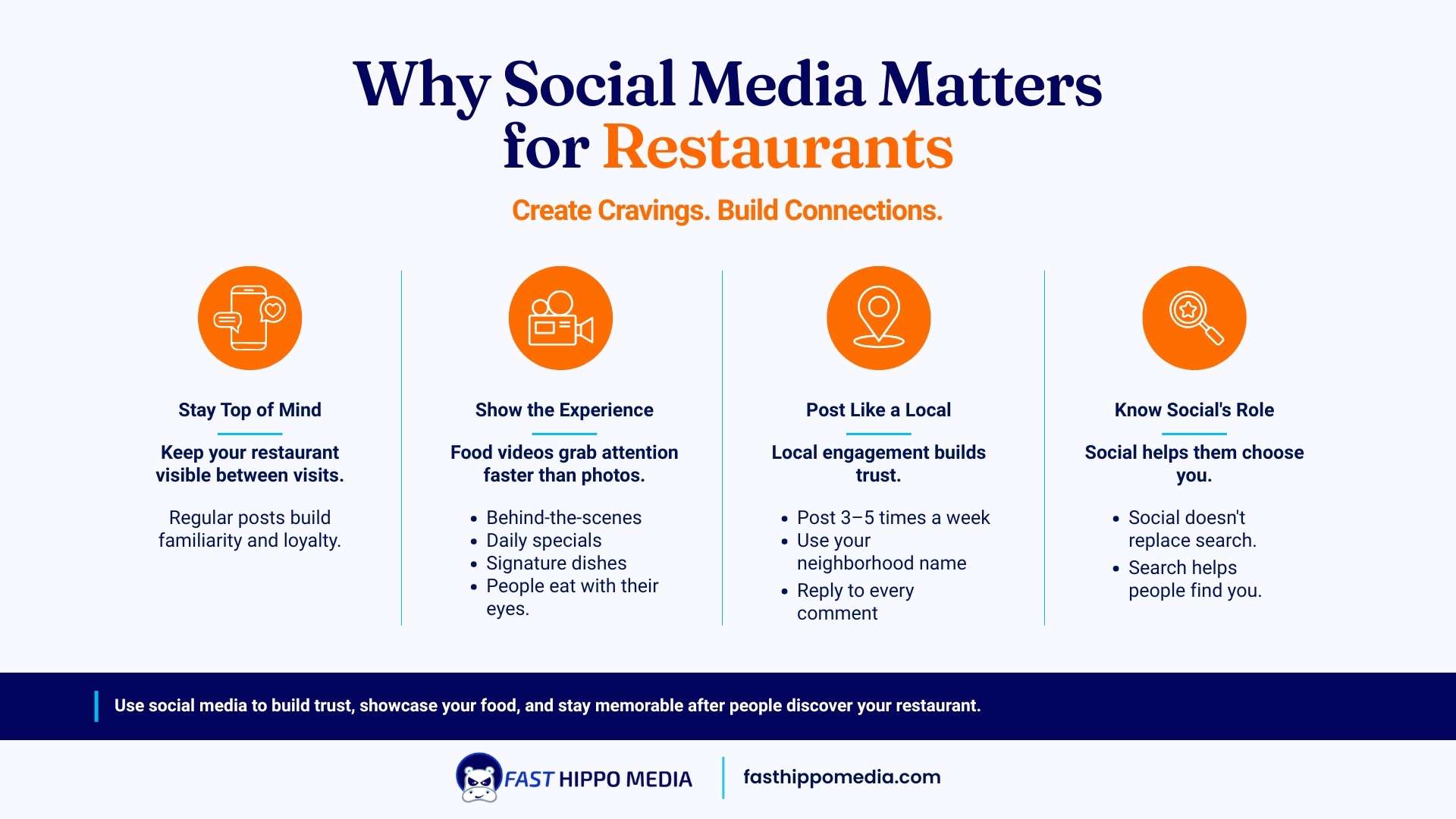
The thing to be honest about: social builds familiarity, not discovery. Someone searching “pizza near me” is not scrolling Instagram. Treat it as the layer that makes people choose you once they have found you.
How can restaurants use paid ads effectively?
Ads buy immediate covers and stop the moment you stop paying, which makes them a tool for specific problems rather than a standing program.
They earn their place for a slow daypart, a new location, a seasonal push, or the first ninety days while local SEO is still building. Target tightly by radius, run the ad to the ordering page rather than the homepage, and lead with a dish photo instead of a logo.
Judge them by covers, not clicks. If your reporting shows impressions and cost per click but nobody can tell you how many tables it produced, the campaign is not being managed; it is being run.
Can email and SMS marketing still work for restaurants?
They are the most reliable channels a restaurant owns, because the list is people who already ate your food and liked it.
Send fewer, better messages. A genuine event, a seasonal menu change, a loyalty reward that is actually worth having. Restaurants get into trouble here by sending a discount every week and training the list to wait for one.
SMS is the highest-intent channel and the easiest to overuse. Keep it to time-sensitive things: tonight’s cancellation table, the last day of a seasonal dish.
Should restaurants invest in influencer marketing?
Local micro-influencers work better than large accounts for a business with one address.
Look for engagement rather than follower count, a genuinely local audience, and food content they shot themselves. A creator with 4,000 followers in your city is worth more than 90,000 spread across the country.
Disclosure is not optional: A gifted meal in exchange for a post is a material connection under FTC endorsement rules, and it has to be disclosed clearly in the post itself. Agree that up front and put it in writing. An undisclosed partnership is a risk to the creator and to you.
How can content marketing attract more diners?
Content earns the searches that happen before someone is choosing a restaurant.
The formats that work for restaurants are narrow and specific: a guide to the dish you are known for, a seasonal menu explainer, and the story of where an ingredient comes from. All of it should name dishes, neighborhoods, and occasions, because those are the words people actually search.
The test for any piece: would someone who has never eaten here find it useful? If it only makes sense to existing regulars, it belongs on social rather than on the site.
Do restaurants need a digital marketing agency?
Only if the work is not getting done, which for most operators it is not, because service comes first and it should.
What an agency should bring is the system running without you: profile and review management, local search, ads tied to covers, and reporting you can check against the POS. What to ask for before signing: which of the four compounding items is weakest right now, and what would they fix first?
If the answer is a package rather than a diagnosis, keep looking.
Your first 30 days
Pick one and finish it.
If your Google Business Profile is incomplete or has no menu link, start there. It is the cheapest work with the fastest return, and it feeds the two ranking factors Google says you can influence.
If the profile is solid but your newest review is from spring, build the review routine instead. With 74% of diners looking for reviews from the last three months, a stale review base is costing you covers right now.
If both are healthy, the gap is almost certainly the menu. Get it out of the PDF and onto a real page, then add the schema. That single afternoon is what puts you in the AI answer rather than next to it.
If you would rather see where you stand before committing, our will run this checklist against your restaurant and your market.
Frequently Asked Questions
It is the work of getting found and chosen online: local SEO and Google Business Profile for discovery, social and reviews for trust, and a fast website with menu, hours, and one-tap ordering for conversion. The goal is booked tables and orders rather than traffic.
Diners decide before they arrive. They check the map pack, skim recent reviews, look at photos, and increasingly ask AI tools where to eat. A restaurant that is invisible or stale in those places loses the table to one that is not.
Start with the four that compound: a fully built Google Business Profile with menu and ordering links, a steady review pipeline, local SEO for neighborhood and dish searches, and a mobile site that converts. Ads, email, and influencers work after those rather than instead of them.
By being readable. AI tools assemble local dining answers from live sources: the Google Business Profile, recent reviews, and the menu. A menu trapped in a PDF or an image cannot be read, so the fix is a text menu on a real page, complete profile menu and ordering links, and LocalBusiness schema naming the cuisine and menu URL.
It scales with market and scope. Judge any quote by deliverables that touch revenue: profile management, review growth, local rankings, and booked covers, with reporting you can check against the POS.