(214) 272-7034
  info@fasthippomedia.com


Golf cart buyers shop locally and research online first. The moves that matter: a fast site with real inventory pages, local SEO and a complete Google Business Profile, review collection at delivery, and answer pages for the questions buyers actually ask, street-legal rules included. Ads buy visibility while the SEO builds.
Golf carts stopped being a golf course product years ago. They are neighborhood transport, farm equipment, resort fleets, event shuttles, and increasingly a second vehicle for short trips. That shift changed who buys them and how they shop.
Almost every cart purchase now starts online, and almost every one ends within driving distance of the buyer’s home. That combination, national research and local purchase, is what makes search the deciding channel for a dealership. This guide covers what actually moves units.
Why digital marketing matters for golf cart dealers
As the market expanded past golf courses into residential communities, resorts, and commercial fleets, the buyer changed. They arrive knowing more and having already narrowed the list.
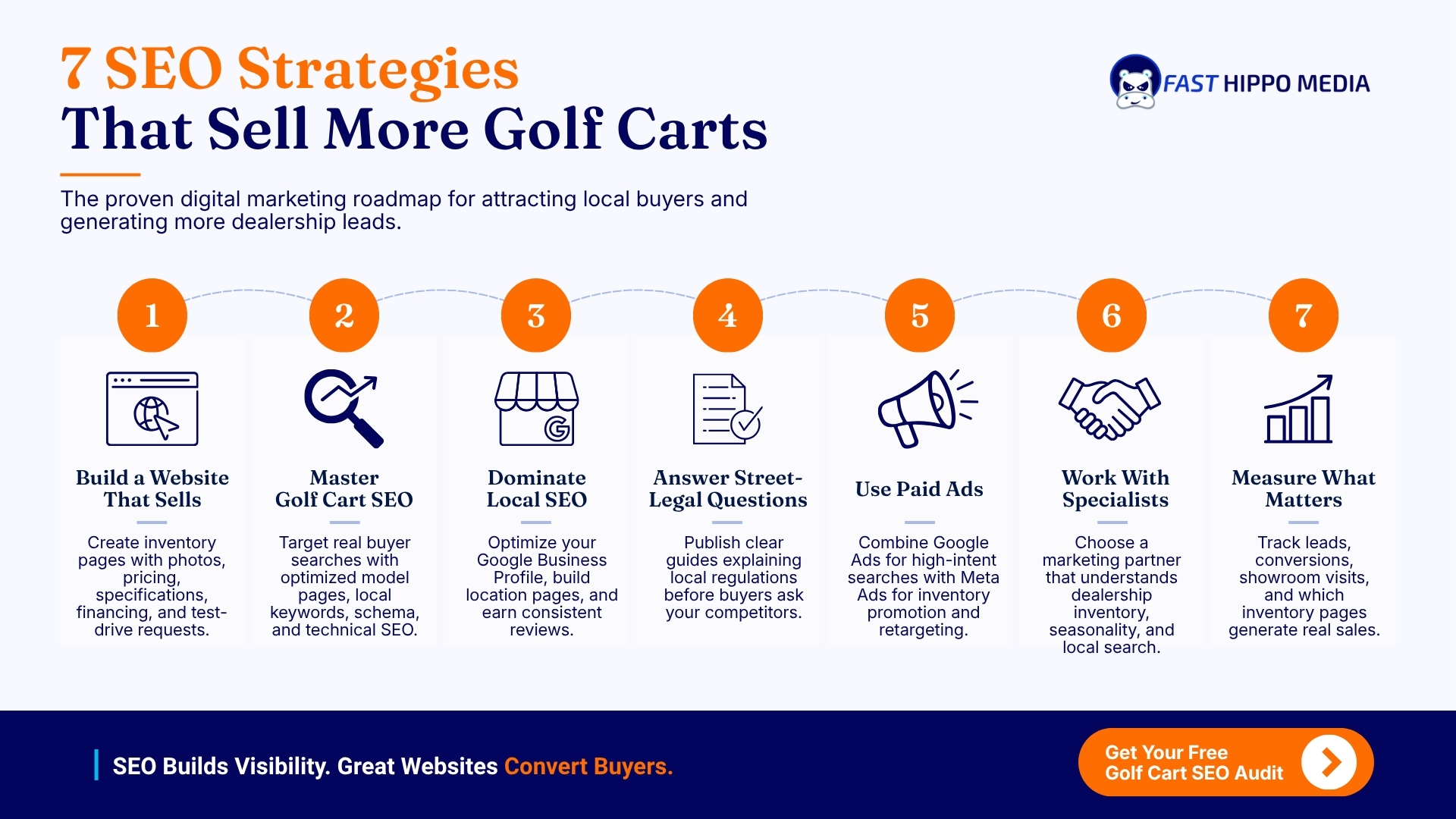
That means the dealership competing on showroom experience alone is competing for a shortlist it never made. Strong online presence brings qualified traffic, visibility in the local market, brand authority against national sellers, and better conversion because buyers arrive informed.
The advantage in this vertical is that most competitors are not doing this well. Dealership websites tend to be brochures with a phone number, which leaves the map pack and the buyer questions wide open.
1. Build a website that sells carts, not one that describes them
Before promotion, the site has to convert. That means clear navigation, real product pages with quality images and specs, lead capture that matches how people actually buy (test drive request, financing pre-approval, trade-in valuation), an embedded map, and pages that load fast on a phone in a parking lot.
The piece most dealers skip is real inventory pages. A page per model, with specs, price, photos of the actual unit, and availability. Not a PDF, not a gallery, not “call for pricing.” Buyers search by model and configuration, and a dealership with a page for the 2026 four-passenger lifted electric in street-legal trim can be found by someone searching exactly that. A dealership with one “Our Inventory” page cannot.
The same page then does the work in terms: metadata, alt text, internal linking, and structure that lets search engines understand what is for sale.
2. Master golf cart SEO basics
Search visibility is the foundation. Done properly, puts you in front of buyers at the moment they are deciding.
Keywords that reflect how buyers actually search. Not “golf cart dealer marketing,” which is what agencies search. Buyers search “street legal golf cart Frisco,” “used golf carts for sale near me,” “6-passenger golf cart price,” and model names.
On-page work per model and per location, with schema markup so search engines can read inventory rather than infer it.
Content that answers real buying questions: new versus used, electric versus gas, lithium versus lead-acid, and what a cart actually costs to run for a year.
Technical hygiene: crawl errors, broken links, HTTPS, and pages that do not take eight seconds to show a photo.
One thing worth naming plainly. Ranking is no longer the whole job. A growing share of these questions get answered before anyone reaches a website at all, which is why the sections below on local search and buyer questions matter more than they did two years ago.
3. Local SEO, because carts are bought close to home
Most of your sales come from within a radius, so local visibility decides more than site-wide authority does.
Complete the Google Business Profile properly: photos of actual inventory, accurate hours including seasonal changes, service and parts listed as services, and posts when new stock lands. Keep the name, address, and phone identical across Google, Yelp, Bing Places, Apple Maps, and the powersports directories.
Build a page per area you genuinely serve: A Dallas-area dealership needs Frisco, Plano, and McKinney pages that say something different on each: local ordinances and the communities that allow carts and where buyers actually drive them, rather than the same paragraph with the town name swapped.
Reviews decide the close: Ask at delivery when the buyer is standing next to the cart they just bought and is at peak enthusiasm. That is a better moment than any follow-up email. Send a direct review link so it is one tap.
Never offer anything in exchange for a review, and never tell a buyer what to write. Both breach Google’s review policies, and the penalty lands on your profile rather than on the customer.
4. Answer the street-legal question before your competitors do
Ask any dealer what buyers want to know first, and it is rarely horsepower. It is, “Can I actually drive this in my neighborhood?”
Almost no dealership answers that in writing, which makes it the cheapest visibility win in this vertical. Buyers put that exact question to Google and to AI assistants before they visit a showroom, and whoever answers it clearly becomes the source those tools quote.
The federal layer: A golf cart and a Low-Speed Vehicle are not the same thing. Under , an LSV is a four-wheeled vehicle whose maximum speed attainable in one mile is more than 20 mph and not more than 25 mph, with a gross vehicle weight rating under 3,000 pounds. To qualify, the regulation requires headlamps, front- and rear turn signal lamps, taillamps, stop lamps, reflex reflectors, mirrors, a parking brake, a conforming windshield, a VIN, and seat belts at every seating position. Newer requirements add rear visibility and an audible alert for quiet vehicles.
That list is the difference between a cart a buyer can register and one they cannot, and most buyers have never seen it.
The state layer: Texas is a useful example because it catches people out. Under Texas Transportation Code §551.402, a golf cart operated on a public street needs a golf cart license plate, obtained through the county tax assessor-collector rather than through titling. §551.403 limits operation to roads posted at 35 mph or less.
The local layer, which is where buyers actually get stung: Texas gives cities and counties real authority over golf carts inside their own boundaries. A valid state plate does not mean every road in town is open. If the municipality has not passed an ordinance permitting carts on its streets, a properly plated cart can still be stopped.
What to publish: One page per state you sell into and where it matters, per city. What your state requires, which of your models qualify as-is, which can be upfitted, and for how much, and where the local rules differ. Write it in plain language, and put a “last reviewed” date on it.
Then check it quarterly. These rules change, and an outdated legality page is worse than no page at all, because a buyer who acts on it and gets ticketed will remember where they read it.
5. Use paid ads for immediate results
SEO compounds; ads switch on. Both have a job.
Google Ads earn their place on high-intent searches: “golf carts for sale near me,” “street legal golf cart dealer,” and model names with “for sale.” Send the click to the model page, not the homepage.
Meta ads work differently here because carts photograph well. Showcase actual inventory, run seasonal pushes, and retarget the people who looked at a model page and left. Spring and pre-summer are the obvious windows in most markets, and the dealership whose pages are already indexed when that demand arrives pays less for the same visibility.
Ads make the most sense in the first ninety days while organic visibility builds, and for seasonal peaks after that.
6. Partner with an agency that knows dealerships
Running all of this alongside actually selling carts is the real constraint.
A worth hiring should know the dealership model specifically: seasonal demand curves, why inventory pages matter more than blog volume, that service and parts revenue is often the steadier half of the business, and that the street-legal question varies by state.
Ask what they would fix first and why. A specialist looks at your profile, your inventory pages, and your reviews and names the weakest one. A generalist recites a package.
7. Track what actually matters
Marketing without measurement is guessing.
Google Analytics for traffic sources and behavior, Search Console for rankings and indexing, and your CRM for what actually closed. Set targets for traffic growth, leads per month, conversion rate, and ad return.
The number that matters most is the one most dealerships do not track: which model pages produce showroom visits. That tells you what to stock and what to write next, which is more useful than any ranking report.
Your first 30 days
Pick one and finish it.
If your Google Business Profile is incomplete or has no recent photos, start there. It is the cheapest work with the fastest return in a business where buyers choose from the map pack.
If the profile is solid but you have one “Inventory” page, build real model pages instead. That is the single change most likely to bring in buyers who already know what they want.
If both are healthy, write the street-legal page for your state. Nobody else in your market has one, and it answers the question every buyer is already asking somewhere else.
If you would rather see where you stand before committing, our team will run this checklist against your dealership and your market.
Frequently Asked Questions
Golf cart SEO is optimizing a dealership’s website and Google Business Profile so buyers searching for carts, parts, and service in your area find you first. It covers local search, the map pack, model inventory pages, and the buyer questions people now ask AI tools.
Because carts are bought close to home. Buyers search “golf cart dealer near me” or their city name, check the map pack, and visit a showroom. Local SEO puts your dealership in that map pack and keeps your name, hours, and inventory consistent everywhere buyers look.
Profile and citation fixes can move map rankings within weeks. Competitive organic terms take three to six months of consistent work. Paid ads fill the gap while organic visibility builds.
Hire help when you lack the time or expertise in-house, or when growth has stalled. Look for a partner who knows the dealership model: seasonal demand, inventory pages, service revenue, and the street-legal questions buyers ask in your state.
Yes, for immediate visibility on high-intent searches and seasonal pushes. Ads work best alongside SEO: the ads capture demand now, while SEO builds the rankings that keep producing after the campaign stops.