(214) 272-7034
  info@fasthippomedia.com



TL;DR
Roofing is a “near me plus urgency” business, so local SEO usually decides who gets the call. Google ranks local results on relevance, distance, and prominence, and two of those three you can influence. The seven moves: build out the Google Business Profile, create service and location pages, target the three roofing search intents, collect recent reviews, keep citations identical everywhere, publish for local homeowner moves are to buildthe site fast on mobile. Start with the profile.
Local SEO for roofing companies is one of the most effective ways to bring in high-intent leads from nearby homeowners and property managers who are already searching for roofing help. When your business appears in Google Maps, local pack results, and organic search for terms like “roof repair near me” or “roofing company local SEO services,” you create a steady pipeline of qualified traffic that is far more valuable than random website visits.
For roofing businesses, local SEO is not just about ranking higher. It is about showing up in the right place at the right time when someone has an urgent roofing need. A strong local presence can help a small roofing contractor compete with larger companies, improve trust, and generate more calls, quote requests, and booked inspections.
Why local SEO matters for roofing companies
Roofing is a location-based service, which means most customers want a contractor they can trust in their own city or service area. Search behavior reflects that. People often search with local intent, such as “roofing company near me,” “roof leak repair in Dallas,” or “best roofing SEO company in Frisco.” If your business is not optimized for those searches, you are leaving leads on the table.
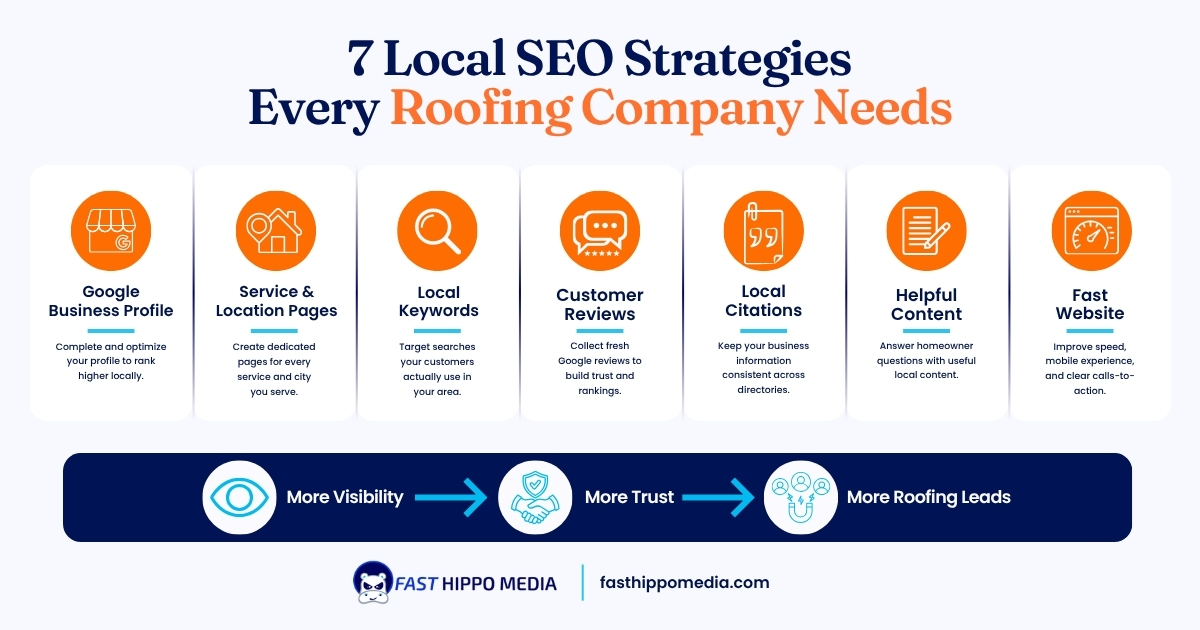
Google is unusually direct about how local results are ranked. Its own guidance names three factors: relevance, distance, and prominence. Distance you cannot change. Relevance comes from how completely your profile and pages describe what you do. Prominence comes from reviews, links, and citations. Two of the three are work you control, which is the entire argument for local SEO in a trade where every competitor is the same distance from the same neighborhood.
Local SEO helps roofing companies build visibility across the full search journey. That includes Google Business Profile results, map listings, location pages, service pages, reviews, and citations. When these elements work together, your business becomes more visible and more credible.
1. Optimize your Google Business Profile
Your Google Business Profile is often the first thing people see when they search for roofing services locally. It can influence whether someone calls you, visits your website, or chooses a competitor. A complete and well-optimized profile is one of the fastest ways to improve your local visibility.
Start by making sure your business name, address, and phone number are accurate and consistent. Choose the most relevant primary category, usually something like roofing contractor, and add secondary categories only when they truly fit your services. Write a clear business description that includes your core services, service area, and main value proposition.
Add high-quality photos of your team, trucks, completed projects, repairs, and before-and-after results. Update the profile regularly with posts, offers, and service updates. Use the services section to list roofing repairs, roof replacements, storm damage repair, inspections, gutter work, or other relevant offerings. A strong profile makes it easier for Google and customers to understand what you do.
2. Build service and location pages
One of the most important local SEO moves for a roofing company is creating dedicated pages for each service and location you want to target. A single generic homepage is usually not enough to rank well for competitive searches like “roofing digital marketing” or “SEO for roofing company.” Search engines need clear signals about what you offer and where you offer it.
Create individual pages for key services such as roof repair, roof replacement, emergency roofing, flat roofing, shingle roofing, and roof inspections. Then build location pages for the cities, neighborhoods, or service areas you want to target. Each page should include unique content, local references, service details, and a clear call to action.
Avoid copying the same content across every city page. That makes the pages less useful and weaker for SEO. Instead, add details about local weather conditions, common roof issues in the area, permit considerations, and examples of work completed nearby. This helps each page feel useful to users and more relevant to local search intent.
3. Target the right local keywords
Keyword research is where most roofing SEO goes wrong, and the mistake is easy to make. “Roofing company local SEO services,” “local SEO for roofing companies,” and “seo for roofing company” are not three keywords. Google reads them as one query with three spellings. Chasing the variants produces six thin pages competing with each other.
Roofing search happens in three moments instead, and each is a genuinely different keyword family.
The emergency moment. Water is coming through the ceiling and the homeowner searches fast and sloppy: “emergency roof repair Plano,” “roof leak repair near me,” “24 hour roofer.” These searchers call the first company in the map pack that answers the phone. You win this family with your Google Business Profile and a page that says emergency out loud, phone number above the fold.
The replacement moment. Nothing is leaking. The roof is eighteen years old and the searches read like homework: “roof replacement cost Frisco,” “how long does a shingle roof last in Texas,” “metal vs shingle roof.” This buyer compares three or four companies over several weeks, so the company that answers the cost question with real numbers earns the shortlist spot. Almost every roofer hides pricing. That is the opening.
The insurance moment. After a hail event the queries flip overnight: “hail damage roof insurance claim,” “roof inspection for insurance Colorado Springs,” “does homeowners insurance cover wind damage.” In Texas and Colorado this is the highest-stakes family and the least competed. The companies with an insurance-claim page already indexed when the storm hits take the surge. Everyone else publishes one two weeks late.
Structure follows from the moments: one page per intent for each city you serve, with the question searches (“how much does a roof replacement cost in Frisco?”) living in your FAQ where they can earn snippets and AI citations. Write the keywords the way people say them. If a sentence would sound wrong read aloud to a customer, it is stuffed.
4. Collect more positive reviews
Reviews are a major trust signal for roofing companies and a strong ranking factor for local visibility. A roofing business with lots of recent, genuine reviews will usually look more credible than one with little or no feedback. Reviews can also improve click-through rates because people are more likely to contact a company with strong social proof.
The numbers back this up. BrightLocal’s 2026 Local Consumer Review A survey found that 97% of consumers read reviews before choosing a local business, and 41% now always read them, up from 29% a year earlier. Recency is the part roofers underestimate: 74% look for reviews written in the last three months, and 32% want them from the last two weeks. A profile with forty reviews and nothing since spring reads as a business that stopped working. 85% say positive reviews make them more likely to use a business, and 77% say negative ones put them off.
Create a simple review request process after each completed job. The best time to ask is usually after a successful inspection, repair, or installation, when the customer is satisfied with the result. Send a direct link to your Google review page and make the process easy. The fewer steps involved, the more likely people are to leave feedback.
Ask at the moment the job closes, when the customer can still see the finished work. Send a direct review link so it is one tap, and follow up once if nothing arrives. Never tell a customer what to write, never offer a discount or gift in exchange for a review, and never filter who gets asked based on how happy they seem. All three break Google’s review policies and put the profile at risk. Respond to every review, including the negative ones, because the reply is written for the next reader rather than the one complaining.
5. Strengthen local citations
Local citations are mentions of your business name, address, and phone number on trusted directories and industry websites. They help search engines confirm that your business is real and located where you say it is. For roofing businesses, citation consistency is especially important because even small errors can reduce trust and cause ranking issues.
Start with major business directories, then move into home services and local directories. Make sure your NAP details are identical across every listing. That means the same business name format, the same phone number, and the same address structure. Even small differences can create confusion.
Useful citation sources for roofing businesses often include:
- Google Business Profile.
- Bing Places.
- Yelp.
- Facebook.
- Better Business Bureau.
- Angi.
- Houzz.
- HomeAdvisor.
- local chamber of commerce sites.
- regional contractor directories.
The goal is not to get listed everywhere. The goal is to be listed accurately on relevant, trustworthy platforms that reinforce your local authority.
6. Publish useful content for local homeowners
Many roofing companies focus only on service pages and forget about content marketing. That is a mistake because blog content can help you rank for informational searches, build trust, and support your commercial pages. Content also gives you a way to answer the questions homeowners actually ask before hiring a roofer.
Useful blog topics might include:
- How to know if your roof needs repair or replacement.
- Signs of storm damage on a roof.
- How often a roof should be inspected.
- What to expect during a roof replacement.
- How to choose the right roofing contractor in your city.
- Best tools for local SEO for roofing companies.
These articles should be written in a practical, clear tone and tailored to your service area where possible. Local references make the content feel more relevant and can support your city pages. A well-planned blog can also help you target long-tail queries that competitors are ignoring.
7. Improve your website experience
Website design plays a big role in local SEO for roofers because search engines want to send users to pages that are fast, clear, and useful. If your site loads slowly, is hard to navigate, or is not mobile-friendly, visitors may leave quickly. That can hurt both rankings and conversions.
Your website should make it easy for visitors to find services, service areas, reviews, contact details, and quote forms. Put your phone number in a visible spot on every page. Use strong calls to action like “Request a Free Roof Inspection” or “Get a Roofing Quote Today.”
Make sure your site works well on mobile devices because many roofing searches happen on phones, often during urgent situations. Add trust elements such as certifications, warranties, before-and-after photos, and testimonials. The more confidently people can move from search result to contact, the better your SEO investment performs.
Best tools for roofing SEO
Roofing companies do not need a massive stack of tools, but the right ones can make local SEO much easier to manage. A good setup helps with tracking rankings, managing listings, finding keyword opportunities, and auditing technical issues.
Some of the most useful tools include:
- Google Business Profile for local visibility management.
- Google Search Console for performance and indexing insights.
- Google Analytics for traffic and conversion tracking.
- Google Keyword Planner or similar tools for local keyword discovery.
- Listing management platforms for citation consistency.
- Rank tracking tools to monitor map and organic positions.
Whether you run this in-house or work with an agency, these tools can help you prove results more clearly. They also make it easier to identify where leads are coming from and which pages are driving calls.
Local SEO strategy for new roofing companies
A new roofing company usually cannot rely on brand recognition, so local SEO becomes even more important. The first priority should be building a strong Google Business Profile, a clean website, and a few targeted service and location pages. This creates a basic foundation that search engines can understand.
Next, focus on getting initial reviews, building local citations, and publishing a few highly relevant blog posts. Avoid trying to rank for every possible keyword at once. Instead, target the specific service and geographic areas where you can realistically win early traffic.
New companies should also pay close attention to website design and trust signals. Strong messaging, proof of work, and a clear contact path matter a lot when users are deciding whether to call a business they have never heard of before. For a newer company, local SEO is often the fastest way to build visibility without depending only on paid ads.
Common mistakes to avoid
Many roofing businesses make the same SEO mistakes over and over again. One of the biggest is using the same content across multiple city pages. That can make pages look thin and unhelpful. Another common mistake is ignoring reviews until a reputation problem appears.
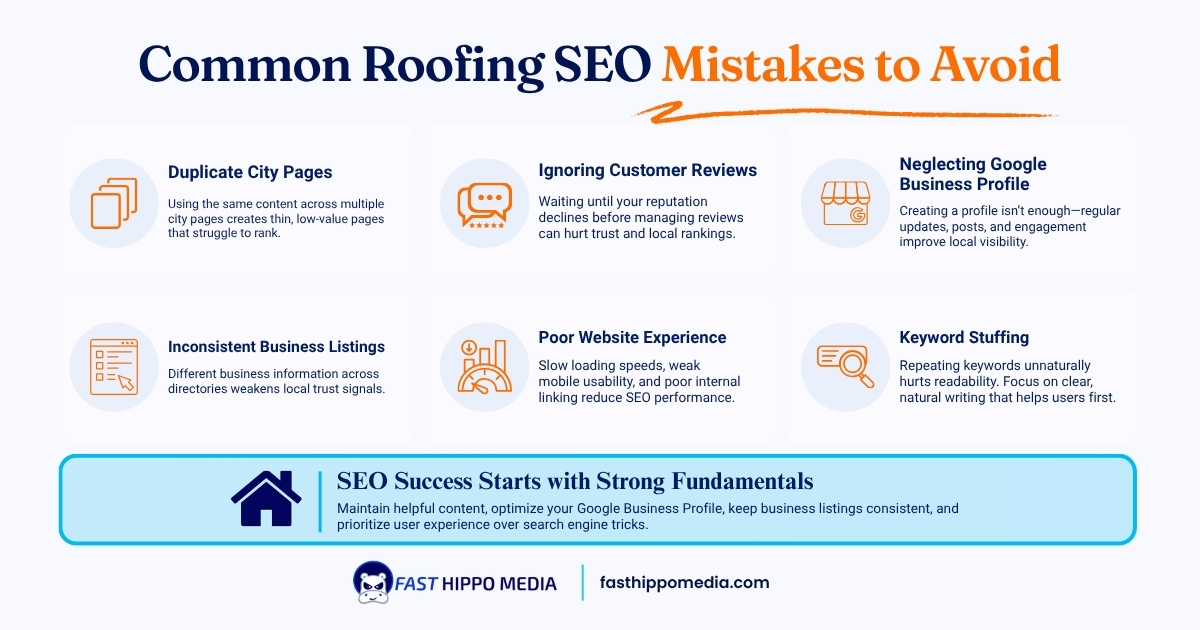
Some companies also neglect their Google Business Profile after creating it. That is a missed opportunity because ongoing activity can improve visibility and engagement. Others fail to keep directory listings consistent, which weakens trust signals. A slow website, weak mobile experience, or poor internal linking can also hurt performance.
Avoid keyword stuffing, too. Search engines do not need to see the same phrase repeated in every sentence. Clear, natural writing works better for both readers and rankings.
Where to start this quarter
Local SEO for roofing companies works best when the basics are done consistently. A strong Google Business Profile, targeted service and location pages, reviews, citations, and useful content can help your business show up where nearby customers are already searching. Roofing companies that treat local SEO as an ongoing system rather than a one-time task usually see better leads and more stable growth.
Pick one move and finish it before starting the next. For most roofing companies, the order is: complete the Google Business Profile this week, build the emergency and insurance-claim pages next, then turn reviews into a routine rather than an afterthought. Those three cover relevance and prominence, which are the two ranking factors Google says you can actually influence. The rest compounds from there.
Frequently Asked Questions
The most effective strategies are Google Business Profile optimization, service and location pages, review generation, citation building, local keyword targeting, and a mobile-friendly website. Together, these help roofing companies appear in both map results and organic search.
Use accurate business details, select the right category, add service descriptions, upload real project photos, collect reviews, and post updates regularly. Keep the profile active and complete.
Improve review quality and quantity, keep business information consistent, add local service pages, and maintain a strong Google Business Profile. Proximity matters too, but relevance and trust are major factors.
Ask customers right after a successful job, send a simple review link, and make the process easy. Respond professionally to every review and keep the request process consistent.
The most important sources usually include Google Business Profile, Bing Places, Yelp, Facebook, BBB, Angi, Houzz, HomeAdvisor, and local business directories. Accuracy matters more than volume.
Website design affects user experience, trust, mobile usability, and conversion rates. A fast, clear, mobile-friendly website helps visitors contact you and supports stronger SEO performance.
Pricing varies depending on location, competition, and scope of work. Agencies often charge monthly retainers, and costs can range widely based on services like content, citations, reviews, and technical SEO.