(214) 272-7034
 info@fasthippomedia.com



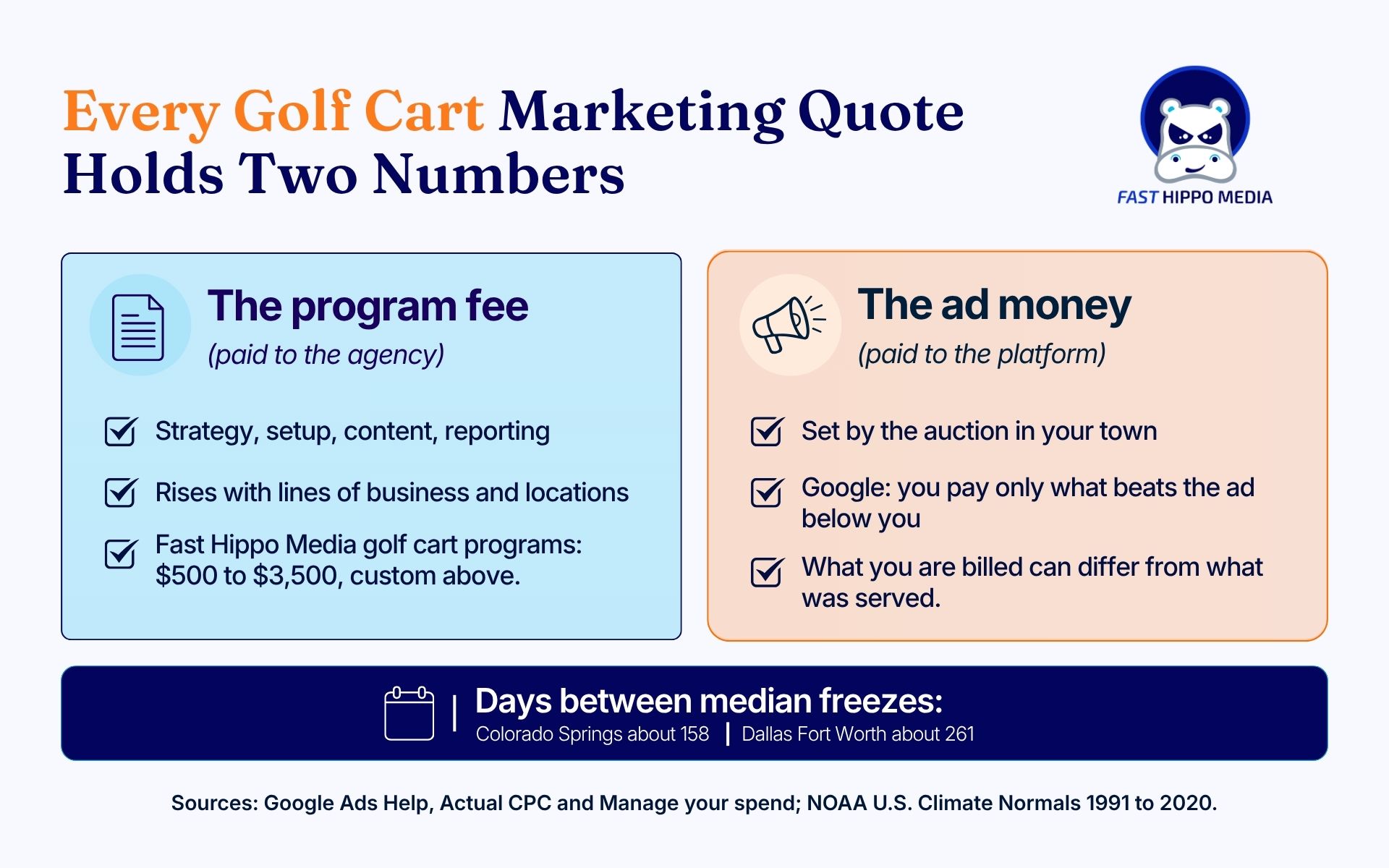
Golf cart dealer marketing costs are really two numbers most quotes blur into one: the fee for the people doing the work, and the money that goes to Google, Microsoft, or Meta for the ads themselves. Our own golf cart programs range from $500 to $3,500, with custom packages above that. Where a dealer lands inside a range like ours depends on how many lines of business it runs, how many locations it has, and how hard its season swings.
TL;DR
Golf cart dealer marketing cost has two parts. The management fee pays for strategy, setup, content, and reporting. Ad spend is paid into the ad platform and is set by the auction in your market, not by the agency.
Fast Hippo Media’s golf cart programs range from $500 to $3,500, with custom packages above that. A cart business pays more when it runs sales, rentals, and service as separate lines, has more than one location, and has a short season, because a short season compresses the same work into fewer months. A Colorado Springs lot gets roughly 158 days between median freezes, while the Dallas-Fort Worth area gets roughly 261, according to NOAA’s 1991 to 2020 climate normals.
When comparing quotes, ask for the fee and the ad budget on separate lines, and keep ownership of your ad account.
In this guide:
- How much golf cart dealer marketing costs, and the two numbers inside every quote
- What a smaller, middle, or larger budget realistically buys
- Why ad money behaves differently from the fee
- The four things that push the cost up for a cart business
- What fixing one inherited ad account involved
- Quote lines worth a second question, and a side-by-side comparison sheet
How Much Does Golf Cart Dealer Marketing Cost?
Golf cart dealer marketing cost, at our agency, starts at $500 and runs to $3,500, with custom packages above that range for operations that need more. That figure is the program. It is the work of planning, building, writing, managing, and reporting. Whatever you spend on clicks inside Google Ads or Microsoft Advertising is a second number, and a good quote shows it separately.
We publish the range so you can decide whether a conversation is worth having before anyone books one.
Here is how the pieces of a typical cart marketing quote break down, whoever writes it.
| Line in the quote | Who receives the money | What changes it |
|---|---|---|
| Management or program fee | The agency | Scope: channels, locations, lines of business, content volume |
| Ad spend | Google, Microsoft or Meta, through your ad account | Competition in your town, your bids, your budget settings |
| One-time build work | The agency or a developer | A new site, landing pages, booking or inventory integrations |
| Tools and software | The software vendor | Call tracking, rental booking systems, review platforms |
| Photos and video | A photographer or the agency | How often inventory turns and how much you shoot in-house |
When the first two rows are added together, comparisons go wrong. A $3,000 quote that includes $2,000 of ad money is a $1,000 program, and it should be compared against other $1,000 programs.
What Each Budget Level Realistically Buys
Money buys either focus or breadth, and the bottom of any range buys focus. We would rather see a dealer run one channel properly than spread a small budget across five and find out nothing from any of them.
This is how we think about the trade-off, stated as general experience across the market rather than as a fixed menu.
| Where the budget sits | What it can do well | What it usually cannot cover |
|---|---|---|
| Near the bottom of a range like ours | One channel, done properly: a cleaned-up Google Business Profile and a few strong pages, or one paid search campaign watched closely | Separate rental and service campaigns, regular new content, more than one location |
| The middle | Search and paid ads working together, with conversion tracking, monthly content, and reporting to see which leads came from where | Heavy video, several locations with distinct pages for each, a new website |
| Near the top | Sales, rentals, and service each treated as their own demand, more content, and closer weekly attention through the peak months | Builds that are really software projects, like a custom booking system |
| Custom, above the range | Multi-location groups, larger rental fleets in resort or beach markets, or a full rebuild alongside ongoing work | Nothing by definition, which is why it gets scoped by hand |
The honest version of this table has one more column, and it is time. A small budget spent on fixing the basics often pays off slower, because search work compounds over months. Paid search produces its first data as soon as the ads start serving, which makes it the faster channel to judge.
If you already know you want both, our golf cart dealership marketing for sales lots and rental fleets plans search, ads, content, and email as one program, so the budget is set once and split by what each line of the business needs.
Why Is Ad Spend a Separate Number From the Fee?
Ad spend is separate because nobody at an agency sets the price of a click. The auction does. Google’s own explanation of how the actual cost per click is set says you “only pay what’s minimally required to clear the Ad Rank thresholds and beat the Ad Rank of the competitor immediately below you.” So the price of a click on a golf cart search in Frisco depends on who else is bidding in Frisco that afternoon.
The same Google explanation adds two details that matter for budgeting. Thresholds are “typically higher for ads above search results,” so the top spots cost more per click than the lower ones. And you are “never charged more than your max. CPC bid (unless you’re using automated bidding tools).” Smart Bidding is one of those automated tools, so the cap you set is not always the cap you get.
What you owe is a third figure again. Google’s guide to managing what you spend in Google Ads separates served cost, “the cost of all the clicks or impressions that the campaign received,” from billed cost, “the actual amount you’re responsible for paying, after adjustments have been made to your account for items like overdelivery, invalid activity, and more.” Both sit in reports inside the account.
Two practical things follow for a cart dealer.
- Ask any agency to show you where the ad money is billed. The billing summary and the billed cost report in your own Google Ads account answer that question without anyone’s spreadsheet in between.
- Treat the ad budget as a monthly figure you can raise in spring and trim in the dead weeks. We cover the daily mechanics in the five Google Ads settings that decide a dealer’s daily spend, including why sales and rentals should never share one budget.
We will not quote a typical cost per click for golf cart searches. Google does not publish one for this category, and any figure we gave you would describe someone else’s market, not yours.
What Pushes the Cost Up for a Cart Business
Four things, in our experience, move a golf cart quote up more than anything else. None of them is about the agency charging more for the same work. Each one adds real work.
Selling, renting, and servicing are three businesses
A buyer looking at a new lithium cart, a family booking two carts for a beach weekend and an owner whose batteries died in storage are three different searchers. They type different words and want different pages. When we rebuilt a dealer’s ad account earlier this year, we split sales and rentals into separate campaigns, so a shopper pricing a new Club Car and a family booking a weekend rental never competed for the same budget.
Each extra line means more campaigns, more pages, and more tracking. A dealer that only sells carts can run a tighter program than one that also rents and repairs them.
Every location needs its own copy
A second lot is not a copy of the first one with a new address. Each location needs its own Business Profile, its own landing pages, and its own targeting radius. Google’s Business Profile content policy also prohibits “posting the same content multiple times either from the same account or multiple accounts,” so a single post calendar pasted across three profiles is exactly what the rule describes. Distinct copy for every listing takes time, and time is what a program fee pays for.
A short season packs the same work into fewer months
Weather sets the calendar for many car dealers, and the gap between our offices is wide. NOAA’s U.S. Climate Normals for 1991 to 2020 put the median last spring freeze at Colorado Springs Municipal Airport on May 3 and the median first fall freeze on October 8. At the Dallas-Fort Worth airport station those dates are March 8 and November 24.
| Station (NOAA normals, 1991 to 2020) | Median last spring freeze | Median first fall freeze | Days between |
|---|---|---|---|
| Colorado Springs Municipal Airport, Colorado | May 3 | October 8 | about 158 |
| Dallas Fort Worth Airport, Texas | March 8 | November 24 | about 261 |
A Colorado dealer who wants spring buyers needs the content, the profile updates, and the ad campaigns ready weeks before May, and then needs closer attention through a short summer. A Texas dealer spreads the same effort across a longer stretch. Neither is cheaper by nature, but the Colorado calendar concentrates spend into fewer months, and a dealer with lots in both states is really paying for two calendars.
Not every market follows the thermometer. The Southern California dealer in our PPC case study saw demand that “isn’t driven by the weather” and moved instead with dealer pricing cycles and, for rentals, the local event calendar. Ask whoever quotes you which calendar they planned around.
The website you start with
A good ad sends a shopper to a page that has to finish the job. If the site cannot take a call, an inquiry, or a booking cleanly, part of the first quote will go to fixing that, and it should. That case study dealer came to us with a site “that wasn’t built to turn a visitor into a lead,” and the biggest structural fix was a landing page built for paid search traffic.
A dealer starting from a fast, clear site with real inventory photos pays less to get going. If yours is older, it may be worth pricing golf cart web design that turns phone shoppers into calls and bookings as a one-time project before any ongoing program starts.
What Fixing One Inherited Ad Account Involved
Price only makes sense next to what it produced, so here is the one golf cart ad account we have published in full. It is a single account, in one market, over one quarter, and we present it as that and nothing more.
The dealer sells and rents new carts in Southern California and had already been through two agencies and a stretch of running the ads in-house. The account had loose structure, no managed negative keywords, and clicks coming from well outside the area the dealer could serve. Our team finished the repair work in 10 days, with three people on it from the first day.
Over Q1 2026, our write-up on a Southern California dealer whose ad account we rebuilt reports cost per conversion down 56% and conversion rate up 64%. It also records a 200% increase in return on ad spend, cart sales up 73%, and rentals up 212%.
The lesson for budgeting is where the savings came from. The dealer did not need a bigger ad budget. It needed the existing budget to stop paying for searches that were never going to buy or book. A management fee that fixes waste can cost less than the waste it stops, which is the case worth making to yourself before you sign anything.
Quote Lines That Deserve a Second Question
Most quotes are written in good faith. A few lines, though, are worth stopping on before you sign.
One number for everything: If the fee and the ad money are combined, ask for them split. You cannot judge a program’s price without knowing how much of the total is going to Google.
An ad account the agency owns: Google’s help page on ownership of client accounts explains that when a manager creates a new account, “the manager will automatically become the owner of that account.” The client account still owns its data and can remove an owner by unlinking, but it is far simpler to have the account created in your name, with your payment method, and the agency added as a manager.
No mention of conversion tracking: Clicks are not customers. In the account above, we checked conversion tracking before touching a bid, because an account that optimizes toward the wrong signal “just gets more efficient at wasting money.”
A ranking promise: Google’s own guidance on third-party SEO services says tools and agencies “don’t have access to our internal ranking data” and “can’t guarantee performance.” Anyone who guarantees a position is selling a claim, not a plan.
Review services that pay for reviews: Google’s Business Profile policy bans rewarding people for posting reviews, and its list of banned incentives runs from cash payment to discounts and free goods or services. A package built on rewarding customers who post reviews puts your listing at risk. Asking customers for honest reviews, with nothing attached, is allowed.
The same posts on every location: If a multi-lot quote shows one content calendar for every profile, ask how each listing will get its own copy, for the duplicate-content reason above.
How to Compare Two Quotes Side by Side
Put every proposal into the same grid before you read the sales pitch. It takes ten minutes and it usually settles the decision.
- Copy the management fee into one row and the ad budget into another, even if the quote did not separate them.
- Write down which lines of your business each quote covers: sales, rentals, service.
- Count the locations each quote includes, and check whether each one gets its own pages and profile copy.
- Note who creates and owns the Google Ads and Microsoft Advertising accounts.
- Look for what the report counts. Calls, form fills, and bookings beat clicks and impressions.
- Ask what happens in your slow months, and whether the plan changes or simply keeps billing the same work.
| Compare | Quote A | Quote B |
|---|---|---|
| Management fee | ||
| Ad budget, and where it is billed | ||
| One-time setup or build | ||
| Lines covered (sales, rentals, service) | ||
| Locations covered | ||
| Who owns the ad accounts? | ||
| What the report counts | ||
| Plan for the off-season |
A cheaper quote that covers sales only is not cheaper if you rent carts too. A pricier one that includes landing pages may save you a separate web project. The grid makes that visible. If paid search is the part you want to price first, our paid search management for cart dealers and rental fleets is built around controlling wasted ad spend, which is the line a combined quote hides best.
Price Your Own Golf Cart Season Before You Call an Agency
Before talking to any agency, write four things on one sheet. Which lines do you run: sales, rentals, service? How many locations, and in which towns? Which months carry most of your year? And can your website take a booking or an inquiry from a phone without a struggle?
With those answers in hand, every quote you collect becomes comparable, and you will spot the one that priced someone else’s business. Going by the NOAA dates, a dealer in the Dallas area or Frisco has a longer outdoor stretch to plan for than one around Colorado Springs, and the plan should show it.
When you want a second opinion on a quote, or a quote of your own built around your calendar, Fast Hippo Media works with golf cart dealers and rental operators from our offices in Farmers Branch, Frisco, and Colorado Springs. Send us your four answers, and we will tell you where in our range we think you fit, and why.
Frequently Asked Questions
Fast Hippo Media’s golf cart programs range from $500 to $3,500, with custom packages above that. The figure covers the work itself. Ad spend paid to Google or Microsoft is a separate number that depends on competition in your market and the budget you set.
It depends on the agency, which is why you should ask for the two on separate lines. Ad money is billed through the ad account, and Google Ads shows a billing summary and billed cost report there, so you can always see what went to the platform.
Usually, yes. Rental searchers want availability and a booking button, while buyers want inventory and financing. Separate campaigns and pages for each line keep one from starving the other, and that extra work is reflected in the program cost.
The dealer. Google says a manager that creates a new account becomes its owner automatically, so have the account created in your business name with your payment method, then add the agency as a manager. You keep the history if you ever change agencies.
The work shifts more than the fee. NOAA’s normals put about 158 days between median freezes at Colorado Springs and about 261 at Dallas-Fort Worth, so Colorado dealers concentrate spending into a shorter window while Texas dealers spread it out.