(214) 272-7034
  info@fasthippomedia.com



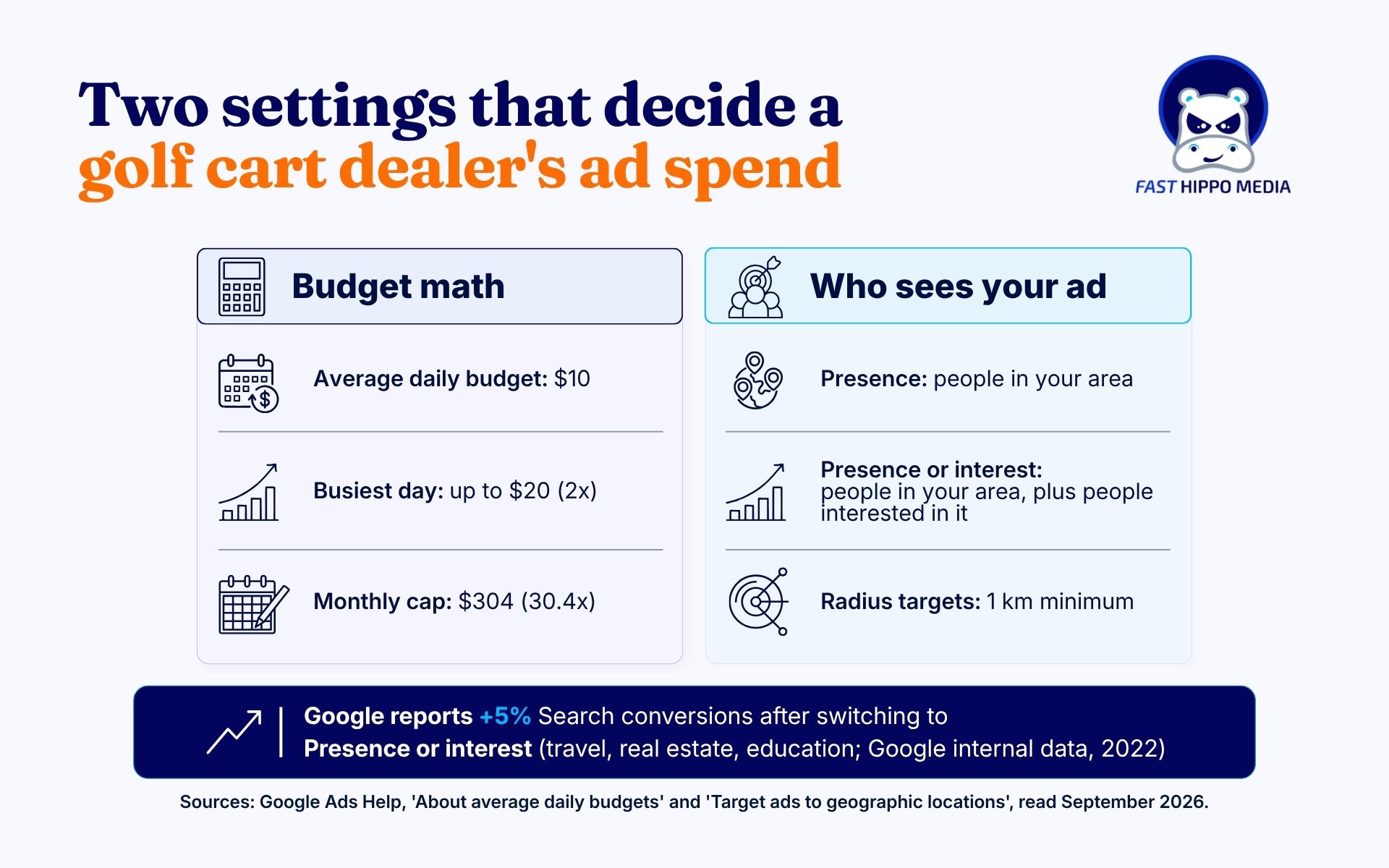
Five percent. That is the lift in Search conversions Google reports for advertisers in travel, real estate, and education who switched one location setting from “Presence” to “Presence or interest”, according to its own help page on geographic targeting. The figure is Google internal data from a ten-day window in 2022, and it is the reason the broader setting is the recommended one. That single toggle is a good place for a golf cart dealer to start, because a cart sold in Frisco has to be picked up or delivered somewhere real, and the right answer for a dealer is often different from the right answer for a rental fleet.
TL;DR
Google Ads for golf cart dealers comes down to five settings you control before any ad runs. Location targeting decides whether people merely interested in your town can see the ad, and Google recommends the broader option while naming cases where the narrower “Presence” setting fits. Conversion tracking decides what the account learns from, and Google offers five separate ways to count phone calls. The average daily budget can run up to twice its set amount on a given day but never more than 30.4 times it in a month. The search terms report shows the real queries you paid for, which is where negative keywords come from. And any ad or landing page that quotes a monthly payment or a down payment triggers federal Truth in Lending disclosure rules.
What Does Google Ads Actually Charge a Golf Cart Dealer For?
You pay for clicks inside a budget you set per campaign, and Google spends that budget unevenly across the month. Google’s page on how average daily budgets work says spend can go up to two times the daily amount on busy days, and never beyond 30.4 times the daily amount across a month. That 30.4 is simply the average number of days in a month (365 divided by 12), and the same page works it through with $304 a month becoming a $10 average daily budget.
So the number to decide on is monthly, not daily.
| Setting you choose | What Google does with it | Worked example from Google’s page |
|---|---|---|
| Average daily budget | Spends more on days it predicts more clicks and conversions, less on others | $10 a day |
| Daily ceiling | Up to two times the average on any single day | Up to $20 on a busy day |
| Monthly ceiling | No more than 30.4 times the average in a month | $304 for the month |
What we will not do here is quote a cost per click for golf cart searches. Google does not publish one for this category, and the numbers floating around agency sites have no source we could trace. Your own account’s keyword planner and first month of data are the only honest figures, and they vary by town and by brand carried.
One practical point for dealers who also rent. Sales and rental demand do not have to peak in the same weeks, and a single shared budget lets whichever side is busier starve the other. Separate campaigns, each with its own budget, keep that decision in your hands.
Location Targeting and the Frisco Problem
Location settings are where the wasted money started in the dealer account we rebuilt this year, and it is the first thing we check on any inherited account. Google gives you two choices inside the campaign’s location options, and they behave very differently for a showroom than for a beach-town rental counter.
| Option | Who can see the ad | Where it tends to fit |
|---|---|---|
| Presence or interest (Google’s recommended default) | People in your targeted area, plus people elsewhere who have shown interest in it | Rental fleets in visitor towns, where the renter is planning a trip from out of state |
| Presence | Only people located in your targeted area | Showrooms selling within a realistic delivery radius |
Google’s own guidance names two situations for Presence: a sensitive vertical with strict targeting limits, or when “you only want to target users in specific locations and not users who may be in other locations but are still interested in your product or service.” A dealer who cannot deliver past a few counties is the second case. A rental operator whose customers book from home before the vacation is the opposite, and that is exactly the travel pattern Google’s five percent figure was measured on.
A lot of dealers do both, and the setting is chosen per campaign, not per account. That is one more reason to keep sales and rentals apart: the sales campaign can sit on Presence around the showroom while the rental campaign reaches the family in another state who is picking a beach week in March.
Exclusions work the same way in reverse. Google lets you exclude locations as well as target them, which is handy when a county line or a river puts a nearby town outside your delivery area even though it sits inside a tidy radius.
Radius targeting has a floor too. The same help page says radius targets must be at least 1 km, and that very small targets may show ads only intermittently or not at all. Drawing a tight circle around the lot can quietly switch your ads off.
Why place names cause trouble
Place names are ambiguous, and paid search inherits the ambiguity. Our own Frisco, Texas pages pick up thousands of Search Console impressions from people who meant Frisco, Colorado, the mountain town in Summit County. A dealer north of Dallas bidding on “golf carts Frisco” will meet the same crowd.
The fix is a short list of negative keywords such as “colorado” and “summit county”, then a look at the search terms report after the first two weeks. Colorado Springs has its own version of this, since “Springs” shows up in many place names across the country.
Which Searches Should a Dealer Pay For?
Pay for searches that could end in a sale or a booking at your location, and block the rest with negative keywords. The search terms report in Google Ads lists the actual queries that triggered your ads, next to the keyword that matched them. That report, read every week, is the whole job in the first month.
Google’s help pages on keywords make two points worth knowing before you build a list. A keyword with no match type set defaults to broad match, which can match searches merely related to it. And negative keywords do not match close variants, so a negative on “rental” will not block “rentals” unless you add both.
When we rebuilt the Southern California account described below, the first negative list came from that report rather than from a generic block list. The junk it was paying for fell into four groups:
- Parts and repair searches, from owners who already have a cart
- Job searches (“golf cart mechanic jobs” and similar)
- Free and cheap modifiers
- Models and brands the dealer does not carry
Brand terms deserve their own ad group. Someone typing a specific brand you stock is further along than someone typing “golf carts”, and the ad and landing page should say that brand back to them.
Set Up Call and Form Tracking Before the First Click
An account learns from whatever you tell it counts as a conversion. If nothing is tracked, automated bidding has nothing to aim at, and if the wrong thing is tracked, it will chase the wrong thing with real money.
For a golf cart business, the phone is usually the main lead source, and Google’s help page on phone call conversion tracking lists five separate ways to count calls:
| Method | What counts | Worth knowing |
|---|---|---|
| Calls from ads | Calls placed straight from call assets or call-only ads | You set a minimum call length; shorter calls are not counted |
| Calls to a number on your site | Calls to a Google forwarding number shown after an ad click | Needs the Google tag plus a snippet that swaps your site number |
| Clicks on a number on your mobile site | Taps on the number, not the call itself | Records intent, not a conversation |
| Call ad clicks without forwarding | Clicks Google estimates led to a meaningful call | An estimate, by Google’s own description |
| Imported calls | Calls your CRM marks as sales, with their value | The most control over which calls count |
Set the minimum call length with some thought. A 20-second “are you open Sunday” call is not a lead for a cart sale, and counting it teaches the account to buy more of them.
Forms and rental bookings need the same treatment. Each one should fire its own conversion action, so the report can tell a financing inquiry from a Saturday rental.
Financing Headlines and the Federal Rule Behind Them
This is the part almost nobody writing about golf cart advertising mentions. The moment an ad states a monthly payment, federal credit advertising rules apply to it.
Regulation Z, the federal Truth in Lending rule, has a section on credit advertising, 12 CFR 1026.24 on the Consumer Financial Protection Bureau’s site. It names four trigger terms. If an ad states any of them, the same ad has to state the down payment, the terms of repayment, and the annual percentage rate.
| Trigger term in the ad | Example of the kind of phrase the rule’s commentary lists |
|---|---|
| Amount or percentage of a down payment | “As low as $100 down” |
| Number of payments or period of repayment | “48-month payment terms” |
| Amount of any payment | “$25 weekly” |
| Amount of any finance charge | “$500 total cost of credit” |
The commentary also says a trigger counts even when it is only implied: “80 percent financing available” signals a 20 percent down payment. Phrases such as “no down payment” and “monthly payments to suit your needs” are not triggers.
Electronic ads get a little room. The commentary allows the full terms to sit in a table elsewhere on the page, provided the trigger term clearly directs the reader there, for example with a link. A text ad has very little room, so the cleanest path is to keep payment figures out of the headline, say “financing available”, and put the complete disclosure on the landing page next to any number you show. Check the wording with your lender before launch; many lenders already supply approved ad language for the programs they run.
Should Sales and Rentals Share a Campaign?
No. Sales and rentals attract different searchers, different budgets, and different landing pages, so they belong in separate campaigns. A renter wants availability and a booking button. A buyer wants inventory, brands, and financing. One campaign serving both sends half its clicks to the wrong page.
That was the state of the Southern California dealer account we rebuilt before we split it. The client sells and rents new carts and is kept anonymous at their request. Two earlier agencies and a stretch of self-management had left it with loose geo targeting, an unmanaged negative list, and a website that was not built for paid traffic.
| Q1 2026 results, as published in our case study | Change |
|---|---|
| Cost per conversion | Down 56% |
| Conversion rate | Up 64% |
| Cart sales | Up 73% |
| Rentals | Up 212% |
| Return on ad spend | Up 200% |
The repair work took 10 days, and the gains came over the rest of the quarter. It is one account in one market, so read it as what the fundamentals did there, and never as a forecast for yours. The page itself credits the split campaigns for the sales and rental lifts, and credits a landing page that shows buyers inventory and renters availability for much of the conversion rate change.
If you want the same structure built for your lot and would rather not run it yourself, our golf cart PPC page lays out how we scope it.
A First-Month Checklist Before Spending a Dollar
Everything above, in the order we set it up on a new account:
- Decide the monthly number, then divide by 30.4 for each campaign’s daily budget.
- Build separate campaigns for sales and rentals, each with its own budget.
- Choose Presence for the sales campaign if you cannot deliver past a set area, and weigh Presence or interest for a visitor-driven rental fleet.
- Keep any radius target above Google’s 1 km floor and wide enough to actually serve.
- Add starter negatives for parts, jobs, free, cheap, and brands you do not carry, plus any place name that shares your town’s name.
- Turn on call reporting, set a sensible minimum call length, and give forms and bookings their own conversion actions.
- Strip payment amounts and down payments out of ad text unless the full Regulation Z disclosure travels with them.
- Read the search terms report weekly for the first month.
Most of these take an afternoon. The weekly search terms review is the one that never ends.
Where Paid Search Sits Next to Organic and AI Answers
Google Ads buys a place on the results page the day it goes live and stops the day the budget does. Organic rankings work on a slower clock and keep running when spend pauses, which is why a dealer in Dallas or Colorado Springs usually wants both.
More on the paid side lives on our pay-per-click management page, the chatbot ad inventory is covered in our piece on advertising golf carts inside ChatGPT, and the compounding side is how dealers get named in AI search results.
Your First Move This Week
Open your Google Ads account and check two settings before anything else: the location option on each campaign, and which actions are marked as primary conversions. Those two decide who sees your ads and what the account learns from, and in our experience they are the two most often left on whatever the setup wizard chose.
Then pull the last 30 days of the search terms report and read it top to bottom. Every query a buyer or renter would never type is a negative keyword waiting to be added. If you would like a second pair of eyes on what you find, the team at Fast Hippo Media reviews golf cart accounts from our offices in Frisco and Colorado Springs.
Frequently Asked Questions
Start with separate campaigns for sales and rentals, choose a location option on purpose, turn on call and form conversion tracking, and add starter negative keywords for parts, jobs, and brands you do not carry. Then read the search terms report weekly for a month.
Google recommends Presence or Interest on Search and reports a conversion lift in travel, real estate, and education. A showroom that only delivers locally often fits Presence better, while a rental fleet serving vacationers who book from home usually fits the broader option.
Yes. Google offers five methods, including calls from ads, calls to a forwarding number on your website, taps on a mobile number, and imported calls from a CRM. You set a minimum call length, so short calls are not counted.
It can, but a stated payment, down payment, number of payments, or finance charge triggers Regulation Z disclosures. The ad must then also state the down payment, repayment terms, and annual percentage rate. Many dealers keep payment figures on the landing page instead.
Google publishes no minimum and no cost per click for golf carts. Pick a monthly figure you can sustain, divide it by 30.4 for a daily budget, and expect daily spend to reach up to twice that on busy days.