(214) 272-7034
 info@fasthippomedia.com


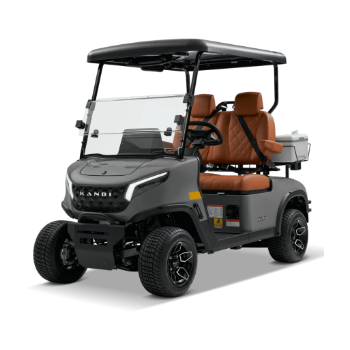
The street-legal golf cart rules for dealers in Texas and Colorado live in state statutes and city codes, and the federal low-speed vehicle definition only covers one slice of them. Texas lets a plated golf cart use certain roads posted 35 mph or less. Colorado hands golf cart street use to each city or county. A dealer who publishes those rules accurately, state by state and city by city, gives buyers and AI assistants the right local answer.
TL;DR
Federal law defines a low-speed vehicle in 49 CFR 571.3 as a four-wheeled vehicle that reaches more than 20 and not more than 25 mph in one mile, with a GVWR under 3,000 pounds. That definition does not tell a buyer where a golf cart may drive. In Texas, Transportation Code chapter 551 allows a golf cart with a golf cart license plate in master planned communities, on beaches open to vehicles, on roads posted 35 mph or less within five miles of where it is parked for golf course trips, and on city roads a council opens. In Colorado, C.R.S. 42-4-111(1)(bb) lets each local government authorize golf cars, so the answer in Colorado Springs depends on local code. Dealers should publish one rules page per state, one per city with its own ordinance, and listing labels that match.
In this guide
- Three vehicles, three rulebooks
- Is a golf cart street legal in Texas?
- The two-mile error on a state agency page
- What Frisco adds on top of state law
- Can you drive a golf cart on the street in Colorado Springs?
- What pages should a golf cart dealer publish?
- How to write rule answers that AI assistants repeat correctly
- What not to say on a street-legal page
- Check your street-legal pages against the statute this week
- Frequently asked questions
Three Vehicles, Three Rulebooks
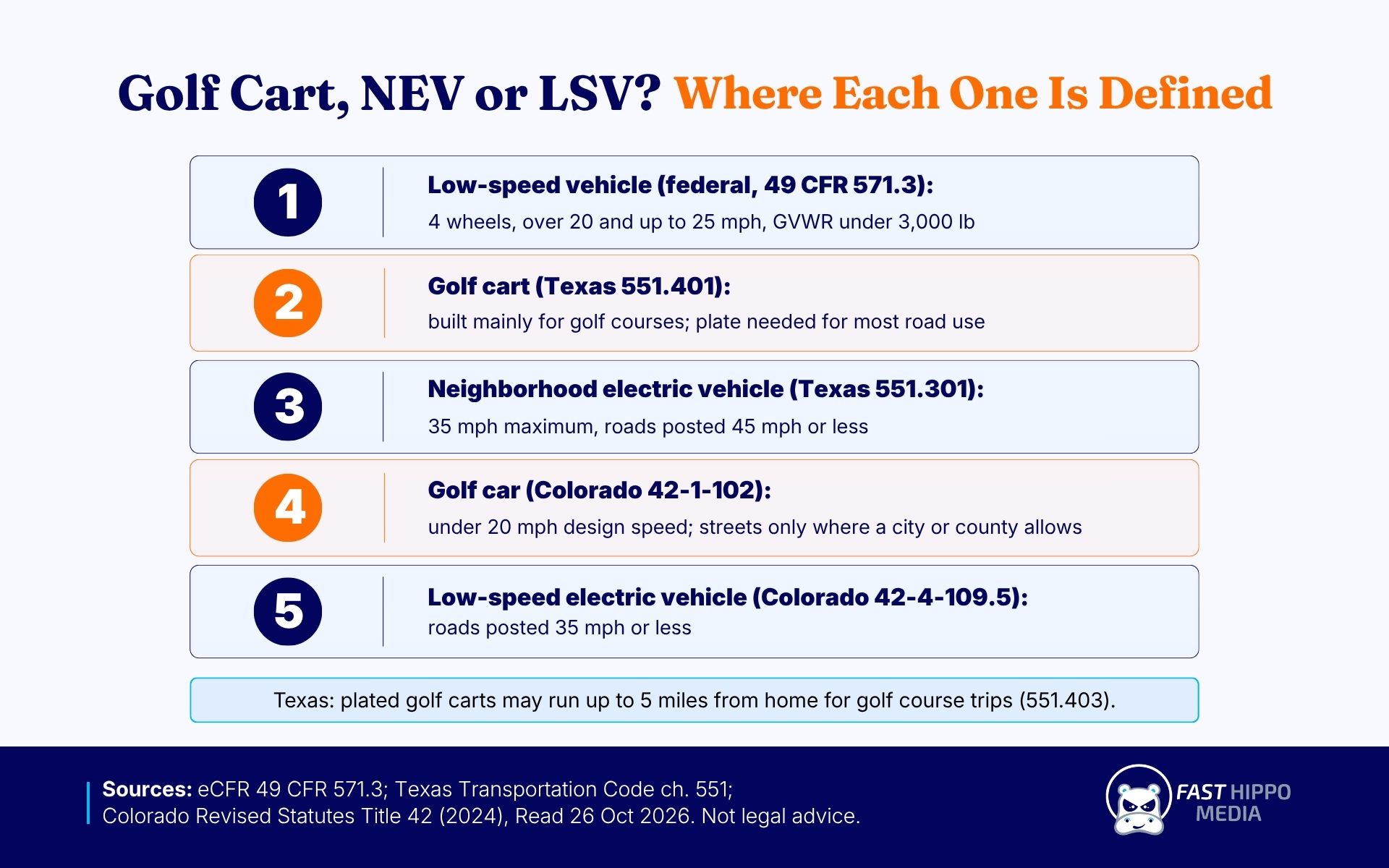
Most confusion on dealer sites comes from treating three legal categories as one. A golf cart, a Texas neighborhood electric vehicle, and a federal low-speed vehicle are defined in different documents, with different speed numbers.
The federal definition sits in 49 CFR 571.3 on the eCFR. An LSV is a motor vehicle that is 4-wheeled, whose speed attainable in one mile is more than 20 mph and not more than 25 mph on a paved level surface, and whose GVWR is less than 3,000 pounds. The equipment that vehicle must carry is set out separately in FMVSS 500, and we already walked through the FMVSS 500 equipment list we broke down for dealers, so we will not repeat it here.
| Category | Where it is defined | Speed in the definition | Other tests |
|---|---|---|---|
| Low-speed vehicle (federal) | 49 CFR 571.3 | More than 20, not more than 25 mph in one mile | 4 wheels, GVWR under 3,000 lb |
| Golf cart (Texas) | Transp. Code 551.401 | None stated | Designed by the manufacturer primarily for use on a golf course |
| Neighborhood electric vehicle (Texas) | Transp. Code 551.301 | Maximum speed of 35 mph | Otherwise complies with FMVSS 500 |
| Golf car (Colorado) | C.R.S. 42-1-102(39.5) | Design speed under 20 mph | 3 or more wheels, empty weight up to 1,300 lb, up to 4 persons |
| Low-speed electric vehicle (Colorado) | C.R.S. 42-1-102(48.6) | None in the definition | Electric, 3 or more wheels, no handlebar steering, Part 565 compliance or a 17-character VIN |
Read the speed column twice. A Colorado golf car must have a design speed under 20 mph, while a federal LSV has to exceed 20 mph. On speed alone, those two definitions do not overlap, which is why a Colorado listing that calls one cart both things is wrong on its face.
There is a Texas wrinkle too. The state wrote its neighborhood electric vehicle definition around a 35 mph maximum while pointing at FMVSS 500, the federal standard whose LSV ceiling is 25 mph. We are not going to resolve that tension on a marketing blog. A dealer page should quote both numbers with their sources and never blend them into one figure.
Is a Golf Cart Street Legal in Texas?
Yes, in specific places, and only with a golf cart license plate in most of them. Texas will not register a golf cart for highway use “regardless of whether any alteration has been made”, but it will issue a golf cart plate, and that plate unlocks the uses the statute lists.
The text is in Texas Transportation Code chapter 551, subchapter F. We read it on October 26, 2026, and the newest amendment to the golf cart sections is House Bill 1281, effective June 15, 2021. The state code mirror carries 2025 session changes in neighboring chapters, so we are confident nothing newer has touched these sections.
| Section | What it allows or requires |
|---|---|
| 551.403(a)(1) | A master planned community that is a residential subdivision or has uniform restrictive covenants, with a county- or city-approved plat |
| 551.403(a)(2) | A public or private beach that is open to vehicular traffic |
| 551.403(a)(3) | A road posted 35 mph or less, in the daytime, no more than five miles from where the cart is usually parked, for trips to or from a golf course |
| 551.403(b) | Inside a qualifying master planned community, no plate needed on roads posted 35 mph or less |
| 551.404 | A city may open roads posted 35 mph or less inside its limits; certain counties may do the same in unincorporated areas |
| 551.4041 | Carts on those city or county roads need headlamps, taillamps, reflectors, a parking brake and mirrors |
| 551.405 | A golf cart may cross a highway at an intersection, including one posted above 35 mph |
| 551.4031 | A city, a county or the Texas Department of Transportation may prohibit golf carts on a road for safety |
One more rule sits outside chapter 551. Transportation Code 547.703(d) says a golf cart, neighborhood electric vehicle, or off-highway vehicle operated at not more than 25 mph must display a slow-moving-vehicle emblem when it is on a highway. Plenty of buyers have never heard of it, and plenty of listings never mention it either.
The plate is cheap, permanent, and personal
Section 551.402 caps the plate fee at $10, says the plate does not expire, and says a new owner may not use the previous owner’s plate. The TxDMV unique vehicles page adds the practical step: the plate comes from the county tax assessor-collector’s office, which will ask for Form 130-U.
Those are three facts a used-cart listing should state outright. A buyer who learns at the county office that the “plated” cart they bought needs a new plate will remember who sold it to them.
Where the neighborhood electric vehicle goes instead
A neighborhood electric vehicle has a wider road range. Section 551.303 allows it on streets posted 45 mph or less, at no more than the lesser of the posted limit or 35 mph, and it may cross a faster road at an intersection. TxDMV titles and registers NEVs, and its page lists evidence of ownership, Form 130-U, and proof of insurance as what to bring to the county office.
The Two-Mile Error on a State Agency Page
Here is the finding that made us write this piece. The TxDMV unique vehicles page, which the agency’s sitemap dates to January 9, 2024, still says a plated golf cart may run on a road “not more than two miles” from where it is usually parked, for golf course trips. The statute has said five miles since 2021.
The legislature changed one word in one subsection, and the agency summary never followed it.
We checked the enrolled text of House Bill 1281 from the 87th Legislature. It strikes “two” and inserts “five” in 551.403(a)(3)(B), and the same bill added the master planned community exception in 551.403(b). The Frisco Police Department’s golf cart page uses the five-mile figure, so the city is current where the state agency summary is not.
That gap matters for dealers in two ways:
Copy built from the agency summary tells buyers a cart can go less than half as far as the law allows, and a buyer who checks the statute will notice.
AI assistants read agency pages too. A dealer page that quotes the statute section and the date it was read gives a better source than a summary that has drifted.
The lesson we take from it is simple. Quote the statute, link the statute, and treat every summary, ours included, as something to re-check.
What Frisco Adds on Top of State Law
Frisco is a useful example because it used the 551.404 power and wrote it down. Section 90-256 of the Frisco Code of Ordinances, adopted by Ordinance 10-10-49 on October 19, 2010, lets a person drive a golf cart on a public street posted 35 mph or less when these conditions are met:
- the driver has a valid driver’s license
- the cart carries financial responsibility as Transportation Code 601.051 requires of other passenger vehicles
- the cart has headlamps, tail lamps, reflectors, a parking brake, mirrors, and a slow-moving vehicle emblem
- Every rider is seated in a seat designed to hold passengers while the cart moves
The police department’s own golf cart page adds that carts may not run on sidewalks or inside a park or playing field unless that is otherwise authorized.
That is a rule a buyer can act on before they ever leave the lot.
A Frisco buyer reading that list has a near-complete answer. A Dallas buyer reading the same list has nothing they can rely on, because Dallas and Farmers Branch each make their own decision under 551.404. Every city page a dealer publishes should quote that city’s own code. Where a city has not opened its streets to carts, the page should say so and cite the code that shows it.
Can You Drive a Golf Cart on the Street in Colorado Springs?
It depends on local code, because Colorado routes golf cart street use through local government. Under C.R.S. 42-4-111(1)(bb), a city or county may authorize and regulate golf carts on roadways by ordinance or resolution. So the honest answer for Colorado Springs, in El Paso County, comes from the city’s code, and a dealer page should link to it rather than guess.
We read Title 42 in the official 2024 Colorado Revised Statutes PDF published by the Office of Legislative Legal Services. The 2025 edition file was not posted at that address on October 26, 2026, and a search of the General Assembly’s 2025 and 2026 bills returned no golf car or low-speed electric vehicle operating bill. The state sets limits that any local rule has to respect:
- no local rule may let an unlicensed golf car driver carry a passenger under 21
- no local rule may let anyone under 16 drive a golf car
- no local rule may allow golf cars on a state highway, except to cross directly at an at-grade crossing
The low-speed electric vehicle rule is statewide
Electric vehicles that meet the Colorado definition follow C.R.S. 42-4-109.5 everywhere in the state. They may run on roadways with a speed limit of 35 mph or less and cross faster roads directly at an at-grade crossing. They may use a state highway posted 40 mph only when the lanes are at least 11 feet wide, there are two or more lanes in each direction, and the state transportation department has found no substantial safety risk. Limited-access highways are off limits, and a violation is a class B traffic infraction.
Section 42-4-109.6 also describes a class B low-speed electric vehicle, capable of more than 25 and less than 45 mph. The state will not title or register one until a federal safety standard for that speed range exists. A dealer advertising a 35 mph electric cart in Colorado Springs should know that sentence before writing the listing.
What Pages Should a Golf Cart Dealer Publish?
A dealer selling into Texas and Colorado should publish one rules page per state, one page per city whose code you have read, and listing labels that point back to them. That set answers the questions buyers type, and it is the part of golf cart local SEO that we rarely see on dealer sites.
Here is the order we would build them in:
- A state rules page for each state you sell into: Quote the sections, link the statute, and print the date you read it. For Texas, that is Chapter 551 plus 547.703(d). For Colorado that is 42-1-102, 42-4-109.5 and 42-4-111(1)(bb).
- A city page wherever a city has its own ordinance: Frisco gets one built on Section 90-256. Each page is written from that city’s code, never cloned from the last city with the name swapped.
- A plate and paperwork page: Form 130-U, the county tax assessor-collector’s office, the $10 cap, and the rule that a plate never passes to a new owner.
- A legal category on every listing: Golf cart, neighborhood electric vehicle, LSV, or Colorado low-speed electric vehicle, with the equipment and the VIN status shown.
- A dated change log: When a council votes or a statute moves, update the page and the date, and say what changed.
Rental operators need the same pages with one extra layer. State law lists a public or private beach open to vehicles as an allowed area, and coastal cities often add rental rules of their own. A beach-town fleet can turn its city’s cart rules into content visitors find on Google Maps, and the same approach works for any rental counter that hands out keys to visitors.
North Texas shops have more to do than rules pages, of course. Search, profiles, and service pages all count, and we laid those out in the Dallas growth plan we wrote for car rental shops. Rules pages fit under its advice on publishing helpful content, and they are where we would start.
How to Write Rule Answers That AI Assistants Repeat Correctly
A buyer who asks an assistant “can I drive a golf cart in Frisco” gets whatever passage the assistant finds clearest. We write each rule so it survives being lifted out of the page on its own: the place, the vehicle category, the number and the section, all in one sentence.
| Weak answer | Answer that travels |
|---|---|
| “Golf carts are street legal on most local roads.” | “In Frisco, Texas, a plated golf cart may use public streets posted 35 mph or less under Section 90-256 of the city code.” |
| “Our LSVs are street legal.” | “A federal low-speed vehicle reaches more than 20 and not more than 25 mph and must meet FMVSS 500; Texas and Colorado decide where it may drive.” |
| “Colorado allows golf carts.” | “In Colorado, C.R.S. 42-4-111(1)(bb) lets each city or county authorize golf cars on roadways by ordinance or resolution.” |
Three habits keep those answers accurate over time:
- One state per answer. A paragraph that mixes Texas and Colorado rules gets quoted half right.
- A read date beside every statute citation, so a reader and a crawler can both see how fresh it is.
- The same wording on the page, in the FAQ and in the listing labels, so nothing contradicts anything else.
None of this is a trick for machines. It is the same clarity a nervous buyer needs, and it is how we approach the AI search work we do for golf cart dealers.
What Not to Say on a Street-Legal Page
Some phrases create risk for the buyer and the dealer. We would cut these on sight:
- “Street legal in all 50 states.” No single rule covers all 50 states, and both states on this page let local government restrict or open roads.
- “Comes with plates” on a used Texas golf cart. Section 551.402 says a new owner may not use the previous owner’s plate.
- “Converted to LSV, so you can drive it anywhere.” The federal definition sets speed and weight. It does not grant road access.
- Any promise that a city will approve carts on a given street.
Every rules page should also carry a plain line in the dealer’s own words: this is general information, not legal advice, and buyers should check their city’s ordinance and their HOA’s rules before driving on a public road. This article is general information too, not legal advice. We are marketers who read statutes carefully, and that is a different job from a lawyer’s.
Check Your Street-Legal Pages Against the Statute This Week
Open the statute for each state you sell into and read it next to your current pages. Fix any two-mile reference in Texas copy, add the slow-moving-vehicle emblem where it is missing, and put a legal category on every listing. Then pick the one city your buyers ask about most and build its page from that city’s own code.
That is a short project for one person with the sources open in two tabs, and it changes what buyers and AI assistants find when they ask about your market. If you want a team to build the state and city pages, check them against the law, and keep them dated as rules move, Fast Hippo Media works with golf cart dealers and rental operators in Texas, Colorado, and beyond. We are glad to read what you have first.
Frequently Asked Questions
Chapter 551 of the Texas Transportation Code lets a plated golf cart use master planned communities, beaches open to vehicles, roads posted 35 mph or less within five miles for golf course trips, and city roads a council opens. Dealers should quote those sections on their pages.
A federal low-speed vehicle under 49 CFR 571.3 has four wheels, reaches more than 20 and not more than 25 mph, weighs under 3,000 pounds GVWR, and must meet FMVSS 500. A golf cart is designed primarily for golf course use.
Under Texas Transportation Code 551.403, a plated golf cart may drive in daylight on roads posted 35 mph or less, up to five miles from where it is usually parked, for golf course trips. The limit was two miles until a June 2021 amendment.
Colorado lets each city or county authorize golf cars on roadways under C.R.S. 42-4-111(1)(bb), so the answer in Colorado Springs comes from the city’s own code. State law bars golf cars from state highways except for direct crossings.
Yes, when it is on a highway at 25 mph or less. Section 547.703(d) of the Texas Transportation Code requires a slow-moving-vehicle emblem on a golf cart, neighborhood electric vehicle, or off-highway vehicle operated at not more than 25 mph on a highway.