(214) 272-7034
  info@fasthippomedia.com



The strongest golf cart marketing ideas are the ones that answer the question a buyer is too embarrassed to ask the salesperson: can I actually drive this thing on my street? We think most dealers leave that question to rumor, forums, and the neighbor with the lifted cart. The dealer who answers it in writing, with the real federal and state rules linked, becomes the shop people trust before they ever visit.
TL;DR
Golf cart marketing ideas work best for a dealer when each one answers a buying question with something the buyer can check. The highest-return idea is a street-legal explainer that links the federal Low-Speed Vehicle standard (49 CFR 571.500) and your own state’s golf cart statute, because buyers ask about road use more than almost anything else. From there, a dealer can turn the Texas rule that a golf cart plate stays with the old owner into a used-cart selling point, send owners short emails tied to the plate, the season, and their model, film each delivery and reuse it across channels, label every inventory listing as a golf cart or a Low-Speed Vehicle, and watch city council agendas for new golf cart ordinances. None of these ideas needs a big budget. Each needs accuracy.
Why Do Most Golf Cart Marketing Ideas Fall Flat?
Most golf cart marketing ideas fall flat because they are generic. “Post on social media”, “run a giveaway,” and “sponsor a local event” would read the same for a boat dealer or a furniture store. A golf cart buyer has specific worries: whether the cart is legal on their roads, whether a used cart comes with a plate, and whether the model they like can be made street-legal later.
We read the current top-ranking guides on this topic before writing this one. They are decent on channels and thin on substance. Two of the most visible ones mention street-legal questions as something a dealer should be ready to answer, and neither links a single federal or state rule so the dealer can actually answer it.
That gap is the opportunity. A dealer who publishes the rules, in plain English, with the source one click away, gives a nervous buyer a reason to stop comparing shops.
| Generic idea | The dealer-specific version |
|---|---|
| Write blog posts | Publish one street-legal explainer per state you sell into, with the statute linked |
| Post on social media | Film each delivery once, then cut it for every channel |
| Send a newsletter | Send owners short emails tied to their plate, their season, and their model |
| Improve the website | Label every listing as golf cart or Low-Speed Vehicle, with the equipment shown |
| Network locally | Track city and county agendas for new golf cart ordinances, then publish the news first |
Idea One: Publish the Street-Legal Explainer Your Buyers Keep Asking For
This is the idea we would run first, because it answers the most common pre-purchase question with documents nobody can argue with. The explainer has three layers: the federal standard, your state’s statute, and your city’s own rules.
The federal layer is short and specific
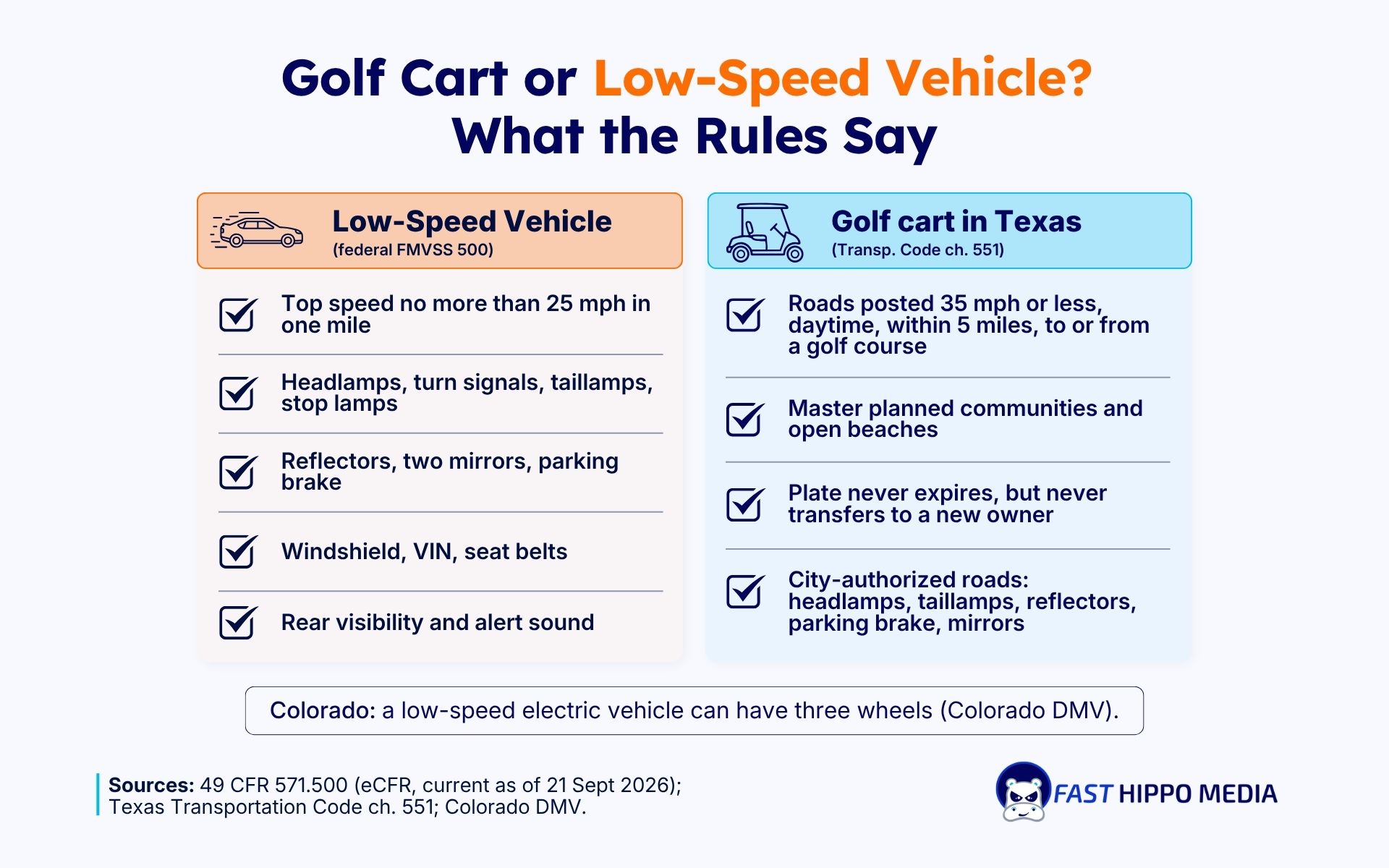
The federal line between a golf cart and a street-capable vehicle is Federal Motor Vehicle Safety Standard No. 500. The current text of 49 CFR 571.500 on the eCFR, shown as up to date on September 21, 2026, says a Low-Speed Vehicle may reach no more than 25 miles per hour within one mile of testing. It then lists twelve pieces of required equipment.
| Required on a Low-Speed Vehicle under FMVSS 500 | What a buyer should look for on the cart |
|---|---|
| Headlamps, taillamps, and stop lamps | Working lights front and rear |
| Front and rear turn signal lamps | Turn signals at both ends |
| Red reflex reflectors on each side and the rear | Reflectors placed as far back as practicable |
| Driver-side exterior mirror plus a passenger or interior mirror | Two mirrors, not one |
| A parking brake | A brake that holds on a slope |
| A windshield meeting the federal glazing standard | Glazing marked to the standard, not a plain acrylic panel |
| A 17-character VIN under Part 565 | A VIN plate, not only a serial number decal |
| A seat belt at each designated seating position | Belts for every seat, rear seats included |
| Rear visibility per FMVSS 111 | The rear visibility equipment the rule requires |
| An alert sound per FMVSS 141 | The pedestrian alert sound |
That table alone answers a dozen forum threads. The two items buyers most often miss are the VIN and the alert sound, so put those near the top of the post.
The Texas layer is where buyers get confused
Texas separates golf carts from neighborhood electric vehicles, and the rules differ. Under Texas Transportation Code chapter 551, a golf cart may run in a master planned community, on a beach open to vehicles, or during the daytime on a road posted 35 mph or less within five miles of where it is usually parked, for trips to or from a golf course. A city council may also open roads posted 35 mph or less inside city limits, and carts driven under that permission need headlamps, taillamps, reflectors, a parking brake, and mirrors.
The same chapter treats a neighborhood electric vehicle differently. It may be driven on streets posted 45 mph or less, at no more than 35 mph, and a county or city can still prohibit it on a given road for safety.
A buyer in Frisco or Dallas who reads those two paragraphs side by side knows more than most people selling them carts. That is the point.
The Colorado law uses a different definition
Colorado shows why one national explainer is not enough. The Colorado Division of Motor Vehicles defines a low-speed electric vehicle as self-propelled by electricity, with at least three wheels on the ground, no handlebar steering, and either Part 565 compliance or a 17-character VIN. The federal standard describes a four-wheeled vehicle, so a three-wheeled cart shopper in Colorado Springs gets a different answer than a shopper in Texas.
The same Colorado DMV page leaves golf carts out of its off-highway vehicle definition. A Colorado buyer who assumes the cart can simply be registered like an ATV is starting from the wrong premise.
How to write it without giving legal advice
We are marketers, not lawyers, and your post should say something similar in its own words. Quote the rule, link it, and tell the reader to confirm local ordinances with their city or county. That keeps you accurate and makes the page something a buyer can forward to a spouse or an HOA board.
Idea Two: Turn the Texas Plate Rule Into a Used-Cart Selling Point
One sentence in the Texas statute deserves its own post. Section 551.402 of the same Transportation Code chapter says a golf cart license plate does not expire, and that a person who becomes the owner of a golf cart may not use the previous owner’s plate.
Private sellers on marketplace listings rarely mention this. A used cart that “comes with a plate” in a private listing may come with one the new owner cannot legally use.
A dealer can turn that into three pieces of marketing:
- A short post titled around the question “does a golf cart plate transfer in Texas”, quoting the statute.
- A line on every used Texas listing explaining that the buyer applies for their own plate, with the statute linked.
- A handout at delivery walking the new owner through what the plate rule means for them.
This is exactly the kind of content that earns trust from a buyer comparing a dealer against a private sale. The dealer is not claiming to be cheaper. The dealer is showing the buyer something the private seller did not know.
What Should a Dealer Email Owners After the Sale?
A dealer should email owners about things that change after the sale: the plate or registration step, the season, and the model they own. Owners open those because each one is about their car, not about a promotion. Four emails cover the first year for most buyers.
- Week one: the plate or registration step for their state, with the statute linked, and who to call with questions.
- First change of season: storage and charging guidance from the manufacturer of their model, quoted rather than paraphrased.
- Before a local event season: a reminder of where the cart can legally go, using your street-legal explainer.
- Around the first anniversary: an invitation to a service check, with no discount attached to a review request.
The seasonal email is where geography matters. An owner in Colorado Springs is heading into winter storage questions in the fall, while an owner in Dallas is still riding. Send different emails, or you train half your list to ignore you.
We cover list building, segmentation, and automation for dealers in the owner email program we build for dealers. The short version: segment by state and by model before you write a single subject line.
One rule to keep clean. Never tie a discount, gift, or entry into a giveaway to leaving a review. Google’s Business Profile policy prohibits review incentives, and a customer asking for an honest review with nothing attached is the only request we recommend.
Idea Three: Film the Delivery Once and Use It Everywhere
Every cart that leaves the lot is a piece of content, and most dealers waste it. A delivery video shows the cart, the customer’s actual use, and the walk-through your staff gives. That covers the questions a stranger has about your shop.
Here is how one delivery becomes a week of material:
- Record the full walk-through at delivery, with the customer’s permission.
- Cut a short vertical clip of the handoff for social channels.
- Pull the walk-through segment on lights, mirrors, and seat belts into your street-legal explainer.
- Add the clip to the inventory page for that model, so the next buyer sees the cart in use.
- Write two or three sentences for the owner email that goes to buyers of the same model.
We run this approach across search, social, video, and AI answers for dealers, and we describe how we spread one piece of dealer content across every channel. The idea works for a single-location shop too. It just needs someone who remembers to press record.
Idea Four: Label Every Listing as a Golf Cart or a Low-Speed Vehicle
An inventory page that hides the legal category costs you calls. Buyers want to know, before they drive to you, whether the cart on the screen can go on their street.
Add a short spec block to every listing:
| Field | Why it belongs on the listing |
|---|---|
| Category: golf cart or Low-Speed Vehicle | The single question behind most calls |
| VIN present: yes or no | The federal standard requires one on a Low-Speed Vehicle |
| Street-legal equipment fitted | Lights, signals, mirrors, belts, windshield, alert sound |
| States you can help register it in | Sets expectations before the visit |
| Link to your street-legal explainer | Sends the reader to the full answer |
A listing built this way answers the buyer before the phone rings, and the calls you do get are from people who already know which cart they want. Our team builds dealer websites built around inventory questions on exactly this principle: the page should answer the question the buyer would otherwise call about.
Idea Five: Watch City Agendas and Publish the News First
Texas law lets a city council open roads posted 35 mph or less to golf carts, and a county or city can also close roads for safety. That means golf cart rules change locally, one council vote at a time, across North Texas suburbs like Frisco and in cities across the state.
A dealer who reads the local council agendas and publishes a short post the week a golf cart ordinance is proposed, adopted, or changed becomes the local source on the topic. That post earns links from neighborhood groups and HOA newsletters in a way a sale announcement never will.
Keep it factual. Quote the ordinance number, link the city’s own page, name what changed, and say plainly what the rule does not cover. We wrote about other ways Dallas-area shops can grow in our earlier Dallas playbook for golf cart shops, and this idea is the one we would add to it today.
Idea Six: Speak to the Community You Actually Sell Into
Texas law explicitly names master planned communities as places golf carts may run. The Colorado DMV page quoted above says nothing about communities at all. That difference shapes who your buyer is.
In Texas, a dealer can create one page per large master planned community it serves, covering which roads inside are open to carts and what the HOA requires. Each page must be unique, written from what that community’s own rules say, never a template with the name swapped.
In Colorado Springs, where we have worked with a locally owned dealership selling custom builds, used carts, and rentals, buyers ask about neighborhood, off-road, and utility use. Content there should answer storage, terrain, and registration questions instead.
Which Ideas Should a Dealer Skip?
Skip anything that risks the business listing or the buyer’s trust. Three ideas show up in generic lists that we would not run.
- Keywords in your Business Profile name. Google does not permit extra descriptors in the business name field, and it can lead to suspension.
- Review incentives or scripted reviews. Prohibited by Google’s Business Profile policy, and a legal risk too.
- Vague “street legal” claims in ads. If an ad says a cart is street legal, name the state and the category, or leave the claim out.
Some channels deserve their own guides rather than a paragraph here. Map rankings for rental fleets, booking software, and paid search each get a dedicated article in this series.
If you would rather hand the whole program to a golf cart digital marketing agency, look for one that shows you its sources before it shows you a price. Anyone promising a guaranteed ranking is telling you something Google itself says nobody can promise.
Start Your Golf Cart Marketing With One Explainer This Week
Pick the state you sell into most. Open the federal standard and that state’s statute, and write the street-legal explainer in plain English with both linked. Add the golf cart or Low-Speed Vehicle label to your five busiest listings and link them to the explainer. Then film your next delivery.
That is a week of work for one person, and every later idea on this list builds on it: the owner emails point to it, the delivery clips feed it, and the ordinance posts update it. If you want a second set of eyes on the draft, or a team to run the whole plan across Texas and Colorado, Fast Hippo Media works with golf cart dealers on exactly this kind of content, and we would be glad to look at what you have.
Frequently Asked Questions
The best golf cart marketing ideas answer a buyer’s real question with a source they can check. Start with a street-legal explainer linking the federal Low-Speed Vehicle standard and your state statute, then build owner emails, delivery videos, and clearer inventory listings around it.
No. A Low-Speed Vehicle must meet the federal FMVSS 500 standard, including a speed cap, lights, mirrors, seat belts, a windshield, a VIN, and an alert sound. Most golf carts are built for courses and do not meet that standard as sold.
No. Texas Transportation Code Chapter 551 says a golf cart plate does not expire, but a new owner may not use the previous owner’s plate. Used-cart buyers need to apply for their own plate.
Email when something changes for the owner: the registration step after purchase, the change of season, local event rules, and the first service anniversary. A handful of useful emails a year beats a weekly promotion that owners start skipping.
No. Google’s Business Profile policy prohibits offering discounts, gifts, or payment in exchange for a review. Asking customers for an honest review with nothing attached is allowed, and it is the only approach we recommend.