(214) 272-7034
  info@fasthippomedia.com


TL;DR
Google ranks local results on relevance, distance, and prominence. A business sitting just outside the pack is usually strong on two of those and stuck on one, so blanket advice like “post more and build citations” tends to spend money on the two that were already fine.
Start by confirming the profile is eligible and unduplicated, then work out whether the searches you want are happening too far from your pin (distance), whether your categories and services describe the exact job being searched (relevance), or whether your reviews and web presence are thinner than the three businesses above you (prominence). Google states plainly that there is no way to request or pay for a better local ranking.
Why Am I Not in the Map Pack When My Website Ranks?
Because they are two different rankings, decided on different inputs, and one of them is heavily geographic. Your website competes on the ordinary organic list. The pack is drawn from Business Profiles and ordered on what Google calls relevance, distance, and prominence. A site can rank sixth organically in a whole metro and still be invisible in the pack three miles from its own front door.
That gap trips up owners constantly, because the two results appear on the same screen.
There is a second reason the confusion sticks. The pack you see is not the pack your customer sees.
Google’s own explanation of how local results are determined puts distance among the three ranking inputs, which means the result set is redrawn for every searcher’s position. Standing in Uptown and standing in Frisco are two different queries with the same words in them.
When an owner says they checked and they are not there, they have usually checked from one spot: their desk, inside their own building, where their odds are best.
So the first honest answer to the question is that you are probably in the pack somewhere, for some searchers, and out of it for most. What you are missing is not presence. It is coverage.
That distinction changes the diagnosis completely, because the shape of your coverage names the lever.
| What you see across your service area | The lever that is stuck |
| No coverage anywhere, from any point | Something structural in the profile itself, not ranking |
| A tight bubble around your address, nothing beyond it | Distance, with prominence too weak to overcome it |
| Wide coverage for one service, none for the one you want | Relevance |
We measure this as a grid rather than a single position, which is the only way to see the shape of the problem, and it is the first thing we build when we track map ranking across a metro.
The Three Levers Google Names, and Which One Is Usually Stuck
Relevance, distance, and prominence are not a framework somebody in the industry invented. They are Google’s own words, and each one fails recognizably.
| Lever | Google’s definition | How it fails | What it looks like |
| Relevance | How well a Business Profile matches what someone is searching for | Wrong primary category, missing services, no description of the actual job | You rank for your trade in general and vanish for the specific service |
| Distance | How far each business is from the customer who’s searching | Your pin is on the edge of the demand, not in the middle of it | Strong within a mile or two, gone by the fourth |
| Prominence | How well-known a business is | Fewer reviews, thinner web presence, less mention elsewhere than the three above you | Even nearby searchers see competitors first |
Google adds one sentence that decides where the effort goes: “More reviews and positive ratings can help your business’s local ranking.” It does not say the same about posting frequency, profile photo counts, or any of the weekly busywork sold as local search engine optimization.
Most owners guess prominence, because that is what everybody sells. In our experience, the binding constraint on a business sitting at four or five is more often relevance, and it is cheaper to fix.
Check Eligibility Before You Check Rankings
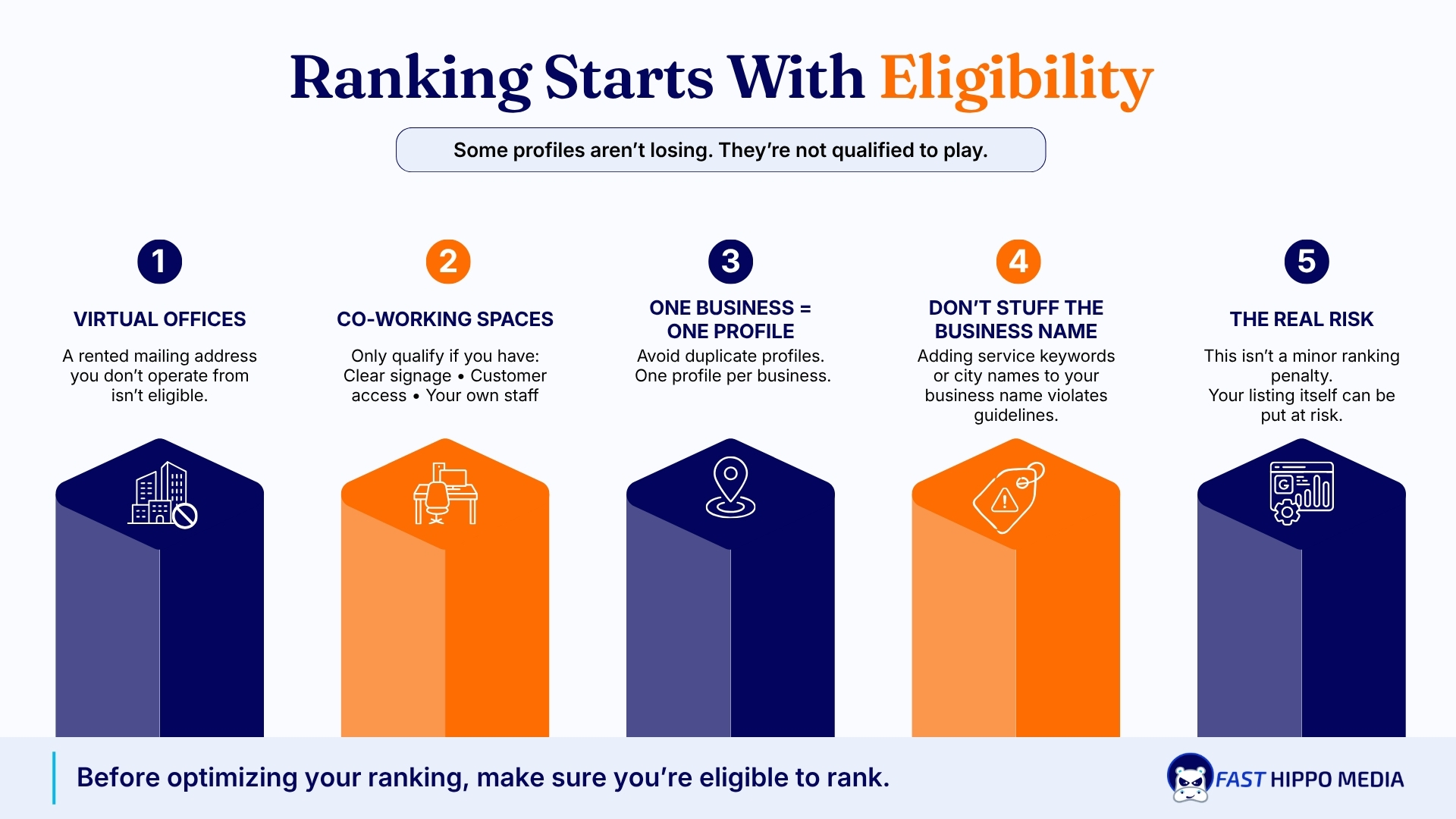
Some profiles are not losing. They are not qualified to play.
The guidelines for representing your business, on the same Google help site, are stricter than most owners realize. A rented mailing address you do not operate from is a virtual office and is not eligible. A desk in a co-working space only qualifies if the office has clear signage, receives customers during business hours, and is staffed by your own people. And there should be one profile per business, because duplicates cause problems with how information displays across Maps and Search.
One more, because it burns people who were trying to help themselves: adding service keywords or a city to your business name breaks the guidelines. It is not a shortcut with a small penalty attached. It puts the listing itself at risk, which is a worse outcome than sitting at position four.
What Distance Is Doing to Dallas Businesses Right Now
The pin does not move. The customers do, and in this metro they are moving fast enough to change who is nearest.
Census Bureau estimates released on 26 March 2026 put the Dallas-Fort Worth-Arlington metro at 8,477,157 people, a gain of 123,557 in a single year and the second largest numeric increase of any metro in the country.
The interesting part for local search is underneath that headline. Collin County, which holds Plano, Frisco, McKinney, and Allen, added 42,966 residents and ranked second among all US counties, while Dallas County lost 2,616. Those are the Vintage 2025 county and metro estimates published on census.gov.
Read that as a search map instead of a population table. The volume of people typing “roofer near me” is growing fastest twenty-five miles north of downtown, and a business with a Dallas address is progressively further from the middle of its own demand every year. Nothing about the profile got worse. The center of gravity moved.
There are three honest responses, and none of them involve faking a location. You can define real service areas on the profile and accept that the pack will favor closer competitors in the outer ones. You can build genuine pages for the towns you actually serve, written town by town rather than cloned, which is the work behind the Plano side of the metro. Or you can open a second staffed location, which is the expensive answer and sometimes the right one.
Timing matters here too, because local demand is lumpy and dated. Texas ran its sales tax holiday from 7 to 9 August 2026 on clothing, shoes, school supplies, and backpacks, per publication 98-490 on comptroller.texas.gov, and North Texas school calendars start the following week. Every profile with wrong hours that weekend lost the busiest three days of its quarter, and no amount of citation building recovers a weekend.
How Reviews Actually Feed Prominence
Reviews are the one prominence signal Google names out loud, which is why they attract so much bad advice.
The rules are not vague. The prohibited and restricted content policy for Business Profiles prohibits offering payment, discounts, or free goods and services in exchange for a review, and prohibits the same trade for revising a negative one. Staff must not be asked to bring in a set number of reviews, or reviews containing particular content. Gating is prohibited too, so you cannot screen for happy customers and route only those to the review form.
Asking every customer for an honest review is allowed, and it is the whole game.
Where owners go wrong is treating the review count as the target. Volume without recency reads as a burst, and a business with sixty reviews that stop in 2024 looks closed to a human reader long before any algorithm weighs in. A steady trickle from a real intake habit, asked at the moment the job finishes, beats a campaign every time and carries no policy risk at all.
Two of the posts we audited on other sites last month recommended incentives anyway, which is worse than useless advice: incentivized reviews conditioned on sentiment have been illegal under federal rules since the Federal Trade Commission’s final rule banning fake reviews and testimonials, announced on ftc.gov in August 2024, took effect, with civil penalties attached. A client following that advice is exposed twice over.
The Channel That Just Became Third, and Why It Changes the Pack Job
Something moved underneath local search this year, and most map pack articles have not caught up.
BrightLocal’s Local Consumer Review Survey 2026, a representative panel of 1,002 US adults surveyed via SurveyMonkey and published in February, found that use of ChatGPT and similar tools for local recommendations rose from 6% to 45% in twelve months. That makes AI the third most common source of local business recommendations, behind Google and Facebook. Google’s own share fell from 83% to 71%, and 42% of respondents said they trust an AI platform’s recommendation as much as a written review. The figures are on BrightLocal’s survey page.
Here is why that belongs in a map pack article rather than an AI one. The facts an assistant repeats about your business are the same facts your profile publishes: the category, the hours, the service list, the address, the reviews. A profile with a stale category is now wrong in two places at once, and the second place has no pack position to lose because it never had one. Getting the profile itself accurate and complete does double duty, and Google’s position is that no separate technique is required for the AI surfaces.
The same goes for the site the profile points at. Slow, thin, or duplicated pages undercut prominence, and they undercut being quotable, so the crawl and speed work underneath is not a separate project from local.
What Nobody Can Sell You
A position. One sentence on the local ranking help page settles it: “There’s no way to request or pay for a better local ranking on Google.”
Its guidance on third-party SEO services at developers.google.com, updated 5 June 2026, goes further and names AEO and GEO tools specifically: “Google doesn’t evaluate third-party services, so be wary of such claims and those making them.” Paid placement above the pack does exist, and it is Local Services Ads, clearly labelled as advertising and sold by the lead.
Running the Pack Diagnosis on Your Own Profile
Take one query, the one that would actually pay your bills, and check it from four points: your address, three miles out, eight miles out, and the far edge of the area you serve. Write down where you appear and where you stop.
Then read the pattern:
- Off everywhere at once, including at your own address: look at eligibility and duplicates before anything else.
- Holding near the pin, gone by the outer rings: prominence is losing to distance.
- Holding everywhere for one service and nowhere for another: relevance, a category and services problem you can fix this week.
That grid is the first deliverable in the local SEO Dallas businesses hire us for, and it is the same starting point for a clinic, a restaurant, or one of the roofing contractors working the northern suburbs.
Send us the query and the towns, and we will run it: FastHippo Media, or straight to a scoped quote.
Frequently Asked Questions
Usually, one of three things: the profile is ineligible or duplicated, your pin is farther from the searcher than the three businesses shown, or your categories and services do not match the exact query. Google ranks local results on relevance, distance, and prominence.
Google does not list posting as one of the factors that affect local ranking. It names relevance, distance, and prominence, and says that more reviews and positive ratings can help. Posts are useful for what customers read, not as a ranking lever.
There is no fixed radius, because distance is weighed against relevance and prominence rather than applied as a cutoff. A well-known business with strong reviews holds further out. A new profile with six reviews rarely holds past a few miles.
No, and it puts the listing at risk. Google’s representation guidelines prohibit keywords, taglines, and location information in the business name. Use the service areas field and real pages for each town you cover instead.
The pack is redrawn for each searcher’s location, and Google personalizes results. Checking from inside your own building is the single most flattering position available. Check from several points across your service area instead.