(214) 272-7034
  info@fasthippomedia.com



AI search did not change what good content is. It changed what gets rewarded: pages that answer one real question plainly, prove someone actually knows the subject, and stay accurate. Most businesses do not need more content. They need to fix what they have, publish less of it, and structure it so machines can quote it. Here is the order to do that in.
The algorithm is not your problem
Most businesses reading about AI search reach for the wrong fix. They read that models now interpret intent, and they respond by writing more posts about intent.
The mechanics are worth understanding, and we cover them properly in our guide to . But knowing how the systems work does not tell you what to do on Monday, and the gap between those two things is where most content strategies stall.
This page is the other half. Not how the machines decide. What to change in your content operation, in what order, and what to stop doing.
The honest starting position: if your content is not working now, adding to it will not fix it. Volume was a strategy when ranking was mechanical. It stopped being one when quality became measurable.
What AI search actually rewards
Three things, and none of them is a tactic.
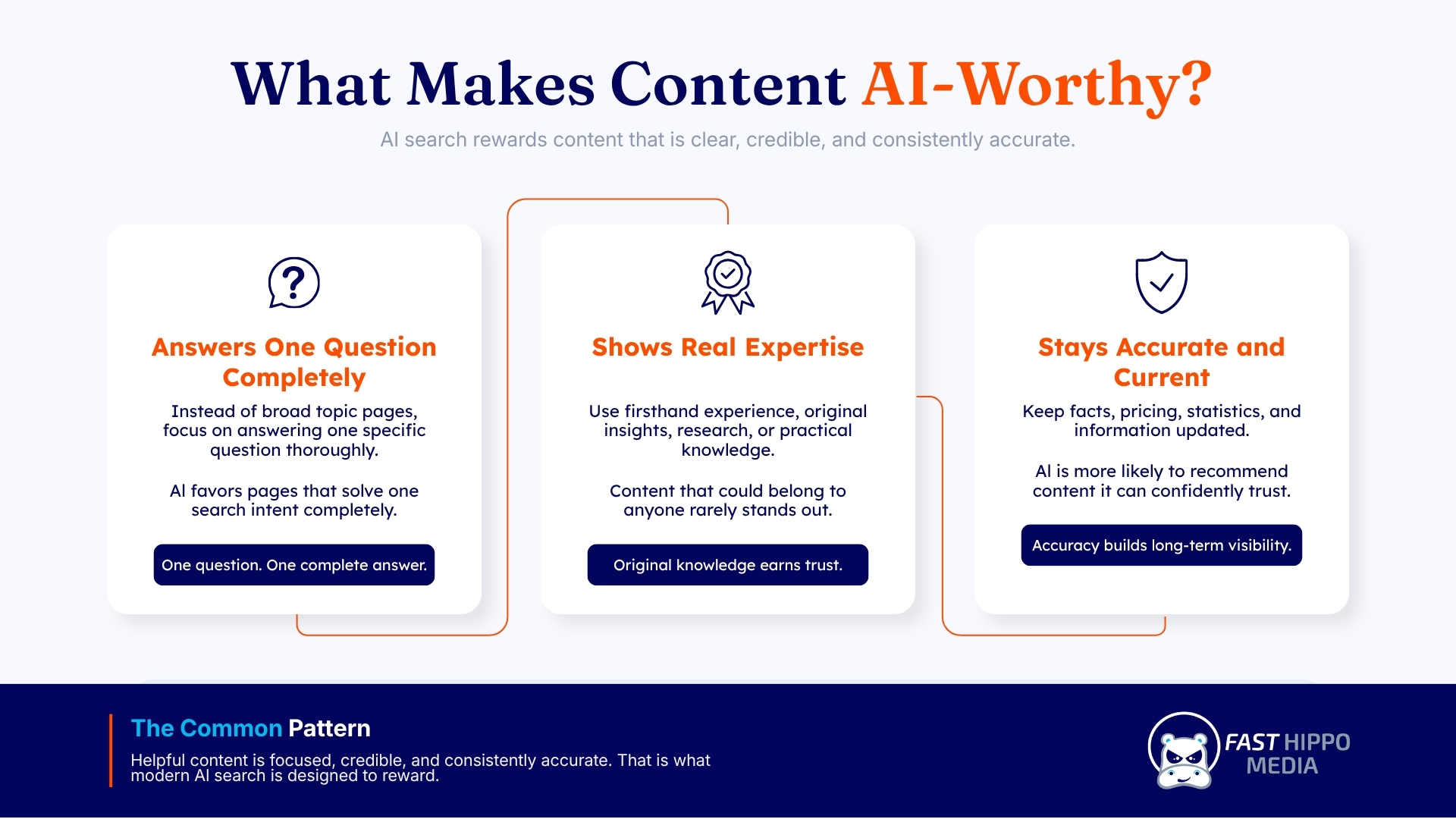
Content that answers one question completely: Not a page covering a topic. A page answering a question, in the first two sentences under a heading phrased the way somebody would ask it. Pages built to cover a topic broadly get outranked by pages built to close one question.
Content that proves somebody knows the subject: Google publishes the test it wants you to apply, and it is worth reading the wording rather than the summary. From its , updated in December 2025:
“Does the content clearly demonstrate first-hand expertise and a depth of knowledge (for example, expertise that comes from having actually used a product or service, or visiting a place)?”
And the one most content fails:
“Does the content provide original information, reporting, research, or analysis?”
Read those as a filter. If your page would read identically with a competitor’s logo on it, it fails both.
Content that stays true: Accuracy is now a ranking input rather than a courtesy, because a system that has to decide whether to repeat you will not repeat something it cannot verify. A price from two years ago is not a small error to a machine deciding whether you are a reliable source.
Audit what you have before you write anything new
This is the step everyone skips, and it is the one that pays.
List every page you have and what question each one answers: One line each. Most businesses discover two things immediately: several pages answering the same question and obvious questions nobody has answered at all.
Find your duplicates: Two pages targeting one question is worse than one page, because you have split whatever authority you had, and neither page is complete. Decide which one wins, merge the useful parts into it, and redirect the other.
The test for whether two pages genuinely compete is narrower than it looks, and most people get it wrong by reading the pages instead of the data. Two articles can cover similar ground and rank for completely separate queries, in which case they are not competing, and merging them destroys something that works. What matters is whether both pages appear for the same searches. In Search Console, filter by a query and check how many of your URLs show up for it. If two pages both surface on the same query family, one of them is holding the other down. If they surface on different queries, leave them alone.
When two pages do collide, the survivor is whichever has more impressions and more ranking queries, not whichever reads better or was published more recently. A better-written page with no traction loses to a rougher page that search engines already trust.
Check what is stale: Prices, timelines, tool names, statistics, anything with a year in it. Stale specifics are the fastest way to lose a position you already held.
Ask the assistants your customers’ questions: Five real pre-purchase questions in your category, typed into ChatGPT, Perplexity, and Google. Write down who gets named. That list is your actual competitive set, and it is usually not the one you assumed. What the answers cover and your site does not is your content plan, already prioritized. That exercise is the front end of , and it costs an afternoon.
Only after those four do you write anything.
The order that works
Four moves, in sequence. The sequence matters more than the individual tactics, because each one makes the next one worth doing.
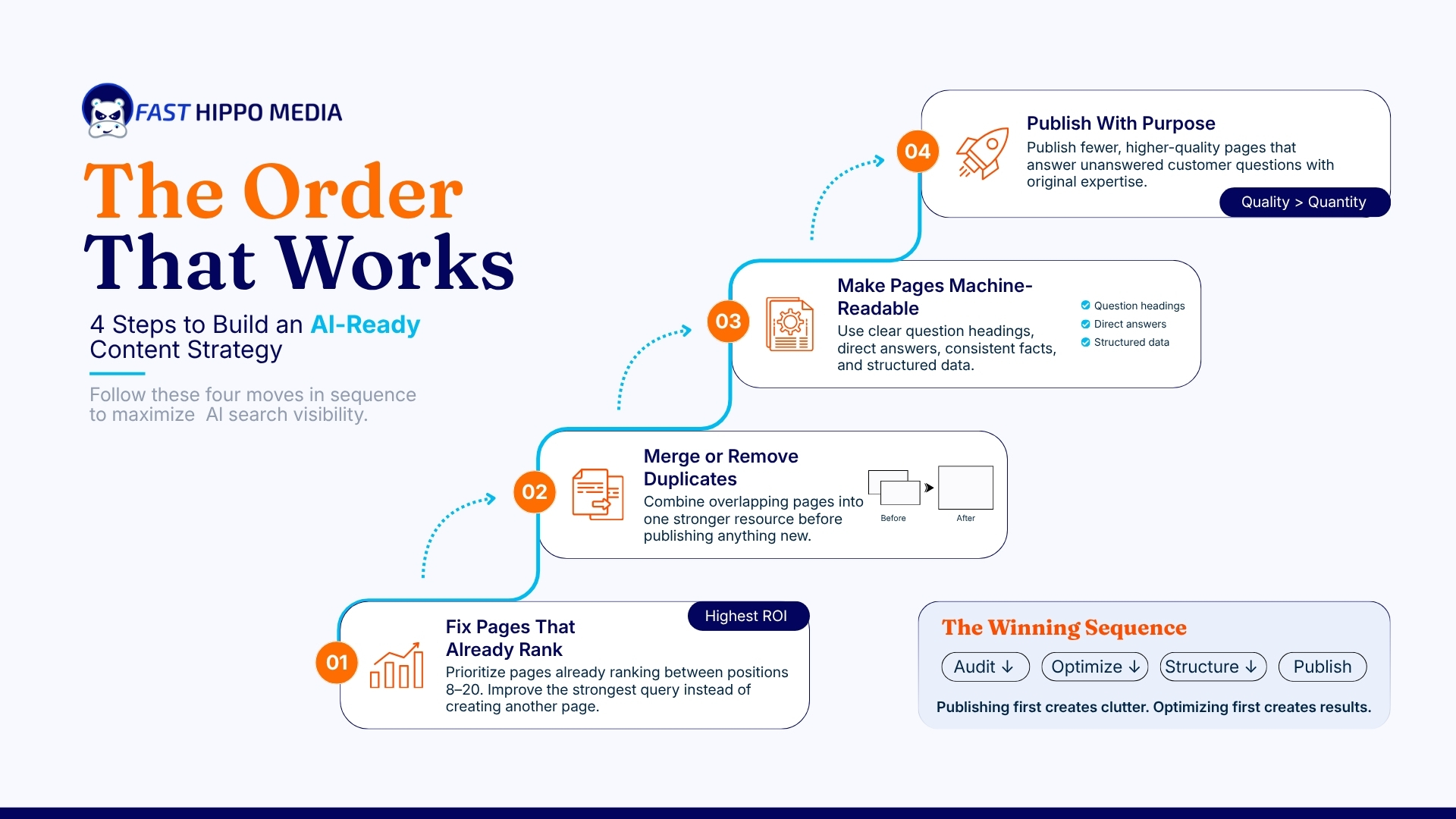
1. Fix the pages that already rank
A page at position twelve is closer to real traffic than any new page you could publish this quarter. Find them, work out what question they half-answer, and finish the job. This is the highest-return work available to almost every business, and it is the least glamorous.
How to find them without a paid tool: open Search Console, go to Performance, and sort by impressions. Then look at the average position. The pages you want are the ones with real impressions and a position between roughly eight and twenty. Those are pages Google already considers relevant and does not yet consider the best answer. A page with high impressions at position thirty is a different problem, usually a mismatch between what the page is and what the query wants. A page with almost no impressions at position five is fine; nobody is searching for it.
For each page in that eight-to-twenty band, look at the queries it already ranks for. Most of the time you will find the page half-answers two or three questions rather than fully answering one. The fix is to pick the question with the most impressions, restructure the page around it, and move the rest somewhere they belong.
2. Merge or cut the duplicates
From the audit. Do this before publishing anything new, or you will add to the pile.
3. Make the survivors machine-readable
Clear headings phrased as questions, the answer directly underneath, facts that match everywhere they appear, and structured data generated from your page’s own fields rather than pasted. Which types still earn rich results and which quietly stopped is in our guide to .
4. Then publish, slowly, on what the audit revealed
Fewer pieces, each one answering a question nobody has answered well, each one containing something only you could write.
Most content strategies invert this. They start at step four, publish into a mess, and conclude that content does not work.
What to stop doing
Shorter list, faster wins.
Stop publishing to a calendar: Four posts a month because it is four posts a month produces four posts a month. It does not produce results, and it fills your site with pages that dilute the ones that work. We went into why volume stopped working and .
Stop writing for topics instead of questions: “A guide to commercial roofing” answers nothing. “How long does a commercial flat roof last in Texas heat?” answers something specific, and specificity is what gets quoted.
Stop rewriting other people’s articles: Google names this directly: does the content “avoid simply copying or rewriting those sources, and instead provide substantial additional value and originality?” A synthesis of the top five results is the top five results with worse authority.
Stop measuring content by volume published: Count the questions you answer better than anyone else. That number is usually much smaller, and it is the one that moves.
How we run this
Our own process, since a page telling you how to work should say how we work.
We start with the audit, not the calendar. Every engagement begins with the full page list, the duplicate check, and the assistant test above, because it consistently finds more upside in what already exists than in anything we could add.
We use AI for production and not for judgment. Research, structure, first drafts, repurposing, all fair game. What to publish, whether a claim is true, and the final read stay human, because those are the three places a mistake costs trust rather than time.
We publish less than clients expect and distribute more than they expect. One properly researched piece contains a month of social, an email, a video script and three sections of a service page. Getting all of that out of one piece is what our system exists to do, and it is why our output looks larger than our publishing schedule.
And we refresh on a schedule rather than when someone notices. Cornerstone pages quarterly, fast-moving topics monthly.
How to tell if it is working
Not by traffic, at least not first. Traffic moves last and tells you least.
Positions on the pages you fixed: If a page moved from twenty-two to fourteen, the work is working, even if the clicks have not arrived. Clicks arrive in the top handful of results, so the leading indicator is movement toward it.
Whether the assistant names you: Run the same five questions monthly and note the change. This is slower and noisier than a rank tracker, and it is closer to the outcome you actually want.
Impressions on new questions: New queries appearing at all means your content has been understood and matched to something. That is the earliest signal you get.
Then clicks: They lag the rest by months, and treating them as the first metric is how good work gets abandoned two months before it pays.
Where to start this quarter
Three things, in order, and none needs a budget.
Do the audit. Every page, one line on what question it answers. It takes an afternoon, and it will tell you more than any tool.
Fix the three pages closest to page one. Not the ones you like. The ones the data says are close.
Ask the assistants your five questions and write down who gets named.
If you would rather have that run for you, our start with the same audit, and the first deliverable is usually a list of things to stop doing.
Frequently Asked Questions
No. It changes what SEO optimizes for. Rankings, answers and recommendations all still run on visibility systems, and someone has to make your business legible to them. The tactics evolve, the job does not.
The order changes. A traditional plan starts with keywords and a publishing calendar. An AI-era plan starts with an audit of what you already have, fixes and merges that, makes it machine-readable, and only then publishes, on questions the audit proved nobody has answered well.
As much as you can make genuinely better than what already ranks, and no more. For most businesses that is fewer pieces than they currently publish. Volume dilutes the pages that work.
Old content first, almost always. A page already ranking at position twelve is closer to traffic than anything you could publish this quarter, and finishing it is faster than starting from nothing.
Include what only you have: your own data, your own cases, named people with real credentials, and corrections of things your industry repeats incorrectly. Google’s own test asks whether content demonstrates first-hand expertise and provides original information. Most content fails both.
Position movement on fixed pages shows first, then impressions on new queries, then clicks. Clicks lag the rest by months, which is why judging the work by traffic in month two usually ends good programmes early.