(214) 272-7034
  info@fasthippomedia.com



Schema markup is code that tells machines what your content means, and in 2026 machines write the answers. The types that still earn rich results: Organization or LocalBusiness, Article, Product, Review snippet, and Video. FAQ and HowTo no longer do, though FAQ is still worth shipping for AI extraction. Ship through templates or a plugin, validate with Google’s Rich Results Test, and keep your facts identical everywhere.
What is schema markup, and why does it matter now?
Schema markup is code that labels your content so a machine knows what it is looking at. This is a business. This is its address. This is a price, a rating, an author, a date.
Without it, a search engine or an AI model has to infer all of that from prose, and inference is where things go wrong. With it, you are stating the facts outright in a format built for the purpose.
The vocabulary is maintained at , a collaborative standard that Google, Microsoft, Yandex and others all read. What changed in 2026 is not the code. It is what reads it. Search engines used it to decorate a listing. AI systems use it to decide whether they can quote you accurately.
How does schema help AI engines understand your content?
It removes guesswork, and guesswork is what stops a model naming you.
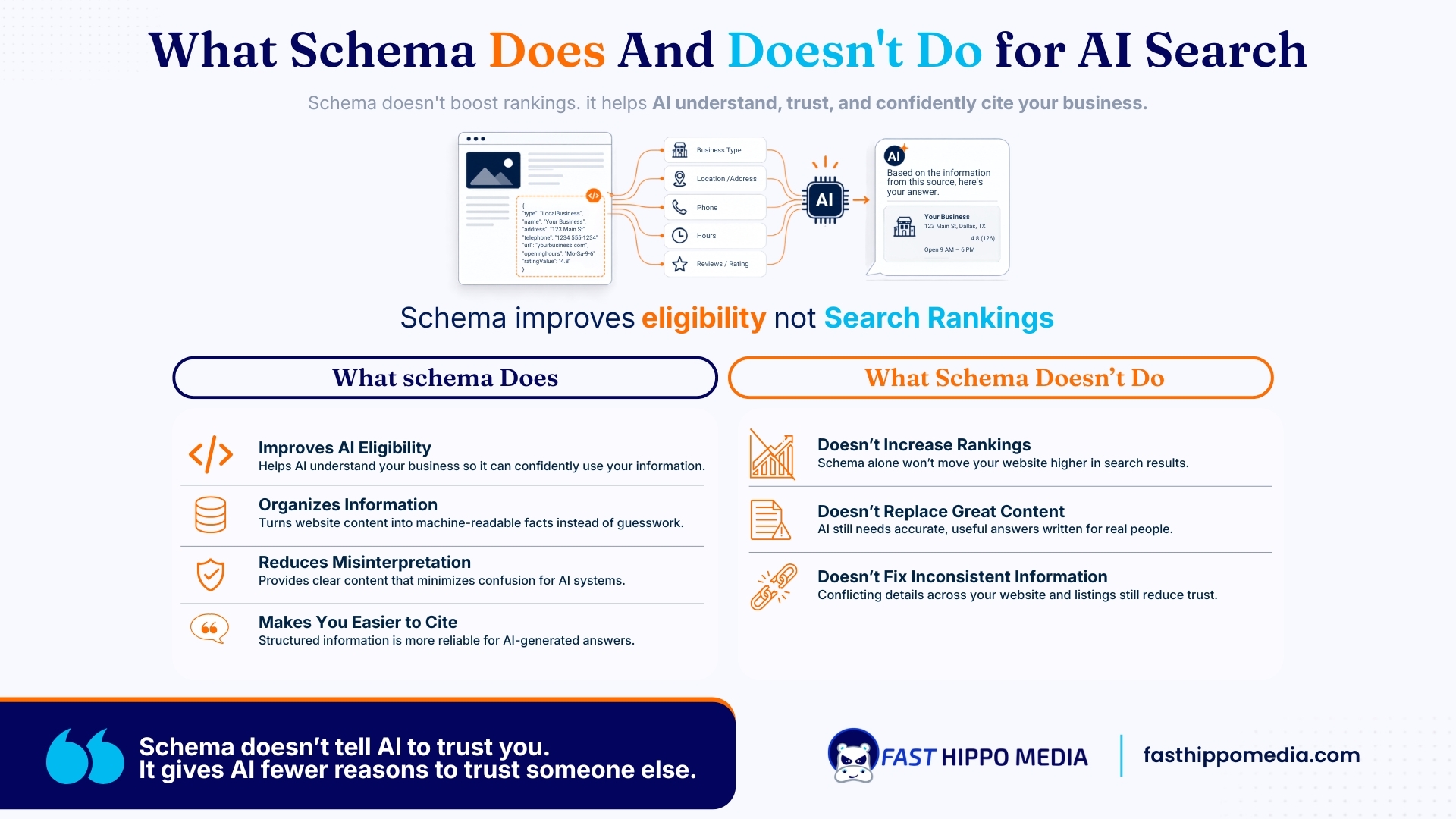
An AI assembling an answer has to decide what it can state confidently. Text it had to interpret carries risk; facts it was handed carry none. Given two businesses, one whose hours and services are marked up and one whose are buried in a paragraph, the model can quote the first without hedging.
That is the whole mechanism. Confident facts get repeated. Hedged inferences get skipped.
Does schema actually improve AI search visibility?
It improves eligibility rather than ranking, and it is worth being precise about the difference, because a lot of schema marketing is not.
Schema does not push you up a results page. What it does is make you safely quotable, and AI systems favour sources they will not misquote. Pair it with clear answers and facts that match across your website, your Google Business Profile, and your directory listings, and you have removed most of the reasons a model would pick a competitor instead.
Anyone selling schema as a ranking lever is overselling it. Anyone calling it optional in 2026 has not looked at how answers get assembled.
Which schema types actually matter?
This is where most guides, including the earlier version of this one, are out of date.
Types that still earn rich results in Google Search, from :
- Organization or LocalBusiness — who you are, where, and how to reach you
- Article — for blog and news content
- Product — for anything sold, including price, availability and condition
- Review snippet — ratings shown in results
- Video — for embedded video
- Event, Job posting, Recipe, Breadcrumb and others, where relevant
Types that no longer earn rich results, and why it matters:
HowTo was deprecated in . Google removed the search appearance, the Search Console report, and Rich Results Test support, then removed the documentation.
FAQPage was narrowed to authoritative government and health sites in that same announcement, and has since been removed from the supported list entirely.
Here is the nuance almost every schema guide gets wrong. FAQPage is still worth shipping, just not for the reason people think. It no longer produces a SERP feature, but it hands AI engines clean question-and-answer pairs they can lift without interpreting. The value moved from the results page to the answer layer. Keep using it, stop expecting stars.
If you have HowTo markup on your site, Google’s guidance is that you do not need to remove it. Unused structured data causes no harm; it simply does nothing.
For most local businesses the priority is short: LocalBusiness, plus Article on your content, plus FAQPage for the AI benefit. Everything else is situational.
Here is what LocalBusiness looks like in practice:
<script type="application/ld+json">
{
  "@context": "https://schema.org",
  "@type": "LocalBusiness",
  "name": "Example Plumbing Co.",
  "telephone": "(214) 555-0181",
  "address": {
    "@type": "PostalAddress",
    "streetAddress": "410 Elm St",
    "addressLocality": "Frisco",
    "addressRegion": "TX",
    "postalCode": "75034"
  },
  "url": "https://exampleplumbing.com",
  "openingHours": "Mo-Sa 07:00-19:00",
  "areaServed": "Frisco, Plano, McKinney",
  "aggregateRating": {
    "@type": "AggregateRating",
    "ratingValue": "4.8",
    "reviewCount": "212"
  }
}
That block takes two minutes to adapt and tells a machine more about the business than the entire homepage does.
How does schema support featured snippets and AI answers?
Indirectly, and it helps to be honest about the mechanism.
Schema does not create a snippet. What it does is make the content around it unambiguous, so the system extracting an answer knows which part is the answer. A page with a clear question, a direct response, and markup confirming the structure is easier to lift from than a page where all three have to be guessed.
The practical version: answer the question in the first two sentences under the heading, then let the markup confirm what you have done.
What is the role of structured data in AI search?
It is the difference between being read and being understood.
An AI system building an answer about local plumbers is reconciling several sources: your website, your Google Business Profile, directory listings, reviews. Where those agree, it has a fact. Where they conflict, it has a problem, and the safe response to a problem is to use a different business.
Structured data is how you make sure they agree. Not because the schema itself is authoritative, but because writing it forces you to state your facts explicitly, and explicit facts are easy to keep consistent.
Does schema affect voice search?
Yes, for the same reason it affects AI answers: a voice assistant returns one result, not ten.
There is no second place in a spoken answer. The assistant needs a source it can state without qualification, which means complete business information, unambiguous hours, and content that answers the question asked rather than the topic generally.
This is the same discipline as , applied to a channel where the stakes are higher because there is no list to fall back to.
Does schema matter for ChatGPT and AI assistants?
Less directly than for Google, and worth being accurate about.
Google reads schema natively and uses it to build features. AI assistants mostly read pages and reconcile sources, and how much weight any given model gives structured data is not published. What is observable is that businesses with consistent, well-labelled information get named more often than businesses without it.
Google itself is explicit that structured data is not required for its generative AI features. The reason to ship it anyway is that the same discipline, stating your facts clearly and identically everywhere, is what makes any model confident enough to recommend you.
If you sell products, that discipline is worth more: is one of the few places where structured data maps directly onto an AI surface.
What are the best practices?
Five, in order of how often they get broken.
Mark up what is on the page: Schema describing content a visitor cannot see breaks Google’s guidelines and can get your structured data ignored entirely.
Keep it consistent with everything else: The address in your markup, on your contact page, in your Google Business Profile, and on Yelp should be one address, character for character.
Validate it: Run every template through the before you ship it and after any redesign. Markup breaks silently.
Use one method, not two: A plugin generating FAQPage plus a hand-pasted block produces two entities on one URL, which is worse than having neither.
Ship it through templates: Markup added page by page drifts the moment anyone edits the copy. Markup generated from the page’s own fields cannot.
Want to see it live? View the source of the page you are reading. The FAQ below is marked up exactly the way this article describes.
Can a small business do this without a developer?
For the common cases, yes.
WordPress plugins including Yoast SEO and Rank Math generate Organization, Article, Breadcrumb and FAQ markup automatically from fields you fill in. If you are on WordPress, a good deal of this is a settings screen rather than a coding job.
The first thing to do is not to add anything. It is to find out what you already have. Put your homepage into the and look at what comes back. Most owners are surprised in one of two directions: either their plugin has been quietly doing this for years, or a page they assumed was marked up carries nothing at all.
What mistakes should you avoid?
Marking up invisible content: The most common cause of structured data being ignored.
Two sources of the same type: Plugin plus manual block, both emitting FAQPage.
Shipping and forgetting: A redesign that changes the template can strip markup without anyone noticing, because nothing visibly breaks.
Expecting rich results from FAQ or HowTo: Covered above, and still the most repeated error in schema advice.
Inconsistent facts: Marked-up data that contradicts your Google Business Profile is worse than no markup, because now the conflict is explicit.
Where schema fits in an AI SEO strategy
It is a foundation rather than a tactic, and it sits underneath everything else.
Clear content answers the question. Consistent facts make the answer verifiable. Schema makes both machine-readable. Reviews and third-party mentions corroborate them. That is the whole stack, and schema is the layer that makes the rest legible.
Which is also why it is the wrong thing to start with if your Google Business Profile is empty. Fix the facts first, then label them.
Where to start this week
Three steps, in order, none of which needs a developer.
Run your homepage through the Rich Results Test: Find out what you actually have.
Add or check LocalBusiness or Organization markup: For most businesses this is the highest-value single block, and the example above is a working starting point.
Make your facts match everywhere: website, Google Business Profile, and directories. If they disagree, fix that before adding anything new.
If you would rather have someone audit what your site currently carries and what it should, that is a straightforward piece of work and it starts with the same test you can run yourself in two minutes.
Frequently Asked Questions
Schema markup is code that labels your content so machines know what it means: this is a business, this is a review, this is a price. It matters in 2026 because AI engines answer questions directly, and they answer from content they can parse with confidence.
It removes guesswork. An AI engine reading unlabelled text has to infer what your page is about; schema states it outright. Confident facts get quoted, hedged inferences get skipped, and schema is the difference between the two.
It improves eligibility rather than ranking. Schema does not rank you by itself, but structured pages are easier to cite accurately, and AI systems favour sources they will not misquote. Pair it with clear answers and consistent facts across your web presence.
Organization or LocalBusiness, Article for content, Product for anything sold, Review snippet, and Video. FAQ and HowTo no longer produce rich results in Google Search, though FAQPage is still worth shipping because AI engines use it to extract clean question and answer pairs.
Yes. WordPress plugins like Yoast and Rank Math generate Article, Organization and FAQ schema automatically, and Google’s Rich Results Test shows what your pages already carry. Start by testing your homepage; most owners are surprised by what is missing.