
 (214) 272-7034
  info@fasthippomedia.com


TL;DR: Publishing more will not fix flat visibility. Search engines, AI systems, and buyers reward clarity and coherence rather than volume. Content works when it reinforces your services, connects into topic clusters, and gets redistributed across the platforms your buyers actually use. Structure first, then volume.
Publishing more content does not automatically improve SEO, social reach, or AI visibility. For growing businesses, content usually stops working because it lacks structure, reinforcement, and alignment with the services being sold. Search engines, AI systems, and decision-makers all reward clarity and coherence rather than volume.
The Myth That More Content Equals More Visibility
At some point nearly every growing business reaches the same conclusion. “We just need to publish more.”
The logic feels solid. More blog posts mean more SEO opportunities. More content means more chances to rank. More social posts mean more engagement. So output goes up.
Yet results do not improve. In some cases they get worse.
This is not because content marketing stopped working. It is because content without structure creates confusion rather than authority. When content is disconnected, search engines struggle to understand what you are expert in, AI tools struggle to summarize your business, and buyers struggle to trust what you do best.
More content does not fix that. It magnifies it.
Why This Advice Still Persists
The advice to “just be consistent” comes from an earlier phase of digital marketing, when competition was lower, search engines leaned heavily on keywords, AI interpretation did not exist, and publishing frequently was itself a relevance signal.
In that environment, volume worked. That environment is gone.
Today, consistency without direction reads as noise. Publishing without reinforcement weakens authority signals instead of building them.
This hits hardest in the service categories where trust decides the sale. A dental practice, a roofing company, a restaurant, and a pest control business all sell something a buyer has to believe before they book. Clever ideas do not close that gap. Clarity does.
How Search Engines and AI Actually Evaluate Content
Modern search engines and AI tools do not evaluate content one page at a time. They look at the full picture: topic focus over time, relationships between pages, internal linking patterns, whether expertise is reinforced, whether services and content line up, and whether the story holds together across platforms.
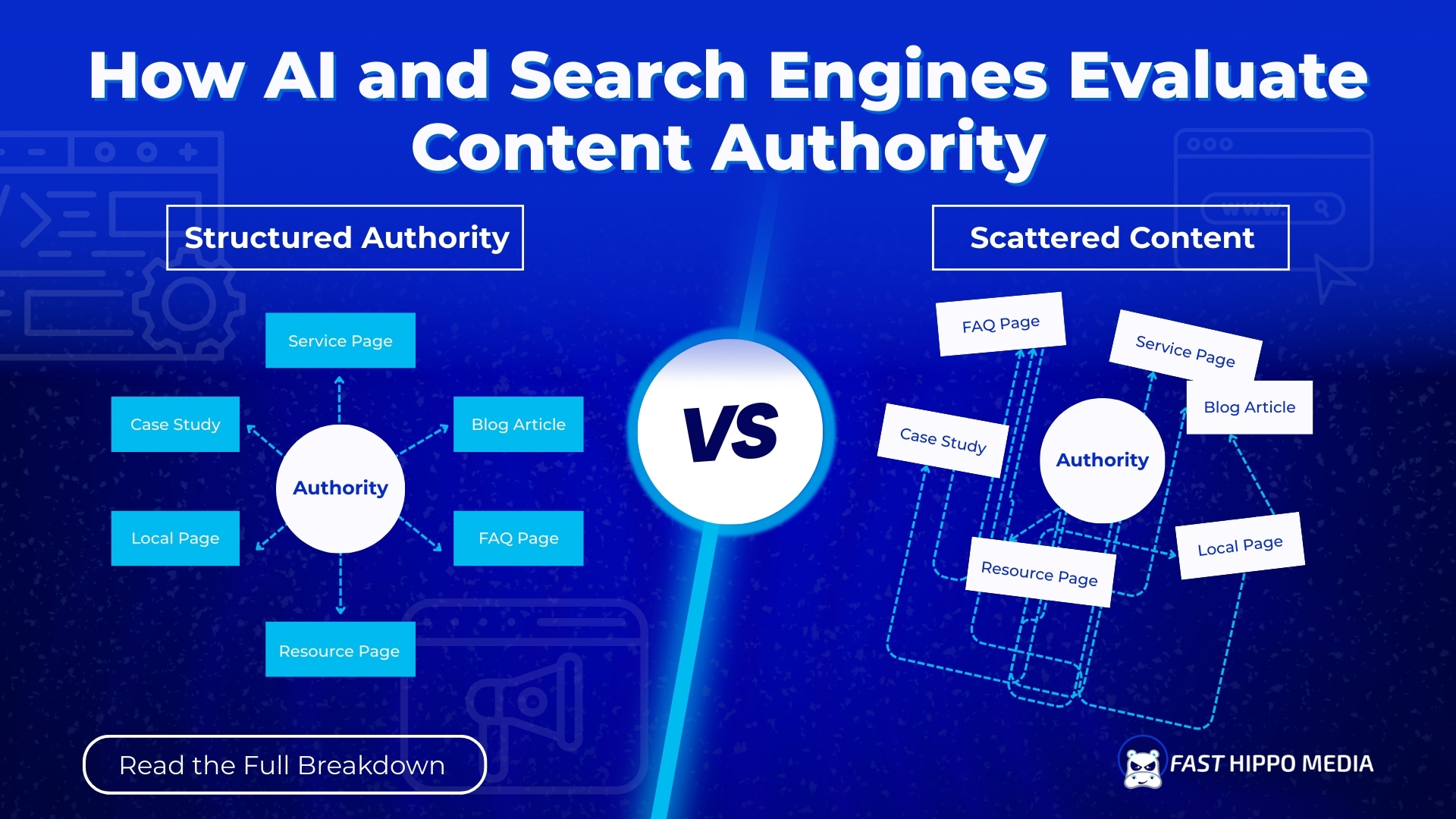
They are not asking how often you publish. They are asking what you are clearly known for.
This is not a guess about how the machines work. Google’s own guidance on generative AI features says there are no tricks available: Structured data isn’t required for generative AI search, and there’s no special schema.org markup you need to add, and the instruction is to continue prioritizing foundational SEO best practices, such as building a clear technical structure and creating unique, valuable content.
Clear structure and valuable content. That is the entire instruction, and it is the opposite of a volume strategy. It is also why is a structural discipline rather than a publishing one.
This is why two companies can publish the same number of blog posts, and only one gains visibility in Google, in AI summaries, and in local results.
Content Authority Is About Signals, Not Posts
Authority is not created by one blog post. It is created by signals stacking over time.
Strong signals look like this: clear service pages for the things you actually sell, supporting content that explains those services, internal links connecting education to offer, consistent language across the site and profiles and social, and structured data that helps a machine place your business.
When those align, content compounds. When they do not, content resets.
The gap between ranking and being cited is now measurable. Ahrefs found that only 38% of pages cited in AI Overviews also rank in the top ten for that query, down from 76% earlier in the year. Two in three citations go to pages a searcher would never see on page one. Position and authority have come apart, which is exactly why counting posts tells you nothing about either. The same logic drives everything in our : the system produces the visibility, not the page count.
The Difference Between Content That Compounds and Content That Resets
This is where most businesses get stuck.
Content That Compounds
Topics build on each other. Blog posts support service pages. Internal links guide readers logically. Social posts reinforce the same message. Videos explain core services and real problems. Authority grows.
Each new piece strengthens the last. That is how a business builds durable search visibility, trust, and AI recognition.
Content That Resets
Each post stands alone. Topics jump around. Blogs do not link to services. Social tells a different story. Videos chase trends unrelated to what you sell. Platforms operate independently.
In this state every new post starts from zero. Teams feel busy. Metrics show activity. Visibility goes nowhere.
Why Publishing More Often Makes the Problem Worse
When businesses do not see results, the usual response is more output. More blogs, more short-form, more video.
Without structure that produces topic dilution, conflicting authority signals, confusion for buyers, and lower confidence from AI systems.
Instead of becoming known for emergency roof repair, or Invisalign, or termite treatment, the business becomes known for a little bit of everything.
That is not authority. That is noise.
Where Most Growing Businesses Break Their Content System
We see the same four breakdowns across every vertical we work in.
1. No Clear Topic Hierarchy
Content gets created without anyone deciding which services matter most, which topics support them, or what buyers actually search. Without hierarchy, content has no direction.
2. Blogs Don’t Reinforce Service Pages
Educational content exists but points nowhere. A roofing blog that never links to the roofing service page. A dental article that never mentions the practice offers the treatment it describes. Search engines see information. They do not see expertise.
This post is the obvious place to model the fix rather than only describe it, which is why the paragraph above links to rather than leaving the point abstract.
3. Social Content Operates Separately
Social does not reinforce the blog. The blog does not reinforce services. Video explains ideas unrelated to the core offering. Each platform tells a different story about the same company.
4. Content Is Created for Output, Not Infrastructure
Most businesses treat content as something to publish. High-performing businesses treat it as infrastructure that supports visibility, trust, and conversion. That shift changes what gets made and what gets cut.
Why This Problem Appears After $1M in Revenue
Smaller businesses can get away with scattered content. Growing ones cannot.
This is especially true for the service businesses we work with, , , and , where trust and clarity matter more than clever ideas. And in our client work the wall shows up at a predictable point: somewhere around $1M in revenue, the marketing that got a business there, steady posting, and a bit of everything stop moving the needle. From that size on, search engines and buyers both expect a business to look like a specialist.
What changes at that threshold is the competition. Buyers compare more carefully. The market is crowded enough that “we do good work” stops being a differentiator. Paid ads cost more than they did. AI tools sit between the search and the click. Trust becomes the deciding factor rather than a nice-to-have.
At this stage clarity beats creativity and structure beats volume. This is where content strategies either mature or stall.
How AI Changes the Visibility Game
AI search tools do not only show links. They summarize businesses. They decide who reads as an expert, who reads as reliable, and who deserves to be cited.
Those systems lean on clear specialization, repeated topic signals, and structured relationships between pages. If your content is scattered, an AI cannot confidently explain what you do, so it explains a competitor instead.
The stakes moved as well. SparkToro and Similarweb found that 68.01% of US Google searches ended without a click in early 2026, and only 276 of every 1,000 searches now reach the open web at all. When most searches never produce a visit, the question stops being how much you published and becomes whether a machine can summarize you accurately. That is the whole discipline behind .
This is not an AI problem. It is a content alignment problem.
How Content Everywhere℠ Changes the Equation
At Fast Hippo Media we do not treat content as isolated tasks. is a structured system built to make content compound.
One core idea becomes many reinforcing assets. Content supports services instead of distracting from them. Blogs, social, video, and search work from the same map. Search engines and AI systems see a coherent expertise graph rather than a pile of posts.
Instead of publishing more, businesses publish in a way that accumulates. That is how visibility grows without burning out the team producing it.
What to Fix Before Publishing Anything Else
Before creating another blog post or video, fix these five.
1. Define What You Want to Be Known For
Pick the services that actually drive revenue and decide those are the topics. A roofing company that wants storm work and a roofing company that wants replacements need different content maps, and trying to serve both equally serves neither.
2. Align Content With Buyer Intent
What does someone search for the week before they book? What do they ask on the call? Those questions are your content plan, and most of them are already sitting in your inbox and your Google Business Profile messages.
3. Group Related Topics Together
Build clusters around the services you named in step one, each with a hub page and the supporting pieces that answer the questions around it. Each cluster reinforces one thing rather than each post arguing alone.
4. Make Platforms Reinforce Each Other
Blogs support services. Social supports blogs. Video supports both. One message, many formats, rather than four teams telling four stories.
5. Treat Content as Infrastructure
Content should build value over time. If a piece does not strengthen the system, it does not get published. That single rule cuts more waste than any calendar ever will.
Is your content compounding or resetting?
If you are publishing consistently and visibility has not moved, the problem is rarely effort. It is structure and alignment, and those are diagnosable in an afternoon.
The test is simple enough to run yourself. Take your last ten posts. For each one, name the service it supports and the cluster it belongs to. If more than three come back blank, you have found the reason volume has not worked.
We help growing businesses diagnose why content stalls across search, social, paid, and AI. If the ten-post test came back badly, that is the conversation worth having before anything else gets published.
📞 (214) 272-7034
📧 info@fasthippomedia.com
🌐 fasthippomedia.com