(214) 272-7034
  info@fasthippomedia.com



The 2026 through-line is search everywhere. Customers find brands on Google, on social, and inside AI answers, often without clicking anything. The winners publish real expertise once and distribute it across every surface, use AI for production but not for judgment, and treat digital PR and reviews as ranking inputs. Start with one trend per quarter rather than nine at once.
People no longer search for brands in one place. They search on Google, scroll social platforms, ask AI tools, and use browsers that make decisions for them. The brands that win in 2026 will not be the loudest. They will be the easiest to find, the easiest to trust, and the easiest to talk to.
This guide covers nine trends and, more usefully, what we would actually do about each one.
Midyear scorecard: how these predictions are holding up
Updated August 2026
We published this list in January. Half a year is long enough to start grading it, so here is the honest check-in rather than a quiet edit.
AI discovery engines: called it, and faster than we expected: Four weeks after this post went live, OpenAI turned on advertising inside ChatGPT for US users on the Free and Go tiers. The entry price was around $60 CPM with a $200,000 minimum commitment, which made it an enterprise-only channel. By 5 May the minimum was gone entirely, and the platform went self-serve. In twelve weeks, AI assistants went from a place you hoped to be mentioned to a place any business can buy space in. We wrote up separately.
Search everywhere, right, but the popular version of it is wrong: We said the search had left Google, and that holds. Around 40% of Gen Z now use TikTok and Instagram for search rather than Google, according to Google’s own internal data, and roughly half of US consumers have used TikTok as a search engine at least once.
What we did not predict, and what most trends coverage still gets wrong, is the direction of the preference. Trying social search is near-universal; preferring it is rare and falling. Survey data puts Gen Z, who actively prefer TikTok to Google for search, at around 4% in 2026, down from about 8% in 2024. People are not abandoning Google. They are using different tools for different jobs: social for discovery and inspiration, and Google for the factual, transactional, high-stakes question.
The practical read is not “move to TikTok.” It is that your brand has to be findable in both, because the same customer uses both within the same afternoon.
What surprised us: we will fill this line with a real observation from client work rather than a plausible one. See the note at the end of this document.
1. Why is on-platform content winning?
Social platforms reward content that keeps people inside the app. Posting a link and hoping for the click works far less well than it did, because the algorithm has no reason to send traffic away.
What to do: rebuild one existing blog post as a native carousel or a short teaching video this month, with the whole idea contained in the post rather than gated behind a link. Use in-app lead forms and DMs instead of routing everything to a contact page. Judge it on saves and shares rather than clicks, because those are the signals the platform is actually measuring.
2. What does “search everywhere” mean for your marketing?
Search stopped being a destination and became a behaviour. The same customer asks Google a pricing question, asks TikTok what something looks like in real life, and asks an AI assistant to summarise the options.
What to do: Take your ten most common customer questions and make sure each one is answered somewhere on every surface you own. Question-shaped titles, answer-first opening lines, local and problem-specific phrasing. This is the whole discipline behind , and the work is less about new content than about the same answer existing in more places.
3. How is AI changing campaigns and content production?
AI made production cheap and judgment scarce. The teams struggling in 2026 are not the ones that failed to adopt AI; they are the ones that let it decide things.
What to do: use AI for the parts with a right answer, meaning outlines, variants, first drafts, and data summarisation. Keep human judgment on the parts with a decision in them: what to say, what to promise, and what to leave out. A useful test before publishing anything: could a competitor have generated this from the same prompt? If yes, it is not ready.
4. What are AI discovery engines, and why do they matter now?
AI tools do not return a list for a person to evaluate. They return a recommendation, and being the recommendation is a different job from ranking well.
What to do: structure content so a machine can lift a clean answer, keep your business facts identical everywhere they appear, and check that your site is not blocking AI crawlers. That last one costs nothing and catches more businesses than you would think. The full method is in our guide to .
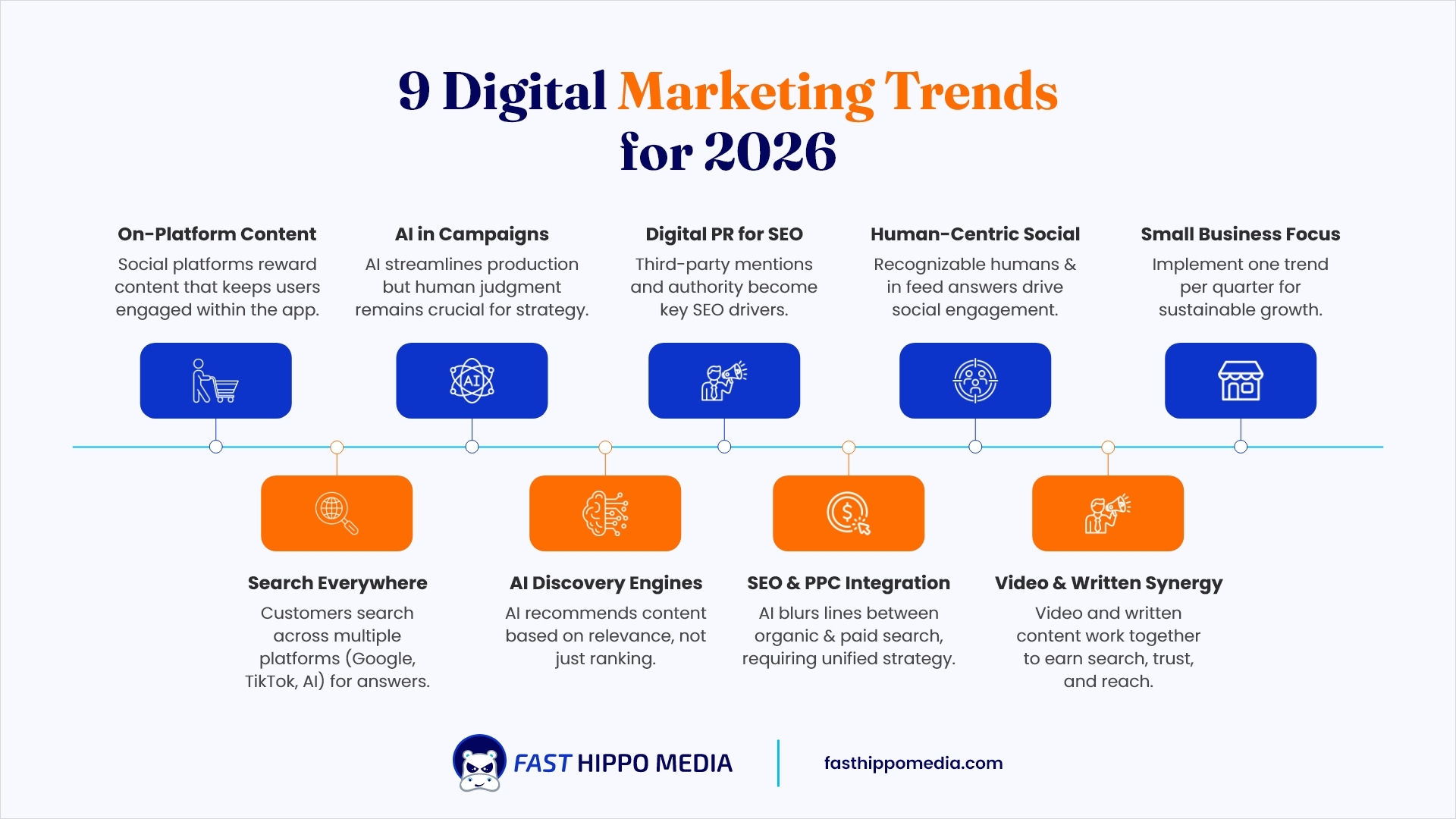
5. Why is digital PR suddenly an SEO strategy?
Authority stopped being a link-count problem and became a mention problem. Being named by a source people already trust does more than a dozen directory listings, and AI tools treat third-party mentions as corroboration in a way they do not treat your own website.
What to do: publish one thing a year that other people need to cite. Original numbers from your own work, a survey of your own customers, and a comparison nobody else has bothered to run. Then pitch it to the two or three local publications and industry outlets that actually cover your field. This is what a is for, and it compounds in a way advertising does not.
6. How should SEO and PPC budgets shift this year?
The wall between them is coming down. AI placements are now a paid channel with an organic prerequisite: the ChatGPT ad auction is relevance-weighted, so the businesses already treated as relevant enter it cheaper than the ones buying their way in.
What to do: stop budgeting them as separate line items and start asking which questions you want to own, then answering each one organically and buying the ones where the answer is not landing yet. works best as amplification of something that already works, rather than as a substitute for it.
7. Which social media shifts actually matter?
Two: people want a recognisable human, and they want the answer in the feed. The rest is platform churn.
What to do: run one short live Q&A a month answering real customer questions, then cut it into clips that each answer one thing. Use polls and DMs to collect the questions rather than guessing them. This is the cheapest content system there is, because the audience writes the brief. It also gives your something to publish that is not a repost of your blog.
8. How do video and written content work together now?
They stopped being separate formats and became the same idea at different lengths.
What to do: start with one real answer, publish it as a written piece, record a two-minute explainer of the same thing, then cut that into clips answering one question each. One idea, four surfaces, one afternoon. The written version earns the search, the video earns the trust, and the clips earn the reach. Our take on goes deeper on the sequencing.
9. How can a small business put these trends to work?
Not by doing all nine. By doing one per quarter, properly.
What to do: if customers find you locally, start with your , because it feeds both the map pack and the AI answers. If you sell to other businesses, start with digital PR, because credibility is the constraint. Publish one genuinely useful piece a month rather than four thin ones, and repurpose each into social and video.
Pick the trend closest to how your customers already find you. Momentum from one finished thing beats nine started ones, and this is a marathon that most of your competitors have not entered.
Where to start this quarter
The through-line in all nine is that being findable stopped being one job.
Pick the single trend closest to how your customers currently reach you and run it for ninety days. Measure whether enquiries changed, not whether traffic did. Then pick the next one.
If you want a read on which of the nine is actually your bottleneck, that is the conversation worth having before any of the work starts.
Frequently Asked Questions
The through-line is search everywhere: being findable in Google, on social platforms, and inside AI tools at once. Under that umbrella sit on-platform content, AI-assisted production, digital PR, and video working alongside written content rather than replacing it.
Pick the one trend closest to how your customers already find you and run it for a quarter. A local business usually starts with AI-readable local presence; a B2B brand with digital PR. Stacking one habit per quarter beats launching nine at once and finishing none.
More than for large brands. AI tools lowered production costs, and AI answers reward the most relevant result rather than the biggest budget. A small business that is machine-readable and well-reviewed can out-recommend a national chain in its own neighbourhood.
Not in the way the headlines suggest. Around 40% of Gen Z use TikTok and Instagram for search, and roughly half of US consumers have tried TikTok as a search engine. But the share who actively prefer it to Google is small and has been falling, around 4% in 2026 against 8% in 2024. People use social for discovery and Google for decisions. You need both.
AI answers resolve more searches before the click, so content has to be structured for citation rather than only for ranking: clear answers, consistent facts, and clean structure. AI placements also became a paid channel in 2026, and the auction rewards businesses that are already relevant.
Start from the questions your customers actually ask, then make one piece of real expertise answer them everywhere: site, profile, video, social, and the surfaces AI reads. Distribution across channels beats volume in one.