(214) 272-7034
  info@fasthippomedia.com


OpenAI turned on ads inside ChatGPT for Free and Go users in February 2026, making AI conversations a paid channel rather than only an organic one. The launch carried a $200,000 minimum. By May that minimum was gone and the platform went self-serve. AI now writes, tests, and reallocates ad creative faster than any team can, but the strategy still belongs to humans. Brands already visible in AI answers organically will pay less to appear in them as ads.
If you have run ads in the past year, you have probably felt it. Campaigns that worked last quarter suddenly stall. Audiences behave differently. Platforms roll out “AI features” faster than most teams can test them. That confusion hit a new level in February 2026, when OpenAI launched advertising inside ChatGPT and quietly reset expectations for how advertising, content, and customer engagement work together.
This article breaks down what that launch means for marketers, local business owners, and brands trying to stay visible without wasting budget. We will cover what actually shipped, what has changed in the months since, and what you can do about it now. The goal is clarity rather than hype.
How is ChatGPT’s 2026 ad launch changing advertising?
ChatGPT’s ad launch shifted the unit of targeting from the keyword to the conversation. Ads are matched in real time to what a person is actively discussing, which makes relevance the currency rather than bid depth.
What actually launched
On February 9, 2026, OpenAI began testing ads inside ChatGPT for logged-in adult users in the United States on the Free and Go tiers. Users on Plus, Pro, Business, Enterprise, and Education plans do not see ads. Placements appear in clearly labelled, visually separated boxes below responses, and OpenAI has been explicit that ads do not influence the answers the model gives.
Targeting draws on the topic of the current conversation, previous chats, and prior ad interactions. Someone researching recipes may see ads for grocery delivery or meal kits. Advertisers receive aggregated performance data only. They do not get access to individual conversations or personal details.
Why this matters for businesses
Search catches people who already know what to type. Social media catches people who are not looking for anything. A conversation catches someone mid-decision, describing their actual problem in their own words, often before they know the name of the product that solves it.
That is a genuinely different advertising environment, and it rewards different things. In search, you buy the keyword. Here you earn the context.
What has happened since the launch?
The February headline was that ads existed. What followed matters more to anyone deciding whether to buy.
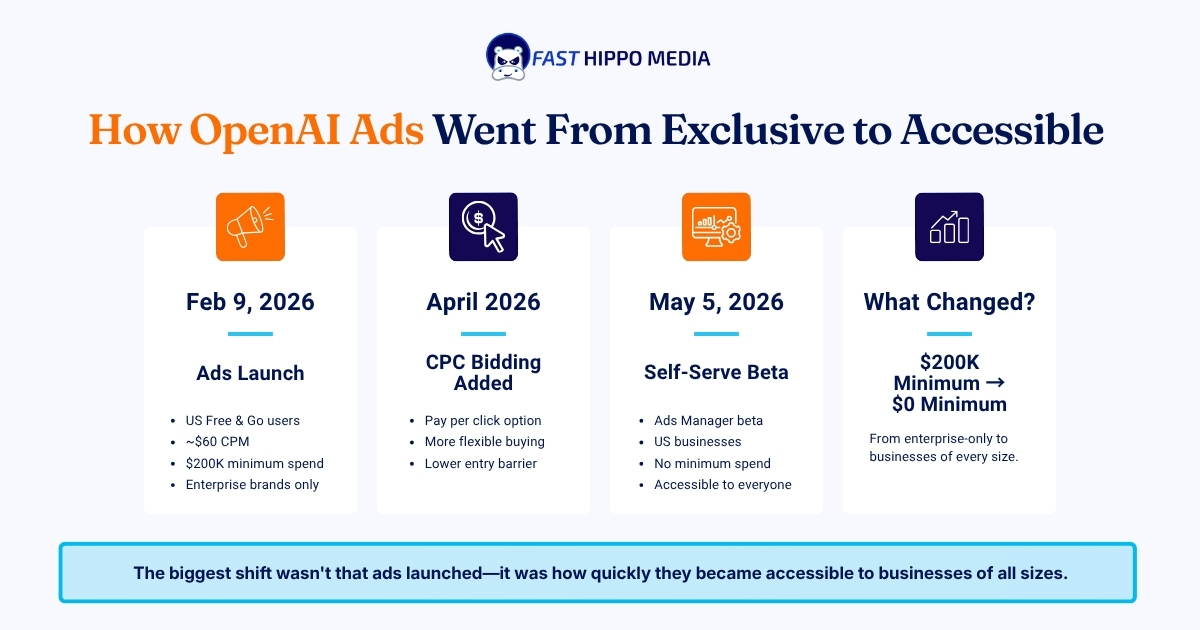
February 9, 2026: Ads went live for US Free and Go users. Entry pricing was roughly $60 CPM with a $200,000 minimum commitment. That floor is why nearly all the February coverage was written for enterprise brands. At that price this was not a channel a local business could touch.
April 2026: CPC bidding arrived, giving advertisers an alternative to buying impressions outright.
May 5, 2026: OpenAI opened a self-serve Ads Manager beta to US businesses and removed the minimum spend entirely.
In roughly twelve weeks the barrier to entry went from $200,000 to nothing. That is the part almost nobody has written about, and it is the part that matters if you run a business rather than a brand.
Current reported rates run around $3 to $5 per click, or $25 to $60 CPM depending on category, through a relevance-weighted second-price auction. That last detail carries more weight than the numbers do. As with Google Ads, a more relevant ad can cost less to serve than a less relevant one from a competitor bidding higher. Money alone does not win the placement.
Which leads to the strategic read: the companies already appearing in AI answers organically are the ones whose ads will be judged most relevant. Organic AI visibility and paid AI placement are not two programs. The first makes the second cheaper, which is the argument for treating as paid media groundwork rather than a separate line item.
We update this section as the platform changes. Last reviewed on 3rd August 2026.
What are the biggest AI advertising trends in 2026?
Four things are real. Most of the rest is vendor noise.
Creative and generated and tested at machine speed: Teams that shipped four ad variants a month now ship forty, and the winner is found by data rather than by argument in a meeting.
Budget reallocated on behavior signals rather than schedules: Spend moves during a campaign, not at the next review.
First-party data as the personalization input: Third-party signal keeps degrading. What you know about your own customers is the durable asset.
Answer engine visibility is becoming part of the paid strategy: This is the newest and the least understood. Being cite-able now affects what your ads cost.
The mindset shift underneath all four: the question stopped being “which ad works best” and became “which intent signal matters right now.”
How does generative AI improve ad performance?
By collapsing the cost of iteration. Testing used to be expensive, so teams tested rarely and defended their guesses. When a variant costs almost nothing to produce, you stop guessing.
The gains show up in three places: faster creative testing, continuous optimization against live engagement, and lower cost per acquisition as the learning compounds. Paired with predictive analytics, the system starts anticipating rather than reacting.
A worked example. A cleaning company runs dozens of ad variations automatically. The system detects which message converts local homeowners fastest and reallocates spending toward it inside days rather than at the end of the quarter. No human could have run that many tests, and no human needed to.
Are AI-powered ad campaigns replacing human strategy?
No. They replace manual execution, which is a different thing entirely.
Humans still decide the brand voice, make the ethical calls, and hold the long-term plan. AI handles A/B testing at scale, real-time optimization, audience clustering, and creative adjustment.
The failure mode worth naming: teams that hand strategy to the tool because the tool is fast. Speed applied to the wrong offer just reaches the wrong conclusion sooner. The machine optimizes what you point it at. Pointing is the job.
How does conversational AI change advertising?
It turns advertising into a two-way exchange rather than a broadcast. A person can ask a follow-up, get a specific answer, and move toward a decision inside the same session.
That compresses the funnel. Instead of clicking a generic ad and landing on a page that answers a different question, someone works through pricing, timelines, and availability in conversation. The intent is clearer to the advertiser, and the friction is lower for the buyer.
It also raises the bar. In a conversation, a vague claim gets a follow-up question. Ads that survive that scrutiny are the ones backed by something real.
What role does personalization play in AI-first advertising?
Personalization is the whole advantage, and it is also where the discipline is required.
AI uses behavior signals to deliver location-aware messaging and intent-based offers at scale. Done well, the ad feels like a useful answer. Done badly, it feels like being followed. The line is not technical; it is editorial: does this message make sense to the person receiving it, given what they just asked?
People do not want more ads. They want better answers. The advertisers who understand that distinction spend less to get more.
How can brands adapt to AI-first marketing today?
Start where the leverage is, not where the novelty is.
Audit the funnel you already have, because AI applied to a broken funnel produces broken results faster. Get your business answerable, meaning your services, pricing signals, and expertise are structured so an AI can extract and cite them. Test AI-generated creative against your own brand standards rather than shipping whatever the tool produces. Align messaging with the questions people actually ask, which you can read directly out of your own .
Then, and only then, consider buying . The sequence matters, because entering a relevance-weighted auction with thin content is how you pay a premium for the privilege.
What ethical concerns come with AI-generated advertising?
Three, and regulators are already looking at all of them.
Disclosure: AI-generated claims that sound authoritative but are not sourced. The risk is not that the copy is machine-written; it is that nobody checked it.
Privacy in personalization: There is a point where relevance becomes intrusion, and the boundary is set by expectation rather than by law.
The blur between organic and paid: OpenAI has kept ads visually separated and stated they do not influence answers. That separation is the thing to watch as the format matures, because the value of an AI answer rests entirely on the belief that it was not bought.
Use AI to assist rather than to deceive. The credibility compounds, and so does the damage.
Where does this leave your ad budget?
Three things are true at once right now.
ChatGPT ads are open to businesses of any size for the first time. The auction rewards relevance, so a well-targeted small advertiser is not automatically outbid by a larger one. And the brands already appearing in AI answers organically start that auction ahead.
If you have never run an AI-placement ad, the sequence is not “buy ads.” It is: get answerable first, then buy into a channel where being answerable already lowers your cost.
That order is the whole lesson of the February launch, and it is why we build organic AI visibility and paid strategy as one program rather than two. If you want a read on where your business currently stands in AI answers, that is the conversation worth having before any budget moves.
Frequently Asked Questions
Advertising is moving inside AI conversations themselves. Ads now appear in ChatGPT for Free and Go users, AI optimizes creative and targeting in real time, and brands win by being present in AI answers rather than only in classic search results.
OpenAI began showing ads to Free and Go tier users on February 9, 2026, creating a new inventory channel inside the most-used AI assistant. It signalled that AI platforms will monetize attention the way search and social did before them.
Yes, and that changed during 2026. The February launch carried a minimum commitment around $200,000, which put it out of reach for most businesses. OpenAI opened a self-serve Ads Manager and removed the minimum spend in May, so the channel is now accessible at ordinary budgets.
Reported rates run roughly $3 to $5 per click, or $25 to $60 per thousand impressions depending on category, through a relevance-weighted second-price auction. As with Google Ads, a more relevant ad can cost less to serve than a less relevant one bidding higher.
They iterate faster. AI campaigns generate creative variants and reallocate budget in real time. Strategy, offer, and brand voice still decide whether any of it converts.
It produces and tests more creative variations than a human team can, learns which messages land with each audience, and cuts the cost of iteration so budget moves to what works.
Disclosure of AI-generated content, data privacy in personalization, and the blur between organic AI answers and paid placements. Regulators are already examining all three.