(214) 272-7034
  info@fasthippomedia.com



AI now handles content production and analysis. Strategy, expertise, and trust stay human, and they are what machines cite. Build once, distribute everywhere customers and AI tools look, structure it so it can be parsed, and measure whether you get named rather than only where you rank. The future arrived earlier than most forecasts expected, which is worth remembering before you plan around another one.
Where content marketing actually stands
AI stopped being the question and became the environment.
By early 2026 the argument about whether to use it was over. Every serious marketing platform has it in the workflow, drafting is close to free, and the constraint moved from producing content to deciding what is worth producing. That shift happened faster than almost anyone forecast, which is the first thing worth saying on a page about the future.
What follows is where content marketing goes from here and what to change while competitors are still deciding whether to. If you want the broader landscape rather than the content-specific view, that is our guide to .
About the $107 billion figure
You will see a number quoted constantly in posts like this one: the AI in the marketing market reaching roughly $107 billion by 2028. It is usually credited to Statista. This page used to credit it that way too.
It is worth unpacking, because it demonstrates the thing this post is actually about.
The research is not Statista’s: It comes from The Insight Partners, a market research firm. Statista republished it, which is how it came to be attributed to Statista almost everywhere it appears.
It was published in December 2021: The base year is 2020, valuing the market at about $12 billion, with a projected 31.6% compound annual growth rate through 2028.
Its base year predates ChatGPT: Generative AI reached consumers in November 2022, nearly a year after that forecast was written. So the most-quoted number about AI in marketing was produced by analysts who had not yet seen the thing that caused the change they were forecasting.
The figure may well turn out to be close. That is not the point. The point is that a projection written in one technological era gets quoted in the next as though it were a measurement, and the further we get from 2021 the more confidently it is repeated.
The practical version, for anyone planning: treat any forecast in this space as an indication of direction rather than a number to budget against, and check the publication date before you quote it. That habit is worth more than any single statistic, and it is the reason this post carries one number rather than five.
Why AI is driving this
Not because the tools are impressive. Because they moved the bottleneck.
Content used to be constrained by production. Writing took time, design took time, video took a great deal of time, and the question every marketing team argued about was capacity. That constraint is largely gone. A competent team can now produce more content in a week than it could previously produce in a quarter.
What did not change is how much attention exists, or how much of it any single piece can earn. So the binding constraint moved from how much you can make to whether any of it is worth making and whether anyone or anything can find it.
That is why “publish more” stopped working as a strategy, which we went into properly in . Production capacity is no longer scarce. Judgment is.
Which content shifts matter most this year
Four, and they compound.
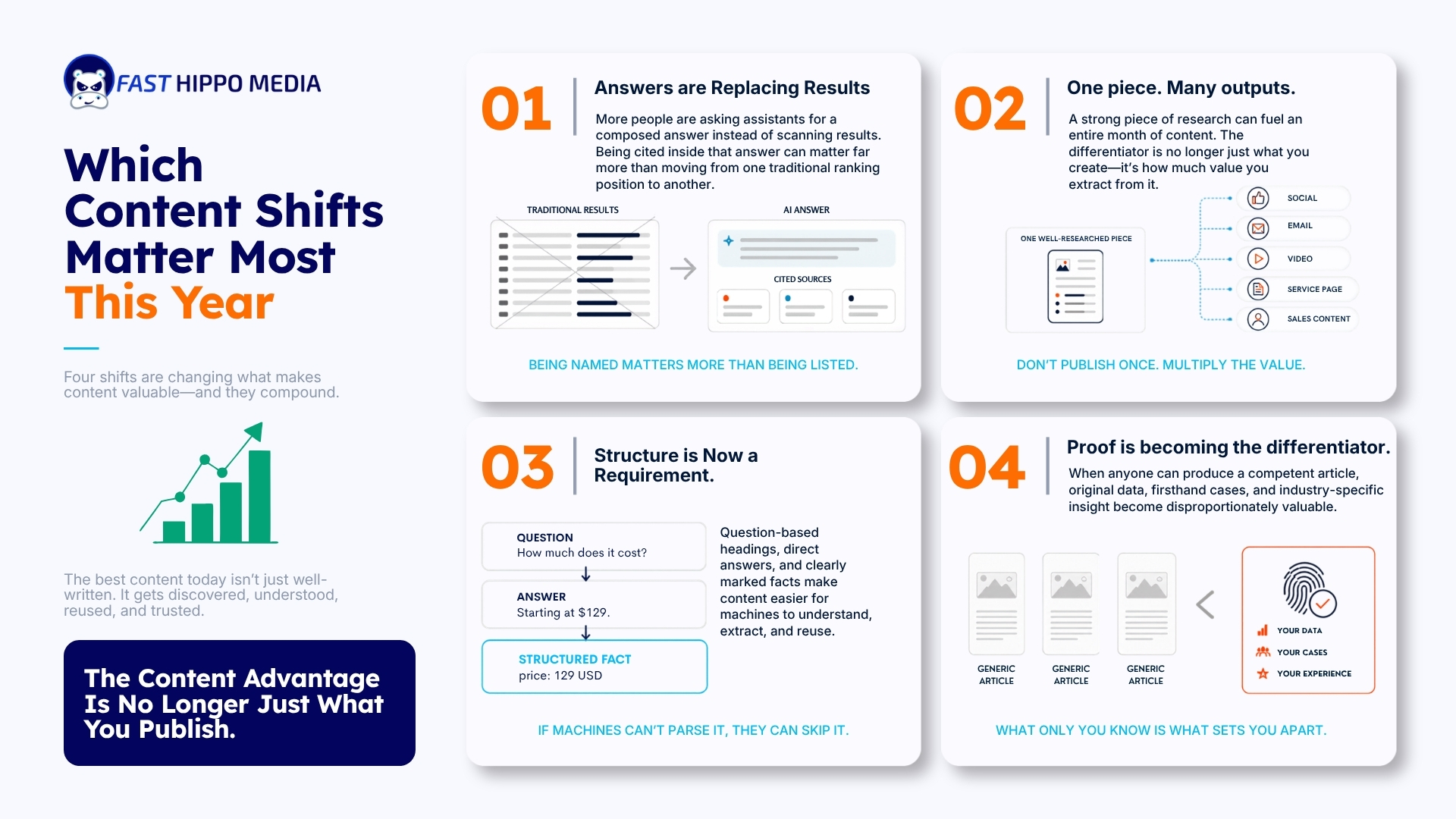
Answers replaced results for a growing share of questions: People ask an assistant and get a composed answer naming two or three sources. Ranking below that answer is not the same as being in it, and the gap between being cited and not being cited is much larger than the gap between position three and position eight ever was.
Distribution became the differentiator: One well-researched piece contains a month of social media, an email, a video script, and several sections of a service page. Most businesses extract one of those and leave the rest in the document. That is the cheapest unclaimed value in most content programmes, and it is the argument behind our .
Structure became a requirement rather than a nicety: Content a machine cannot parse cleanly gets skipped in favour of content it can. That means clear headings phrased as questions, answers in the first two sentences, and facts marked up so they are stated rather than inferred.
Proof got scarcer and therefore more valuable: When anyone can produce a competent article about anything, the only durable differentiator is something only you have: your own data, your own cases, your own corrections of things your industry repeats wrongly. In longer sales cycles this shows up first, which is what we found looking at .
How to build an AI content strategy that holds up
Four steps, in order. The order is the part most teams get wrong.
1. Decide what is worth making
Before any tool is involved. A real question customers ask that you can answer better than the pages currently answering it. If you cannot state the question in a sentence, the piece is not ready.
2. Use AI for production, not judgment
Research, structure, first drafts, variants, repurposing, alt text, and formatting. All fair game and all faster. What stays human is what to publish, whether a claim is true, and the final read by somebody who would notice if the advice were subtly wrong.
The teams that got this backwards produced more content nobody needed. We wrote up how to hold that line in practice in our guide to .
3. Make it machine-readable
Headings phrased as questions, the answer directly underneath, structured data generated from your own fields rather than pasted, and facts that agree across your website, your profiles, and your listings. Where they disagree, a system reconciling them has a reason to use somebody else.
4. Distribute deliberately, then measure being named
Publishing is the middle of the process, not the end. And the scoreboard changed: rankings still matter, but so does whether an assistant names you when asked what your customers ask. That second measurement is the one almost nobody is taking, and it is the front end of .
What stays human?
Worth being specific, because “humans stay important” is the kind of reassurance that means nothing.
Deciding what to say: Model output reflects what already exists. A position that contradicts the consensus, correctly, has to come from somebody who knows the subject.
Anything a customer will act on: Prices, timelines, code requirements, and warranty terms. A model will produce a plausible number, and it will be wrong in a way that reads correct.
Your cases and your data: The only material a competitor cannot also generate.
The final read: Not proofreading. A read by somebody who would notice bad advice.
Everything on that list got more valuable as production costs fell, not less. The people in trouble are the ones whose entire role was production.
There is a practical test for whether a piece of work belongs on this list, and it takes about five seconds: would being wrong here cost time or cost trust? A weak outline costs ten minutes. A confidently wrong permit timeline costs a reader who acts on it and every other page they might have believed. Automate the first category without hesitation. Keep a person on the second.
The same test explains why the reviewing model most teams adopted does not work. Handing a person forty finished drafts to approve puts them at the end of a process they had no input into, checking work they cannot meaningfully verify at that volume. Handing the same person the decision about what to make, and the final read on ten things instead of forty, uses the expensive resource where it changes the outcome.
Where does this leave SEO?
With two scoreboards instead of one.
Classic search still drives most measurable traffic for most businesses, and the work that earns it has not changed much: relevance, structure, technical health, and authority. What was added is a second surface where the same content is read by a system deciding whether to quote you, and where the outcome is binary rather than ranked.
The useful part is that both run on the same foundations. Clear answers help you rank and help you get cited. Structured data helps a search engine understand you and helps an assistant repeat you without hedging. Consistent facts help both. There is no separate AI content to produce; there is the same content, held to a stricter standard on ambiguity.
What changes is what you measure and in what order. Positions on the pages you fixed move first, because they respond to the work directly. Impressions on new queries follow, which tells you your content has been understood and matched to something. Whether assistants name you moves on its own timeline and is the only one that requires a person to check manually. Clicks lag everything and tell you least about whether the work is landing, which is why judging a content program on traffic in month two ends good work two months before it pays.
One caution worth carrying into next year. Every few months something gets announced that is described as the end of search, and so far each has turned out to be a change in where the answer appears rather than whether people look for one. The businesses that handled the last three shifts well were not the ones that predicted them. They were the ones whose facts were clear, consistent, and easy to verify, which happened to be what each new surface rewarded.
What to do this quarter
Three moves, in order, and none needs a new budget.
Ask the assistants what your customers ask: Five real pre-purchase questions, typed into ChatGPT, Perplexity, and Google. Write down who gets named. That list is your competitive set, and it is usually not the one you assumed.
Finish distributing your best existing piece: Not a new one. The one you already paid for. Social, email, video, and the sections of it that belong on a service page.
Pick one thing only you can say, and say it: Your data, your case, or your correction of something the industry gets wrong. One of those is worth more than a quarter of competent general articles.
If you would rather have that built and run, our work starts with what your content currently reaches and what it does not.
Frequently Asked Questions
AI runs production and analysis while humans own strategy, expertise and trust. Content gets built once and distributed across search, social and AI answer surfaces, and the businesses that win are the ones machines can read, verify and cite.
It replaces tasks rather than judgment. Drafting, resizing and reporting are automating quickly. Strategy, subject-matter expertise, editing and client trust are getting more valuable, not less. The marketers in difficulty are the ones whose entire role was production.
Use AI for volume work such as drafts, variants and repurposing, keep humans on the final edit, structure everything so machines can parse it, and distribute each piece across every surface customers check. Production speed means nothing without distribution and proof.
Yes, and it gained a second job. Classic rankings still drive traffic, and the same structured, credible content now feeds AI answers where many decisions happen before a click. SEO and AI visibility are one discipline with two scoreboards.
One general assistant, either ChatGPT, Claude or Gemini, an SEO layer once you publish regularly, schema tooling through your CMS, and analytics that track AI referrals alongside organic. Fewer tools used systematically beat larger stacks.
Directionally at best, and check the publication date. The most-quoted projection about AI in marketing was written in December 2021, with a base year that predates generative AI reaching consumers. Forecasts in a fast-moving field age faster than the field does.