(214) 272-7034
  info@fasthippomedia.com



AI belongs in your content production, never in your judgment. Automate research, first drafts, repurposing and scheduling. Keep strategy, expertise, customer stories and the final edit human. Scale only as fast as your review step can hold, because Google’s problem has never been with AI, it is with volume that nobody checked.
Why AI cannot replace your strategy
AI can write a competent blog post in ninety seconds. It cannot tell you whether that post is worth publishing.
That is not a limitation better models will fix, because the missing information is not in the model. It is in your business. Which customers are worth more than others, which objection kills the sale, what your last twenty jobs actually taught you, why the competitor down the road wins on price and loses on scheduling. None of that is in the training data.
The pattern shows up clearly in the survey work. When the U.S. Chamber of Commerce Foundation in mid-2026, employers using AI reported a positive impact on the time it takes to complete tasks at 54%, and on the quality of the work at 47%. Speed moved further than quality did. That gap is the whole design problem: AI gives you more output than you had before, and none of the judgment you needed to make it good.
What AI actually changes for a small business
Not the thinking. The distance between the thinking and the published page.
Most small businesses do not have a content problem in the sense of not knowing what to say. The owner usually knows exactly what customers ask, what they get wrong and what closes the deal. What is missing is the four uninterrupted hours it takes to turn that into a page and then the second four hours to turn that page into everything else it could have been.
That second part is where the leverage sits. One properly researched article contains a week of social posts, an email, a video script, and three sections of a service page. Getting all of that out of it used to be a rewriting job nobody had time for. It is now an editing job, and editing is fast.
The catch is that repurposing multiplies whatever it starts with. Applied to a thin post it produces thin posts in nine formats. We built our system around making the source piece good enough to be worth multiplying, which is why the human step sits at the front of it and not at the end.
What to automate, and what to keep human
The line is not about difficulty. It is about whether being wrong is recoverable.
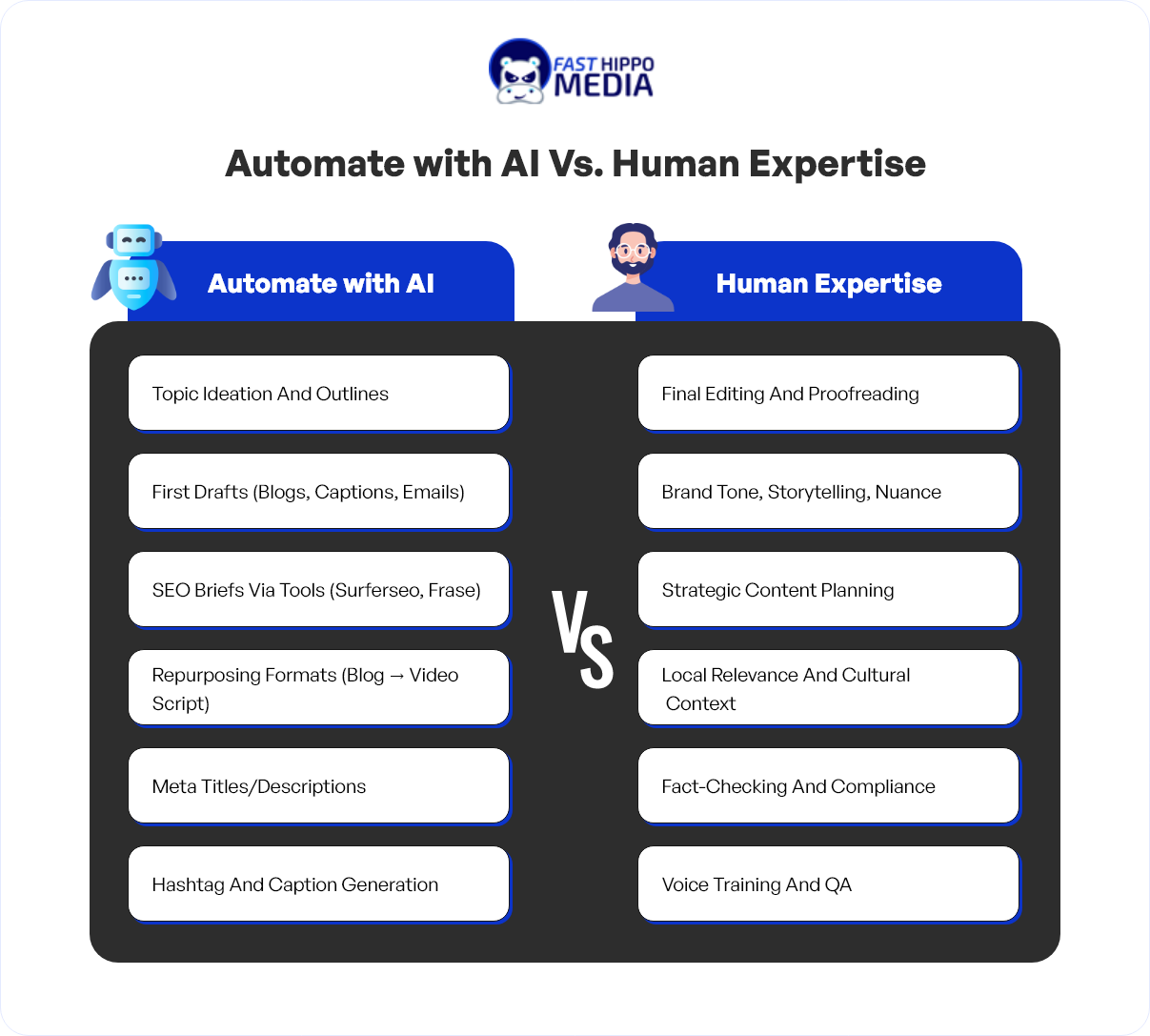
Automate
- Research and outlines: Gathering what exists on a topic and structuring it. A weak outline costs you ten minutes.
- First drafts: The blank page is the expensive part, not the editing.
- Repurposing. Turning an approved article into social copy, an email or a script.
- Meta descriptions, alt text and headings: Mechanical, high volume, easy to check.
- Scheduling and distribution: Nothing here needs a person.
Keep human
- What to write about, and why now: The one decision that determines whether the rest was worth doing.
- Anything factual about your industry: Prices, timelines, code requirements, and warranty terms. A model will produce a plausible number and it will be wrong in a way that reads correct.
- Customer stories and results: These are the only things on your site a competitor cannot also publish.
- The final read: Not a proofread. A read by somebody who would notice if the advice were subtly bad.
The rule underneath: automate the work where a mistake costs you time, keep human the work where a mistake costs you trust.
Is AI content against Google’s guidelines?
No, and the reason matters more than the answer, because most of what gets repeated about this is wrong in both directions.
Google’s , last updated in December 2025, does not treat AI as a category. What it names is a behavior: using generative AI “to generate many pages without adding value for users may violate Google’s spam policy on scaled content abuse.” The trigger is scale without value. A human typing the same empty pages by hand breaks the identical rule.
The instruction Google gives is short. “Focus on accuracy, quality, and relevance, especially when automatically generating the content.” That word “especially” is doing real work. Google is not warning you off the tool. It is telling you the tool raises the volume, and volume is what turns a quality problem into a penalty.
Two practical consequences. Nobody is scanning your page to detect whether a model wrote it; that is not what the policy describes and not how enforcement works. And publishing forty unreviewed posts this month is a genuine risk, whatever produced them.
An AI-assisted workflow that survives contact with reality
Six steps. The order is the point, because most teams that get burned did steps two through five and skipped one and six.
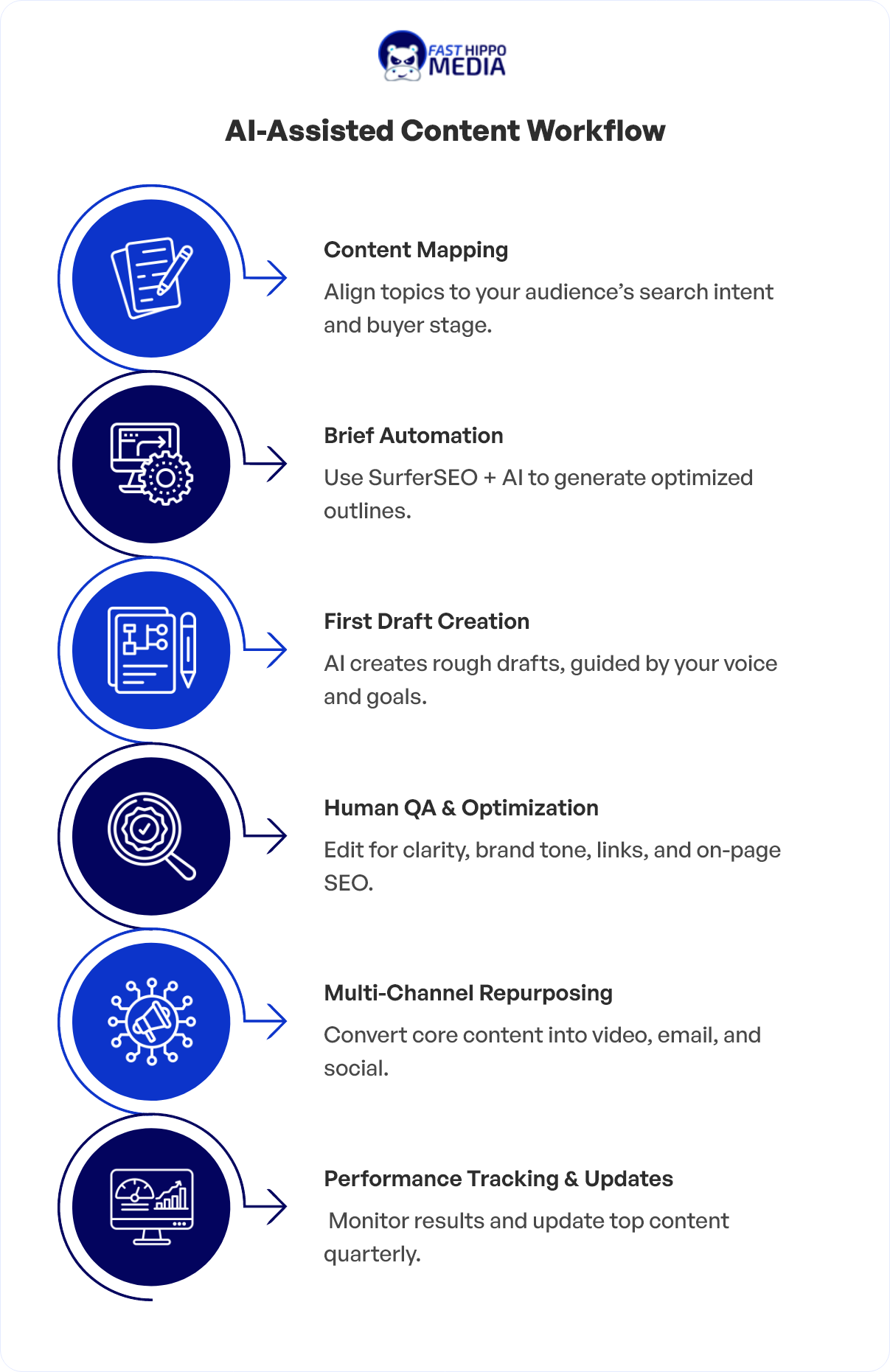
1. Decide the piece is worth making
A real question a customer asks that you can answer better than the pages currently answering it. If you cannot name the question in a sentence, stop here.
2. Brief the model properly
Your audience, what you want the reader to do, the facts that must appear, the things that must not be claimed. A thin brief produces generic copy, and then people blame the model.
3. Generate a draft, and treat it as a draft
Structure, coverage, and an argument to react to. Not copy.
4. Rewrite the parts only you can write
The opening, the examples, anything with a number in it, and the section where you disagree with the standard advice. In practice this is 30% of the words and most of the value.
5. Check every factual claim
Each figure gets a source or gets cut. This is the step that gets skipped under the deadline, and it is the one that costs you.
6. Publish once, distribute everywhere
Article, social, email, video script, and the pieces of it that belong on your service pages. This is where the time you saved actually turns into results, and it is the step most businesses never reach. Our work exists because publishing and being found are now separate problems.
The four ways AI content goes wrong
Generic voice
Every business in your category gets the same three paragraphs about quality and customer service. The fix is not a prompt asking for personality. It is a one-page voice guide with real examples of how you actually talk, supplied with every draft, plus an editor who knows the difference. Voice is preserved in the edit. It is never produced in the generation.
Structure nothing can read
Models write in flowing paragraphs. Search engines and AI assistants pull from clear headings, direct answers and consistent facts. A page can be well written and still be unquotable. Headings should be questions somebody types, and the answer belongs in the first two sentences underneath, not in the fourth paragraph.
Inaccuracy that reads correct
The dangerous errors are not the obvious ones. They are the confident, plausible, specific ones: a permit timeline, a price range, a warranty term, a statistic with no source attached. A reader who catches one stops trusting the other nineteen pages too.
Overproduction
The most common failure, and the only one Google names directly. Output scales instantly, and review capacity does not, so teams publish past the point where anybody is checking. That is precisely the scaled content abuse pattern. The ceiling on your content program is not what AI can write. It is what a person can read.
Does more AI content mean better results?
Not on its own, and the industry data on this is unusually blunt.
The Content Marketing Institute’s found that while 95% of organizations now use AI-powered applications, only 39% said content performance had improved. Productivity improved for 87%. The machines made teams faster almost immediately and made the content work far less often. We looked at what that gap means for separately, and the conclusion holds for a two-person business as well as a twenty-person team.
Read alongside the Chamber Foundation’s 54% on speed and 47% on quality, the picture is consistent across two unrelated surveys. AI is a production multiplier. Whether it multiplies something worth having is still entirely your decision.
Which AI tools should a small business start with?
Fewer than you think, and the specific brand matters less than people expect.
One general assistant: ChatGPT, Claude or Gemini. They are close enough in capability that the right answer is whichever one you will actually open. Pick one and learn it properly rather than sampling all three.
One SEO layer: such as SurferSEO or Frase, once you are publishing regularly enough for structure to matter. Not before.
The project tool you already use: Asana, Trello, ClickUp, a shared doc. Adding a new system to fix a workflow problem usually creates a second workflow problem.
Design and video, Canva and CapCut, at the point where you are repurposing into rather than only publishing articles.
Start with two. Add a tool when a bottleneck appears, never in anticipation of one.
How fast can you scale?
Faster than you expect on production, and exactly as fast as your review step allows on publishing. Those are different numbers and only the second one is real.
A business that could research and write two posts a month can draft eight with AI. Whether it should publish eight depends on one thing: whether somebody with subject knowledge can genuinely read eight. If that person can read four, the answer is four, and the other four drafts become social copy, email content and service page sections instead.
This is the calculation most teams get wrong, because production capacity is visible and review capacity is not. One inaccurate post costs more trust than ten extra posts earn.
Where to start this week
Three steps. None needs a budget.
Write your voice guide: One page. How you talk, the phrases you use, the phrases you never use, two paragraphs of your own writing as reference. Every draft from here gets it.
Pick one question and do the full loop: A real customer question, all six steps, including the source-checking step. Doing it properly once teaches more than reading about it ten times.
Decide your review ceiling before you scale: How many pieces can somebody who knows the business actually read this month? That number is your publishing limit. Everything above it goes into distribution instead of new articles.
Where this ends up is a content operation that produces more than it used to and still sounds like you wrote it, which is roughly for everybody. If you would rather have that built and run than build it yourself, can take it on.
Frequently Asked Questions
No. Google’s guidance targets content produced at scale without value for readers, however it was made. AI-assisted content that is accurate, adds something, and has been reviewed by somebody who knows the subject is fine. Unreviewed mass output is the problem, and a human writing it by hand breaks the same rule.
That is not what the policy describes. Google’s published guidance addresses scaled production without value, not the tool used. There is no advantage in trying to disguise AI assistance, and no penalty attached to it.
One general assistant, either ChatGPT, Claude or Gemini, plus the project tool you already use. Add an SEO layer such as SurferSEO or Frase once you publish regularly. Start with two tools and add one only when a bottleneck appears.
Write a one-page voice guide with real samples of how you talk, supply it with every draft, and keep a human editor who knows the business as the final step. Voice survives in the edit, not in the generation.
Drafting speed roughly triples straight away. Publishing speed is capped by review capacity, so scale to what a knowledgeable person can genuinely read and route the surplus into repurposing instead.
Anything factual about your industry that a customer would act on, your customer stories and results, and the decision about what to publish at all. Those three are also the only parts of your content a competitor cannot copy.