(214) 272-7034
  info@fasthippomedia.com



B2B buyers research alone now, and AI tools do the summarizing. Nearly every B2B marketer has adopted AI, and most are not seeing performance gains from it, which tells you the advantage has moved from using AI to having something worth summarizing. The content that wins in 2026 is expert-led, machine-readable, and honest enough to help a buyer decide without a sales call.
Something odd is happening in B2B marketing this year.
Adoption of AI tools is essentially universal, and most teams are not getting more out of their content than they were two years ago. CMI’s B2B Content and Marketing Trends: Insights for 2026, published October 2025 from 1,015 B2B marketers, found 95% say their organizations use AI-powered applications. Only 39% say content performance has improved.
That gap is the story of the year, and it explains most of what follows. When everyone can produce content faster, producing content faster stops being an advantage. What is left is having something worth producing.
What are the top B2B content marketing trends for 2026?
Three, and they reinforce each other.
Buyers research alone: Most of the evaluation now happens before anyone contacts sales, which means your content is doing the selling whether or not it was designed to.
AI systems summarize before anyone reads: A buyer asking about vendors gets a composed answer built from whatever the model can parse confidently. Ranking well is no longer the same as being described well.
Expertise beats volume, for the first time in a while: With production costs near zero, output stopped being a differentiator. What a machine cannot generate is a named expert saying something specific and defensible.
How is AI changing B2B content marketing?
Two ways, and only one gets discussed.
The obvious one: AI compresses the research phase. Tools summarize vendors, compare options, and answer questions before a buyer visits anyone’s site.
The one that matters more: AI made content production cheap for everyone simultaneously, which is why 95% adoption produced 39% improvement. If your competitor can generate the same article in the same afternoon, neither of you gained anything. The teams pulling ahead are using AI for production and humans for the part that cannot be generated: a real opinion, real numbers, and a name attached to both.
The practical test before publishing anything: could a competitor produce this from the same prompt? If yes, it will not differentiate you, no matter how well it is optimized.
How are B2B buyer expectations evolving?
Buyers now expect to get most of the way to a decision without talking to anyone.
That means the things sales used to handle in a call have to exist in writing: what it costs, who it is not for, how it compares to the obvious alternative, and what implementation actually involves. Vendors who withhold those answers to force a conversation are increasingly just removing themselves from the shortlist.
The uncomfortable version: if your pricing page says “contact us” and a competitor’s says a number, the AI summarizing both for a buyer has more to say about them than about you.
What role does data play?
First-party data is the one asset AI cannot generate, and B2B marketers are sitting on more of it than they use.
Your own customer outcomes, your own benchmark numbers, your own survey of the people you serve. That material is unique by definition; it is what earns citations from both journalists and AI systems, and almost nobody publishes it because it feels like giving something away.
The teams that do publish it find the same thing: a single original number gets referenced more than a year of well-optimized commentary.
How is personalization shifting?
Away from inserting first names and toward answering different questions for different roles.
The buying committee has not shrunk, and its members want different things. A technical evaluator, a finance approver, and an end user researching the same product need three different pages, not one page with three merge fields.
That is more work than templated personalization, and it is the version that survives an AI summary, because the model is looking for the answer to a specific question rather than a warm greeting.
What formats work in B2B now?
The format matters less than whether the content resolves something.
Comparisons that name real alternatives. Pricing guidance with actual figures. Original research. Expert commentary with a byline. Implementation detail that assumes the reader is smart.
What has stopped working is the top-of-funnel explainer that defines a term and links to a demo. Those get summarized in a sentence by a machine and never produce a visit.
The formats themselves matter less than the assumptions behind them, and several of the ones B2B teams still work from have quietly stopped being true. We unpack the main ones in content marketing myths.
How do you combine AI and human expertise?
A division of labor that most teams have backwards.
Use AI for the parts with a right answer: outlines, first drafts, variants, summarizing your own data, formatting for structure. Keep humans on the parts with a decision in them: what to claim, what to leave out, what you actually believe.
The 39% figure above is what happens when that gets reversed. Teams that gave AI the judgment work got faster at producing content nobody needed.
What we are watching next
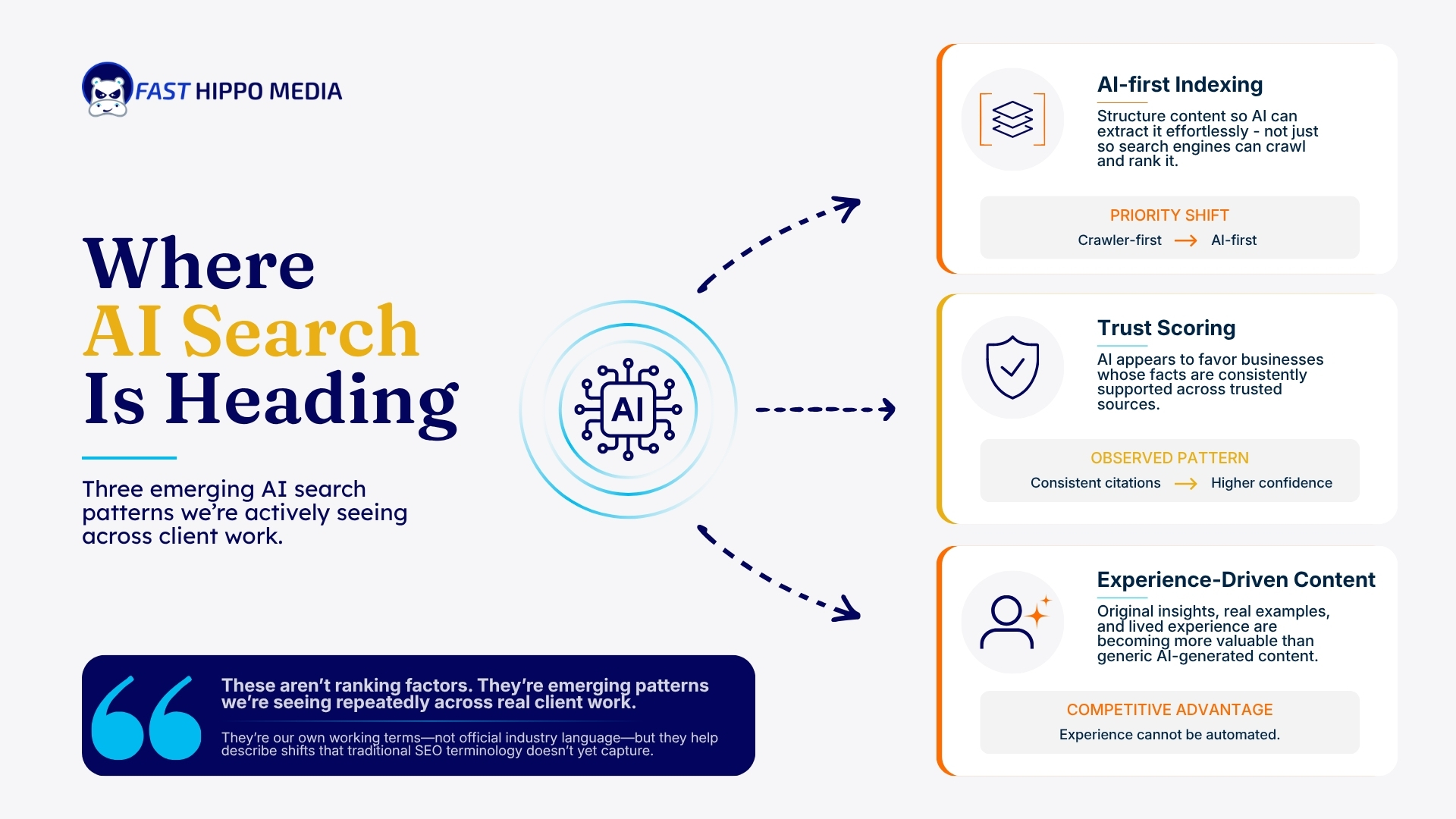
The three patterns below are our own working names for things
we are seeing across client work. They are not industry-standard terms, and we would rather name them early and be corrected than describe them vaguely.
AI-first indexing: Our shorthand for structuring content so a model can extract it cleanly, rather than only so a crawler can rank it. Same work as good structure, different priority order.
Trust scoring: Our name for the pattern where AI systems appear to favor sources whose claims are corroborated elsewhere. Nobody publishes an algorithm for this; what is observable is that consistently cited companies get named more often.
Experience-driven content: Content that could only have been written by someone who did the thing. The one category that has become more valuable as generation costs fell.
For the full grade-out of our January predictions, including which ones landed, see the midyear scorecard on our post.
What changed from 2025 to 2026?
2025: produce consistently, rank, and capture the click. 2026: produce selectively, get summarized accurately, and earn the mention.
The clearest difference is where the decision happens. In 2025 it happened on your site after a click. In 2026 a meaningful share of it happens in a summary the buyer reads before any click, which is why being described correctly now matters as much as being found.
How do you future-proof a B2B content strategy?
Three moves, in order.
Pick the problems you want to be known for: Depth on four topics beats coverage of forty. This is also what makes you summarizable: a model can describe a specialist and struggles to describe a generalist.
Put the expertise at the front: Named authors, real opinions, and first-party numbers. If it reads like it could have come from anywhere, it will be treated as though it did. This is the same discipline behind .
Treat content as a system rather than a calendar: Each piece should reinforce a topic, link into a cluster, and get distributed to the surfaces buyers and AI tools actually read. Our take on covers the mechanics.
Distribution is the part most teams underestimate, because it is the difference between publishing something and having it seen. Our seven marketing trends for content everywhere covers how one piece of expertise reaches every surface that matters.
Where to start this quarter
Audit how AI tools currently describe your company. Ask three of them what your business does, who it is for, and how it compares to a named competitor. The answers will be more useful than any keyword report, because they show you what the market is actually being told.
Then fix whatever those answers get wrong, and add the first-party evidence that would have made them right.
The companies being cited by mid-2026 mostly structured their expertise a quarter or two earlier. That is the whole advantage, and it is still available.
Frequently Asked Questions
Three carry the year: buyers researching alone and deciding before they talk to sales, AI systems summarizing and citing content instead of just ranking it, and expertise-led content beating volume. Strategy now means being the source machines and buyers both trust.
AI compresses the research phase, summarizing vendors and answering questions before a buyer visits anyone’s site. It also made production cheap for everyone at once, which is why 95% of B2B marketers use AI and only around 39% report better performance. Content wins by being citable, structured, and clearly attributed to real experts.
Self-serve depth: honest comparisons, real pricing guidance, first-party data, and expert commentary with a name attached. Formats vary, but the pattern is constant. Content that helps a buyer decide without a sales call earns the shortlist spot.
Pick the problems you want to be known for, publish genuine expertise on each, structure it so machines can parse it, and distribute each piece across the surfaces buyers and AI tools read. Depth on a few topics beats coverage of many.
Audit how AI tools currently describe your company, fix the gaps that reveals, and add first-party evidence to your cornerstone content. The brands being cited by mid-2026 are the ones that structured their expertise a quarter earlier.