(214) 272-7034
  info@fasthippomedia.com



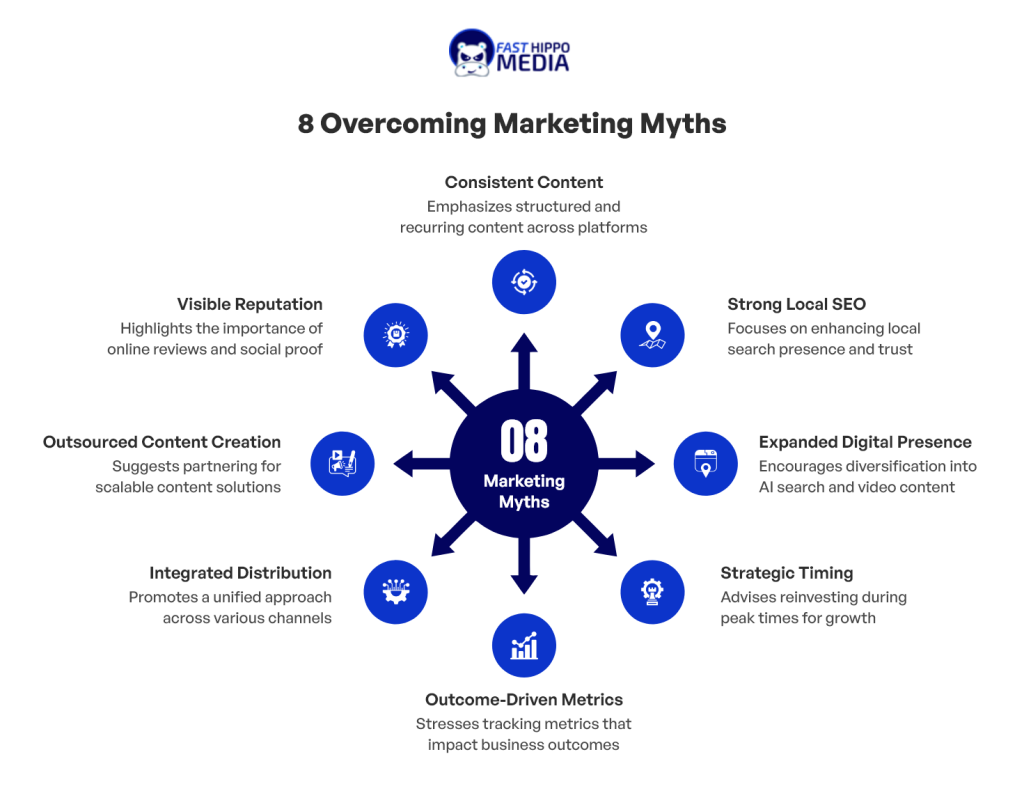
Content marketing rarely fails because the content was bad. It fails because it was treated as a one-off instead of a system. All eight objections below share that root. What works is one piece of real expertise distributed across your website, your Google Business Profile, Maps, video, and the AI tools your customers now ask directly, with each surface reinforcing the others.
The eight things we actually hear
Plenty of businesses put real time and money into content and still see nothing move. The content is rarely the problem. The strategy underneath it usually is, and it fails in one of eight predictable ways.
These are not hypothetical objections. They are the eight things we hear most often in sales conversations, close to word for word. Each one feels true when you say it, which is exactly why it survives. Below is why each one feels true, where the reasoning breaks, and what works instead.
If you only take one thing from this: publishing more is not the fix. We went into why publishing more content does not increase visibility, and every myth here is a variation on the same mistake.
Myth 1: “I’m already doing that myself”
Usually said by an owner who genuinely is doing something. A few posts a month, some photos on the profile, occasional social.
Why it feels true: you are producing content, so the box appears ticked. And you know your business better than any agency will, which means your raw material is better than most.
Where it breaks: doing the work and running a system are different jobs. Content produced without distribution reaches whoever happens to find it. The same piece structured, marked up, published to your profile, cut into video, and shaped so an AI assistant can quote it reaches people who were never going to visit your website at all. Most owner-produced content stops at step one because step two is nobody’s job.
What to do instead: keep producing, and change what happens after you publish. Take your last genuinely good piece and ask where else it should exist. That question, answered properly and repeatedly, is most of the difference between doing content and having a content system. Being quotable by AI tools is a specific discipline within that, covered in our work.
Myth 2: “We already do TV, radio, print, or Facebook ads”
Usually said by a business with real advertising spend and a real audience.
Why it feels true: those channels work. They build recognition, they fill the top of the funnel, and if you have been running them for years you have data showing they do something.
Where it breaks: advertising creates demand. It does not capture the search that follows. Someone hears your radio spot, remembers roughly who you are, and searches for you or your category later that week. If you are not there at that moment, your advertising just paid to send a customer to whoever was. That gap is invisible in your ad reporting, because the failure happens on a channel you are not measuring.
What to do instead: treat search as the capture layer for everything else you spend. Your name searched, your category searched, your city searched. If advertising is working, demand is already being created and the only question is who collects it. That is what exists to do, and it compounds rather than stopping when the campaign ends.
Myth 3: “We have a website, and an SEO guy”
The most common of the eight, and the one with the clearest answer.
Why it feels true: you paid for both. Someone built the site, someone is doing something monthly, and there are reports.
Where it breaks: Google says this plainly in its own documentation: “Just because a page meets all of these requirements and best practices, doesn’t mean that Google will crawl, index, or serve its content.” Having a compliant website is the entry ticket, not the outcome. And most SEO engagements cover the website only, while a growing share of customer decisions now happen on surfaces that are not your website: the map pack, AI answers, video, review platforms.
What to do instead: ask your current provider one question. What do we own outside the website? If the answer is rankings and nothing else, that is not a criticism of their work, it is a description of its scope. The gap is usually and the , which is often the single most visible asset a local business has and the one nobody owns.
Myth 4: “We’re already busy”
Said with justified confidence, usually by a business having a good year.
Why it feels true: you are busy. The phone rings. Marketing that promises more work sounds like a solution to a problem you do not have.
Where it breaks: busy is a snapshot, not a trend, and it hides two things. First, the mix. Being busy with low-margin work you would rather not do is a different position from being busy with the work you want. Second, the pipeline. Demand that arrives without you building it can leave without you noticing, and the businesses that struggle in a downturn are usually the ones that stopped marketing during the boom because they were busy.
What to do instead: use the busy period to build the visibility you will need later and to shift the mix rather than the volume. Content that ranks for your higher-value services changes who calls rather than only how many. That is a better use of a good year than doing nothing until the phone slows.
Myth 5: “It’s not in the budget”
Often the honest one, and it deserves a straight answer rather than a pitch.
Why it feels true: budgets are real and marketing is easy to defer, because nothing visibly breaks when you do.
Where it breaks: the comparison being made is usually marketing against zero. The more useful comparison is marketing against the other things in the budget doing the same job. Most businesses spending nothing on search are spending on something less measurable, and a content system built once keeps working, which is a different economic shape from advertising that stops the day you stop paying.
What to do instead: start with the free and the cheap, in order. Your Google Business Profile costs nothing and is usually the largest single gap. Your existing content can be distributed further without producing anything new. Fix the facts across your listings so they agree. If those three do not move anything in a quarter, you have learned something useful for very little money.
Myth 6: “We tried this before and it didn’t work”
The most important objection on this list, and the one that is most often correct about the past and wrong about the conclusion.
Why it feels true: you did try. You paid someone, content got published, and nothing happened. That is real evidence and it deserves respect rather than a counter-argument.
Where it breaks: almost every time we look at what “content marketing” meant in that engagement, it was a tactic rather than a system. A handful of blog posts, published and abandoned. Nothing distributed beyond the site, nothing structured for machines to read, nothing pointing at the services that make money, no profile work, no measurement beyond a monthly ranking report. Publishing is not the same as marketing, and testing publishing tells you nothing about whether marketing works.
What to do instead: before you try again, ask what specifically was done last time. If the answer is “we posted blogs”, you have not tested this. Ask any new provider what happens to a piece after it publishes. If they cannot answer that in detail, you are about to run the same experiment.
Myth 7: “I don’t have time”
Usually true, and usually a different objection than it sounds.
Why it feels true: you are running a business. Content requires input from the person with the least available hours, which is you.
Where it breaks: the assumption is that content requires your time continuously. What it actually requires is your knowledge, once, extracted properly. A structured conversation gives enough raw material for months of output, because the expensive part is the expertise and not the typing. What eats owner time is the wrong model: being asked to review drafts you have no context on, approve topics you did not choose, and fill gaps somebody else left.
What to do instead: front-load your involvement and then step back. An hour of genuinely detailed conversation about what your customers ask, what they get wrong, and what closes the sale is worth more than ten hours of reviewing generic drafts. Set the input properly once, then judge the output rather than producing it.
Myth 8: “We live on referrals”
The strongest business position on this list, and the most fragile.
Why it feels true: referrals are the best leads you get. They arrive pre-trusted, they convert faster, they haggle less. A business running on them has clearly earned something.
Where it breaks: what happens between the referral and the call. Somebody recommends you, and the person they recommended you to looks you up. They check your reviews, your profile, your website, sometimes they ask an AI assistant about you. That check either confirms the referral or quietly undermines it. A referred customer arriving at a profile with three reviews from 2021 and wrong opening hours has just been given a reason to hesitate, and you will never hear about it, because nobody calls to say they decided not to call.
Referrals are also finite and outside your control. They scale with your network, not with your ambition, and they disappear when a referrer retires or moves.
What to do instead: treat visibility as protection for the referrals you already earn rather than a replacement for them. Get the profile right, get recent reviews, make sure the facts agree everywhere. That work makes every referral convert better, which is a good return before it generates a single new lead.
What the eight have in common
Read them together and the pattern is hard to miss. Every one of these is a reasonable position about a piece of the problem, and every one of them assumes content is a thing you produce rather than a system you run.
The alternative is not producing more. It is taking one piece of genuine expertise and making it exist everywhere your customer might look: your website, your Google Business Profile and Maps listing, video, the review platforms people check, and the AI tools that increasingly answer the question before anyone reaches a website at all. Each surface reinforces the others. Facts that agree everywhere build confidence in a way no single channel does alone.
That is the whole idea behind our approach, and it is why the answer to most of these objections is the same answer.
Where to start this quarter
Three moves, in order, and the first one is free.
Look yourself up the way a referred customer would. Signed out, on a phone. Your profile, your reviews, your hours. Ask an AI assistant about your category in your city and see who gets named. Write down what you find.
Fix the facts before you produce anything. Hours, services, address, phone, across your site and every listing. This is dull and it is the highest-return work available to most businesses.
Pick your last good piece of content and finish distributing it. Not a new piece. The one you already paid for.
If you would rather have somebody run that audit and tell you which of these eight is actually costing you money, and we will start with what your customers currently find.
Frequently Asked Questions
A system publishes one piece of real expertise across every surface customers check: your site, Google Business Profile, Maps, video, social, and the AI tools that now answer questions directly. Blogging is one channel. A system is all of them, reinforcing each other.
Typical SEO optimizes your website for rankings. A content system also feeds the map pack, video search, and AI answers, which is where a growing share of decisions happen before anyone reaches a website. Rankings are one output of the system rather than the goal.
Yes, and an audit will show whether it should. If your agency covers rankings but nobody owns your Maps presence, your video, or your AI visibility, that gap is where a distribution system adds value without duplicating what you already pay for.
Any business whose customers research before buying: home services, healthcare, professional services, retail. The system flexes by vertical. What stays constant is one expert answer distributed everywhere the customer looks.
Profile and structure fixes tend to show movement first because they are the fastest things to change. Authority, rankings and AI citations build over months and keep building. Anyone promising page one in two weeks is selling something else, and we would rather set the expectation honestly than win the meeting.
It might not be, and the way to find out is to ask what was actually done last time. If content was published and then abandoned, with no distribution, no structured data, and no profile work, that tested publishing rather than marketing. Ask any provider what happens to a piece after it goes live.