(214) 272-7034
  info@fasthippomedia.com



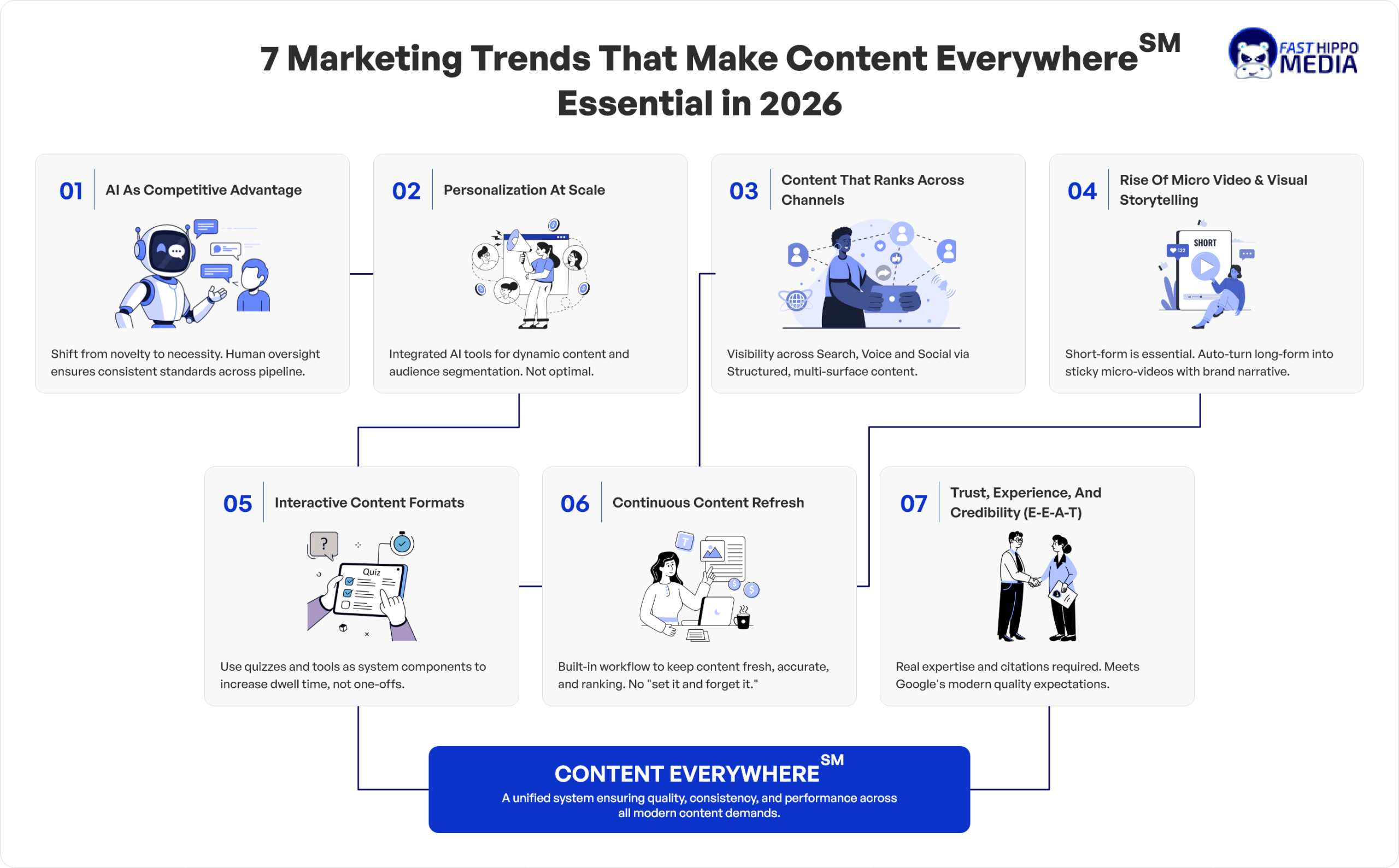
Seven shifts decide content marketing in 2026: distribution as a system, personalization at scale, ranking across search and AI answers at once, micro video, interactive formats, continuous refresh, and provable credibility. The thread running through all seven is the same: one piece of real expertise, structured once and distributed everywhere people and machines look. That is the job Content Everywhere℠ was built for.
Why 2026 is an evolution, not a disruption
Almost nothing on this list is new. What has changed is that the gap between knowing about these shifts and running them as a system has become the whole competition.
The personalization research makes the point better than any prediction could. In by StackAdapt with the research firm Ascend2, covering 450 brand and agency marketers, 93% of brands and 94% of agencies agreed that AI is improving personalization. Only one in five had fully integrated it across their channels.
That is the shape of every trend below. Near-universal agreement that something works, and a small minority actually operating it. The businesses that win 2026 are not the ones that discover these trends. They are the ones that already stopped treating them as separate projects.
We map the wider landscape in our guide to . This post is narrower: the seven that decide whether your content reaches anyone.
Trend 1: Distribution stops being an afterthought
The old model was to publish and hope. The new one is to publish once and deliver everywhere on purpose.
A single well-researched article contains a week of social posts, an email, a video script, a slide, and three sections of a service page. Most businesses extract one of those and leave the rest in the document. That is not a content problem; it is a distribution problem, and it is the most expensive one on this list because the work has already been paid for.
The shift in 2026 is that audiences no longer come to you in one place. They are on search, in AI assistants, inside social feeds, and in their inbox, and each surface reads differently. Publishing to one and calling it done reaches a fraction of the people who were interested.
That is what our system was built to solve: the source piece is made good enough to be worth multiplying, then multiplied deliberately rather than opportunistically.
Trend 2: Personalization at scale
Expectations here were set years before most businesses could meet them.
McKinsey’s benchmark research, published in November 2021, found that 71% of consumers expect companies to deliver personalized interactions, and that faster-growing companies derive 40% more of their revenue from personalization than slower-growing ones. Note what that second figure actually says: it is a share of revenue attributable to personalization, not a promise that personalization lifts revenue by 40%. The distinction matters because the overstated version circulates widely.
Five years later, the intent has caught up. The StackAdapt and Ascend2 research found 87% of brands plan to increase personalization spend in 2026. The capability gap is the story: near-universal spend, one in five running it across channels.
You do not need a CRM to start. Page-level intent is segmentation you already have. Someone on a pricing page wants something different from a first-time blog reader, and serving those two differently is personalization before any tool is involved. We looked at how this plays out for longer buying cycles in our analysis of .
Trend 3: Content that ranks across search, AI answers and social
Google is one surface now, not the surface.
The places a buyer forms an opinion in 2026: classic search results, Google’s AI Overviews, AI assistants like ChatGPT, Gemini and Claude, YouTube, and social search inside Instagram, TikTok and LinkedIn. Each has different mechanics and one shared requirement, which is that your content has to be structured clearly enough for a machine to understand and quote it.
This is where a lot of 2025-era advice went stale. Optimizing separately for each surface does not scale and mostly is not necessary. What works is writing content that answers a real question directly, marking it up so the facts are stated rather than inferred, and keeping those facts identical everywhere they appear. That is the discipline behind , and it improves classic rankings at the same time.
The practical test: could an assistant quote a paragraph of your page without hedging? If it would have to interpret you first, it will find someone easier to quote.
Trend 4: Micro video carries the weight
Short vertical video stopped being a channel and became the default format for discovery.
The reason is not that people prefer video. It is that video is the format every major platform currently promotes hardest, and reach follows promotion. A ninety-second clip explaining one thing well now travels further than the article it came from.
The practical version for a business without a studio: take the article you already published, pull the three points that stand alone, and record them plainly. Add captions, because most of the audience watches without sound. Put a clear next step at the end, because a video with no ask is a brand impression rather than a lead.
The mistake to avoid is treating video as a separate content program. It is a format for expertise you already have.
Trend 5: Interactive formats
Passive content informs. Interactive content qualifies.
A cost estimator, a readiness quiz, a comparison tool, and a configurator. These do two jobs at once: they answer a question a buyer genuinely has, and they tell you something about that buyer in the process. They also tend to earn links and mentions in a way that a well-written article does not, because they are useful in a way that is hard to copy.
Start with the question you get asked most before someone buys. If it is “what will this cost”, build the estimator. If it is “which option is right for me”, build the comparison. One useful tool answering a real question beats a dozen decorative ones.
Trend 6: Continuous refresh, not static publishing
Publishing is not shipping. Content decays, and in 2026 it decays faster because the facts underneath it change faster.
A workable cadence: cornerstone pages reviewed quarterly, fast-moving topics like AI monthly, and anything reviewed the moment a fact in it changes. What counts as a refresh is the part people get wrong. Updating the date stamp is not a refresh. Replacing a stale figure, adding a development, and correcting a claim that is no longer true that is a refresh.
This is our own editorial practice showing up as advice, which is the only reason it is on the list. Most of what makes a page stop performing is not competition. It is that the page quietly stopped being accurate.
Trend 7: Credibility you can prove
Everyone can now produce competent content. Fewer can prove it should be trusted.
Google’s position on this is published and worth reading directly rather than through interpretation. Its , last updated in December 2025, does not treat AI as a category at all. What it names is a behaviour: using generative AI “to generate many pages without adding value for users may violate Google’s spam policy on scaled content abuse.” The trigger is scale without value; however, the content was produced.
So the differentiator is not whether a human typed it. It is whether anything in it could only have come from you: your data, your cases, your named people with real credentials, and your corrections of things the industry gets wrong. We went into how to keep that intact while using AI for production in our guide to .
The uncomfortable version: if your content would read identically with a competitor’s logo on it, it is not demonstrating expertise. It is demonstrating access to the same tools everyone else has.
How we run this
Content Everywhere℠ exists because these seven trends stopped being separable. Personalization without distribution reaches nobody. Distribution without credibility gets ignored. Refresh without structure is maintenance for its own sake.
The system runs them as one workflow: research and structure the source piece properly, mark it up so machines can read it, adapt it deliberately for each surface, and keep it current on a schedule rather than when someone notices. Everything recommended in this post is something we run weekly, which is also how we know which parts of it matter and which parts are theatre.
Where to start this quarter
Three moves, in order.
Pick your last good article and finish distributing it. Social, email, video, and the sections of it that belong on a service page. You have already paid for the thinking; almost nobody collects on it.
Choose one surface you have never optimized for and make one piece work there properly. For most businesses that is AI answers or social search, not another blog post.
Put your cornerstone pages on a refresh schedule with a date attached, not an intention.
If you would rather have that built and run rather than build it yourself, and we will start with what your content is currently reaching and what it is not. For the wider view of where this is all heading, our guide to covers the surfaces that will matter next.
Frequently Asked Questions
No. Google’s published guidance is about quality rather than production method. It names scaled content produced without value for readers as the problem, however it was made. AI-assisted content that is accurate, adds something, and has been reviewed by someone who knows the subject is fine.
Use the segmentation you already have, which is page-level intent. A visitor on a pricing page wants something different from a first-time blog reader, so serve those two differently. Collect emails with a genuinely useful resource, and move to CRM-driven personalization once the list justifies the cost.
Cornerstone pages quarterly, fast-moving topics such as AI monthly, and any page the moment a fact inside it changes. A refresh means updated data, new developments and corrected claims, not a new date stamp.
Turn your most-asked pre-purchase question into a small tool: a cost estimator, a readiness quiz, or a comparison checklist. One useful interactive asset that answers a real question beats a dozen decorative ones.
Start where your buyers already decide. For most local and service businesses that is search plus AI answers, with one social platform run properly rather than four run badly. Adding a surface you cannot maintain is worse than covering fewer surfaces well.
Yes, and the production quality matters less than the clarity. Record the three points from an article you have already published, add captions because most viewing is silent, and end with a clear next step.