
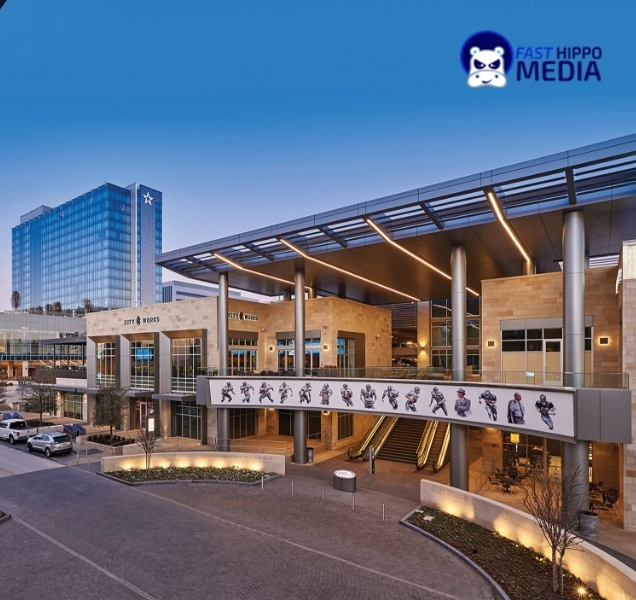
When a McAfee VP asks Claude “what’s the best agency near our Frisco office” — or an Omni Frisco guest asks Gemini “where should I have dinner near Cowboys Way” — there is exactly one cited answer. AEO is the discipline of being it. Fast Hippo Media builds Answer Engine Optimization for Star District businesses with question-form content, FAQ schema, entity reinforcement, and the citation density that AI engines reward.
No business audience in Frisco adopts AI search faster than the one inside The Star. Executives travel with Perplexity and Claude open as their default research surface. Hotel guests ask Siri and ChatGPT instead of TripAdvisor. Cowboys-org employees, professional athletes, and high-net-worth tenants of the Cowboys Way residential adjacencies treat Google’s AI Overview as the new front page of search. The blue-link audience still exists, but it is no longer the audience that drives your highest-value bookings, contracts, or covers.
Answer Engine Optimization is the discipline of being cited when those buyers ask. It is not blue-link SEO with a new label — it is a fundamentally different optimization target, with different inputs and different success metrics.
We build AEO programs for Star District businesses from our Frisco office at 7700 Preston Rd. Our methodology is purpose-built for The Star’s audience composition, search behavior, and competitive density.
Three audience segments concentrate inside The Star, and all three are heavy AI-search adopters:
Segment 1 — Corporate executives. McAfee, Comerica, Cowboys org leadership, and the regional offices of the dozens of national companies with Cowboys Way presences. AI-search penetration in this demographic is well above 60% by mid-2026. They Google less, prompt more.
Segment 2 — Hospitality guests. Omni Frisco runs 250–300 rooms a night of business and event travelers. Younger demographics inside that mix default to ChatGPT or Perplexity for restaurant, transit, and entertainment research before they touch Google or a hotel concierge.
Segment 3 — Premium locals. The high-income residents and professionals who live and work within five miles of Cowboys Way. Heavy LLM adoption, especially for research-heavy decisions in finance, healthcare, aesthetics, and real estate.
Each segment has its own AI-engine preference distribution, its own question patterns, and its own decision velocity. We build AEO programs that address all three concurrently.
AEO measurement is the youngest discipline in search. We measure what we can replicate honestly:
We do not track third-party “AI visibility scores” that nobody else can replicate.

AI engines pick which Star District businesses to cite using a process that is part algorithmic and part heuristic. From what we have observed and measured across hundreds of test queries, the consistent inputs are:

The AI engine has a clean, consistent record of who you are, where you are (with explicit Cowboys Way or The Star geographic signals), and what you do.

Industry press, Frisco-area publications, the Frisco EDC and Chamber, hospitality and B2B directories the engines treat as trustworthy, and your own structured content all feed the citation graph.

AI engines prefer content structured as questions and direct answers because it matches the format their users use to query them. We rewrite or build out pages for this structure.

Machine-readable signals confirming the structure and intent of the content.

Real, useful, exhaustive content on the topics your buyers care about — not 500-word blog filler.

AI engines weight recent content more heavily than stale content for many local and commercial queries.
Every Star District AEO engagement systematically builds all six.
Step 1 — Audience and question mapping. We profile the three Star District audience segments (executives, hospitality guests, premium locals) and map the actual question queries each segment uses for your category, drawn from real People Also Ask data, AI-engine response analysis, autocomplete patterns, and your customer call transcripts.
Step 2 — Entity rebuild. Cowboys Way address signals throughout your schema, on-page content, GBP, and citations. Distinct from “Frisco TX” — explicit and consistent.
Step 3 — Answer-first content production. Every important page restructured around question-form H2s with direct, sub-60-word answers. Every page gets FAQPage schema. Service pages get Service schema with areaServed = The Star District as an explicit Place.
Step 4 — Earned citation campaign. PR outreach to local publications (D Magazine, Frisco Style, Community Impact, Dallas Innovates), industry trade outlets relevant to your category, hospitality and B2B directories, and the niche publications where AI engines disproportionately source citations.
Step 5 — Continuous monitoring. Weekly AI Overview and LLM citation tracking for your top 25–50 question queries, with iteration cycles every two weeks.
Star District AEO engagements start at $5,500 per month. Most programs run $7,500–$15,000 monthly, often delivered as a stack with AI SEO and selective Content Everywhere℠ components. The compounding effect of running all three together is materially greater than any one alone.
Initial AI Overview citations typically appear inside 60–90 days when the foundation work is complete. LLM citation density takes 3–6 months to build because the source ecosystem refreshes on a slower cadence. We project specific category timelines in the free audit.
Especially for corporate audiences at The Star. Executive AI-search adoption is among the heaviest in the country, and B2B research now starts in LLMs more often than in Google for many categories. AEO is a leading-edge B2B play here.
Yes. The Star functions as both a place (“near The Star”) and a brand entity (“Dallas Cowboys headquarters”). The schema and content choices required to be cited for both types of query are distinct, and most agencies miss the distinction entirely.
No, and any agency telling you otherwise is selling snake oil. AEO citations follow from entity stability, real content quality, real citations in real publications, and structured data. The work is earnable; it is not buyable.
You need both. AI SEO ranks you in Google’s blue links, Map Pack, and AI Overview. AEO gets you cited by LLMs and AI engines beyond Google. The disciplines reinforce each other and share infrastructure (entity graph, schema, content stack). We deliver them together for that reason.






 (469) 677-7725
  info@fasthippomedia.com
