
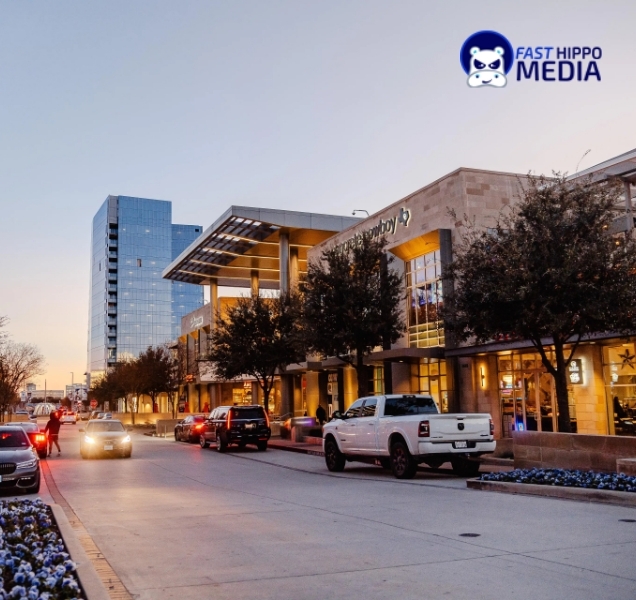
The Star is the most aggressively searched 91 acres in north Texas. Game-day spikes, hotel-guest searches, corporate B2B research, premium F&B comparison shopping — every category here has competition with deep pockets and a head start. Fast Hippo Media’s AI SEO for Star District businesses is engineered for that competitive density: technical SEO, Cowboys Way entity reinforcement, and AI Overview citation strategy built specifically for the buyer who searches from a $400-a-night hotel room or a Cowboys Fit locker room.
There is no other 91 acres in Texas where you can stand in one parking lot and see a $2-billion football headquarters, a luxury hotel running 80%+ occupancy, a 60,000-square-foot fitness club used by professional athletes, two Fortune 500 corporate offices, and a dozen of the best restaurants in DFW. The Star concentrates premium-paying, sophisticated, high-search-volume audiences into a space small enough to walk in fifteen minutes.
That concentration is opportunity and threat in equal measure. A restaurant on Cowboys Way that ranks first in Google’s Map Pack for “best steakhouse near The Star” books a different volume of $500 covers than the one in position four. A B2B vendor cited by ChatGPT when a McAfee marketing lead asks “best agency near our Frisco office” closes a different size of contract than the firm in the seventh blue link.
AI SEO at The Star is not optional. It is the gatekeeper of every revenue lever that depends on someone outside your business finding you for the first time. We run it from our Frisco office at 7700 Preston Rd, eight minutes from Ford Center.
Three forces compress Star District competition harder than anywhere else in 75034:
First, the audience does not behave like ordinary Frisco residents. Hotel guests, executives traveling for meetings, athletes and their families, event-night visitors, and high-disposable-income locals all generate search behavior with little price sensitivity and high willingness to act on first-result recommendations. That makes Map Pack and AI Overview positions worth several multiples what they’re worth in suburban categories.
Second, the competitive set is professional. Restaurants at The Star have agencies. Hotels have multi-property SEO programs. B2B vendors targeting Cowboys, McAfee, and Comerica have account-based content engines. Casual local SEO does not survive contact with this competitive environment.
Third, Google interprets The Star as both a place (“near The Star”) and an entity (“Dallas Cowboys headquarters”). The businesses that explicitly build entity associations to The Star — through schema, on-page content, citations, and reviews — get pulled into both types of search. Businesses that don’t get filed under generic Frisco and rank against the entire metro.
Hotel guests at Omni Frisco, event attendees at Ford Center, and event-night visitors searching for dinner, late-night drinks, and entertainment within walking distance. Their search behavior is location-first, time-pressured, and decision-immediate. Win the Map Pack or lose the cover.
McAfee, Comerica, Cowboys org, and the dozens of regional and national businesses with offices on or near the Cowboys Way campus. They Google specific service categories, ask LLMs for recommendations, and shortlist vendors based on a combination of authority, proximity, and case-study credibility. Their searches happen weeks before the purchase.
High-disposable-income locals and professional-athlete-adjacent audiences researching sports medicine, aesthetics, personal training, and luxury services. Heavy AI engine adoption. Branded search behavior. Reputation-driven.
A Star District AI SEO program has to serve all three audiences simultaneously without diluting any of them.

We restructure your business as an entity explicitly associated with The Star — through schema (areaServed = The Star Frisco, containedInPlace), through on-page references to specific landmarks (Ford Center, Cowboys Way address, Omni Frisco proximity), through citation density on directories that cluster around the campus, and through Google Business Profile content that geo-tags every photo.

We build separate, optimized landing pages for the three Star District audience patterns where they apply — “near me” for hospitality/F&B, B2B-intent for corporate vendor work, and lifestyle-research for premium consumer categories. Each page targets a distinct query cluster with distinct conversion mechanics.

The Star’s competitive density means a 4.6-star GBP with 80 reviews beats a 4.9-star GBP with 800 stale reviews. We build review velocity programs that ethically produce a steady stream of recent, keyword-rich reviews from the audiences that actually drive your revenue.

Citations on hotel-affiliate sites, restaurant directories, Frisco Chamber, EDC, Visit Frisco, industry trade publications, and the niche directories Google and LLM crawlers treat as authoritative for The Star’s tenant ecosystem. Earned, not bought.
Throughout: transparent reporting, a single point of contact, and Slack or email access to the team doing the work — not a portal that hides what we’re actually shipping.

We monitor your AI Overview presence for top revenue queries weekly and iterate the on-page and schema work against what is actually moving citation positions.
We do not measure success by impression count or “Frisco TX SEO ranking position.” We measure:
Reporting runs five pages and ties every metric back to revenue. No vanity dashboards.

Star District AI SEO engagements start at $5,000 per month given the competitive density. Most programs run $6,500–$15,000 monthly depending on category, scope, and how much foundational repair is needed. We quote every engagement individually after a free audit that includes a full Star District competitive analysis.
Yes — but it takes deliberate work. New entrants typically need 6–9 months of disciplined Google Business Profile optimization, review velocity, on-page entity work, and citation density before they consistently rank top three for primary categories at The Star. We have done it for multiple newcomers; the playbook is repeatable.
SEO will not close an enterprise contract on its own — but it will get you shortlisted. AI SEO builds the authority signal an enterprise procurement researcher looks for when they Google or ask Claude/ChatGPT for vendor recommendations. Combined with LinkedIn and account-based outreach, it shortens enterprise cycles materially.
It compresses the “near me” auction dramatically for an 8–12-hour window before and after each event. Businesses with strong year-round Map Pack and review signals dominate those windows. We build for that pattern explicitly — your content, posts, and ad complement positions you for the recurring event spikes.
We work with businesses inside and adjacent to The Star District. We do not disclose specific client lists publicly out of confidentiality, but we will share relevant case work under NDA during the sales process.
Yes. The Star’s entity treatment in Google (both place and brand), its competitive density, and its audience composition all require methodology adjustments. A generic “Frisco AI SEO” program will underperform here.








 (469) 677-7725
  info@fasthippomedia.com
