(214) 272-7034
  info@fasthippomedia.com



Plumbing jobs are won mid-emergency, in the map pack, and now in AI answers. A good plumbing SEO partner builds your Google Business Profile, one page per service you actually want to sell, steady recent reviews, and clean citations. Expect map movement in 60 to 90 days, with emergency keywords the last to fall. Judge agencies on calls booked, not rankings reported.
Nobody shops around for a plumber the way they shop for a car. Water is on the floor, they search, and they call one of the first names they see.
That compressed decision is what makes local search decide more of this business than anything else you could spend money on. It also means most of the advice written about SEO does not apply cleanly, because it assumes a buyer with time to compare.
This guide covers what a plumbing SEO programme should actually include, what it should cost, how long it takes, and how to tell a specialist from a generalist before you sign anything.
What does a plumbing SEO agency actually do?
Four things, and the order matters.
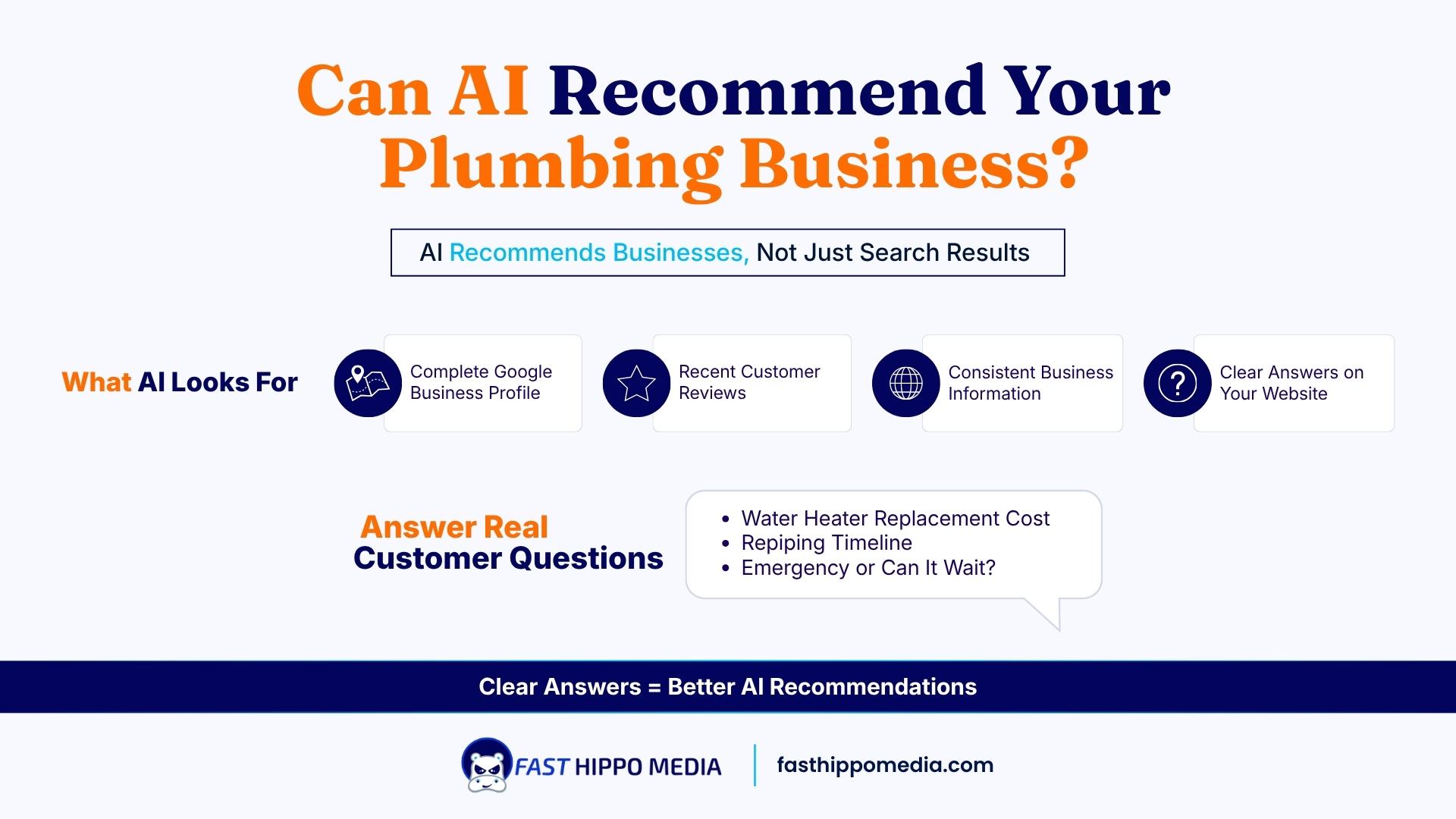
The Google Business Profile: because that is what feeds the map pack and, increasingly, what AI tools read when someone asks for a plumber nearby.
Service pages: one per job you actually want. Water heater replacement, drain clearing, repiping, slableaks, and emergency callouts. Not one “Services” page listing all of them.
Reviews are collected: a routine rather than remembered occasionally, because recency does more work here than total count.
Citations and consistency: so your name, address, and phone match everywhere a machine might check.
Everything else, the blog posts, the technical audits, the reporting, exists to support those four. An agency that leads with content volume before the profile is complete has the order backwards.
Why is local SEO more important for plumbers than national SEO?
Because the job has a radius and an expiry date.
Nobody hires a plumber two towns over when the ceiling is dripping. The searcher wants someone close enough to arrive today, which means your competition is a handful of companies inside a few miles, not the whole internet.
That is unusually good news. National SEO is a fight against everyone; local SEO is a fight against maybe a dozen businesses, most of whom have an incomplete profile and no service pages. The bar is lower than the industry likes to admit.
How does Google decide which plumbers rank at the top?
Google publishes the answer, which is rarer than you would think.
Its names three factors: relevance, distance, and prominence. Relevance is how well your profile matches what was searched. Distance is how far you are from the searcher. Prominence is how well known you are, which it explicitly ties to reviews and links.
Distance you cannot change, and that is the whole reason service-area pages exist. Relevance and prominence are both work you control, and between them they are most of what a good programme does.
One thing sitting above all of it. For plumbers specifically, appear above the map pack and above regular ads, which makes them the highest-click position on the page. They are paid, they require licence and insurance verification, and plumbing gets additional screening including possible video interviews.
Worth knowing if you are budgeting for it: the old Google Guaranteed badge is now the Google Verified badge, and the money-back guarantee that used to come with it has been retired. Google’s current documentation describes the badge as signalling that a business passed its screening process, with no guarantee attached. A lot of plumbing marketing content still promises that guarantee to readers. It is gone.
LSA and organic local are not alternatives. The reviews and responsiveness that feed your LSA ranking are the same signals that feed your map pack position, so the work compounds across both.
What makes a plumbing specialist different from a general SEO firm?
A specialist already knows the answers to questions a generalist will spend your first three months discovering.
Which service pages earn their keep and which never get searched. That emergency intent behaves differently from replacement intent and needs different pages. That your busiest months are not your competitors’ busiest months. That a review mentioning “burst pipe at 11pm” is worth more than five saying “great service.”
You are not paying an agency to learn plumbing on your retainer. Ask any prospect what they would build first for a plumbing company and listen to whether the answer is specific.
How many service pages should a plumbing website have?
One per service you genuinely want more of, plus one per area you genuinely serve.
The test is simple: if you would take the job today and you can get there in a reasonable drive, it deserves a page. If you would not, it does not, no matter how many people search for it.
Most plumbing sites have too few pages and too much on each. A single page covering water heaters, drains, and repiping ranks for none of them well, because it is not clearly about any of them. Three focused pages beat one comprehensive one every time.
Location pages follow the same rule and fail the same way. A page per suburb that swaps the town name into identical copy fools nobody. Each needs something true about that area: the housing stock, the common problems, the response time you can actually promise.
How do reviews affect plumbing rankings?
Reviews are a named prominence factor in Google’s own guidance, and for plumbing they do double duty: they move rankings and they close the call.
Recency matters more than most owners expect. A profile with sixty reviews and nothing since spring reads as a business that has stopped working, and the caller picks the company with a review from last Tuesday.
Ask at the moment the job is finished, when the customer is relieved and standing next to your work. Send a direct link so it takes one tap.
Never offer anything in exchange, and never tell a customer what to write. Both breach , and the penalty lands on your profile rather than on the customer. The same rule covers only asking the people you expect to be happy.
Reply to everything, including the bad ones, and write the reply for the next reader rather than the one complaining.
Are backlinks still important for plumbing SEO?
Less than the industry implies, and not the way most agencies sell them.
Google names links as one contributor to prominence, so they are not irrelevant. But for a local plumbing company, a mention in the local paper, a supplier’s contractor directory, the chamber of commerce, and a genuinely useful listing on a trade site do more than a hundred generic directory submissions.
The honest version: if an agency’s proposal leads with link building for a plumbing company with an incomplete Google Business Profile, they are selling what they like doing rather than what you need.
How does AEO change plumbing SEO strategy?
AI assistants now answer “Who should I call for a burst pipe?” with a name rather than a list, and that changes what visibility means.
The mechanics are less exotic than the term suggests. AI tools assemble local recommendations from live sources: your Google Business Profile, your reviews, your citations, and whatever your website says clearly enough to be extracted. If your information is thin or inconsistent, the model cannot confidently recommend you, so it recommends someone else.
Which means the work is the same work. A complete profile, consistent facts, real answers to real questions, and reviews that are recent. That is the whole overlap between ranking and being recommended, and it is why for a trade business is mostly discipline rather than novelty.
The one addition worth making: answer the questions people ask before they call. What does a water heater replacement cost? How long does repiping take? Is this an emergency, or can it wait until Monday? Those are the questions an AI gets asked, and the company that answered them in writing is the company that gets named.
How long does it take to see results?
Three stages, and the useful one comes last.
Months one to two: Profile rebuild, citation cleanup, service page structure. Map visibility usually moves first because you are correcting things that were holding you back rather than building something new.
Months three to four: Service pages start ranking and review volume builds. First measurable change in call volume.
Months five to six: Compounding. Calls become consistent rather than sporadic.
Emergency keywords fall last: they are the most valuable when they do. Those terms are the most competitive in the vertical because everyone wants them, so they take the longest and pay the most.
Anyone promising page one in weeks is describing ads.
What should plumbers look for when choosing an agency?
Three questions, and the answers tell you more than any case study deck.
What would you fix first, and why? A specialist looks at your profile, your reviews, and your service pages and names the weakest one. A generalist recites a package.
What does the monthly report measure? If it leads with keyword rankings and never mentions calls, you are buying a report. Ask to see a real one with a client’s name removed.
How do you handle AI search? This is the newest question and the most revealing. A straight answer describes profile accuracy, consistency, and structured content. A blank look tells you they have not looked at this in a year.
You can find the full picture of what a programme should cover in our guide to , and the broader marketing view in our .
How much should plumbing SEO cost?
Most plumbing SEO runs as a monthly retainer, and the range is wide because the work is not the same in every market. A single-truck operation in a small town and a six-truck company competing in a major metro are different engagements, and any agency quoting the same number for both is not looking closely.
Rather than a figure, here is how to judge a quote.
Ask what is delivered monthly: Profile management, service pages, review systems, citation work, and reporting are programs. Four blog posts and a rankings PDF are not.
Ask what happens in month one specifically: A real answer is a list of fixes. A vague one means they have not looked at your site.
Ask what the reporting measures: Calls and booked jobs, checked against your own call log, or positions on a keyword list.
Below a certain point, someone is reselling directory submissions and calling it SEO. Well above it, you are paying enterprise prices for local work. The number that actually matters is cost per booked job, and any agency that cannot discuss that is selling activity.
Your next step
If your phone is quieter than your capacity, check three things this week before you buy anything.
Your Google Business Profile: Is every service listed, are the hours right, including weekends, and is there a photo from this year?
Your newest review: If it is more than three months old, that is costing you calls now.
Your service pages: Do you have one for the job you most want more of, or is it a bullet on a combined page?
Whichever comes back weakest is where the work starts. If you would rather have someone run that check against your business and your market, that is what our does, and it starts with telling you which of the three is actually your problem.
Frequently Asked Questions
Yes, more than for almost any other trade. Plumbing demand is urgent and radius-bound; nobody hires a plumber two towns over when water is on the floor. The map pack and local results are where those jobs get decided.
Profile and citation fixes can move map visibility in 60 to 90 days. Competitive service terms take four to six months. Emergency keywords are usually the last to fall and the most valuable when they do.
A specialist already knows the service-page map, the seasonal patterns, which reviews matter, and how emergency intent behaves. You are not paying them to learn your industry on your retainer.
Ask for plumbing or home-services results they can show, reporting in calls and booked jobs rather than rankings, and a straight answer on how they handle AI search. Vague answers to any of the three are your cue to keep shopping.