info@fasthippomedia.com











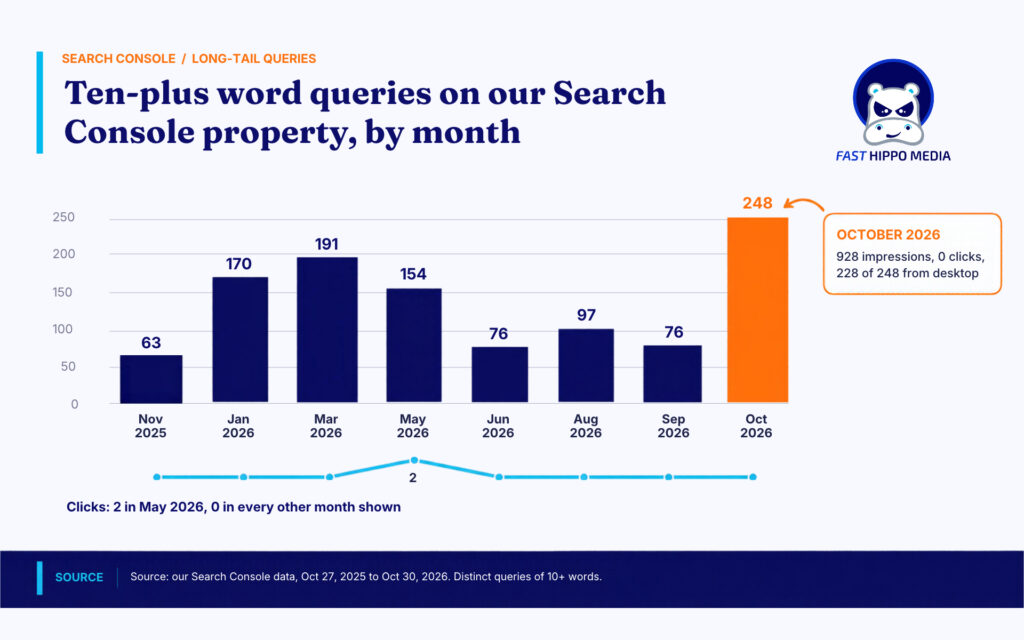
In October 2026 our own Search Console property recorded 248 different search queries that were ten words or longer, worth 928 impressions between them, and not one of them produced a click. Many do not read like anything a person types into a search bar.
Some open with a paragraph describing an imaginary buyer. Others end with an instruction to “provide a definitive answer”. We pulled a full year of these rows, compared them with the other 68 properties in our database, and checked every explanation against what Google and Microsoft actually publish. Here is what holds up and what does not.
TL;DR
Prompt-like queries are long, instruction-shaped strings showing up in the Search Console query table, and on our property they jumped to 248 distinct queries in October 2026, from 76 in September, and across a year they produced two clicks, both on one query in May. Many carry a persona preamble, and one family appeared only after October 3. Google documents two ways such rows could arise: AI Mode follow-up questions counted as new queries, and automated queries, which its spam policies say violate its terms. Nothing Google publishes says which one these are, and we do not claim to know. What we can say: they inflate impressions, pull clicks per impression down, and should be filtered before anyone reads a monthly report. Do not write pages for them.
What Counts as a Prompt-Like Query in Search Console?
For this analysis, it is any query of ten words or more in the Performance report’s query table. The cutoff is ours and blunt by design. Most ordinary searches on our property run two to six words, so a ten-word floor catches the long tail people really type plus every string that looks pasted from a chat window.
Length alone proves nothing. A real owner asking why their franchise locations rank on Google Maps but stay absent from AI answers wrote a long question, and that query sat at an average position of 2.6 in October on why a business can hold the map pack and still be missing from AI answers. Long and human is common. What sets the prompt-like rows apart is structure, so we sort them by shape rather than by length.
| Shape | What it looks like | Typed by a person? |
|---|---|---|
| Long natural question | A full question about one business problem | Usually yes |
| Persona preamble | “I am a … my main motivations: … my main pain points: …” then a question | Reads like a filled template |
| Comparison instruction | “Which is better … provide a definitive answer, along with a list of pros and cons” | Reads like a prompt |
| Glued prefix | “is it” stuck onto the front of an already complete question | Reads like a join error |
Twelve Months of Our Own Rows
The table below is every query of ten words or more on our property, month by month, from our local copy of the Search Console data (rows from October 27, 2025 through October 30, 2026). Position is impression-weighted across query rows, so it will not match the chart in the Search Console interface exactly.
| Month | Distinct queries | Impressions | Clicks | Weighted position |
|---|---|---|---|---|
| Nov 2025 | 63 | 673 | 0 | 31.8 |
| Jan 2026 | 170 | 700 | 0 | 30.4 |
| Mar 2026 | 191 | 1,090 | 0 | 14.1 |
| May 2026 | 154 | 7,108 | 2 | 7.5 |
| Jun 2026 | 76 | 2,118 | 0 | 8.4 |
| Aug 2026 | 97 | 609 | 0 | 27.2 |
| Sep 2026 | 76 | 382 | 0 | 27.5 |
| Oct 2026 | 248 | 928 | 0 | 12.5 |
Two clicks in a year. Both landed on the same query, on May 18 and May 26, 2026, and both went to our service page.
May is the outlier worth reading closely. One question about which services improve visibility in AI search overviews for small businesses in the United States collected 4,303 impressions over 19 days at an average position of 6.1. Around it sat a cluster of reshuffled siblings, the same words in a different order, each with a few hundred impressions. When the same sentence shows up rearranged eight ways inside two weeks, we read it as a template being varied rather than eight people phrasing the same thought.
The October jump, week by week
The rise was abrupt. Counting distinct ten-plus word queries per Monday-start week:
- Week of September 21: 28
- Week of September 28: 55
- Week of October 5: 109
- Week of October 12: 99
- Week of October 19: 62
- Week of October 26 (data through Thursday): 76
The October rows also share a profile. Of the 248, 228 came from desktop devices and carried 872 of the 928 impressions, and 209 came from the United States. Exactly 110 of the 248 had a single impression all month.
Yet 197 averaged a position of 10 or better, and 55 averaged 3 or better. Top-of-page positions with no clicks, mostly on desktop, mostly one impression each.
Three Templates We Can Quote
Patterns beat anecdotes, so here are the three families verbatim, with brand and vendor names removed.
The persona preamble
Sixty-six distinct queries on our property begin “I am a”. The most frequent opens with an age bracket, an industry, “my main motivations:”, and “my main pain points:”, then asks an AEO question. A second preamble describes a brand manager with a job seniority and a company headcount.
The tell is in the variables. Ten of the 66 name several age brackets at once, as in “I am a 25-34, 35-44, 45-54, or 55-64 year old”. One continues, “I work at a company with 250-1k employees, 1k-10k employees, or 10k+ employees”. Nobody describes themselves that way.
It reads as an audience segment definition pasted in whole, with the dropdown values never narrowed to one person. The longest of these strings runs to 166 words.
The comparison instruction
Twenty-six distinct queries ask which of two AEO tools is better, then finish with the same instruction: “provide a definitive answer, along with a list of pros and cons specific to” the feature in question “for each.” Every one of them first appeared on or after October 3, 2026. Every one pits the same vendor against a different rival. We have left the names out on purpose; the pattern is the finding, and the products are not our subject.
The glued prefix
Sixteen queries carry “is it” in front of a question that was already complete, for example, “is it where can i find affordable aeo services that deliver strong seo results?” These 16 collected 326 impressions between December 21, 2025 and October 30, 2026. Two words prepended to a finished sentence look like a join between a prompt fragment and a question list.
Who Sends Them? Two Mechanisms: Google Documents, and No Answer
Nobody outside Google can say, and Google has not said. Its documentation describes two mechanisms that could put strings like these in a query table, without tying either one to these rows. Bing labels AI retrieval phrases separately; Google does not, so a report reader cannot tell the two apart. Anyone who claims to know which tool sends these is guessing.
Mechanism one: AI Mode follow-ups: Google’s Search Console help on performance metrics says that if a user asks a follow-up question within AI Mode, “they are essentially performing a new query”, and that all impression, position, and click data in the new response “are counted as coming from this new user query.” The same document says AI Mode “groups the user’s question into subtopics and searches for each one simultaneously.” A long conversational follow-up would land in your query table as its own row.
Mechanism two: automated queries: Google’s spam policies define machine-generated traffic as “sending automated queries to Google,” including “scraping results for rank-checking purposes or other types of automated access to Google Search conducted without express permission,” and state that “such activities violate our spam policies and the Google Terms of Service.” None of the Google documentation we read says whether Search Console strips such queries out of the Performance report.
| Question | What Google documents | What it leaves open |
|---|---|---|
| Can a long follow-up become its own query row? | Yes, for AI Mode follow-ups | Whether these rows are AI Mode |
| Is automated querying allowed? | No, it violates the spam policies and Terms | Whether the report filters it |
| Does the generative AI report split this out? | Its tabs are pages, countries, dates, and devices | No query view at all |
| Does Bing separate AI retrieval phrases? | Yes, as grounding queries in Webmaster Tools | Nothing comparable on Google |
The privacy threshold makes it stranger
Google’s 2022 Search Central explainer on performance data says anonymized queries are “those that aren’t issued by more than a few dozen users over a two-to-three month period,” and that they are left out of the query table. A 166-word persona paragraph that clears a bar of a few dozen users would mean either the identical string is being sent many times, or the threshold works differently today than that explainer describes. We cannot tell which from our side, so we treat it as a reason for doubt rather than a conclusion.
For contrast, Microsoft’s Bing Webmaster blog introduced grounding queries in February 2026 as “the key phrases the AI used when retrieving content”, and said the data “represents a sample of overall citation activity.” Bing gives AI retrieval phrases their own labeled report. Google’s query table mixes everything into one list.
The Same Pattern Across 69 Properties
Our property is not unusual. Our database holds Search Console data for 69 properties from August 1, 2026 onward, in industries ranging from home services to retail. Of those 69, 62 show queries of ten words or more.
| Measure, Aug 1 to Oct 30, 2026 | Ten-plus word queries | All queries |
|---|---|---|
| Properties with rows | 62 of 69 | 69 |
| Impressions | 56,742 | 5,490,155 |
| Clicks | 56 | 26,843 |
| Clicks per 100 impressions | 0.10 | 0.49 |
The persona preamble, with its “my main motivations” and “my main pain points” blocks, turns up on seven of the 69 properties, including ours, in trades that have nothing to do with each other. The comparison instruction is close to unique to us: 26 distinct queries here since October 3, and one row on one other property back in March. By distinct count, our property ranks third of the 62, with 350 such queries in those three months.
The spread matters more than our own rank. A template hitting a garage door company and a marketing agency with the same “my main pain points” scaffolding is not a niche quirk of AEO searchers.
How These Rows Bend a Monthly Report
Mostly by inflating the denominator. The rows carry impressions and almost no clicks, so they pull click-through rate down. They usually rank well, so they can also pull a weighted position up and make a month look stronger than it was.
| Month | Query rows included | Distinct queries | Impressions | Weighted position |
|---|---|---|---|---|
| May 2026 | All | 5,126 | 126,390 | 28.3 |
| May 2026 | Ten-plus word rows removed | 4,972 | 119,282 | 29.5 |
| Oct 2026 | All | 2,745 | 44,220 | 25.0 |
| Oct 2026 | Ten-plus word rows removed | 2,497 | 43,292 | 25.3 |
In May, the long rows were 5.6 percent of our query-level impressions, almost all from one templated question. In October they were 9 percent of distinct queries but 2.1 percent of impressions. Small for us. On a smaller property with fewer real searches, the same few hundred impressions would be a far bigger share, and a client would be told their visibility grew when a template simply found them.
That is why impressions belong next to numbers still hold up in an AI-era search report and never on their own. A rise made of one-impression, zero-click, desktop-only rows is not demand.
Finding Them in Your Own Export, Step by Step
You can isolate these rows in the Search Console interface today, without a spreadsheet. Search Console’s filtering documentation supports regular expressions on the query dimension, using RE2 syntax, with a choice between “Matches regex” and “Doesn’t match regex.”
- Open Performance, then Search results, and set the date range to the last three months.
- Click “+ Add filter”, choose Queries, then Custom (regex).
- To see only queries of ten words or more, enter ^(\S+\s+){9,}\S+$ and keep “Matches regex”.
- Turn on impressions, clicks, CTR, and position, and sort by impressions.
- For the persona family alone, swap in my main (motivations|pain points).
- To build a clean view for a report, flip the first filter to “Doesn’t match regex” and compare.
One caution before you trust the totals. Google’s Search Console help on data considerations notes that anonymized rows are omitted from the table “but are included in the chart totals unless a query filter is applied.” Any query filter therefore drops them, so the filtered and unfiltered totals will never reconcile. Report the gap rather than hiding it.
If you would rather have someone else do the reading, this is the first pass of an SEO audit that starts from the query export rather than a crawler score.
Should You Write Pages for These Queries?
No. A page built for a persona paragraph or a “provide a definitive answer” instruction is a page built for a template, and templates do not buy anything. Our own record says so: two clicks in a year from rows that frequently sat in the top ten.
There is a more useful move. Read through the template to the question underneath and ask whether a real person asks it.
Sometimes one does: the question “how many prompts should an aeo agency realistically track daily for one client?” collected 9 impressions at position 12.0 in October with no preamble attached, and that is a legitimate topic. The persona rows that asked about AEO techniques mostly landed on our explainer on why answering questions directly matters for AI search, which took 171 of their 210 October impressions. That tells us which page a machine or a model considers the closest match. It does not tell us a buyer was there.
A short decision list worth running before any content plan:
- Strip the preamble and the instruction. Is a plain question left?
- Does that plain question appear elsewhere in the data without a template around it?
- Did any row in the family ever produce a click?
- Is an existing page already the closest match? Then improve that page instead of adding one.
If the answer to the first two is no, the row goes in a footnote, not a brief. If the plain question does turn up on its own, it belongs with the rest of our guidance on how we structure answers for AI search, written for the person and not the wrapper.
What 248 Persona Prompts Still Leave Unanswered
The honest version of this story has a hole in the middle. We know when the rows arrived, how they are built, which devices and countries they come from, and that they rarely click. We do not know who sends them, and Google’s documentation, read on November 2, 2026, does not say. We would rather print that gap than fill it with a guess about a particular tool.
What we would ask of anyone reading their own data this month:
- Count the ten-plus word rows by week. A step change like our October 5 jump deserves a note in the report.
- Separate the templated families from long natural questions before reading CTR.
- Keep the filtered view next to the unfiltered one, with the anonymized-row caveat stated.
- Re-check Google’s performance metrics help and spam policies before repeating either mechanism, since both pages change.
If your Search Console is full of these rows and you want a second pair of eyes on what is real demand and what is noise, that is part of the answer engine optimization work we do, starting with the query table rather than a promise. You can reach the team at Fast Hippo Media.
Frequently Asked Questions
They are long, instruction-shaped strings in the Performance report’s query table, often ten words or more. Some open with a persona description, some end with a command such as “provide a definitive answer”, and on our property they rarely produce a click.
Possibly, but nobody can confirm it from Search Console. Google documents that AI Mode follow-ups count as new queries, and separately that automated querying violates its spam policies. It does not say which mechanism produced any particular row, so we do not attribute them.
Report them separately. They add impressions with almost no clicks, which drags click-through rate down and can flatten weighted position. Show a filtered view beside the full one, and state that any query filter also drops anonymized rows from the totals.
Add a Queries filter, choose Custom (regex), and enter a pattern such as ^(\S+\s+){9,}\S+$ for ten or more words. Search Console uses RE2 syntax and offers both “Matches regex” and “Doesn’t match regex”, so one pattern gives both views.
No. AI Mode and AI Overviews traffic sits inside the Web search type, and the generative AI performance report groups data by pages, countries, dates, and devices only. There is no query tab, so these rows cannot be split by AI surface.