(214) 272-7034
  info@fasthippomedia.com


AI assistants now answer customers directly instead of handing them a list of links, and the businesses those answers name get the customer. Answer Engine Optimization is the work of becoming that answer: direct responses to real questions, schema markup, facts that agree everywhere, and presence on the surfaces AI systems read. It runs alongside SEO rather than replacing it, and since February 2026 you can measure it in a free report.
What is Answer Engine Optimization?
AEO is structuring your business so AI systems can understand it, verify it, and repeat it.
Traditional search gives someone ten links and lets them choose. An answer engine chooses for them. ChatGPT, Perplexity, Google’s AI summaries, Copilot and voice assistants all do the same job: read the available sources, decide which ones can be trusted, and produce a single answer naming a small number of businesses.
The optimization target moved accordingly. SEO earns a position on a page of results. AEO earns the mention inside the answer, which is a different job with different requirements. A page can rank well and never be quoted, because ranking rewards relevance while quoting rewards clarity and verifiability.
Why this stopped being a prediction
Because the answer layer is now where the decision happens, and it is being measured.
For most of 2024 and 2025 you could argue AEO was early. That argument closed. AI assistants are a default research step for a large share of buyers, the major platforms are commercialising the answer surface, and, as of February 2026, one of them will show you exactly how often your pages are cited in AI answers. A discipline with a report attached is not a prediction.
Here is the practical shape of it. When somebody asks an assistant for a plumber, a dentist, or a supplier, they get two or three names and a reason for each. Everyone else is absent. Not ranked lower, absent, because the answer has no page two. The gap between being cited and not being cited is much larger than the gap between position three and position eight ever was.
How AI answer engines actually work
They read, they judge, and only then do they answer.
A model building a response gathers sources, decides which claims it can state without hedging, and assembles an answer from the ones it trusts. Anything it had to interpret carries risk, and the safe move is to use a clearer source instead. That single behavior explains most of what AEO asks you to do.
What surprises most business owners is how mechanical the access layer is. Take ChatGPT. OpenAI , and it runs separate ones for separate jobs: “OpenAI uses OAI-SearchBot and GPTBot robots.txt tags to enable webmasters to manage how their sites and content work with AI.” The settings are independent. In OpenAI’s own example, “a webmaster can allow OAI-SearchBot in order to appear in search results while disallowing GPTBot.”
That distinction matters more than almost anything else on this page. GPTBot is about training. OAI-SearchBot is about whether ChatGPT can surface and cite you. A great many sites blocked GPTBot during 2024 and 2025, reasonably, to keep their content out of model training. Some blocked the search crawler at the same time, or blocked AI agents wholesale, and quietly removed themselves from the answers they now want to appear in. OpenAI is explicit about the third agent too: “ChatGPT-User is not used to determine whether content may appear in Search.”
If an AI assistant never names your business, check your robots.txt before you rewrite a single page. It is a five-minute check and it is the first thing we look at. The wider mechanics of how machine learning reads a page are covered in our guide to .
AEO vs SEO: what is actually different
They share foundations and diverge on the goal.
SEO optimizes for placement. Keywords, links, technical health, and content depth, aimed at ranking a page for a query. The output is a position.
AEO optimizes for citation. Direct answers, structured data, consistent facts, and third-party corroboration, aimed at being the source a machine repeats. The output is a mention.
The overlap is large and worth being honest about. A fast, well-structured, authoritative site does better at both. Schema helps both. Clear writing helps both. What AEO adds is a stricter standard on ambiguity, because a search engine can rank a page it only partly understands, and an answer engine will simply skip it.
Which is why we treat them as one program rather than two budgets. Our goes into where the work genuinely differs for a smaller business.
How to optimize for answer engines
Six steps, in the order that produces results.
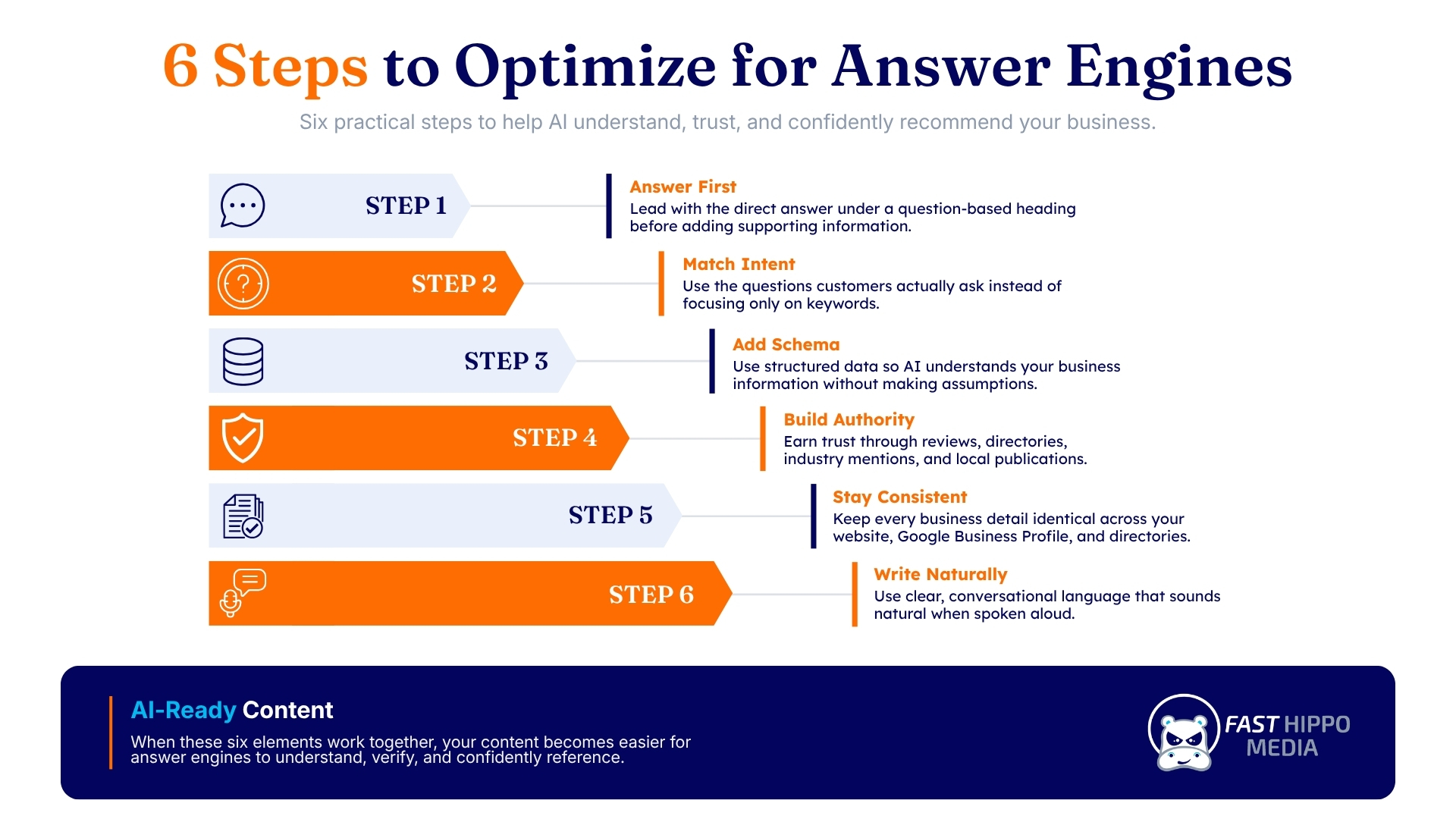
1. Write answers, not articles: Put the response in the first two sentences under a heading phrased the way a customer would ask. Background can follow. A section that takes four paragraphs to reach the point will not be extracted.
2. Match the intent, not the keyword: People ask answer engines full questions: how much, how long, is it worth it, what happens if. Those are the headings. A keyword phrase is not a question and answer engines are not matching strings.
3. Add structured data: Mark up your business, your articles and your FAQs so your facts are stated rather than inferred. Our guide to covers which types still earn rich results, which quietly stopped, and why FAQ markup is still worth shipping for a reason unrelated to Google.
4. Build authority off your own site. Answer engines corroborate. Reviews, directory listings, industry publications and local press all feed the judgment about whether you can be trusted, and they carry more weight than anything you say about yourself.
5. Keep every fact identical everywhere. Your website, your Google Business Profile, your listings. Where they agree, a model has a fact. Where they disagree, it has a problem, and the safe response to a problem is to name a different business.
6. Write for spoken answers. A voice assistant returns one result and cannot show a list. Short sentences, plain phrasing, and the answer stated outright.
How to measure it
This is the question every business asks about AEO, and until recently the honest reply was that you could not measure it directly. That changed.
In February 2026 Microsoft launched an , covering citations across “Microsoft Copilot, AI-generated summaries in Bing, and select partner integrations.” It reports four things:
- Total citations: “the total number of citations that are displayed as sources in AI-generated answers”
- Average cited pages: “the average number of unique pages from your site that are displayed as sources in AI-generated answers per day”
- Grounding queries: “the key phrases the AI used when retrieving content that was referenced in AI-generated answers”
- Page-level citation activity: “citation counts for specific URLs from your site”
That third one is the interesting one. Grounding queries tell you what the AI was actually trying to answer when it reached for your page, which is a different and more useful thing than the keyword you thought you were targeting.
It is free, it takes a verified property to switch on, and it covers one family of surfaces rather than all of them. Nobody publishes the equivalent for ChatGPT or Perplexity yet, so the honest position is that AEO is now partially measurable rather than fully measurable. That is still a long way from the guesswork this discipline started with, and it is the first place we point a client who wants to know whether any of this is working.
Where AEO works hardest
Any business a customer asks about by category rather than by name.
Dentists: “Who is the best dentist near me for implants” is a question an assistant answers with two or three names. Practices with complete profiles, consistent details and clear procedure pages get named; the rest do not appear. The full picture is in our guide to .
Plumbers and trades: Emergency searches are the purest form of this. Nobody comparison-shops a burst pipe, they ask, they get a name, they call it. What decides the name is covered in our .
E-commerce: Product questions increasingly get answered rather than listed, and the products that get named have clean structured data behind them. That is what our work is built around.
Professional services: Anyone answering “how much does this cost” or “how long does this take” is competing to be the source of that number, and the source of the number tends to get the enquiry.
How AEO helps a small business specifically
It rewards the thing a small business actually has, which is knowing the answer.
Ranking has always favoured the site with more pages, more links and more budget. Being quoted favours the source that answers clearly and can be verified, and neither of those is bought. A two-person firm with precise, honest, well-marked-up answers can be cited alongside a national brand, because the model is not weighing your marketing budget. It is deciding whether it can repeat what you said without being wrong.
That is the most genuinely level thing to happen in search in a long time, and it has a short window attached, because it stops being an advantage once everyone does it.
The role of an AEO agency
Most of what is sold as AEO is SEO with the acronym changed. It is worth knowing the difference before you buy.
The work is not glamorous. It is auditing what answer engines can currently see, fixing the access layer, restructuring content so answers are extractable, marking up the facts, making every listing agree, and building the third-party corroboration that makes a model confident. Then measuring, now that measuring is possible.
We run this as , which is our own system rather than a repackaged checklist, and it is where every recommendation on this page comes from. That is also how we know which parts of it matter and which parts are theatre: we do this for clients every week and we see which changes move citations and which ones do not.
If you want the underlying visibility argument in more depth, our post on covers the mechanism, and our page covers what an engagement looks like.
Where to start this quarter
Four steps, in order, and the first two are free.
Ask the assistants your customers’ questions. ChatGPT, Perplexity, Google. Type the five questions that precede a purchase in your category and see who gets named. That list is your competitive set, and it is often not the one you assumed.
Check your robots.txt. Confirm you are not blocking the crawlers that decide whether you can be cited. This is the most common silent cause of absence and the fastest thing on this list to fix.
Turn on the AI Performance report in Bing Webmaster Tools and let it collect. It costs nothing and in a month you will have real citation data instead of an opinion.
Fix the gaps the answers revealed. Usually a handful of questions you have never answered directly, facts that disagree between your site and your profiles, and pages that bury the answer four paragraphs down.
If you would rather have that audited and built properly, can start with what the answer engines can currently see about your business, which is usually the most uncomfortable and most useful hour of the engagement.
Frequently Asked Questions
AEO is structuring your content and web presence so AI systems such as ChatGPT, Perplexity, Google’s AI summaries and voice assistants can understand it, trust it, and cite it when they answer questions. SEO earns a position on a page of links. AEO earns the mention inside the answer.
Because AI assistants increasingly make the recommendation themselves, naming two or three businesses instead of listing ten. There is no page two in an answer, so a business the engines cannot read and verify is absent rather than ranked lower.
By making your expertise legible to machines: direct answers to real questions, schema markup, facts that match across your site and profiles, and corroboration from the third-party sources AI systems trust. Visibility follows verifiability.
No. They share foundations and reinforce each other. Rankings feed the indexes answer engines read, and AEO structure improves classic results too. Businesses need both, run as one program rather than two budgets.
Partly, and more than before. Since February 2026 the AI Performance report in Bing Webmaster Tools shows total citations, cited pages, page-level citation counts, and the grounding queries behind them, across Copilot and Bing AI summaries. No equivalent exists yet for ChatGPT or Perplexity.
Check your robots.txt first. OpenAI runs separate crawlers, and the one governing whether you can appear in ChatGPT search is OAI-SearchBot, not GPTBot. Sites that blocked GPTBot to opt out of AI training sometimes blocked the search crawler too and removed themselves from answers without meaning to.
Ask AI tools the questions your customers ask and see who gets named. Then close the gaps those answers reveal: clear answer pages, schema markup, consistent business facts, and distribution of your expertise onto the surfaces the engines cited.