(214) 272-7034
  info@fasthippomedia.com



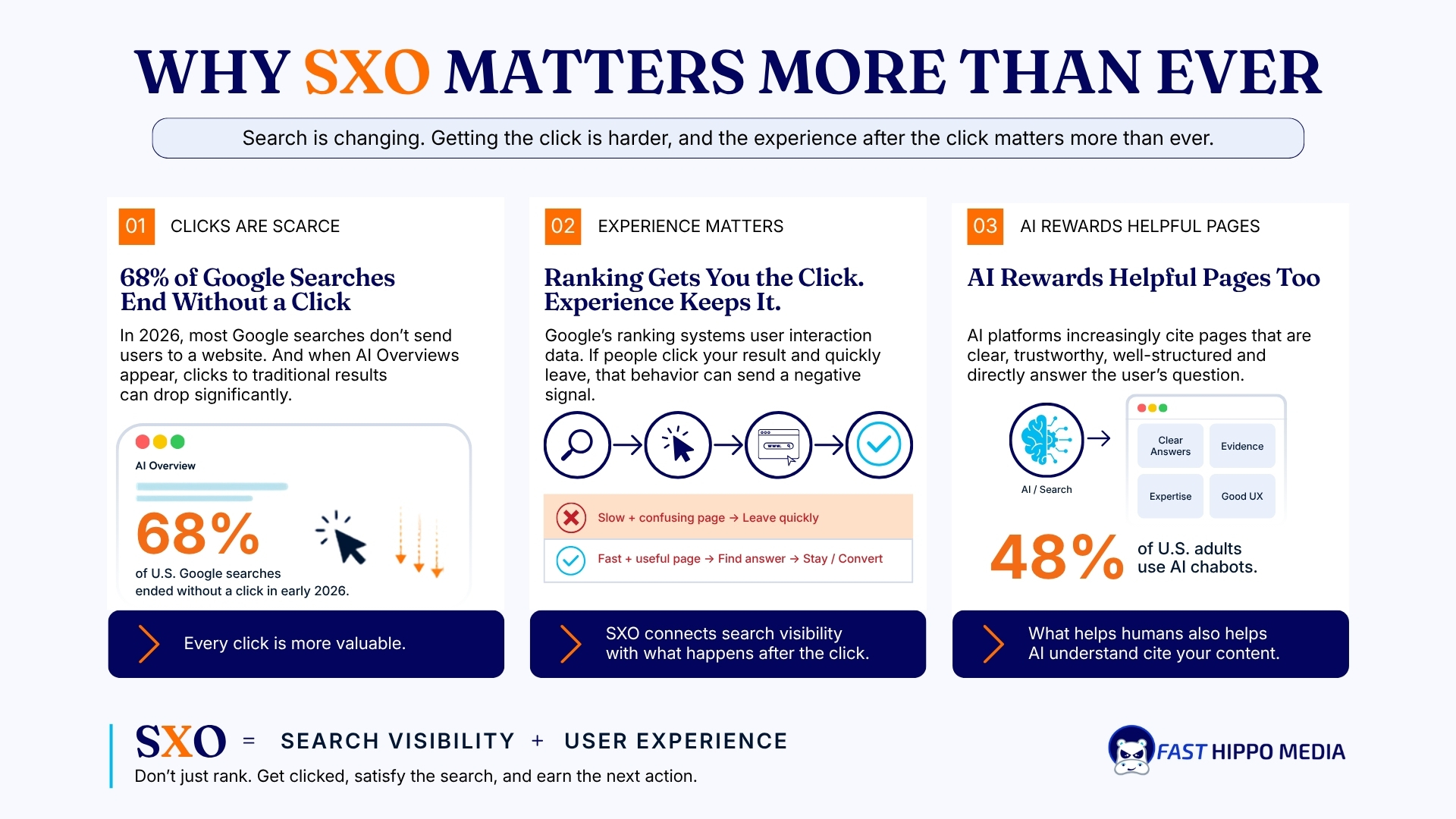
SXO combines SEO with user experience and conversion optimization: rankings get you seen, the experience gets you chosen. It matters now because 68% of U.S. Google searches end without a click and click-through rates drop nearly 60% when an AI Overview appears, so the clicks that survive are worth more than ever. The DOJ antitrust trial confirmed Google uses searcher behavior through Navboost, which makes what happens after the click a ranking input. Adapting means answer-first content, passing Core Web Vitals, one clear next step per page, and treating your Google Business Profile as a landing page.
For most of the last two decades, search marketing had a clean handoff. The SEO team got you ranked, the click arrived, and whatever happened next was someone else’s problem. That model quietly died. Google now resolves most searches without a click, AI engines answer questions before a website ever loads, and the visits that survive go to pages that satisfy people fast. Search Experience Optimization (SXO) is the discipline that grew up around this new reality. Here’s what it is, why it matters more than any acronym since SEO itself, and how to adapt without rebuilding your whole marketing program.
What Is SXO?
Search Experience Optimization (SXO) is the practice of optimizing the full search journey, from the moment someone types a query (or asks an AI) to the moment they finish what they came to do on your site. It combines traditional SEO with user experience design and conversion optimization, so a page ranks, earns the click, and satisfies the visitor.
The term has floated around the industry for years, mostly as a rebrand of “SEO plus UX.” What changed in 2025 and 2026 is the math behind it. When clicks were plentiful, a mediocre landing page could still win on volume. Now that roughly two out of three searches end with no click at all, every visit you do earn carries more weight, and search engines are paying closer attention to what happens during that visit.
Why SXO Matters Now
Clicks are scarce and getting scarcer
SparkToro’s 2026 analysis of Similarweb clickstream data found that 68.01% of U.S. Google searches ended without a click to any website during the first four months of 2026, up from 60.45% in 2024, a 7.6-point jump in two years. The same study reports that AI Overviews now appear on more than 20% of Google searches, and that click-through rates drop by nearly 60% when they do, citing research from Ahrefs. Post-purchase survey data from NP Digital covering 85 businesses found Google is now the third most common way buyers discover a brand, behind social media and word of mouth. Fewer clicks mean each one is worth more, and wasting one on a page that loads slowly or buries the answer is a cost you can feel in revenue.
Google measures what happens after the click
For years, Google’s public position was that it doesn’t use dwell time or click behavior as a ranking signal. Then the Department of Justice antitrust trial put internal documents on the record. Navboost, one of Google’s core ranking systems, draws on 13 months of user click and interaction data to adjust results. We’ve treated this as settled ever since the trial exhibits became public: how searchers behave on your page influences whether Google keeps sending them. A page that ranks, gets clicked, and gets abandoned in four seconds is telling Google something. So is a page that ends the search.
AI engines reward the same things
ChatGPT, Perplexity, and Google’s AI Mode cite pages that answer questions directly, load cleanly, and show real expertise. Pew Research puts AI chatbot usage at 48% of U.S. adults, and the same NP Digital data shows about one in six buyers already discovering brands through AI tools. The pages these engines quote look a lot like the pages humans prefer: clear structure, fast answers, evidence. Optimizing the experience and optimizing for AI citation turn out to be mostly the same work.
SEO vs SXO: What Actually Changes
None of the SEO fundamentals go away. The job description gets longer.
| Comparison | Traditional SEO | SXO |
|---|---|---|
| Goal | Rank and earn the click | Rank, earn the click, and finish the job |
| Ends when | The visitor lands on your page | The visitor gets what they came for |
| Core metrics | Rankings, impressions, clicks | Engagement, task completion, conversions |
| Team involved | SEO specialists | SEO, UX, and CRO working together |
| Question it answers | “Can people find us?” | “Was it worth finding us?” |
The Four Pillars of SXO
1. Intent match
Before design or speed matter, the page has to be the right kind of page. If someone searches “best CRM for roofing companies” and lands on your product homepage, no amount of polish saves the visit. Match the format to the intent: comparison queries get comparisons, how-to queries get instructions, local queries get location pages with real local proof.
2. Page experience
Google’s Core Web Vitals put numbers on what “fast” means: main content visible within 2.5 seconds (LCP), response to taps within 200 milliseconds (INP), and no layout shift bouncing the page around as it loads (CLS under 0.1). Most of these are technical SEO fixes, not redesigns. Mobile is the floor, since that’s where most local and commercial searches happen. And kill the pop-up that ambushes visitors two seconds in. You paid for that click.
3. Answer-first content
Put the answer where a scanner finds it in five seconds: a direct summary up top, headings that read like the questions people actually ask, short paragraphs, an FAQ that handles the follow-ups. This is the same structure AI engines quote, which is why we build every Fast Hippo Media blog post this way, this one included.
4. A frictionless next step
A satisfied visitor with nowhere to go is a wasted visit. Every page needs one obvious action: call, book, request the audit, or read the deeper guide. One. When a page tries to accomplish four things, it accomplishes none, and your analytics will show it as a high-bounce mystery.
Your Google Business Profile Is a Landing Page Now
For local businesses, SXO extends past your website to the place many searches now end: the Google Business Profile. A customer can find you, evaluate you, and contact you without ever seeing your homepage. That means the profile deserves landing-page treatment. Reviews are your social proof, photos are your design, the Q&A section is your FAQ, and the booking link is your call to action.
What that looks like in practice:
- Complete every field and be precise with your primary category. Category choice moves rankings more than most owners realize.
- Respond to every review, good and bad, within a few days. Prospects read the responses as closely as the reviews.
- Add fresh, real photos monthly. Stock photography on a profile reads as a vacancy sign.
- Seed the Q&A section with the questions your front desk answers every week.
- UTM-tag your website link so profile traffic shows up honestly in Analytics.
Google’s local rankings respond to engagement with the profile (calls, direction requests, bookings), so the experience and the visibility feed each other. Most SMBs we audit pour everything into the website and treat the profile like a directory listing. Customer behavior runs the other way.
How to Adapt: A Practical Sequence
- Run the journey yourself. Take your ten most valuable queries, search them on your phone, click your result, and try to do what a customer would do. Note every point where you hesitate. This audit costs nothing, and it embarrasses almost everyone.
- Map intent before rewriting anything. For each target query, decide what the searcher is trying to accomplish, then check whether the ranking page is built for that job. Fix mismatches before touching the design.
- Fix the vitals. Run your key pages through PageSpeed Insights and prioritize real-user data over lab scores. Slow LCP on mobile is the most common failure we see and usually the cheapest to fix.
- Restructure top pages answer-first. Add a summary up top, convert headings into questions where it’s natural, and add an FAQ with schema markup so both Google and AI engines can lift your answers cleanly.
- Give every page one job. Pick the single next step you want from each page and make it unmissable. Cut competing CTAs.
- Bring your Google Business Profile into the funnel. Treat it with the checklist above and review its performance monthly alongside your website metrics.
- Change what you report. If your monthly report leads with rankings, it’s measuring 2019. Lead with engaged visits, conversions by landing page, and profile actions. Rankings become a diagnostic, which is what they always should have been.
Where SXO Meets Content Everywhere℠
SXO governs what happens once someone finds you. Our Content Everywhere℠ methodology governs being findable in all the places search now starts: Google, AI engines, social platforms, YouTube, and podcasts. Publish once, amplify everywhere, then make sure every landing spot finishes the job. Two halves of the same funnel, and running one without the other leaves money on the table.
See how your search experience holds up
Request a free visibility audit from Fast Hippo Media. We’ll show you where searchers find you, where they drop off, and what to fix first.
FAQs: Search Experience Optimization
SXO stands for Search Experience Optimization. It is a digital marketing discipline that combines search engine optimization (SEO), user experience (UX) design, and conversion rate optimization (CRO) to improve the entire journey from search query to completed action on a website.
Traditional SEO focuses on earning rankings and clicks from search engines. SXO includes those goals and adds what happens after the click: how quickly the page loads, whether the visitor finds their answer, and whether they take the next step. SEO gets the visit. SXO makes the visit count.
No. SXO builds on SEO rather than replacing it. Keyword research, technical health, and authoritative content are still required. SXO adds user experience and conversion optimization on top, because search engines increasingly reward pages that satisfy visitors, and because fewer total clicks make each visit more valuable.
For local businesses, the Google Business Profile is often where the search experience starts and ends. SXO treats the profile like a landing page: complete information, accurate categories, fresh photos, answered questions, and prompt review responses. Profile engagement, such as calls and direction requests, supports local visibility.
Measure the full journey instead of rankings alone. Useful metrics include engagement rate and conversions by landing page in Google Analytics, Core Web Vitals scores, and Google Business Profile actions such as calls, bookings, and direction requests. When those move together, the experience works. Our client case studies show what those numbers look like when the work lands.
It helps. AI engines tend to cite pages with clear structure, direct answers, and demonstrated expertise, which are the same qualities SXO builds for human visitors. Answer-first formatting, FAQ sections, and consistent entity signals make content easier for AI systems to quote, the core of answer engine optimization.

Yagnesh D.
CTO