(214) 272-7034
 info@fasthippomedia.com


TL;DR
Affordable answer engine optimization is not about finding the cheapest provider. It is about matching spend to the work that actually moves AI visibility: useful content and clean structure, and skipping the padding. Google says the biggest factor is genuinely useful content, so a focused, honest program beats an expensive one built on secret formulas.
Everyone wants AI search results without overpaying, and the market makes that hard because AEO pricing ranges from a few hundred dollars to tens of thousands a month, with little to explain the gap. The good news is that Google has quietly told you where the value is, and once you know that, affordable stops meaning cheap and starts meaning well-spent. This is how we think about pricing our own answer engine optimization work, laid out so you can judge any provider, including us, on the same honest terms rather than on the number alone.
Affordable Is Not the Same as Cheap
The first trap is treating price as the only variable. Cheap AEO usually means one of two things: a provider doing almost nothing for a small fee, or a provider cutting the parts that matter. Both waste money, because a program that does not move your AI visibility costs you every dollar you spend on it, regardless of how small the invoice looks.
Affordable means something different. It means the money goes to work that changes outcomes and not to overhead, jargon, or a proprietary formula that does not exist. A focused program at a fair price will beat both the bargain-basement provider who does nothing and the premium agency charging for mystique. The goal is value, getting real results for a sensible spend, not the lowest number on the quote. A slightly higher invoice that actually gets you cited is cheaper, in every way that matters, than a small one that changes nothing.
Where the Real Value Actually Sits
Here is the fact that reshapes the whole pricing question. In its guide to optimizing for generative AI features, Google states that structured data is not required for generative AI search, that there is no special markup you need, and that what influences your presence in AI search more than anything else is content people find unique, compelling, and useful.
Read that again as a buyer. The single highest-value input is quality content, which is work you can partly do yourself and which no provider can charge a secret premium for. Google’s AI features documentation reinforces it: there are no special optimizations required beyond being indexed and eligible for normal snippets. That means an affordable, effective AEO program is mostly clear content, sound structure, and consistent entity data. Anyone charging enterprise prices for a magic AI technique is charging you for something Google says does not exist.
The Pricing Models You Will Encounter
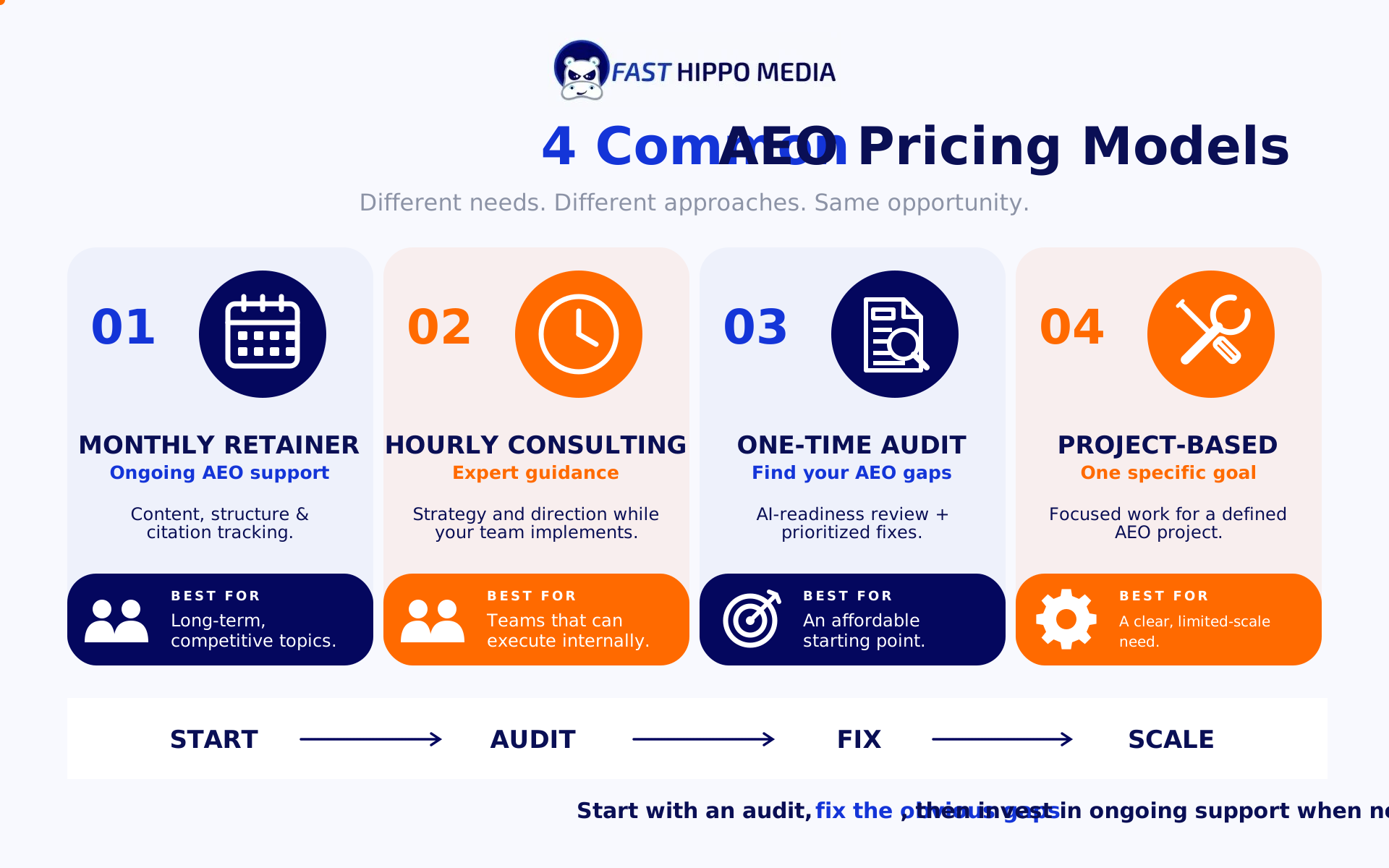
AEO is sold in a few shapes, and knowing them helps you match spend to need rather than overbuying. Providers cut pricing dollar figures in this article on purpose, because published rates vary too widely to quote responsibly; ask each provider for theirs. The models themselves are consistent:
- Monthly retainer. Ongoing content, structure, and citation tracking. Best when you need sustained progress and have competitive topics to cover.
- Hourly consulting. Advice and direction while your team implements. Best when you have capable people who need direction, not hands.
- One-time audit. A fixed-scope review of your AI readiness with a prioritized fix list. The most affordable entry point, and often the smartest first purchase.
- Project-based. A defined build, such as restructuring a section for citation. Best for a specific, bounded goal.
For many businesses, the affordable path is to start with an audit, implement the obvious fixes internally, and only move to a retainer for the work that genuinely needs ongoing hands. That sequence spends the least to find out the most.
What Actually Drives the Price Up or Down
If two AEO quotes differ by a wide margin, the gap is rarely about quality alone. A few real factors move the number, and knowing them lets you tell a fair price from an inflated one.
Competition is the biggest driver. Getting cited for a broad, contested topic takes far more work than owning a narrow, specific one, so a business in a crowded national space will pay more than a local service business with a defined niche. The state of your site matters next. A site with clean structure and consistent information needs less foundational work than one that has to be reorganized before any AEO work can begin, so an audit-first approach often saves money by revealing you need less than you feared. Scope is the third factor: content plus technical plus tracking costs more than any one of them, which is why matching scope to your actual gap beats buying a full program by default. And ongoing versus one-time changes everything, since a retainer buys continuous work while an audit buys a plan you execute yourself.
None of these justify a mystery premium. They are concrete, explainable reasons a price moves, and a good provider will walk you through which ones apply to you. A provider who cannot explain why their number is what it is has not scoped the work, and unscoped work is where budgets quietly run over.
The Cheap AEO Trap
There is a difference between an affordable provider and one who is simply cheap, and the second one costs more in the end. Cheap AEO usually hides one of a few problems worth spotting before you sign.
The most common is volume without value: a low monthly fee that buys a pile of thin, templated pages that add nothing and, worse, can drift toward the scaled content problem Google actively penalizes. Another is advisory-only work at a bargain rate, where you pay for a document of recommendations that nobody implements, so nothing actually changes on your site. A third is stale tactics, where a cheap provider is still selling 2023 keyword work under a 2026 label because they have not done the harder job of shifting to AI search. And the last is no measurement, where the price is low because the provider never built the tracking that would prove whether the work did anything.
The through-line is that cheap providers cut the parts that create results, which is why their work feels affordable and returns nothing. Genuinely affordable AEO keeps the parts that matter and trims the overhead, mystique, and padding instead. When a quote looks too good, ask exactly what is being done and how it will be measured. The answer usually reveals which kind of cheap you are looking at.
How to Get Results Without Overpaying
You can stretch an AEO budget a long way with a few deliberate choices.
Buy the diagnosis before the treatment. A one-time audit tells you what actually needs doing, so you stop paying for guesswork. Do the content work you can. Since useful content is the biggest lever and you know your business best, your team can produce real value that no agency can fake, with a provider guiding structure and priorities. Pay for the technical and measurement work, which is where outside skill earns its fee: entity architecture, clean structure, and citation tracking across the AI platforms. And avoid long lock-ins early, since a provider confident in its work will prove value before asking for a year.
The theme is simple. Spend on the parts that need a specialist, keep the parts you can do well in-house, and refuse to pay for anything Google has already told you is unnecessary.
A Sensible First Budget for AEO
If you are starting from scratch and want to keep the spend honest, there is a sequence that gets you real progress without overcommitting. It is the same order we would recommend to a friend, not just a client.
Begin with a one-time audit. It is the cheapest purchase and the most useful, because it turns a vague worry into a ranked list of what actually needs doing, and it stops you from paying for work you do not need. For most businesses, it costs a fraction of a single month of a retainer, yet it shapes every spending decision that follows, which is why we treat it as the natural first step rather than an optional extra. Next, take the content and simple structural fixes in-house where you can, since Google says useful content is the biggest factor and your team knows the business better than any outsider. Give that a few months and watch whether you start appearing in AI answers for your core questions. Only then, if competitive topics still need sustained work, move to a modest retainer scoped to the specific gap the audit found, rather than a broad program bought on faith.
This staged approach spends the least while you are still learning what works, and it scales the spend only as the results justify it. It also keeps you in control, because each step is a decision made on evidence rather than a long commitment made on a sales pitch. Plenty of businesses find that the audit plus in-house content gets them most of the way, and the retainer, when it comes, is smaller and sharper than it would have been if they had bought everything up front. That is what affordable looks like in practice: spending in the right order, not just spending less.
The Return That Makes AEO Worth It
Affordable only means anything against results, so judge the spend by what a citation is worth to you. As HubSpot’s analysis of AEO trends documents, AI answers increasingly sit between customers and businesses, and being the cited source on a high-intent question can send ready-to-buy visitors that a buried Google ranking never would.
That is why the right frame is value, not price. A modest program that gets you cited for the questions your customers actually ask can return far more than its cost, while an expensive one that chases vanity metrics returns nothing. Ask any provider how they tie their work to outcomes you care about- calls, leads, cited queries- and let that answer, not the sticker price, decide what affordable really means for you.
The Takeaway
Affordable AEO is well-targeted AEO. Match your spend to the work that moves AI visibility: useful content, clean structure, consistent entities, and measurement, and refuse to pay for proprietary formulas Google says are not needed. Start with an audit, keep the content work you can do in-house, pay specialists for the technical and tracking work, and judge everything by results rather than price. Done that way, real AI search visibility is within reach of a sensible budget, and it is the standard we hold our own answer engine optimization service to. If you are still comparing providers, our buyer’s checklist for choosing an AEO service walks through what to look for.
Frequently Asked Questions
Pricing ranges widely, from one-time audits to ongoing retainers, and published rates vary too much to quote reliably. Ask each provider for their model and match it to whether you need advice, a fixed audit, or ongoing hands-on work.
Usually not. Cheap often means a provider doing little or cutting the work that matters. Affordable is better framed as well-spent: money going to what moves AI visibility and not to padding.
Yes. Google says useful content is the biggest factor, and you know your business best, so your team can produce real value while a provider handles structure, entities, and citation tracking.
A one-time audit. It gives you a prioritized fix list you can act on internally, so you find out what actually needs doing before committing to any ongoing spend.