(214) 272-7034
 info@fasthippomedia.com


The golf cart advertising ideas worth a dealer’s money outside Google are the ones whose house rules you know before you pay, because Meta, ChatGPT, a Saturday event, a cart parked by the road, a local creator, and an HOA newsletter each run on a different rulebook. Here is how the six compare at a glance, and what each one will and will not let a cart business do.
| Channel | Who you reach | The rule that bites first | Where it fits best |
|---|---|---|---|
| Meta ads and Marketplace | Local buyers scrolling Facebook and Instagram | Marketplace is meant for person-to-person sales, and financing ads sit in a restricted ad category | Used inventory and model launches with a clear price |
| ChatGPT ads | Free and Go users comparing options in a chat | The ad sits below the answer and cannot change it | Buyers who research brands before they visit |
| Event sponsorships and giveaways | Crowds at parades, tournaments and holiday events | A giveaway that requires a purchase is an illegal sweepstakes | Name recognition in the towns you deliver to |
| The cart as a roadside sign | Drivers passing your lot | City sign codes treat a parked, decorated vehicle as a sign | Showrooms on busy roads, where the code allows it |
| Local creators and customer videos | Followers who trust a neighbor over an ad | Any paid or gifted relationship has to be disclosed | Custom builds and new arrivals |
| HOA newsletters and course screens | Residents of planned communities, golfers | Every claim needs evidence on file | Dealers selling into master planned communities |
TL;DR
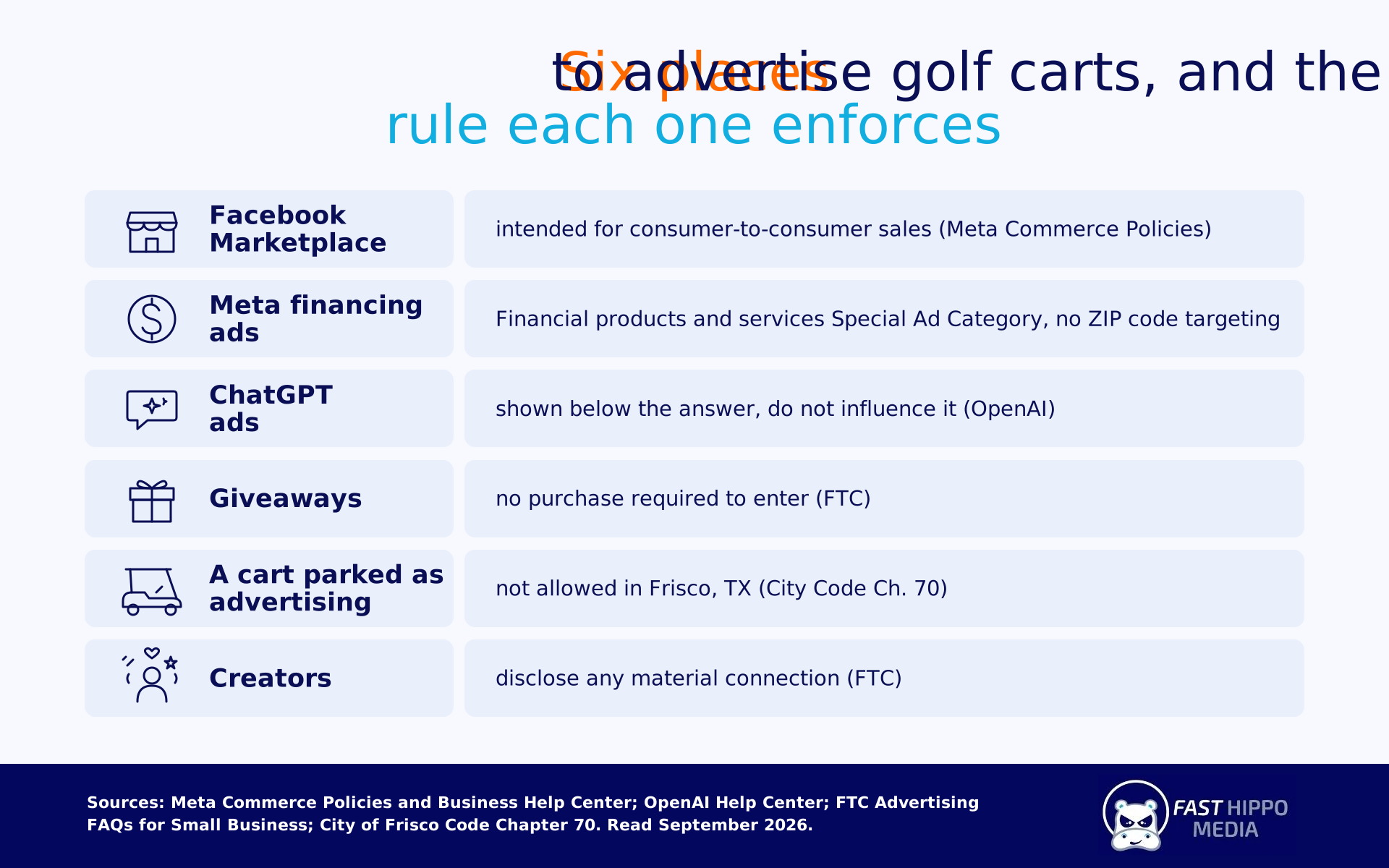
Golf cart advertising ideas beyond Google Ads fall into six channels: Meta ads and Marketplace, ChatGPT ads, event sponsorships, a branded cart used as a roadside sign, local creators, and community print or course screens. Each one has a rule that decides whether it works. Meta’s Commerce Policies say Marketplace is intended for consumer-to-consumer sales and list car rentals among services that commerce surfaces do not allow. OpenAI says ChatGPT ads appear below the response and do not influence the answer. The FTC says a sweepstakes that requires a purchase is illegal and that paid endorsers must disclose the connection.
Frisco, Texas bars parking or decorating any vehicle where the intent is to use it as advertising. Pick one channel, read its rule, and track it with its own landing page.
Can a Golf Cart Dealer Sell on Facebook Marketplace?
A dealer can reach Marketplace shoppers, but Marketplace itself is not built for dealers. Meta’s Commerce Policies state that “Facebook Marketplace is intended for consumer-to-consumer sales,” and they warn that business sellers in some regions may lose access or have listings removed. The United States is not on that restricted list today, so used carts listed by a dealer are not banned outright. They are, though, a guest in a space designed for neighbors selling to neighbors.
Rental fleets have a harder answer, and it comes straight from Meta’s own list.
The same policies say services may only be offered through WhatsApp Business catalogs or through Appointments on Facebook and Instagram, and the services Meta names as not allowed include “Travel services including airline services, hotel accommodations, and car rentals.” A golf cart rental listed like a used couch is likely to be read the same way, and we would not build a rental program on it.
Two more lines in those policies matter to a cart business:
| Policy line | What Meta says | What it means on your lot |
|---|---|---|
| Recalled products | Listings may not sell recalled or banned products; Meta suggests checking the manufacturer’s site or the Consumer Product Safety Commission | Check every used cart’s model against the maker’s recall notices before you list it |
| Vehicle parts and accessories | Catalytic converters, vehicle airbags, and products that alter or bypass emissions controls are not allowed | A parts counter selling gas-cart parts should read this list before posting |
| Community Standards | Commerce content must also meet Facebook’s Community Standards | Photos, captions and comments on your listing are all in scope |
Financing ads change who you can target
Paid Meta ads are the better home for a dealer’s inventory, and they carry their own rule once financing enters the copy. Meta’s Business Help Center now requires advertisers reaching people in the United States to choose the “Financial products and services” Special Ad Category for credit offers, and it says ads may be rejected without it.
That category removes age, gender, and ZIP code targeting, along with lookalike and saved audiences, and city or pin-drop locations get an expanded radius. A Colorado Springs dealer who wants a financing ad aimed at one north-side ZIP code cannot build it. Run the financing message broadly, and keep your tight local targeting for ads that talk about the cart rather than the credit.
How Do ChatGPT Ads Work for a Dealer?
ChatGPT ads are sponsored units that appear below a ChatGPT response, clearly labeled, and shown only to people on the Free and Go plans. OpenAI’s own ads FAQ says ads “do not influence ChatGPT’s answers” and run on separate systems from the chat model. So an ad buys a spot next to the answer. It does not buy a place inside it, and it does not make ChatGPT recommend you.
That distinction matters, because a lot of the pitches aimed at dealers blur it.
Being named in the answer itself is ordinary search work: a clear website, an accurate Business Profile, and facts other sites confirm. Our upcoming post in this series on how AI assistants choose a dealer covers that side.
For the paid side, OpenAI’s guide to ads in ChatGPT for advertisers sets out the mechanics. Billing is by impressions or by valid clicks, and OpenAI suggests starting a cost-per-click bid at $3 to $5. The rest of the setup looks like this:
- Each ad carries your name, logo, a headline, a short description, a landing page, and an image.
- You add “context hints” at the ad group level, describing the conversations or topics where your carts are relevant. OpenAI says these “are not exact-match keywords and do not guarantee delivery.”
- No ads are shown to Plus, Pro, or Business users, or to accounts identified as under 18.
- Static UTM parameters on the landing page URL carry through, so the visits show up in your own analytics.
For a cart dealer, context hints are where the thinking goes. A hint about comparing lithium and lead-acid batteries, or about carts for a master planned community, describes your buyer far better than a brand name alone. If you would rather hand the setup and tracking to someone else, our page on golf cart ChatGPT ads covers how we run them for dealers.
Sponsorships, Parades and Giveaways Without the Legal Trouble
Events put carts in front of people in a way no screen can: they sit in one, they hear the motor, they ask about range. North Texas has two big ones on the calendar. Christmas in the Square opens at Frisco Square in late November, and the PGA Championship comes to Fields Ranch East at PGA Frisco next May. Colorado Springs dealers will have their own mix of holiday parades and neighborhood events.
The trouble usually starts with the giveaway, which is also the easiest part to fix.
The FTC’s advertising FAQs for small businesses put it plainly: “Sweepstakes-type promotions that require a purchase by participants are illegal in the United States,” and each state may add disclosure, licensing, or bonding rules. A “buy a cart, enter to win a second one” promotion is exactly the shape that page describes.
Before you sign a sponsorship or print a giveaway card, run this list:
- Entry is free and does not require buying anything.
- The official rules are written down and easy to find.
- If a “free” accessory comes with a purchase, the cart’s price has not been raised to cover it. The FTC says the purchased product “should not be increased from its regular price.”
- Any rebate states the price before the rebate and the rebate amount.
- The sign, booth, and posts do not suggest you are an official partner of an event unless you are. The FTC treats implied claims the same way it treats spoken ones.
That last point bites hardest around a famous tournament. Sponsoring a watch party or a charity scramble near PGA Frisco is fine. Calling yourself part of the championship is a claim you would need to prove. Our earlier partnership ideas for Dallas cart shops list local tie-ins that avoid the problem altogether.
Parking a Branded Cart by the Road Is a Sign Code Question
It is one of the oldest golf cart advertising ideas going: tie balloons to a cart and park it by a busy road. A dealer marketing column from 2017 still recommends exactly that, and in Frisco it runs straight into the city code.
Frisco’s sign rules, Chapter 70 of the city code, define a vehicle sign and then add that “any vehicle, whether operable or not, shall not be parked and/or decorated where the intent is to use the vehicle as advertising.” A wrapped vehicle is allowed only when displaying the sign is not its primary purpose, it is “currently registered and licensed to operate on public streets,” and it is used in the daily work of the business. A mobile vehicle sign may not be parked “for longer than 20 minutes per 24-hour day.”
Balloons have their own section. In nonresidential districts, they may go up for one seven-day period a year, only within 20 feet of a building’s public entrance, and never attached to vehicles.
| Common tactic | What Frisco’s Chapter 70 says |
|---|---|
| Cart with balloons at the roadside | Balloons may not be attached to vehicles, and a vehicle parked as advertising is not allowed |
| Wrapped cart parked at the curb all day | A vehicle whose main purpose is the sign is not an allowed vehicle sign |
| Branded cart parked in front of a partner’s store | The same test applies on their lot, plus the owner’s consent |
| Wrapped service cart used for deliveries | Allowed when it is registered for public streets and works daily |
Dallas and Colorado Springs have their own sign codes, and we have not reviewed them for this post, so read yours before you park anything. A simple test works in most places: if the cart would still be there when nobody needs it, the city will probably call it a sign.
What Must a Dealer Disclose When Creators or Customers Post About Carts?
Any connection that might change how much weight a viewer gives the post has to be disclosed. The FTC’s endorsement guidance, summarized in the same small business FAQ, says endorsements must reflect the endorser’s honest experience, and advertisers “must disclose any material connection” between the endorser and the seller. An employee, a relative, a free cart, a loaner for the summer, or a discount in exchange for a video all count.
Consumer endorsements must also reflect what typical buyers experience. A creator who squeezed an unusually long range out of a lithium cart on a cool morning cannot be your only evidence for range if most owners see less.
This is how we set it up with a local creator:
- Put the arrangement in writing, including what was given and what is expected.
- Ask for the disclosure in the post itself, not buried in a profile.
- Keep range, speed, and battery claims to what the manufacturer publishes.
- Never ask a customer to post anywhere in exchange for a discount without that disclosure, and never tie it to a Google review.
Customer delivery videos follow the same rule. A happy owner filming a handoff with no incentive is a genuine endorsement. The same video after a free accessory needs a line saying so.
HOA Newsletters, Community Magazines and Course Screens
Print still reaches the buyer who lives in a master planned community north of Dallas, where carts are part of daily life. Autocomplete also shows people searching for golf cart GPS and screen advertising, which means ads on the course carts themselves. Both are fine homes for a dealer. Both carry the FTC’s two basic rules: ads “must be truthful and non-deceptive” and advertisers “must have evidence to back up their claims.”
The FTC looks at implied claims as well as the words on the page. That is where cart copy slips:
| Line in the ad | What a reader takes from it | Evidence to keep on file |
|---|---|---|
| “Ready for the road” | The cart is legal on public streets | The model’s classification and your state’s rule |
| “Longest range in town” | No competitor’s cart goes further | A like-for-like comparison you can show |
| “Comes with a warranty” | Coverage terms are available | How buyers get the full terms, and every condition or time limit |
| “Better than the big-box brands” | A real comparison exists | The comparison itself, since comparative ads must be truthful |
The warranty row trips up more ads than any other. The FTC’s guidance says an ad that mentions a warranty should tell people how to get the details and must clearly disclose conditions such as a time limit.
Where Google Ads Still Fits Next to the Rest
None of this replaces search, and we would not tell a dealer otherwise.
People typing a car model and a town into Google are closer to buying than almost anyone scrolling a feed, which is why the paid search work we run for dealers usually stays in the plan while a new channel is tested.
What changes is how you tell the channels apart. Give each one its own landing page or tagged URL, so a Marketplace visitor, a ChatGPT click, and an event QR code never land in the same bucket. The people you already sold to are the cheapest audience you have, and the email programs we build for cart owners cost nothing per click.
If running six channels sounds like a second job, that is the point where one team planning every channel for a cart business starts to earn its fee.
Pick One Channel Outside Google This Month
Choose the channel that matches your season and your inventory. A dealer heading into the holidays with a lot full of used carts will get more from a Meta ad set with honest prices than from a sponsorship. A dealer near PGA Frisco might book a community event now for the spring.
Then write down that channel’s rules before the first dollar goes out: the Marketplace and rental limits, the Special Ad Category for financing, the free-entry giveaway, the city sign code, the disclosure line, or the evidence file for your claims. Give it its own landing page and read the numbers after four weeks.
If you want a second opinion on which one fits your lot, Fast Hippo Media works with golf cart dealers in Texas and Colorado and is happy to look at your plan.
Frequently Asked Questions
Good golf cart advertising ideas beyond Google Ads include Meta ads for used inventory, ChatGPT ads for research-heavy buyers, free-entry event giveaways, disclosed creator partnerships, and HOA newsletter or course screen ads. Each channel has its own rules, so check them before spending.
Meta says Marketplace is intended for consumer-to-consumer sales, and US business listings are not banned outright. Rentals are harder: Meta lists car rentals among services not allowed on commerce surfaces. Paid Meta ads are usually the better route for a dealer.
No. OpenAI states that ads do not influence ChatGPT’s answers and run on separate systems. Ads appear below the response, labeled as sponsored, for Free and Go users. Being named inside the answer depends on ordinary search visibility, not on ad spend.
It can be, if entry is free. The FTC says sweepstakes-type promotions that require a purchase are illegal in the United States, and states may add disclosure, licensing, or bonding rules. Publish written rules and keep purchase out of the entry.
Check your city first. Frisco, Texas, bars are prohibited from parking or decorate any vehicle where the intent is to use it as advertising, and balloons cannot be attached to vehicles. Other cities, including Dallas and Colorado Springs, have their own sign codes.