(214) 272-7034
  info@fasthippomedia.com


If someone is still selling you vehicle listing schema as the fix for your cart inventory, they are selling a feature Google retired. Google removed that documentation on September 9, 2025, because the markup is “no longer shown in Google Search results”. Golf cart inventory pages rank now on older, plainer things: one stable URL per cart, copy written for the buyer, honest prices, and photos taken on your own lot.
TL;DR
Golf cart inventory pages are the pages a dealer builds for each cart in stock. Google stopped showing vehicle listing structured data in Search and removed its documentation on September 9, 2025, so that markup no longer justifies a golf cart dealer rebuilding a site. What still moves a cart page is ordinary work: a descriptive URL for every cart, links a crawler can follow without JavaScript, a spec block drawn from the manufacturer’s sheet plus the details only the dealer knows, real photos, and a price that tells the truth. In Texas, a licensed dealer’s advertised price must also meet state rules, including a ban on a separate “internet price.” Sold carts and empty categories need a plan rather than a pile of dead pages.
Is Vehicle Listing Schema Still Worth Paying For?
No. Google’s own Search Central changelog records that on September 9, 2025, it removed the documentation for vehicle listing structured data, alongside course info, estimated salary, learning video, and special announcement, because “these structured data types are no longer shown in Google Search results”. The warning came earlier: a June 12, 2025 entry in the same Google Search Central documentation updates log put retirement banners on those features as part of simplifying the results page.
That matters for golf cart dealers because the markup got sold hard to anyone with inventory. Schema generators and dealer marketing blogs still publish vehicle listing templates today, and some pitch them as the edge that gets a lot’s stock into Google.
The display those templates were built for is gone.
We are not telling you to rip out markup a plugin already prints. We are telling you not to pay for a rebuild on the strength of it, and to put that budget where Google still looks.
| What dealers still get pitched | What it buys you in Google Search now |
|---|---|
| Vehicle listing markup on every cart | No display. The feature was retired in 2025 |
| A new theme with a flashy inventory slider | Nothing, if each cart has no URL of its own |
| Bulk manufacturer descriptions on every page | Forty pages that say the same thing |
| One page per cart with real copy and photos | The thing a buyer and a crawler can both read |
One Cart, One Address
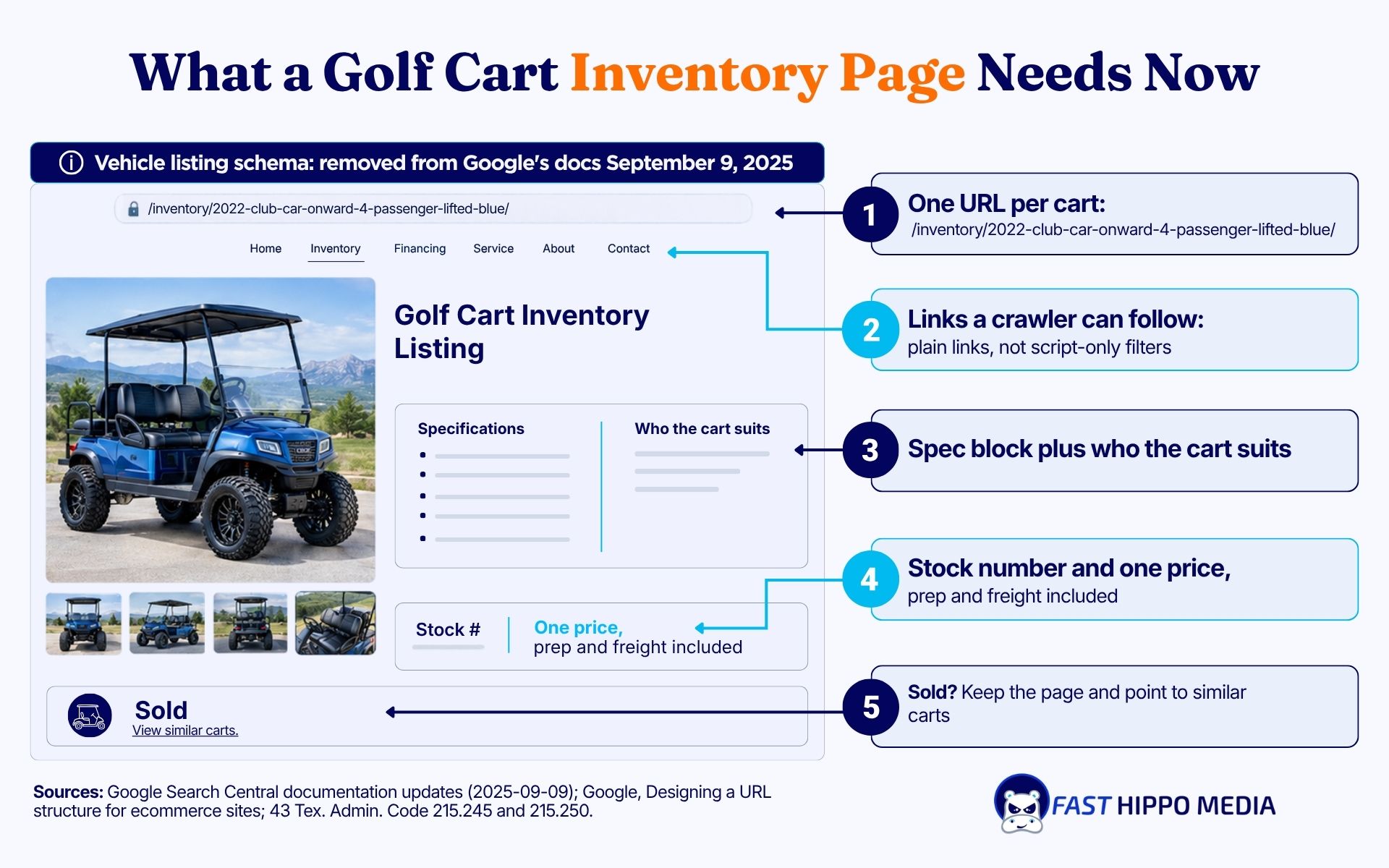
Every cart on the lot deserves its own URL, and that URL should still describe the cart six months from now. Most inventory problems we see on dealer sites start here, before anyone writes a word of copy.
Google’s guidance on designing a URL structure for ecommerce sites is written for online stores, but a golf cart lot is an online store with bigger products. It recommends descriptive words in the path, prefers /product/black-t-shirt-with-a-white-collar over /product/3243, and asks for a self-referencing canonical tag on every indexable page. It also warns that Googlebot “might not detect navigation from JavaScript code”, so links between pages should be ordinary <a href> links.
That last line is where a lot of dealer inventory tools fall.
A filter panel that swaps carts in and out with script can look fine to a shopper and leave a crawler staring at an empty grid.
| Pattern | Example path | Verdict |
|---|---|---|
| Descriptive, one per cart | /inventory/2022-club-car-onward-4-passenger-lifted-blue/ | Keep |
| Stock number only | /inventory/88213/ | Readable to you, not to a buyer |
| Session or tracking value in the link | /inventory?session=81c2 | Creates duplicate URLs |
| Cart shown only through a script filter | No URL at all | Invisible to a crawler |
Sold carts and empty categories
The same Google document covers the page that runs out of stock. If a category has no items, it recommends a noindex robots meta tag, and if the site removes an empty category from browse and search automatically, it suggests returning a 404. That fits a “4-passenger lifted” category that sits empty between shipments.
A sold cart is a judgment call rather than a rule. We keep a sold page live, mark it sold in plain words at the top, and link to the closest carts still in stock, because a buyer arriving from an old search result should land on a next step rather than an error page.
What Should a Golf Cart Inventory Page Actually Say?
A golf cart inventory page should answer the questions a buyer would otherwise call about: what the cart is, what condition it is in, what it costs out the door, and whether it will do the job they bought it for. Manufacturer specs cover the first part. The rest only the dealer knows, and that is the part competitors cannot copy.
Pull the core specs straight from the manufacturer’s own spec sheet for that model and year rather than retyping them from memory. Then add the dealer layer.
The spec block every listing carries
- Year, make, model, and seating, written the way a buyer would search it
- Power source, and for a used electric cart, the battery type and when the pack was installed if you know it
- Lift, wheels, seats, and accessories added after the factory
- Condition notes in plain words, including the scuff on the rear cowl
- Stock number, price, and exactly what that price includes
The paragraph only you can write
Two or three sentences on who the cart suits. A lifted six-seater with a rear flip seat suits a family on acreage outside Denver. A low-hour four-seater with new batteries suits someone in a Frisco neighborhood who wants to reach the pool without buying a second car. That sentence is the difference between your page and forty others running the same manufacturer paragraph.
The legal category of each cart is its own question, and our marketing ideas post in this series covers labeling a listing as a golf cart or a Low-Speed Vehicle, so we will not repeat it here.
Photos Taken on Your Own Lot
Stock images tell a buyer what the model looks like. Your photos tell them what this cart looks like, which is what they are deciding on. Shoot every cart in the same order: front three-quarter, both sides, rear, seats, dash, and any wear worth disclosing.
- Put photos in normal image tags rather than CSS backgrounds or a script-only slider
- Name files for the cart, such as 2022-club-car-onward-blue-front.jpg, rather than IMG_4471.jpg
- Write alt text that says what the photo shows, one plain sentence each
- Compress before upload, because the buyer you are building for is often standing in a driveway on a phone
Texas Price Rules That Reach a Listing Page
This is the section most generic dealer SEO advice skips, and it is where a Texas listing page can get a dealer in trouble with a regulator rather than a search engine. The Texas Department of Motor Vehicles advertising rules in 43 Texas Administrative Code chapter 215, subchapter F, cover advertising by persons under the department’s jurisdiction. Section 215.250, the dealer price advertising rule, says four things that land directly on an inventory page.
| What 43 TAC 215.250 says | What to change on the listing |
|---|---|
| The dealer must be willing to sell at the featured price to any retail buyer | No price you would not honor at the counter |
| Destination, dealer prep, and any added markup belong inside the featured price | Put prep and freight in the number, not in the fine print |
| Advertising an “internet price” or “e-price” is prohibited | One price, online and in the showroom |
| Savings claims or discount offers are allowed only on new vehicles | No “was and now” pricing on a used car |
A neighboring section, 215.245 on availability, adds that when an advertised price applies to one specific vehicle, the ad must show that vehicle’s stock number or VIN. That is one more reason the stock number belongs in the spec block above.
Scope matters here.
These rules govern motor vehicle advertising by persons the department regulates, so they matter most to a Dallas or Frisco dealer who holds a Texas dealer license and lists titled carts such as Low-Speed Vehicles. Whether a particular cart falls under them is a question for your license counsel. We build every Texas listing to the stricter standard anyway, because a buyer who finds a different price at the counter does not care which vehicle class the rule covers.
The Subdomain Problem We Fixed in Colorado Springs
The clearest example of inventory pages failing in search is our own. Lifestyle Golf Carts, a Colorado Springs dealer we work with, kept its product inventory on a separate Carts subdomain, and the case study describes that inventory as practically invisible in search: about 6,700 impressions and 6 clicks a month on key product URLs.
The work on that subdomain was unglamorous. We fixed indexing issues, restructured it so a crawler could get through it, rewrote titles and headers on the inventory pages, and added internal links between product and location pages. The case study reports impressions growing from 6,700 to 35,000 and clicks from 6 to 441 over three months.
Two honest caveats.
The same engagement also rebuilt paid search and added question-led content, so the subdomain fixes were one part of the result, not the whole of it. And one engagement proves the approach can work, not that it will produce the same numbers for every lot.
How Do You Know an Inventory Page Is Working?
Check it in Google Search Console, page by page, rather than trusting a site-wide traffic line. Filter the Performance report to your inventory folder and look at which cart URLs earn impressions, which queries they appear for, and which never show up at all. A cart page with zero impressions after a few weeks usually has a crawl or linking problem rather than a copy problem.
Then run the checks below on your five best-selling models.
- Paste the cart URL into URL Inspection and confirm it is indexed, with the canonical you intended
- Open the category page with JavaScript switched off and confirm each cart still has a working link
- Search your own stock number and model name on a phone and see what a buyer sees
- Compare the phone number and hours on the listing with your Business Profile
- Read the price line aloud and ask whether you would honor it to anyone who walked in
That fourth check is small and easy to skip. Buyers bounce between your listing and your Maps result, and mismatched hours or a stale number costs trust on both, which is why keeping the profile and the site telling the same story is part of how we manage a dealer’s profile.
For dealers who want the whole site handled rather than a page at a time, the inventory pages sit inside the site-wide SEO work we do for cart dealers and rental fleets. If the build itself is the problem- a platform that cannot give each cart its own address- that is a golf cart dealer website design question, and it is cheaper to answer before launch than after.
What Changes When Inventory Pages Are Built Right?
The wider picture is simple. A buyer who can find the exact cart, see its real photos, and trust its price is a buyer who calls ready to talk about delivery rather than availability. Our earlier look at how digital marketing grows golf cart sales covers the channels around the website. The inventory page is where those channels land.
| Weak inventory page | Strong inventory page |
|---|---|
| One gallery URL for the whole lot | One descriptive URL per cart |
| Manufacturer paragraph copied onto every listing | Specs plus a paragraph on who the cart suits |
| “Call for price” or a separate web price | One price that includes prep and freight |
| Sold carts deleted, links break | Sold page kept, pointing to similar carts |
Rebuild Your Five Best-Selling Cart Pages This Month
Do not start with the whole lot. Pick the five models that sell most often, give each cart one clean URL, rewrite the spec block and the “who it suits” paragraph, reshoot the photos in the same order, and fix the price line so it would pass a Texas regulator’s read even if you sell in Colorado. Then watch those five URLs in Search Console for a month before touching the rest.
If the platform fights you at the first step, that is the signal the site itself needs work. Fast Hippo Media can look at your inventory setup and tell you whether it needs a rebuild or a few weeks of cleanup.
Frequently Asked Questions
Golf cart inventory pages rank on basics: one descriptive URL per cart, links a crawler can follow without JavaScript, a spec block with the dealer’s own condition notes, real lot photos, and a single honest price. Vehicle listing schema no longer shows in Google Search.
We keep a sold page live, say it is sold at the top, and link to the closest carts in stock. For an empty category, Google suggests a noindex tag, or a 404 if the site removes that category automatically.
No. Google retired the vehicle listing feature and removed its documentation on September 9, 2025, saying it was no longer shown in Search results. There is no reason to pay for it now. Put that budget into page copy and photos.
Texas rule 43 TAC 215.250 prohibits advertising an “internet price” or “e-price” for dealers it covers, and prep and freight belong inside the featured price. Check with your license counsel whether a given cart falls under it.
Long enough to answer the calls you keep getting. For most carts, that means the spec block, condition notes, and two or three sentences on who the cart suits. A copied manufacturer paragraph adds length without giving a buyer anything new.