(214) 272-7034
 info@fasthippomedia.com


We wrote audit or fix files for five golf cart dealer websites between late July and mid-October 2026, and the faults that hurt them were rarely the ones a generic checklist asks about. Three of them answered automated visitors with a bot challenge page. On all five, at least one page carried a title or description that a template wrote, that belonged to another page, or that named the wrong place. This checklist follows those files, in the order we now check them.
TL;DRA golf cart dealer SEO checklist should start with access and indexing, not keywords. Of the five dealer sites we audited in 2026, three answered automated visitors with a bot challenge page, three had inventory filter URLs sitting in Google’s index, two had noindex on contact, financing or service pages, four had no LocalBusiness-type structured data, and four had sitemaps that described a different site from the one Google was showing. Every one of the five had at least one title or description written by a template or copied from another page. The fixes are all in Google’s own documentation: crawl control for faceted navigation, a crawlable page for any noindex rule, name and address in business markup, and permanent redirects for moved URLs. Run these checks before buying content or links.
The Checklist at a Glance
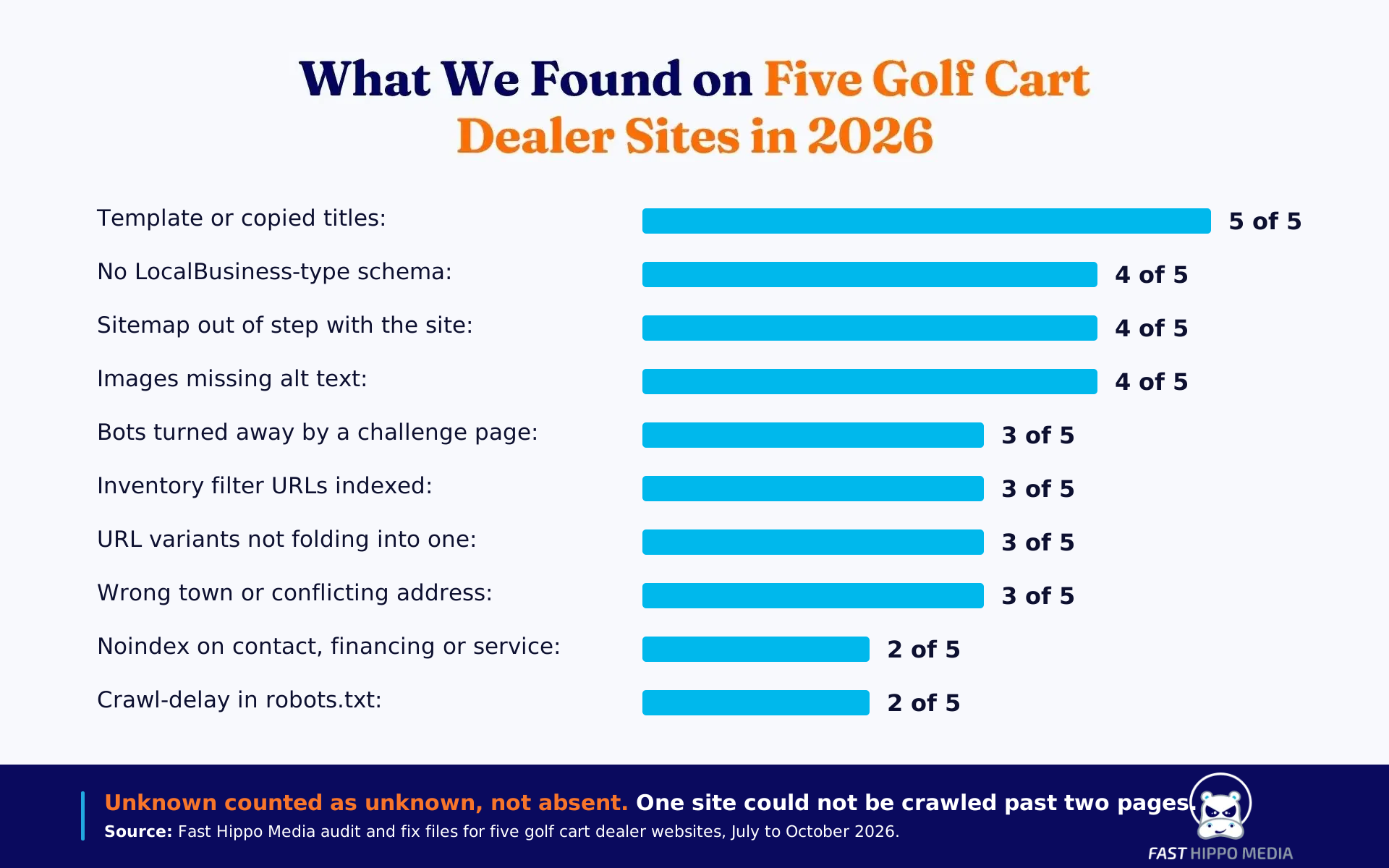
Ten checks, each with the number of dealer sites (out of five) where our files record the fault. The sections below take them in this order.
| No | Check | Sites with the fault |
|---|---|---|
| 1 | Bots and AI fetchers turned away by a challenge page | 3 of 5 |
| 2 | A crawl-delay line in robots.txt | 2 of 5 |
| 3 | Inventory filter URLs indexed | 3 of 5 |
| 4 | Noindex on contact, financing, or service pages | 2 of 5 |
| 5 | A sitemap out of step with the site | 4 of 5 |
| 6 | No LocalBusiness-type structured data | 4 of 5 |
| 7 | Titles or descriptions from a template, or from another page | 5 of 5 |
| 8 | Images with no alt text at scale | 4 of 5 |
| 9 | Host, protocol, or case variants that do not fold into one URL | 3 of 5 |
| 10 | Wrong town on a local page, or conflicting address details | 3 of 5 |
How we counted, and what we left out
The five sites belong to golf cart dealers we audited this year. Of those, three run their main site on a hosted dealer platform, one on a hosted store builder, and one on a dealer management system with its own web layer. Three of the five also run a separate WordPress install on a subdomain, for a blog or for town pages.
Every count comes from what our audit files record, nothing else. Where we could not read a site, the fault counts as unknown for that dealer, never as absent. That matters for one dealer whose bot challenge let us read only two pages, so its structured data and alt text never entered the count.
We name no dealers, and nothing below is a results claim. These are faults found, not fixes measured.
Our team works out of Frisco, Farmers Branch, and Colorado Springs, and this list now opens every dealer audit we run from any of the three.
Can Google and AI Tools Actually Reach the Pages?
On three of the five sites, automated visitors could not. A content delivery network sat in front of each one and answered plain requests with a JavaScript challenge page and an HTTP 403. All three were on hosted dealer platforms, and one challenged requests for the XML sitemap too.
Googlebot was still getting through on the one site where we could check, because URL Inspection in Search Console showed recent crawls.
The visitors that bounced were the ones a dealer never sees in analytics: audit tools, and the fetchers AI assistants send when a shopper asks which dealer to visit. A platform policy on one of them let verified search crawlers in and blocked AI crawlers outright.
How to check yours in ten minutes:
- Request your home page with a plain HTTP tool such as curl, from outside your office network. A 403, or a page that says “Just a moment”, is the challenge.
- Repeat the request with the user agent of an AI search fetcher, such as OAI-SearchBot.
- Ask whoever runs the CDN to let verified search crawlers through, plus the AI search fetchers you want citing your inventory.
Telling a real Googlebot from an impostor is documented. A reverse DNS lookup on the IP should land on googlebot.com, google.com, or googleusercontent.com, and a forward lookup on that name should return the same IP. A firewall rule built on that check stays strict without shutting Google out.
Opening the door to the right crawlers and nobody else is crawl and server work we do on hosted dealer platforms. It also decides whether a dealer can show up when AI assistants choose which cart dealers to name.
The crawl-delay line that only slows Bing
Two of the five robots.txt files carried a crawl-delay line, one set to 5 seconds and one to 10 seconds for Bing. The robots.txt specification Google publishes lists the fields it reads and says other fields “such as crawl-delay aren’t supported”.
So the line never slowed Google.
It slowed Bing and any other crawler that honors it, on two sites small enough that no crawler was ever going to strain them. Delete it unless your host can name a load reason.
What Is Google Indexing, and What Is It Missing?
Access is the first question. The second is whether the pages Google keeps are the pages you sell from. It went badly in three different ways, and three of the five dealers had at least two of them.
Filter pages swallowing the inventory
Inventory search filters create a new URL for every combination of brand, seat count, condition, and model year. Three of the five sites had those combinations in Google’s index.
- One site had dozens of filter URLs indexed, none of them in its sitemap. Together they drew about a fifth of the whole site’s impressions over six months and almost no clicks, and some were four-filter combinations pinned to a single model year.
- On another, filter URLs with query strings made up most of the sitemap, so the sitemap itself asked Google to crawl them.
- The third had filter URLs both indexed and crawled but not indexed, some stacking up to five filters.
Google’s guidance on managing crawling of faceted navigation URLs is blunt about the cost. Filter URLs “can generate infinite URL spaces”; crawlers spend time on them before deciding they are useless, and new pages get found more slowly. Where the filtered pages do not need indexing, the first suggestion is a robots.txt disallow. Canonical tags and nofollow on filter links are “generally less effective in the long term”, and a combination with no results should return a 404 where it was requested.
We read it more narrowly for dealers than “block them all”. On two of these sites, brand and seat-count searches were landing on single-filter pages because no real brand or seating page existed. So we keep one-filter pages indexable until a written page replaces them, then deal with the deep combinations.
Order matters.
A URL already in the index needs a noindex that Google can see, and the indexing documentation says noindex only works if robots.txt does not block the page.
Block crawling after those URLs drop out, never before. The cart pages themselves need one clean URL for every cart on the lot, so the filters have something better to point at.
Noindex on the pages that sell
Two of the five sites had a noindex tag on pages a buyer would search for. The first tagged its contact page noindex, nofollow while also listing it in the sitemap. The other had noindex on six pages at Google’s last crawl: financing, the service request page, contact, staff, factory promotions, and new models.
Contact, financing, and service request are all form pages. Here is our read, and it is only a read: both platforms shipped form pages noindexed by default, and nobody switched it off. Worse, one page editor had no robots setting at all, so removing the tag took a support ticket.
Open Search Console and run URL Inspection’s live test on contact, financing, service, and every model or brand page. Then read the indexing line. The financing page above kept drawing impressions every month while Google’s last crawl recorded a noindex on it, and two Google records disagreeing is a reason to test the live page, not to trust either one.
Sitemaps that describe a different site
Four of the five sitemaps were out of step with what Google indexed. The worst case was stark: nine in ten sitemap URLs earned zero impressions in 75 days, while 101 of the 152 pages that did earn impressions were missing from the sitemap.
The rest were smaller and just as telling. The second listed a noindexed contact page, set every URL to priority 1.0, and carried no lastmod dates. The third left all seven blog posts out. The fourth still listed an empty default blog and a product URL ending in -copy-copy, one of 28 product URLs for roughly 12 real carts.
Google ignores <priority> and <changefreq>, per its sitemap documentation, and uses <lastmod> only when the date is consistently and verifiably accurate. A sitemap is also a weak canonical signal, so it cannot rescue a duplicate. Treat it as the list of URLs you want indexed: no filter pages, no noindexed pages, no drafts.
Is Your Business Described in Structured Data?
Four of the five sites had no LocalBusiness markup and no subtype of it. The fifth is the site we could barely read, so it stays unknown rather than clean. The store builder site did carry an Organization block, and its name was the store’s URL slug with nine empty sameAs values.
The local business structured data documentation from Google needs only two properties, name and address, and asks for “the most specific LocalBusiness sub-type possible”. For a cart dealer, that raises a real question. Schema.org defines its AutoDealer type as a car dealership, and a golf cart is not a car.
We have used AutoDealer for one dealer and Store for another in our own fix files, for exactly that reason. Pick the type you can defend, put it on every page that carries the block, and never switch it per page.
| Property | What to put there |
|---|---|
| name | The business name exactly as it appears on the sign |
| address | The showroom address, matching the Business Profile character for character |
| telephone | The number that rings at that location |
| openingHoursSpecification | Showroom hours, plus a separate department if service keeps different hours |
| sameAs | Only real profile URLs, never empty strings |
Two things to stop paying for.
Vehicle listing markup is gone: Google removed its documentation on September 9, 2025, because the feature was no longer shown in Search. Expandable FAQ results stopped appearing in Google Search on May 7, 2026, so FAQ markup sold as a search feature is selling something Google retired.
Titles and Alt Text Written by a Template
Titles were the only fault on all five sites.
Each had at least one page whose title or description came from a template, from another page, or from somewhere it should never have come from.
- Every inventory listing page shared one description: the words “Search Results” followed by the business name, town, and phone number.
- Auto-generated inventory titles repeated the town twice in a row, the longest running to 86 characters.
- Eight town pages used one title frame, all between 70 and 77 characters.
- An about page served the repair page’s title and description, so two URLs chased one keyword.
- A home page title ended with the name of a different golf cart dealer in another state.
- A rental blog post carried the title tag of a financing post.
None of these show in a browser window, because the title sits in the tab and the description only appears in results.
Sort a crawl export by title, then by description. Duplicates rise to the top, and so does any string with a phone number or the word “results” in it.
Our house limit is 60 characters for a title and 160 for a description. The brand goes in the title only on the home, about, and contact pages.
Alt text nobody wrote
Four of the five sites had images with no alt text at scale. The largest gap was 1,301 of 2,835 image tags with no alt attribute, and because every category page showed the same count, the cause was one template loop rather than careless data entry. Another had 18 to 22 images per town page, and only the logo carried alt text, generated from the file name.
Alt text is, in Google’s image guidance, the most important attribute for describing an image. For a dealer, fixing the template covers most of it: year, brand, model and town on every inventory thumbnail, and an empty alt=”” on spacers and icons.
One Address for Every Page
The same page answered at more than one address on three of the five sites. The first answered on the bare domain with a 200 instead of redirecting to www. The second served inner town pages over plain HTTP with a 200, while its home page redirected correctly. The third sent HTTP to HTTPS with a 302, took a second hop to reach www, and served uppercase and trailing-slash versions of its contact page, with each one naming itself canonical.
The redirect documentation draws the line. A permanent redirect tells Search to show the new URL, and a temporary one keeps the old URL in results. Redirects are also the strongest canonical signal Google lists, so every variant should reach its one real URL in a single permanent hop.
Sold carts and renamed listings
Inventory turns over, so listing URLs die as carts sell. Any missing URL on one site is redirected to the home page, which hides every broken link and turns each sold unit into a homepage alias. A 404 or 410 is the honest answer for a page that is gone.
Elsewhere, a renamed listing left its old URL behind, noindexed and pointing at the new one, where a permanent redirect belonged.
Two hosts, one dealer
Two of the dealers with a WordPress subdomain had trouble from the split. In one case, the subdomain’s town pages competed with the main site for the same city searches. In the other, the main site’s home page did not link to the blog subdomain at all.
Town Pages and the Address Customers See
A local detail was wrong on three of the five sites. A town page’s FAQ turned out to be the neighboring town’s FAQ, pasted in with that town’s name all through it. A live article placed one shop in a different city, which happened to be a competitor’s hometown.
Address data drifted too. Citations for one dealer carried a different street number and phone number from its business record, and its website never printed the street address on any page; the only copy sat in a meta description. Another labeled one store’s phone with a neighboring town’s name above a different town’s street address.
Google’s guidelines for representing a business on its Business Profile ask for a name that “should reflect your business’s real-world name, as used consistently on your storefront, website, stationery”. The same guidelines ask for a phone number that connects to the individual location. Read your footer, contact page, and structured data against the profile, line by line.
Town pages need the same care. Say a showroom in Frisco writes pages for Prosper and Celina: each one has to say something true about that town, and the Prosper FAQ should never mention Celina. A Colorado Springs lot writing for Monument faces the same test. Our map pack work for cart dealers starts with this read before any new town gets a page.
Which Platform Problems Need a Vendor Ticket?
Most of these faults sit where the dealer cannot reach them. Take one hosted platform: the page editor had no robots control, robots.txt was a template nobody could edit, and any slug change needed a redirect made by vendor support.
Sort the list by owner before anyone starts.
| Fix | Site editor | Vendor ticket | CDN or DNS |
|---|---|---|---|
| Bot challenge rules | Yes | ||
| Noindex on form pages | Sometimes | Often | |
| Filter URL handling | Yes | ||
| Business structured data | Yes, if custom code is allowed | Otherwise | |
| Title and description templates | Page by page | For listing templates | |
| Sitemap contents | Yes | ||
| HTTP, www and case redirects | Sometimes | Yes | |
| Alt text on inventory | Template loop |
If that table is longer than your team’s month, it is the ongoing golf cart SEO work we do for dealers and rental fleets. And when a platform refuses half the fixes, a dealer build where you own the templates and the redirects is usually the cleaner way out.
Run Five Dealer Checks Before Friday
Start with the checks that cost nothing. Request your home page with curl and see what comes back. Run URL Inspection on contact, financing, and service. Search your crawl export for duplicate titles and the word “results”. Count the sitemap URLs with a question mark in them, then read the address in your footer against your Business Profile.
That is an afternoon.
It tells you whether the site needs a vendor ticket, a developer, or a rebuild. Whether your lot is in Dallas or Colorado Springs, the order holds: access, indexing, business details, then content. If you want a second pair of eyes on what comes back, Fast Hippo Media runs the same audit for cart dealers and will tell you which fixes your platform allows.
Frequently Asked Questions
Start with access and indexing: can bots reach the site, are filter URLs indexed, do contact and financing pages carry noindex. Then business details in structured data, template-written titles, sitemap contents, URL variants, town page accuracy and alt text on inventory images.
Usually not the deep combinations. Google suggests disallowing faceted URLs that do not need indexing. We keep one-filter brand or seating pages indexable until a written page replaces them, and add noindex before any robots.txt block.
A dealer needs LocalBusiness-type markup with at least name and address, per Google’s documentation. Schema.org defines AutoDealer as a car dealership, so some dealers use Store instead. Choose one type, use it on every page, and match the Business Profile.
Google’s robots.txt specification supports user-agent, allow, disallow and sitemap, and says fields such as crawl-delay are not supported. The line still slows Bing and other crawlers that read it, so remove it unless your host needs it.
Yes. Googlebot still got through where we checked, but AI search fetchers and audit tools received the challenge page. Those fetchers are how AI assistants read a page before naming a dealer to a shopper.