(214) 272-7034
  info@fasthippomedia.com



Your website is the showroom most buyers visit first. The parts that actually sell carts: clean mobile design, inventory pages a buyer and a search engine can both read, fast load times, real photos, and one obvious next step on every page. SEO belongs in the build rather than bolted on afterwards.
Why your golf cart dealership needs a great website
Most buyers see your website before they see your lot. They are checking whether you have what they want, what it costs, and whether you look like a business worth driving to.
That is a different job from a general business site, which is why we treat web design for dealerships as aninventory problem first and a design problem second.
A dealership website has a narrower job than most people assume. It is not a brochure. It is the difference between someone getting in the car and someone opening another tab.
What makes a great golf cart dealer website?
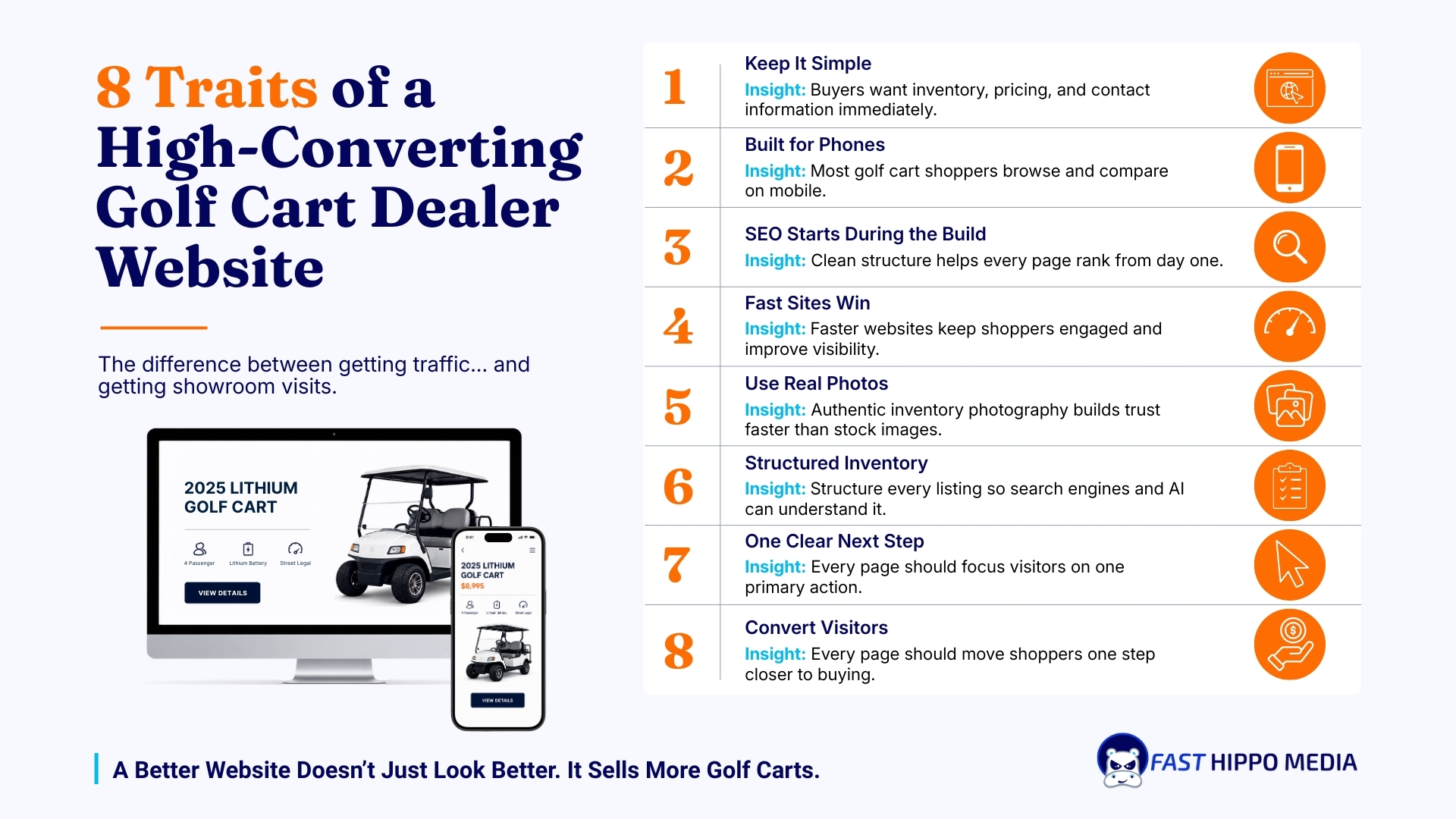
1. Simple, clean design
Buyers are looking for carts, prices, and a phone number. Everything competing for attention with those three things is costing you inquiries. The best dealer sites look almost boring and convert well because of it.
The same restraint applies to the pages buyers never see as a homepage: your model
pages, your location pages, and the Google Business Profile most buyers actually meet you through.
2. Mobile-friendly layout
Most of this traffic arrives on a phone, often from someone standing in a driveway or sitting in a parking lot. If your inventory needs pinching and zooming to read, that visit is over.
3. SEO built into the structure
Search visibility is a build decision, not a post-launch add-on. Page structure, URL patterns, location pages, and schema all get decided while the site is being made, and retrofitting them costs more than doing it once. That is why and the build should be the same conversation, and why the
Local search work a dealership needs is easier to do on a site that was structured for it.
4. Fast load times
This is where a lot of dealer sites quietly lose money, and it is now measurable rather than a matter of opinion.
Google’s set the standard: Largest Contentful Paint should happen within 2.5 seconds, Interaction to Next Paint should be 200 milliseconds or less, and Cumulative Layout Shift should stay at 0.1 or below. INP replaced First Input Delay and became a stable metric in 2024, which means responsiveness now counts alongside raw load speed.
Those are not abstract numbers. They are a ranking input and a real description of whether your site feels broken to someone on a phone. A dealer site heavy with unoptimized cart photography usually fails LCP first.
Fixing that is technical SEO work rather than design work, which is why it usually survives a redesign untouched unless somebody goes looking for it.
5. Quality photos and video
Carts sell on how they look. Real photography of your actual inventory, in your actual light, beats manufacturer stock every time, and buyers can tell the difference instantly. A short walk-around video of a lifted cart does more than six paragraphs of copy.
6. Inventory pages a machine can read
This is the one most dealer sites get wrong, and it is the biggest single opportunity.
Each cart deserves its own page, and each page should carry Product structured data: make, model, year, price, condition, and availability written in code that search engines and AI tools read directly. Google’s accepts itemCondition values including UsedCondition, and availability values including InStock and SoldOut, which is exactly the vocabulary a used-cart dealership needs.
That is what puts your inventory in front of someone who asks Google or an AI assistant for “used Club Car for sale near me” instead of hoping your homepage ranks for it. A dealership whose carts are machine-readable gets recommended cart by cart. A dealership with an inventory PDF gets skipped entirely, because a PDF is a locked door to a machine.
When a cart sells, keep the page live and mark it SoldOut rather than deleting it. Those pages accumulate search authority the way a testimonial wall accumulates trust, and the next similar cart inherits it.
7. Clear calls to action
One obvious next step per page. Call, check availability, book a test drive, and get financing. Not all four at once, and not buried under the fold.
8. Built to convert
Everything above is in service of one thing: turning a search into a showroom visit. Traffic that does not convert is a hosting bill.
Tips for a successful launch
Gather photos, specs, and financing details before web design starts; content readiness is what decides the timeline, not design complexity.
Decide who owns inventory updates on day one, and make sure that person can do it without calling anyone.
Launch with the location pages already written. A site that goes live without them spends its first three months invisible for exactly the searches it was built to win.
Those pages are the foundation of the local SEO that brings buyers in after launch, and writing them during the build costs a fraction of retrofitting them later.
Where to start
If your current site is slow, hard to update, or invisible for the searches that matter, the useful first step is finding out which of the three is actually costing you the most.
That is an audit rather than a rebuild pitch: what ranks, what loads slowly, and where buyers drop off. Sometimes it says redesign. Often it says, “Fix three things.” Either way you get the answer before spending anything.
If you would rather have someone run that audit against your current site, that is where
a golf cart marketing team earns its place. Request a quote and we will tell you which of the three is costing you the most before anyone talks about a rebuild.
Frequently Asked Questions
Because a dealership sells inventory, financing, and trust, and template sites handle none of those well. A custom build gives you real inventory pages buyers and search engines can read, local SEO baked in, and a design that makes the showroom visit feel like the obvious next step.
A typical dealer site takes a few weeks from kickoff to launch, depending on inventory size and content readiness. The fastest launches happen when photos, cart specs, and financing details are gathered before design starts.
Yes. Dealer sites should be built so your team can add carts, change prices, and mark units sold without a developer. If you cannot update your own inventory, the site was built wrong.
It should be from day one: site structure, location pages, schema markup, load speed, and inventory pages that target what buyers actually search. SEO added after launch costs more and works less.
Start with an audit of your current site: what ranks, what loads slowly, and where buyers drop off. That audit becomes the build plan, and it tells you whether you need a redesign or a rescue.