(214) 272-7034
  info@fasthippomedia.com



Search engines now use machine learning to read what a query means rather than which words it contains. Google names four of these systems publicly: RankBrain, BERT, neural matching, and MUM. At the same time, AI answers are absorbing clicks that used to reach websites. To stay visible: answer real questions directly, mark your pages up so machines can read them, keep your facts identical everywhere, and refresh cornerstone pages quarterly. The goal has shifted from ranking to being the source a machine quotes.
What AI-driven SEO actually means
Search has changed more in the past two years than in the previous ten, and machine learning is the reason.
The old model was mechanical. A search engine matched the words in your query against the words on a page, weighed a few hundred signals, and ranked what came back. Optimizing for it meant making sure the right words appeared in the right places often enough.
That model is gone. Google now runs systems that interpret what a query means before deciding what answers it, which is why a page can rank for a phrase it never uses and a page stuffed with the exact phrase can rank for nothing. The unit of optimization stopped being the keyword and became the question.
AI-driven SEO is simply working with that. Not tricking a model, and not adding the word “AI” to your pages. Making your content unambiguous enough that a machine can tell what it says and confident enough to repeat it.
Which AI systems Google actually uses
This part gets discussed constantly and sourced almost never, which is odd, because Google publishes the list.
Google’s , last updated in December 2025, names seventeen systems. Four of them are described by Google itself as AI:
RankBrain is “an AI system that helps us understand how words are related to concepts. It means we can better return relevant content even if it doesn’t contain all the exact words used in a search.” That single sentence undoes twenty years of keyword-density advice. Google is telling you the exact words are not the requirement.
BERT is “an AI system Google uses that allows us to understand how combinations of words express different meanings and intent.” Combinations, not words. The difference between “can you get a prescription for someone” and “can someone get a prescription for you” lives entirely in word order, and BERT is why the results differ.
Neural matching is “an AI system that Google uses to understand representations of concepts in queries and pages and match them to one another.” Concept to concept, not string to string. This is the mechanism behind ranking for phrases you never wrote.
MUM is “an AI system capable of both understanding and generating language,” used for specific applications rather than general ranking.
Four systems, four public definitions, and one theme: Google reads meaning. Nothing in that list rewards repetition, and nothing in it can be gamed by phrasing. It can only be satisfied by being clear.
What AI answers are doing to your traffic
Here is the part most explainers skip, because it is uncomfortable.
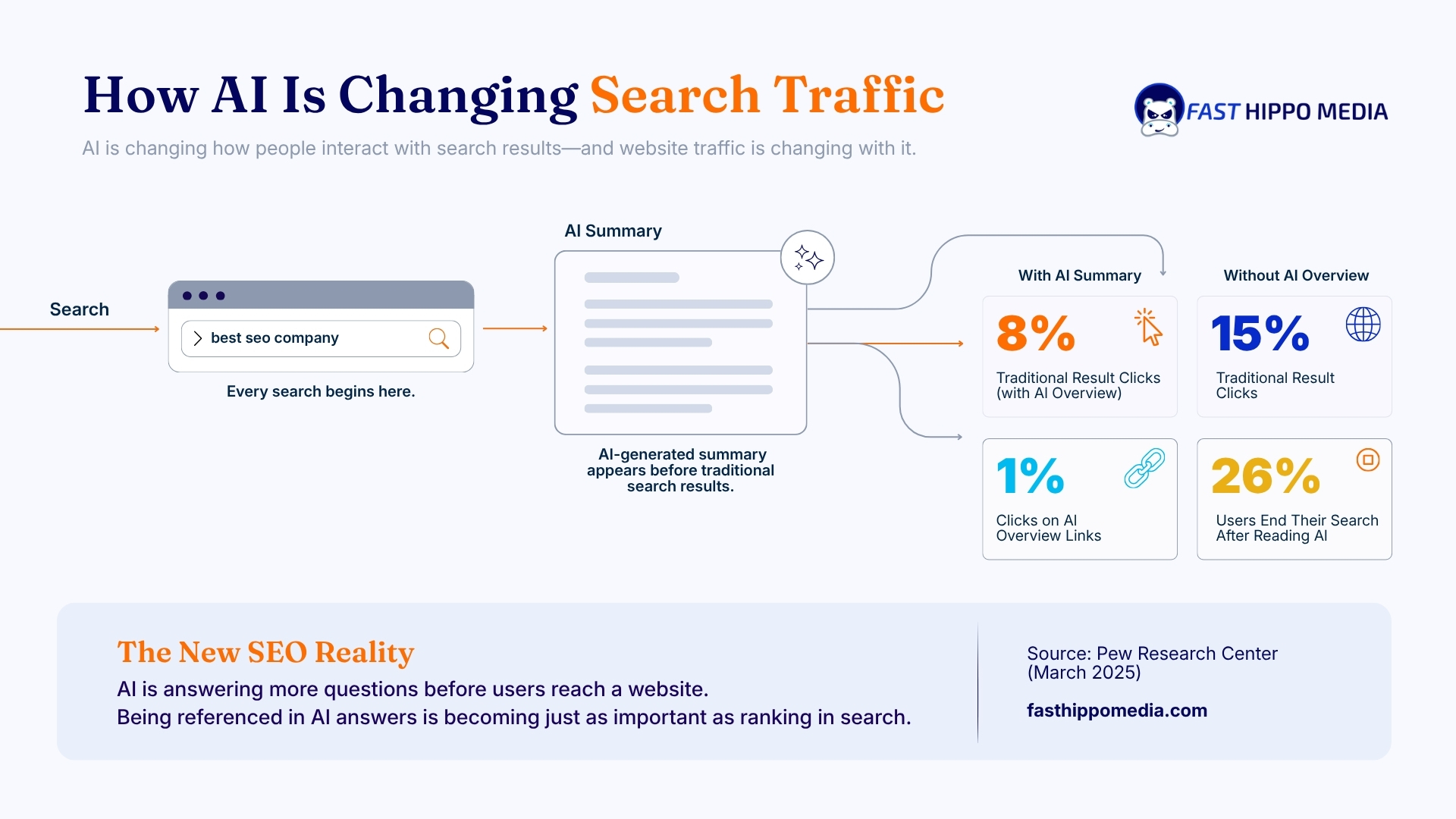
Ranking and receiving a visit used to be close to the same event. They are now separate, and the gap is measurable. The across nearly 69,000 Google searches. On searches that produced an AI summary, users clicked a traditional result in 8% of visits. Without a summary, 15%, close to double. Links inside the summary itself were clicked in 1% of visits. And users ended their session on 26% of pages carrying a summary, against 16% without.
Two caveats worth stating plainly. That fieldwork ran in March 2025, so it is a snapshot rather than today’s number, and no more recent wave has been published. And a lower click rate is not the same as a lower value per click; the visitor who does click has usually read a summary first and arrives further along.
What it establishes is the direction. A growing share of the answers your content produces are consumed without a visit. Being quoted in that answer is worth more than ranking below it, which is what is actually about.
What this means for your business
Three practical consequences, and none of them is a tactic.
Thin pages stopped working entirely: When a system evaluates whether a page genuinely answers a question, four hundred words assembled around a keyword fails the test on the merits. There is no volume of such pages that adds up to one good one.
Being unclear now costs you directly: A machine building an answer has to decide what it can state without hedging. Anything it had to interpret carries risk, and the safe move is to use a different source. Ambiguity used to cost you a little ranking. It now costs you the citation.
Your facts have to agree with each other: Your website, your Google Business Profile, your directory listings and your reviews are all read together. Where they agree, a model has a fact. Where they conflict, it has a problem, and a business with a problem is easy to skip.
How to adapt: six steps
1. Answer questions directly: Put the answer in the first two sentences under the heading. Not the background, not the setup, the answer. Everything else can follow it.
2. Use short, clear paragraphs: Two to four sentences. Long blocks are harder for a person to scan and harder for a system to extract a clean passage from.
3. Add context, not filler: Depth means the detail that changes the reader’s decision: the exception, the cost, the thing that goes wrong. It does not mean more words around the same point. This is also where AI-assisted drafting most often goes wrong, which is why the human edit matters more than the generation, something we go into in our guide to .
4. Use structured data: Mark up your business, your articles, and your FAQs. So the facts are stated rather than inferred. Start with the block that carries the most weight for a local business and expand from there; our guide to covers which types still earn rich results and which ones quietly stopped. Getting it generated from templates rather than pasted page by page is work, and it is the difference between markup that survives a redesign and markup that does not.
5. Update content quarterly: Not a rewrite. A pass over your cornerstone pages checking that prices, timelines, tools, and claims are still true. Stale specifics are the fastest way to lose a citation you already had.
6. Use AI tools for production, not judgment: Research, drafts, repurposing, and structure are fair game. What to publish, what is true, and the final read are not.
How AI changes local search
Local results were always contextual, and machine learning made the context finer.
A query like “best HVAC company near me for AC repair” is not one question. It is a location, a service category, an urgency signal, and an implied standard of quality, all resolved at once. The system weighs proximity, category match, review quality and recency, how complete and consistent the business information is, and how confidently any of it can be verified. We build programs around exactly that list, because for a service business those signals are the ranking factors.
The practical version is unglamorous. A complete, current whose hours, services and address match your website character for character will beat a better-written website with inconsistent facts. Consistency is not a hygiene task in local search. It is the ranking work.
How this affects voice search
Voice is the same problem with the margin removed.
A spoken assistant returns one answer, not ten. There is no second place and no list to fall back to, so the system needs a source it can state without qualification. That rules out anything ambiguous, anything contradicted elsewhere, and anything that takes three paragraphs to get to the point.
Which means voice needs no separate strategy. The page that answers plainly, states its facts consistently, and can be quoted without hedging is the page that wins the spoken answer. The discipline is identical, the tolerance for vagueness is zero.
Where this goes next
The direction is clear even if the specifics are not.
Systems that understand language will keep improving, and the gap between what your content says and what a machine thinks it says will keep closing. That favors clear writing and punishes clever writing. More answers will be assembled rather than listed, so the question shifts further from “where do we rank” toward “are we the source?. “And the pages that get quoted will keep being the ones whose facts are easy to verify, which is a content problem before it is a technical one.
What does not change is the underlying job. Know what your customers actually ask, answer it better than the pages currently answering it, and make it legible to a machine. That has been the work for a decade; the machines just got better at telling the difference. If you want the wider view of where distribution is heading, our cover the surfaces this content has to reach.
If you would rather have this audited and built than work through it yourself, our can start with what your pages currently say and what a machine can currently tell about them.
Frequently Asked Questions
Search engines now interpret what a query means instead of matching its words, using systems Google documents publicly, including RankBrain, BERT and neural matching. At the same time, AI-generated answers absorb a growing share of clicks. SEO now means being clear enough for a machine to understand and confident enough for it to quote.
It works out what a query means, judges which pages genuinely answer it, and learns from what people do next. Google describes BERT as understanding how combinations of words express meaning and intent, which is why word order changes results and why pages that answer plainly outperform pages that repeat keywords.
Google publicly names four in its ranking systems guide: RankBrain, which relates words to concepts; BERT, which reads how word combinations express intent; neural matching, which matches concepts in queries to concepts in pages; and MUM, which understands and generates language for specific applications.
On both sides. Search engines use AI to rank, and marketers use AI tools to research, draft and structure content faster. The teams that gain use AI for production while keeping strategy, subject expertise and the final edit human.
Local results weigh context: proximity, service category, review quality and recency, profile completeness, and how confidently a business’s details can be verified across the web. Machine-readable consistency between your site, your Google Business Profile and your listings is what local ranking rewards.
Answer real questions directly, keep paragraphs short, add structured data, make your facts identical across your website and profiles, and review cornerstone pages quarterly. The aim is to be a source an AI system can quote without hedging.