(214) 272-7034
  info@fasthippomedia.com



AI tools like ChatGPT and Gemini recommend specific local businesses by name. They build those recommendations from your Google Business Profile, your reviews, your citations, local press, and forum threads, rather than from your website alone. Keep your profile and citations identical everywhere, stack recent reviews, publish straight answers to the questions customers ask, then distribute that expertise across the surfaces AI actually reads. Run the 90-day plan below and test your visibility monthly with the prompts at the end.
Ask ChatGPT for the best CRM software, and you get a careful market summary. Ask it who should fix your roof inFrisco,o and you get names. Specific companies, with reasons attached.
That difference is the whole opportunity for local businesses, and almost nobody is working it on purpose. This guide is about earning those recommendations: the actual moment an AI tool says your name to a customer standing in their kitchen with a problem.
What is LLM optimization?
LLM optimization (LLMO) is the work of making your business visible to large language models, the systems behind ChatGPT, Gemini, Claude, and Perplexity, so they bring you up when customers ask for help.
For national brands, that means chasing mentions across the whole ecosystem of sources those models read. For a local business the game is narrower and easier to win. You need AI tools to recommend you for your services in your city, against maybe a dozen competitors, most of whom have never thought about this.
The inputs differ too. A brand earns mentions with PR and data studies. A local business earns recommendations with its footprint: profile, reviews, citations, and a few surfaces most owners ignore completely.
One thing to get out of the way first, because the industry keeps selling it. There is no secret markup that gets you into AI answers. Google states plainly that , and that the right move is to Anyone selling you an “AI schema package” is selling something Google has already said does not exist. Schema still earns rich results and keeps your business facts consistent, which is worth doing. It is not a shortcut into the answer.
Where AI tools get their local answers
When someone asks an AI tool for a local recommendation, the model rarely answers from memory. ChatGPT, Gemini, and Perplexity run live searches behind the scenes, read what comes back, and compose an answer from it. So the practical question is simple: when an AI searches your category in your city, what does it find?
Six sources decide most local recommendations.
Your Google Business Profile: It feeds Google’s AI Overviews and AI Mode directly and shapes what every other tool sees downstream. Google names as its local ranking factors. Distance you cannot change. Relevance comes from how completely your profile describes what you do, and prominence comes from reviews and citations. A complete profile is a set of machine-readable facts: categories, services, hours, photos, and service area. An incomplete one is a shrug.
Reviews: Volume helps, recency decides, and specifics get quoted. found 97% of consumers read reviews before choosing a local business, and 85% are more likely to use one after reading positive ones. The number most owners miss is recency: 74% look for reviews written in the last three months, and 32% want them from the last two weeks. Models behave the way people do. They trust the recent and the specific. A review that says “replaced our hail-damaged roof in two days and handled the insurance paperwork” is AI ammunition. “Great service, highly recommend” is not.
Citations and directories: When your name, address, and phone match across Yelp, BBB, Angi, Nextdoor, and the chamber site, the model treats your business as a settled fact. When they conflict, it hedges. Hedges do not get recommended.
Local press and “best of” lists: LLMs lean hard on published roundups. One placement in a “best dentists in Plano” piece can do more for AI visibility than a month of social posts, because the model reads it as someone else’s verdict rather than your marketing.
Reddit and community forums: Models weight forum threads because they read like honest experiences. You cannot fake this one. You can only show up, answer real questions in your specialty, and let the thread age into evidence.
Your own site’s machine-readability: LocalBusiness and Service schema, clear question-led headings, server-side rendering, and a robots.txt that does not block AI crawlers. Check that last one first. Paying for AI visibility while blocking GPTBot happens more often than you would think.
Why recommendations beat rankings
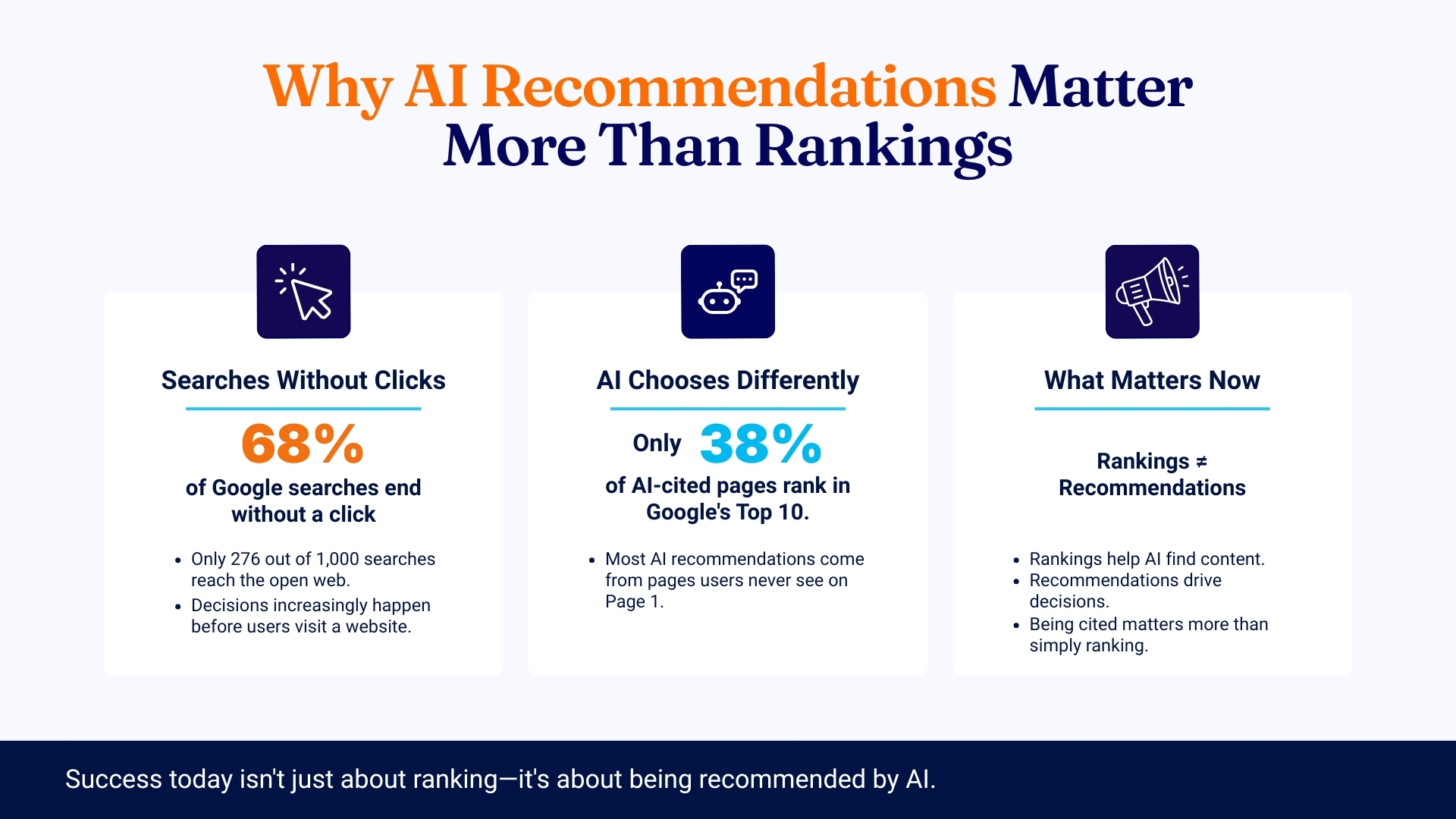
Two numbers explain the shift.
SparkToro and Similarweb found that 68.01% of US Google searches ended without a click in early 2026, up from 60.45% two years earlier. Only 276 of every 1,000 searches now reach the open web at all. The decision increasingly happens inside the answer, before any website loads.
The second number is the one almost nobody has absorbed. Ahrefs found that only 38% of pages cited in AI Overviews also rank in the top ten for that query, down from 76% earlier in the year. Roughly two in three citations go to pages a searcher would never see on page one.
Read those together and the conclusion is uncomfortable for anyone who has spent a decade chasing positions: ranking well and being recommended have come apart. They are related but no longer the same job.
Our take is that we would rather be the one name an AI says out loud than the third blue link nobody scrolls to. Rankings still matter, because they feed the machines. But the recommendation is the conversion event now.
How Content Everywhere℠ turns one answer into many recommendations
LLMs cross-check. A claim that appears once, on your own website, is marketing. The same claim appearing on your site, in your Google Business Profile posts, in a YouTube video, on two directory profiles, and inside an answered forum question reads like consensus. Consensus is what models repeat.
That is the mechanical reason works as LLM optimization. One piece of real expertise, a roofer’s honest guide to hail claims, a dentist’s straight answer on implant costs, gets built once and distributed across every surface the models read. The distribution is the optimization. It is also why and LLMO are one program in practice: the same clear, structured answer serves both.
There is a strategic reason this compounds rather than just adding up. Being cited is starting to affect what visibility costs. When OpenAI opened ChatGPT ads to businesses of any size in May 2026, it did so through a relevance-weighted auction, which means the businesses AI already treats as relevant enter that auction ahead of the ones buying their way in. We wrote about separately. The short version: organic AI visibility now makes paid AI placement cheaper, so the two are one budget conversation rather than two.
The 90-day LLMO plan
Days 1 to 30: the foundation: Rebuild the Google Business Profile completely: categories, every service listed, service area, fresh photos, and a weekly post. Clean your top ten citations until the name, address, and phone match the character. Put a review ask into your job close-out routine with a direct link, and never tell customers what to write or offer anything in exchange, both of which breach and can cost you the profile. Add the LocalBusiness and Service schema to the site, and check robots.txt for blocked AI crawlers.
Days 31 to 60: the answers. Publish three pages that answer the questions customers actually ask before hiring you: what it costs, how long it takes, and how to choose. Add FAQ blocks with schema. Run the first Content Everywhere℠ cycle: turn the best answer into GBP posts, a short video, social clips, and an updated directory description. Upgrade your two most-trafficked directory profiles from stubs to sales pages.
Days 61 to 90: the authority: Pitch one local “best of” list or news piece. Establish a genuine presence in one or two community threads where your customers ask questions. Publish one original data point from your own work: jobs completed, seasonal patterns, or average timelines. Original numbers are citation magnets precisely because nobody else has them. Then run the visibility test below and let the results set month four’s priorities.
Test your own AI visibility in ten minutes
Open ChatGPT, Gemini, and Perplexity and ask each one:
- “Best [your service] in [your city]”
- “Who should I call for [urgent problem] in [your city]?”
- “Is [your business name] any good?”
- “What do reviews say about [your business name]?”
Log which businesses get named, in what order, and which sources each tool cites. Repeat monthly.
The citations are the map. Every source an AI names that you are absent from is your next task, and it is a more useful to-do list than any keyword report, because it tells you exactly which door you are not standing in.
The two things to fix first
Profile and reviews. Everything else on this page stacks on those two, and they are the only items your competitors might already be doing well.
If your Google Business Profile is incomplete, start there. It is the cheapest work with the fastest return, and it feeds two of the three factors Google says decide local results.
If the profile is solid but your newest review is from spring, fix that instead. With 74% of consumers looking for reviews from the last three months, a stale review base is costing you calls right now, and the same staleness reads to a model as a business that has stopped working.
If you would rather see your gaps before committing the 90 days, and we will run this exact checklist against your business and your market.
Frequently Asked Questions
Make your business easy for it to verify: a complete Google Business Profile, consistent citations, recent specific reviews, and mentions on surfaces the model trusts, like directories, local press, and forums. ChatGPT composes local recommendations from live search results, so whatever those results say about you is what it says about you.
Yes, as one input among several. For local queries, your profile, reviews, and third-party mentions usually carry more weight than your site alone. The site’s job is to be machine-readable and to hold the clear answers everything else points to.
Footprint fixes, profile, citations, schema, start surfacing in weeks because AI tools search live. Reviews, press placements, and forum presence build over two to three months. The 90-day plan above sequences it in that order on purpose.
They share foundations: clean structure, real answers, consistent business data. The difference is the target surface. SEO earns positions on results pages; LLMO earns mentions inside AI answers. Done right, one program feeds both, which is why we run them together.
The basics, yes: rebuild the profile, fix citations, systematize review asks, run the monthly visibility test. Where owners stall is distribution, getting one piece of expertise onto a dozen surfaces month after month. That’s the part agencies are for.