(214) 272-7034
  info@fasthippomedia.com



TL;DR
Enterprise SEO in 2026 is two games at once: classic Google rankings and citations inside AI answers. Treat search as infrastructure. Standardize templates, keep crawl paths clean, ship schema through templates, and put governance in place so thousands of pages stay consistent. Template fixes pay off in weeks. Authority and AI citations take months.
Enterprise SEO in 2026 means winning two search systems at once: Google’s classic rankings and the citation logic of AI answer engines like AI Overviews, ChatGPT, and Perplexity. For large sites, the winning move is to treat search as infrastructure, with standardized templates, clean crawl paths, machine-readable content, and governance that keeps thousands of pages consistent.
We work with sites that run into the thousands of pages, and the pattern is nearly always the same. The problem is rarely one bad page. It is a scale. A single misconfigured template quietly breaks ten thousand URLs at once, and a governance gap lets new issues appear faster than anyone can fix them. In 2026, AI search raised the stakes on both. If you want the short version of how we approach this, it is our enterprise SEO playbook written out in full.
What Makes Enterprise SEO Different From Regular SEO
Regular SEO is a page problem. Enterprise SEO is a systems problem.
When you have 25 pages, you tune each one by hand. When you have 25,000, hand-tuning is impossible, so the advantage moves to the template, the CMS, and the rules your team follows. At that size, the usual failure modes are structural, not creative:
- Crawl budget waste, where Googlebot spends its time on filtered, faceted, and duplicate URLs instead of the pages that earn revenue.
- Duplicate and near-duplicate content created by parameters, print views, and location permutations.
- Inconsistent metadata across teams, so title tags and structured data drift page by page.
- Weak internal linking, where deep pages sit five or six clicks from the homepage and never gather authority.
- Fragmented content strategy, where three departments publish on the same topic and split their own rankings.
None of these are exotic. They are what happens when a big site grows faster than its standards. The job of enterprise SEO is to put the standards back and enforce them in the template layer, not the editing layer, so that correctness is the default state of every new page.
Why 2026 Changed the Math
The ten-blue-links era is over, and the data leaves little room for argument. SparkToro’s June 2026 study put US zero-click Google searches at 68.01% across January through April, a jump from 60.45% two years earlier. Put another way, barely one search in three still delivers a visitor to the open web. AI overviews are driving much of that: they surface on more than a fifth of Google searches, and where they appear, click-through rates fall by close to 60%. The AI side is scaling just as fast at I/O 2026 Google reported that AI Mode had crossed a billion monthly users, with query volume more than doubling each quarter since launch.
For a large site, that shift is both a threat and an opening. The threat is obvious: if AI answers the question, your ranking earns fewer clicks than it did a year ago. The opening is that AI engines have to pull their answers from somewhere, and they favor sources they can parse and trust. Brands that earn those citations see roughly 35% more organic clicks than brands that do not. Enterprise sites, with their depth of content and domain authority, are well placed to be the source of AI quotes, but only if the content is built to be quotable.
That is where our answer engine optimization work meets enterprise SEO. The same page that ranks in Google can be structured to get cited by AI, but only when it is machine-readable, factual, and consistent across the whole domain.
The Three Programs We Run in Parallel
We do not treat enterprise SEO in 2026 as one project. We run it as three concurrent programs because each needs a different owner and a different toolset.
Technical SEO at scale
This is the foundation, and at enterprise size, it is mostly automation. We standardize title tags, meta descriptions, canonical rules, and schema inside the CMS templates so a page is correct the moment it is created. We audit crawl budgets and block the low-value URL patterns eating them. We automate internal linking so a new page inherits links from the right hubs on its first day. Sites that push structured data through templates rather than by hand show roughly three times higher AI Overview inclusion for the same keywords, which is why we treat schema as a template feature, not a per-page chore.
AI search visibility
Ranking in Google is no longer the only scoreboard. We track whether the brand gets cited across ChatGPT, Perplexity, Gemini, Claude, and Copilot because those are now real discovery channels. In practice, that means structuring content so a language model can lift a clean, factual passage: a direct answer near the top, clear headings, defined entities, and claims backed by data rather than adjectives.
Content governance
On a 50-person marketing team, SEO issues get introduced faster than they get fixed unless someone owns the standards. We put a governance framework in place: clear ownership of templates, documented content standards, a briefing process every writer follows, and brand voice rules that hold across regional teams. Governance is the least glamorous part of the job and the one that decides whether a site steadily improves or quietly churns.
How AI Engines Choose Which Enterprise Site to Cite
When an AI engine builds an answer, it does not rank ten links and stop. It selects a handful of passages it trusts enough to quote, and the selection runs on signals that reward large, well-run sites when those sites are structured correctly.
Three things carry the most weight. The first is entity clarity: the engine needs to understand what your brand is, what it does, and how its products relate, which comes from consistent naming, structured data, and an about page that states plain facts. The second is passage quality: a clean, self-contained answer near the top of a page is far easier to lift than a claim buried in paragraph nine. The third is corroboration, where the engine cross-checks a claim against other sources and favors brands it already recognizes.
For an enterprise site, this is genuinely good news. You already have the content depth and the authority. The gap is almost always structured, whether the right passage is quotable and whether your entity data is consistent across thousands of pages. Fix those two, and a large site can move from invisible in AI answers to the default citation for its category.
What We Actually Check in an Enterprise Audit
When a large site plateaus, we start with a structured audit rather than guesswork. The first pass looks at how the site behaves in bulk, not how any single page reads:
- Index coverage: how many pages Google actually holds versus how many exist, and which templates are bloating or starving the index.
- Crawl distribution: where Googlebot spends its budget, and how much is wasted on parameters and duplicates.
- Template health: whether titles, canonicals, and schema are correct at the template level, since a template fix repairs every page under it at once.
- Internal link flow: whether authority reaches the money pages or pools at the homepage, which is the single most common reason a strong site still ranks on page three.
- Citation readiness: whether the highest-value pages are structured so AI engines can quote them cleanly.
That order is deliberate. Template and crawl issues move the largest number of pages for the least effort, so they come first and set the base that authority and AI citations build on.
Common Enterprise SEO Mistakes at Scale
Most of the damage we find on large sites comes from a short list of repeat offenders, and they are worth naming because they are avoidable.
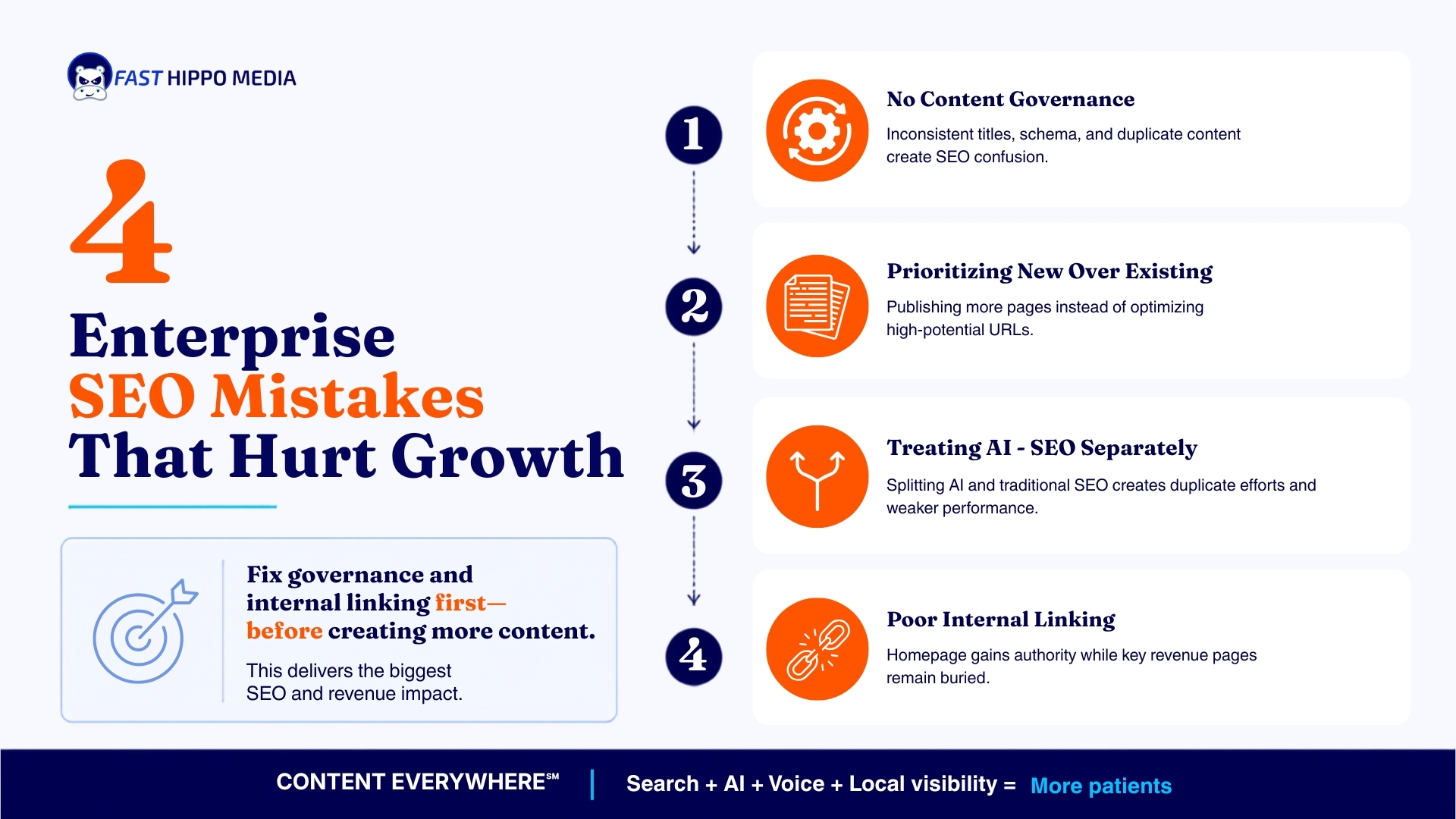
- The first is publishing without governance. A team ships hundreds of pages a quarter, each slightly different, and within a year, the site has no consistent title format, no reliable schema, and three versions of the same topic competing.
- The second is chasing new pages while ignoring the existing ones, so a site of 40,000 URLs keeps adding rather than fixing the 5,000 that already have impressions and need only a structural repair.
- The third is treating AI search as a separate side project rather than a property of the same content, which leads to a second team, a second budget, and content that ranks poorly in neither system.
- The fourth, and the most expensive, is letting the homepage hoard authority. On a large site with weak internal linking, the homepage ranks while the money pages sit on page three, exactly the pattern we see over and over. The fix is not more content. It is routing links deliberately from strong hubs to the pages that are supposed to earn.
We fix these in the order that moves the most revenue, which usually means governance and internal linking before a single new article gets written.
How This Looks for a Multi-Location Business
Multi-location and multi-region sites carry an extra layer because every location page competes for attention and can slide into thin, cloned boilerplate. AI engines and Google both discount pages that read like a mail merge. We build location pages that are genuinely unique to each market, with local proof, local entities, and content that answers the specific audience’s questions rather than a template with the city name swapped in.
If you also operate across regions or languages, hreflang becomes a scale problem of its own. A single wrong tag can send Google the wrong version of a page for the wrong market, and at hundreds of location and language combinations, the errors compound quietly until traffic in a whole region softens. We handle hreflang the same way we handle everything else at this size, through templates and automated validation rather than hand-tagging, so the relationships stay correct as pages are added and retired.
The harder question for many businesses is whether they even need an enterprise program or a sharper local one. If your footprint is regional rather than national, the honest comparison is enterprise SEO versus local SEO, because the right path depends on how your demand is actually shaped, not on how big the site happens to be.
Where to Start if Your Site Is Large and Stalling
If you manage a big site and traffic has flattened or slipped in 2026, this is the order we work in:
- Fix the template layer first. Standardized titles, schema, and canonicals repair thousands of pages in a single move.
- Reclaim crawl budget. Point Googlebot at the pages that earn and block the ones that do not.
- Rebuild internal linking so authority reaches your money pages, not just your homepage.
- Make your best content quotable, so AI engines cite you instead of a competitor.
- Put governance in place so the fixes hold instead of eroding over the next two quarters.
The Takeaway
Enterprise SEO in 2026 is not about chasing a hundred individual rankings. It is about running your site like infrastructure, so scale becomes an advantage instead of a liability, and so both Google and the AI engines can find, trust, and quote you. That is the work we do at Fast Hippo Media, and it starts with a technical and content audit of how your site behaves at scale. The audit gives you a prioritized list: template fixes first, then crawl and internal linking, then the citation and governance work, so you always know which move returns the most for the least effort. Nothing on that list is guesswork, because every item is tied to a page group and a measurable outcome you can watch in Search Console over the following weeks.
Frequently Asked Questions
Generally a site large enough that pages are governed by templates and multiple teams rather than one editor, often in the thousands to hundreds of thousands of URLs, with several stakeholders and a complex CMS.
No. It is a second parallel channel. Google still drives most discovery, but AI answer engines now sit on top of it, so we optimize for both rather than choosing one.
Template and crawl fixes can move large groups of pages within weeks because they apply site-wide at once. Authority and AI citation gains build over months as the improved structure is recrawled and trusted.
At enterprise scale, yes, delivered through templates. Template-driven structured data is a major driver of AI Overview inclusion, and hand-coding it does not scale past a few hundred pages.