(214) 272-7034
  info@fasthippomedia.com


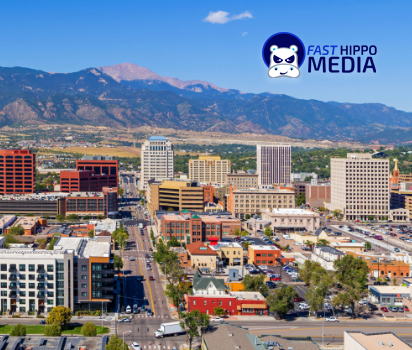
Colorado Springs isn’t just a smaller version of Denver- it’s a unique local search market that requires a different SEO strategy.
- Most agencies treat Colorado Springs as a smaller version of Denver. It is a different market with different physics.
- Three forces drive the difference: constant household turnover from five military installations, a city organized by corridor rather than neighborhood, and tourist seasonality that reshapes search demand twice a year.
- Generic city-level SEO ignores all three, which is why so many Springs businesses rank for terms that never produce customers.
- The fix is a strategy built around how this city actually searches: district pages, review depth, and AI search visibility for people who research the Springs before they even arrive.
The Denver-satellite assumption
Ask a Front Range marketing agency in Colorado Springs, and you will usually get Denver’s playbook with the city name swapped. Same keyword lists, same content calendar, same assumptions about how customers find businesses. The assumption is understandable. It is also wrong, and the businesses paying for it can see the gap in their own numbers: rankings that look fine, phones that stay quiet.
Colorado Springs is the second-largest city in the state, the seat of Colorado’s most populous county, and its own media market. More important for search: the people doing the searching here live different lives than searchers in Denver, and they arrive at Google by different roads.
Force one: the city that replaces itself
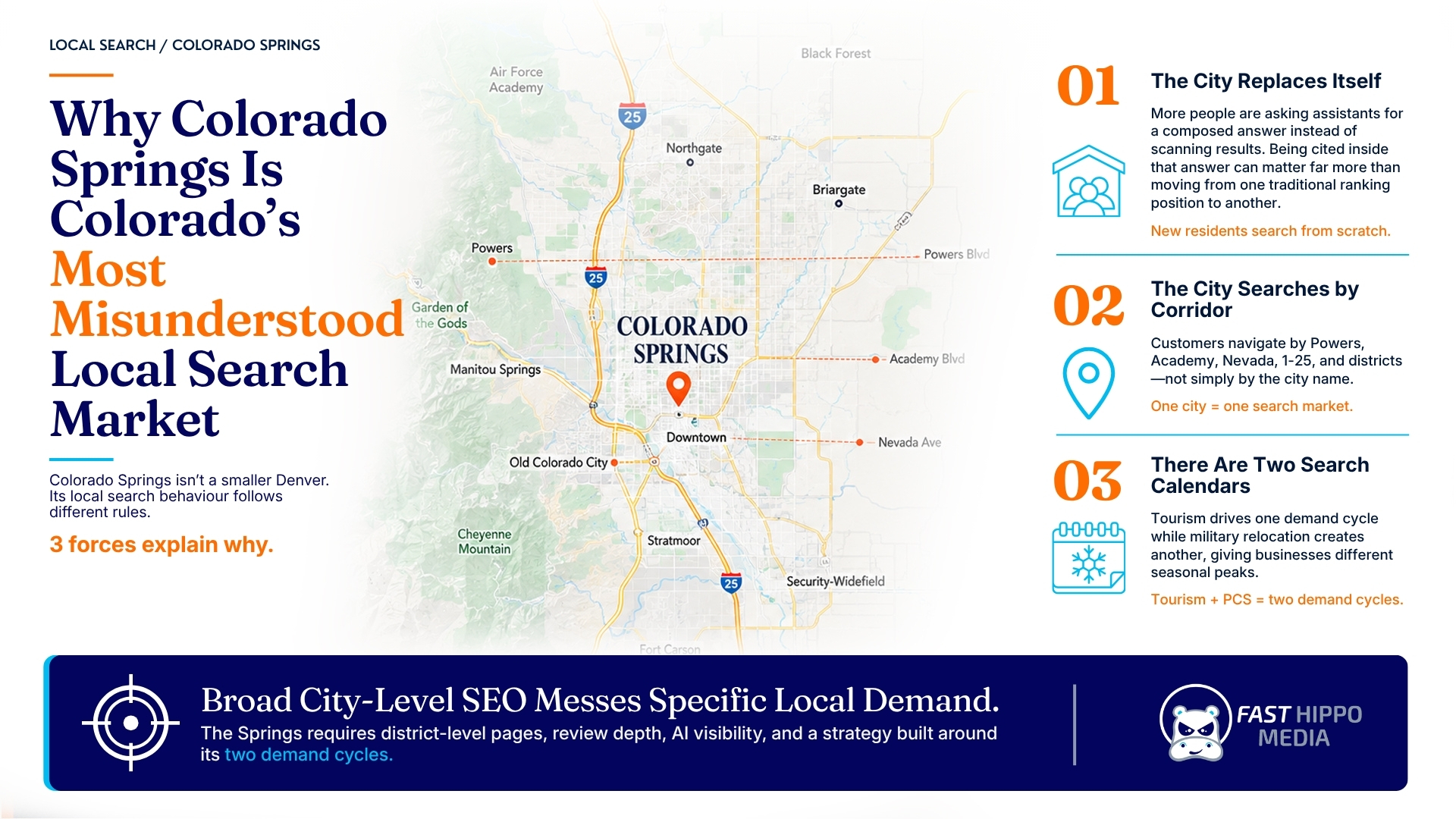
Five military installations ring the city: Fort Carson, Peterson SFB, Schriever SFB, the Air Force Academy, and Cheyenne Mountain. Every year, permanent-change-of-station orders rotate thousands of households and thousands of new ones in, concentrated between May and August.
Think about what that does to local commerce. A meaningful slice of every Springs business’s customer base is new to town, has no accumulated brand knowledge, and asks Google and AI assistants for everything: a dentist, a mechanic, a gym, a church, a pediatrician. In most cities, reviews confirm a choice a customer was already leaning toward. In Colorado Springs, for the newest residents, reviews are the choice. No other market in Colorado works this way at this scale.
Force two: corridor geography
Denver is organized by neighborhood. The Springs are organized by corridor. Locals navigate by Powers, Academy, Nevada, and I-25, and by district: Downtown, Old Colorado City, Briargate, Northgate. The city covers roughly 195 square miles, and Google’s Map Pack localizes results block by block across all of it.
The practical consequence: there is no such thing as ranking “in Colorado Springs.” A business at First & Main and a business on South Nevada are effectively in different search markets at the moment a customer types “near me.” One city page cannot cover that geography, which is exactly why we build district-level pages for our clients and for ourselves.
Force three: two search calendars
Garden of the Gods, Pikes Peak, and the Manitou corridor pull a river of visitors through the city every summer, and those visitors search from the sidewalk with their wallets open. Meanwhile, the resident economy runs its own calendar, peaking when the PCS wave lands. A restaurant in Old Colorado City and a plumber in Briargate are both “Colorado Springs businesses,” and their demand curves barely overlap.
Agencies running one campaign on one calendar miss both peaks. The Springs rewards businesses that know which economy they are in and plan the year around it.
What does the misunderstanding cost
Here is the pattern we see in audit after audit: a Springs business ranks respectably for a broad term like “HVAC Colorado Springs,” gets congratulated by its agency, and still loses the customers that matter, because the searches that convert are “furnace repair near Briargate,” asked from a kitchen table in 80920, and “best HVAC company Colorado Springs,” asked to ChatGPT by a family that has not finished unpacking. Broad rankings are a vanity metric here. Specific presence is revenue.
What a Springs-native strategy looks like
Built from the ground up for this market, the program looks like this: district-level pages that match corridor geography, a review engine tuned for velocity because the audience refreshes annually, Answer Engine Optimization for the questions relocating families ask before they arrive, Google Business Profiles maintained like storefronts, and a content calendar that respects both the tourist season and the PCS wave. That is the system we run from our own office at 2205 Montebello Square Dr, on this exact page architecture. The rest of this blog series walks through each piece.
Want this work done for your Colorado Springs business?
Fast Hippo Media’s Colorado Springs office runs this exact playbook for Springs businesses every day. Get a free audit, and we will show you the gap between where you stand today and where you could stand in 90 days.
Want this work done for your Colorado business?
Frequently Asked Questions
Colorado Springs has different search behavior than Denver because of military relocation, tourism patterns, and its spread-out corridor-based geography.
Frequent military moves bring thousands of new residents who depend on Google, reviews, and AI recommendations to find trusted local businesses.
Areas like Briargate, Downtown, Powers, and Old Colorado City have different customer behaviors, making location-specific SEO pages more effective.
Tourists create seasonal search demand for restaurants, attractions, and services, while residents follow a different search cycle throughout the year.
A strong strategy combines local landing pages, review growth, Google Business Profile optimization, and content designed for both residents and visitors.