(214) 272-7034
 info@fasthippomedia.com


Choose an answer engine optimization service by evidence, not vocabulary. A real provider can show its own brand cited in AI answers, track citation share rather than only Google rankings, do hands-on technical and content work, and never promise a certain placement. Google itself says no special AI optimization is required, so be wary of anyone selling a secret formula.
TL;DR
Answer engine optimization is the fastest-growing corner of search marketing, and fast growth attracts both real specialists and opportunists who rebranded overnight. If you are paying for AEO, you want the first kind. The problem is that both use the same words, so you have to judge on evidence. This is exactly the service we deliver, so here is the honest buyer’s checklist we would want you to hold us to. It supports our own answer engine optimization work, and it applies to any provider you consider.
Start With What AEO Actually Is
Answer engine optimization is the practice of making your content the source that AI answer engines quote: Google AI Overviews, ChatGPT, Perplexity, Gemini, and Copilot. The goal is not only a ranking, but also a citation inside the answer, because a growing share of searches now end on the results page without a click.
That framing matters when you shop, because it tells you what real work looks like. It covers entity clarity so the engines understand your brand, clean structure so a model can lift a passage, accurate and genuinely useful content, and measurement of whether you actually get cited. A provider who cannot describe AEO in these terms, and only talks about keywords and blog volume, has not made the shift.
The Single Fastest Credibility Check
There is one test that cuts through every sales pitch. Search for the agency’s own brand in ChatGPT, Perplexity, or Google’s AI answers on a relevant question and see whether it gets cited. A provider that sells AI visibility should have earned its own. If the engines do not know them, ask how they plan to get you cited when they cannot do it for themselves.
It is not a perfect test, and a new agency can be skilled before it is famous, but it is a strong signal. The best AEO providers use their own site as the proof of concept, which is precisely what we try to do, and it is a fair standard to apply to us and to everyone you evaluate. If a provider cannot be found in the answers it promises to win for you, that absence is data worth weighing.
What Google Actually Says (and Why It Matters When Shopping)
Here is the fact that protects you from most AEO hype. Google’s own documentation states that there are no additional requirements or special optimizations needed to appear in AI Overviews or AI Mode, and that eligibility simply comes from being indexed and eligible for normal search snippets. You can read this in Google’s AI features guidance.
Google goes further in its guide to optimizing for generative AI features, stating plainly that structured data is not required for generative AI search and there is no special schema you must add, and that what moves the needle most is content people find unique, compelling, and useful. This is your shield against any provider selling a proprietary AI formula or a secret markup file. The real work is quality and structure, not a magic trick, and a provider who claims otherwise is either misinformed or hoping you are.
The Red Flags That Should End the Conversation
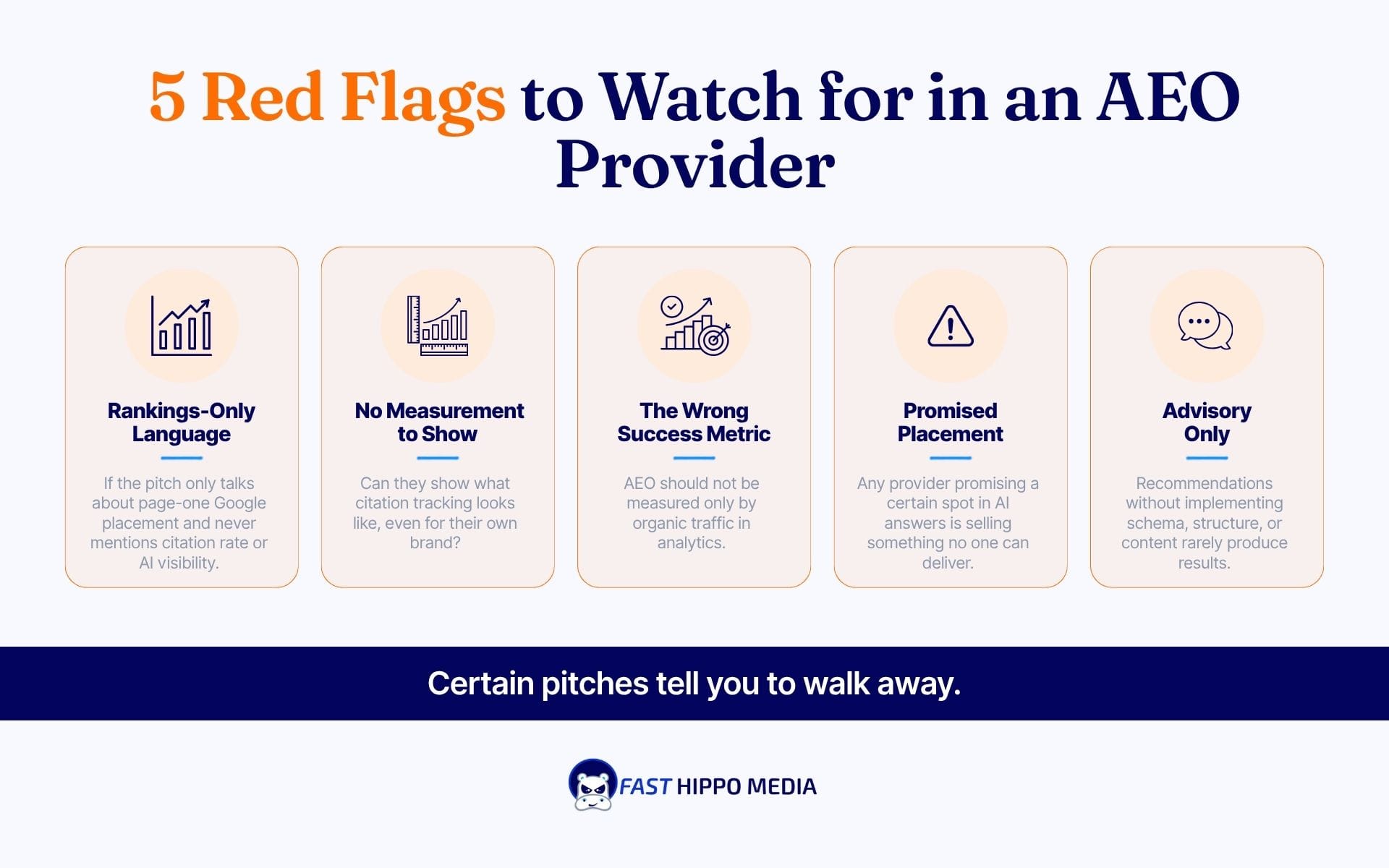
Certain pitches tell you to walk away. Watch for these.
- Rankings-only language: If the entire pitch is about page-one Google placement and never mentions citation rate or AI visibility, the provider has not shifted to AI search.
- No measurement to show: Real AEO providers can show you what citation tracking looks like, even for their own brand. If they cannot, they lack the infrastructure to deliver it for you.
- The wrong success metric: AI citations do not always send a click, so a provider who measures AEO only by organic traffic in analytics is measuring the wrong thing.
- Promised placement: Any provider promising a certain spot in AI answers is selling something no one can deliver. Google explicitly warns about this, and it is worth quoting.
- Advisory only: A provider who only writes recommendations and never implements schema, structure, or content rarely produces results, because AEO is hands-on work.
Why “Guaranteed” Is the Biggest Warning of All
One red flag deserves its own section, because Google named it directly. In its guidance on third-party SEO services, Google specifically calls out “AEO” and “GEO” tools and services, and states that using a service or tool does not assure ranking success, and that third parties do not have access to Google’s internal ranking data and cannot promise performance.
That is the platform itself telling you that a promised result is not a real offer. Google adds that good advice either qualifies its claims as opinion based on data and experience, or backs them by citing official Google guidance. Hold any AEO provider to that bar. A credible one speaks in probabilities and shows its reasoning. The one promising certainty is the one to avoid, and now you can say Google agrees.
What Real AEO Work Actually Includes
It helps to know what you are buying, because the scope is where good and bad providers separate. Real answer engine optimization is hands-on across four areas, and a provider should be able to speak to all of them.
The first is entity architecture: making sure the AI engines understand what your brand is, what it offers, and how its parts relate, through consistent naming and an information structure the engines can follow. The second is content, which Google itself flags as the biggest factor, meaning genuinely useful, accurate, well-structured pages that answer the questions your customers actually ask. The third is technical structure: clean, parseable pages where a direct answer sits where a model can lift it, rather than buried in filler. The fourth is measurement, tracking whether you get cited across ChatGPT, Perplexity, Gemini, and Google’s AI answers, so the work is judged by outcomes rather than activity.
A provider who does only one of these, usually content, and calls it AEO is giving you a fraction of the work. Ask directly which of the four they handle and which they leave to you. The answer tells you whether you are buying a complete service or a slice dressed up as one.
How to Compare Two Providers Side by Side
Once you have two or three candidates, a simple scorecard keeps the decision honest and stops a smooth sales call from deciding it for you. Score each on the same handful of factors.
Rate whether their own brand is cited in AI answers, since that is the clearest proof they can do the work. Rate whether they can show real citation tracking, even for themselves. Rate how they talk about results, whether in probabilities and evidence or in promises. Rate which of the four work areas they actually deliver. And rate how they price, since a provider who cannot explain their pricing model is telling you the scope is undefined, which is where budgets quietly overrun.
Lay those scores next to each other, and the choice usually becomes obvious. The provider who wins on evidence, honesty, and completeness is almost always the right one, even when they are not the cheapest or the most confident on the call. Confidence is easy to perform. The scorecard is what separates a provider who can do the work from one who can only talk about it, and it is the same discipline we would want you to apply to us.
The Questions to Ask on the Call
A short, specific interview separates specialists from the rebranded. Ask when they first ran an AEO engagement for a paying client and what the measurable outcome was, listening for citation data rather than vague “AI visibility improvements.” Ask how they track whether you get cited across the AI platforms. Ask to see a sample report. Ask which parts they implement themselves versus hand to you. Ask how they would handle your entity data and structure. The specifics in the answers, or the lack of them, tell you almost everything.
Industry coverage backs up why this rigor matters now: as HubSpot’s analysis of AEO trends documents, AI answers increasingly mediate discovery, which is why serious providers have built real citation measurement and casual ones have not.
Why Vertical Experience Is Worth Paying For
One factor separates a provider who will get you cited from one who merely understands AEO in the abstract: experience in a business like yours. AI answer engines pull from the sources they judge most relevant to a specific question, and relevance is shaped by the language, entities, and questions particular to your field.
A provider who has worked in your vertical knows what your customers actually ask an AI assistant, which is often different from the keywords a generic tool would suggest. They know which sources and directories the engines trust in your space. They know the entities that matter, the certifications, the service categories, the local landmarks that make your business legible to a model. A generalist has to pick all of that up on your budget, and may never fully get there. That does not mean you should only hire specialists in your exact niche, since a strong provider transfers experience across related fields, but it does mean you should ask directly what comparable work they have done and what it produced.
The reason this matters for an affordable, effective engagement is that vertical experience shortens the path. A provider who already understands your space spends less time getting oriented and more time getting you cited, which is both faster and cheaper than paying someone to map your field from scratch. When you compare providers, weigh relevant experience heavily. It is often the difference between a program that works from the first month and one that spends its opening weeks, and your budget, simply catching up on how your industry talks.
The Takeaway
Choosing an AEO service is an evidence exercise. Look for a provider cited in AI answers itself, one that tracks citation share, does the hands-on technical and content work, and speaks honestly about what can and cannot be promised. Lean on Google’s own words: no special optimization is required, and no one can guarantee results. Anyone whose pitch contradicts those two facts has told you what you need to know before you have spent a dollar. Score your candidates on evidence, weigh real experience in your field, and let the provider who is honest about what can and cannot be promised win the work. If you want a partner who works to that standard, our answer engine optimization service is built on it, and you can read how AI search changed the fundamentals in our guide to AI-driven search.
Frequently Asked Questions
It works to make your content the source AI answer engines cite, through entity clarity, clean structure, genuinely useful content, and measurement of whether you get cited across platforms like ChatGPT, Perplexity, and Google AI Overviews.
No. Google’s own guidance states structured data is not required for generative AI search, and there is no special markup to add. Useful, well-structured content is what matters most.
No. Google explicitly states that third-party services cannot assure ranking or AI performance because they lack access to its internal data. Treat any such promise as a red flag.
Search for their own brand in ChatGPT, Perplexity, or Google’s AI answers. A provider selling AI visibility should have earned its own and should also be able to show you real citation tracking.