(214) 272-7034
  info@fasthippomedia.com


TL;DR
Enterprise SEO and local SEO solve different problems. Enterprise SEO fixes search at the system level for large sites with thousands of templated pages. Local SEO wins visibility in a specific place through Google Business Profile, reviews, and location pages. A multi-location business usually needs both, applied in the right proportion to how its demand is actually shaped.
Business owners often ask which one they need, as if it were a single choice. It rarely is. The two disciplines target different searches, use different signals, and are measured in different ways. Picking wrong wastes budget on the pattern that does not match your demand, so it is worth understanding what each actually does before you commit. Both sit inside the work we run under enterprise SEO and local SEO, so here is the honest comparison.
What Each Discipline Is Really For
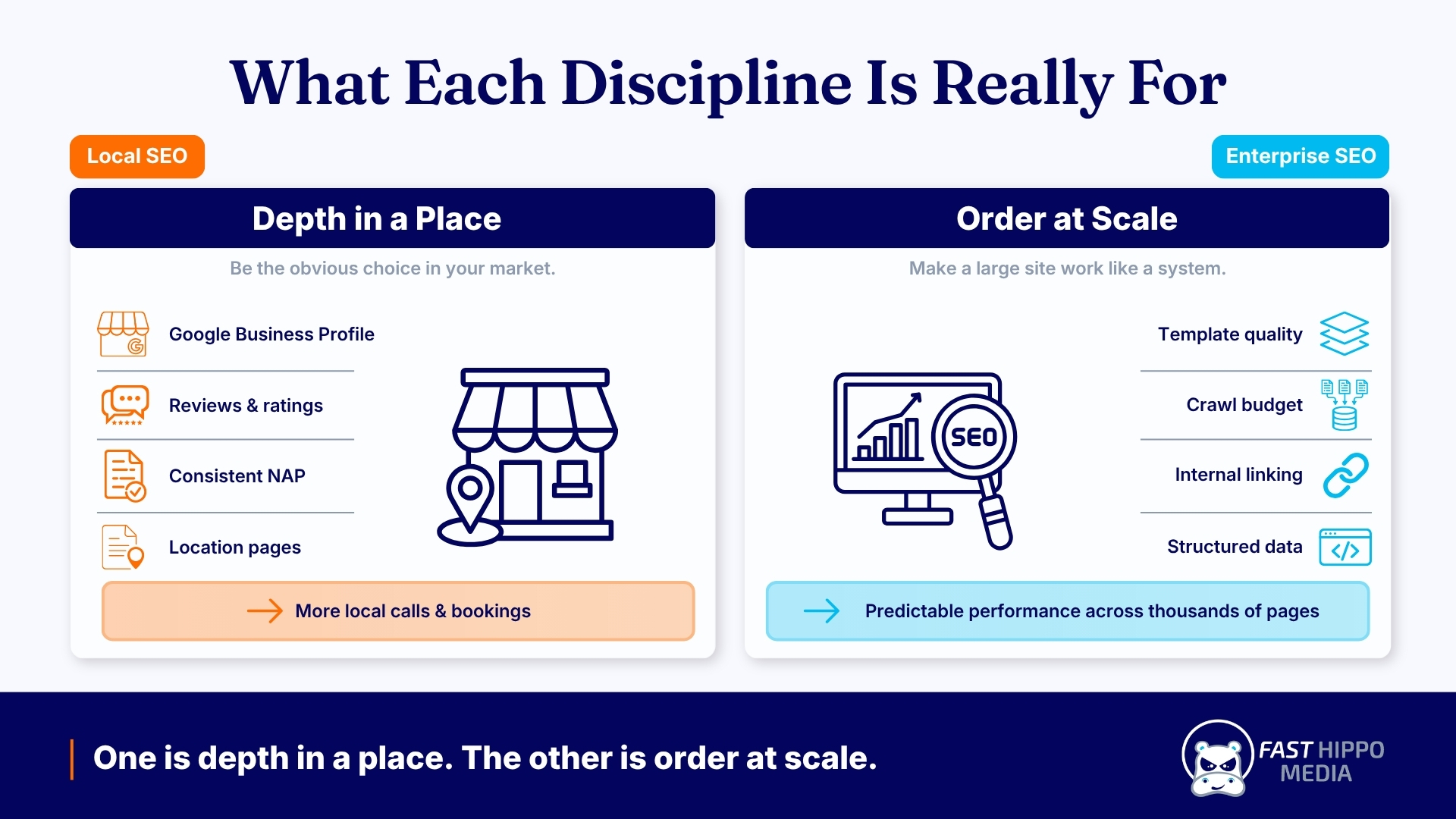
Local SEO is about being chosen in a place. When someone searches for a service near them, Google assembles a local pack and a map, and it ranks businesses on proximity, prominence, and relevance. The signals that move the needle are your Google Business Profile, your review volume and rating, consistent name, address, and phone details across the web, and location pages that genuinely serve each market. The goal is a phone call or a booking from someone nearby.
Enterprise SEO is about controlling search at scale. When a site has thousands or hundreds of thousands of pages, the wins come from systems, not from any single page. The signals that matter are template quality, crawl budget, internal linking, and structured data delivered site-wide. The goal is to make a large, complex site behave predictably so its size becomes an advantage rather than a source of duplicate content and wasted crawl.
One is depth in a place. The other is order at scale. They are not competing answers to the same question.
A Side by Side Comparison
The clearest way to see the difference is to line the two up on the factors that decide a strategy.
| Factor | Local SEO | Enterprise SEO |
| Primary goal | Be chosen in a specific area | Control a large site at scale |
| Typical site size | 20 to a few hundred pages | Thousands to hundreds of thousands |
| Core signals | GBP, reviews, NAP, location pages | Templates, crawl budget, internal links, schema |
| Main competitors | Nearby businesses | Large national or category sites |
| Measured by | Map pack rank, calls, direction requests | Index coverage, page-group rankings, organic revenue |
| Who runs it | Marketer plus GBP management | Consultant working with engineering |
Most businesses do not sit cleanly in one column. A regional chain has enterprise-scale technical needs and local-scale demand at the same time, which is why the real question is proportion, not either or.
When You Lean Enterprise
You lean toward an enterprise approach when your problems are structural and site-wide. If you run thousands of pages, several teams publish, and your category or product pages sit on page three while your homepage ranks, the bottleneck is your system. No amount of Google Business Profile work fixes a broken template or authority that pools at the homepage. The fix is upstream, and it is the work laid out in our guide to enterprise SEO in 2026.
Signs you are in enterprise territory include index coverage that does not match your published pages, crawl budget wasted on parameters and duplicates, inconsistent metadata across teams, and content that competes with itself because nobody governs the topic map. These are scale problems, and they need scale solutions.
When You Lean Local
You lean toward a local approach when your demand is geographic, and your site is small enough to manage by hand. A service business, a clinic, or a shop with a handful of locations wins by owning its map packs, gathering reviews faster than the competition, keeping its listing details consistent everywhere, and building location pages that actually speak to each town rather than swapping a city name into a template.
For most local and service-area businesses, this is where the money is, because the searches that convert are local and high intent. Someone searching for a service near them is usually ready to call. If that describes your demand, pour your effort into the local signals before you touch anything enterprise.
The Multi-Location Business That Needs Both
The interesting case is the business that genuinely straddles both: a franchise, a regional chain, or a multi-branch service company. Here the two disciplines stack rather than compete.
The enterprise layer handles the system: a location page template that produces clean, unique pages at scale, correct schema on every one, internal linking that connects the national brand to each local page, and hreflang if you cross regions or languages. The local layer then handles each market: a managed Google Business Profile per location, local reviews, and content that reflects the real service area. Get the enterprise layer right, and every location page is technically sound. Get the local layer right, and each one actually ranks in its market. Skip either and the whole network underperforms.
The common failure is doing only one. Businesses that nail local signals but ignore the template end up with thin, duplicate location pages that Google and AI engines both discount. Businesses that build a beautiful template but never manage the individual profiles rank technically and convert poorly. The multi-location winners run both in proportion.
A Simple Way to Decide
If the columns still feel close, three questions usually settle it.
First, where does your demand come from? If most of your searches carry local intent- a service near a town, a clinic in a city- then local signals will return more than any technical project. If your demand is national or category-wide, the site itself is your storefront and its structure decides your ceiling.
Second, how is your site managed? If one person can still touch every important page by hand, you are local in practice regardless of your revenue. If pages are produced by templates and several teams, you have enterprise-shaped problems whether or not you call them that.
Third, where are you actually losing? Pull your own Search Console data and look. If your location and service pages rank but the phone is quiet, the gap is local, in reviews, profiles, and conversion. If your pages barely rank while your homepage carries the site, the gap is structural, and that is enterprise work. The data answers the question more honestly than any rule of thumb, which is why we always start a strategy by reading it rather than assuming.
Budgeting for Each Approach
The two disciplines spend money differently, and knowing that up front prevents wasted budget.
Local SEO is a steady operating cost. The spend goes to profile management, review generation, citation consistency, and a stream of genuinely local content, and it tends to be predictable month to month. The payoff is durable local visibility, and for a small footprint it is usually the highest return you can buy. The risk is spreading thin across too many locations without giving each one real attention.
Enterprise SEO front-loads investment into fixing the system, then shifts to maintenance. The early spend covers the audit and the template, crawl, and internal linking work, which is where most of the value is created because it moves whole page groups at once. After that, the cost drops to governance and content, keeping the standards from eroding. The mistake we see most often is a large business buying a local-sized package for an enterprise-sized problem, then wondering why steady blogging never fixed a broken template. Match the spend to the shape of the problem, not to a round number, and both disciplines pay back.
How AI Search Changes the Comparison
AI search raises the stakes on both sides, and it does so in the same direction. Whether the searcher is national or local, a growing share of answers now appear on the page through AI Overviews, ChatGPT, and Perplexity, and those answers cite sources the engines can parse and trust.
For local businesses, that means being recommended by an AI assistant is becoming its own channel, and it rewards the same things local SEO already values: consistent data and strong reviews. For enterprise sites, it rewards structured, quotable content delivered consistently at scale. In both cases, the underlying requirement is the same: clean structure and consistent entity data, which is why our answer engine optimization work runs alongside both disciplines rather than replacing either.
Common Mistakes When Choosing Between Them
Most businesses that pick wrong make one of a few predictable errors, and they are easy to avoid once you know the pattern.
The first is choosing by company size instead of demand shape. A large company with purely local demand can waste a fortune on enterprise technical work when the real gap is reviews and profiles. A small company competing nationally can pour money into local signals that never move a national ranking. Size is a distraction; demand and site structure are the real inputs.
The second is treating the two as rivals. Owners sometimes ask which to cut, when a multi-location business genuinely needs both. Cutting the enterprise layer leaves thin, duplicate location pages. Cutting the local layer leaves technically sound pages that nobody manages or converts. The disciplines work together, each covering what the other cannot, and framing them as either or is the mistake itself. On a multi-location site, the enterprise layer makes the pages exist correctly, and the local layer makes them chosen, so removing one always weakens the other.
The third is ignoring the data in favor of a hunch. The single most reliable guide is your own Search Console. If your pages rank and the phone is quiet, you have a local and conversion problem. If your pages barely rank, you have a structural one. The numbers point clearly once you look, yet plenty of strategies get chosen on gut feel instead. We start every engagement by reading the data precisely because it prevents these three mistakes before a dollar is spent. A morning spent in Search Console and your Google Business Profile performance data will tell you more about which discipline you need than any sales pitch, and it costs nothing but attention.
The Takeaway
Do not choose enterprise SEO or local SEO by the size of your company. Choose by the shape of your demand and the state of your site. If your searches are local and your site is small, go local. If your problems are structural and site-wide, go enterprise. If you are a multi-location business, you need both, layered so the system supports every market and each market ranks in its own right. That is the balance we build, and our enterprise SEO services exist to get the proportion right for your specific footprint. The honest starting point is your own data rather than a template answer, so we read your Search Console and your map pack performance first, then decide how much of each discipline your situation actually calls for. That way the budget follows the demand instead of a guess, and every location either gets the local attention it needs or the structural fix that was holding it back.
Frequently Asked Questions
Yes, and multi-location businesses usually do. The enterprise layer keeps the site technically sound at scale, while the local layer wins each market through profiles, reviews, and genuinely local pages.
No. They target different searches and use different signals. Enterprise SEO fixes systems like templates and crawl budget, while local SEO wins map packs through profiles, reviews, and location relevance.
Local SEO often shows quicker wins for a small footprint because profile and review improvements move fast. Enterprise template fixes also move quickly but across whole page groups, while authority gains take longer on either side. The honest answer is that speed depends on where your gap sits, so the fastest route is to fix the discipline your data says is actually holding you back rather than the one that is easier to start.
It reinforces both. AI answers reward consistent data and structured content, which are exactly what strong local and enterprise programs already produce, so neither discipline goes away.