(214) 272-7034
  info@fasthippomedia.com


That answer is assembled, not ranked in the old sense. The assistant rewrites the question into web searches, reads what it finds about the stores nearby, and names the ones whose facts it can confirm. So how AI assistants choose a golf cart dealer comes down to which facts are easy to find and hard to doubt, and none of it requires a secret technique.
TL;DR
How AI assistants choose a golf cart dealer is simpler than the sales pitches suggest: they search the web on the buyer’s behalf and summarize what they find. According to OpenAI’s help page for ChatGPT search, it rewrites a question into targeted search queries, can use an approximate location from the buyer’s IP address, and ranks results “using multiple factors”, with placement not guaranteed. Google says there are no special requirements to appear in AI Overviews or AI Mode beyond being indexed and eligible for a normal snippet, and it names an up-to-date Business Profile among the basics worth checking. Microsoft points local businesses to Bing Places so address, hours, and contact details stay eligible for AI answers. For a dealer, that means three sources matter most: the text on your own site, your business listings, and what other people publish about you. Test the answers yourself before paying anyone to change them.
What Happens Between the Buyer’s Question and the Answer?
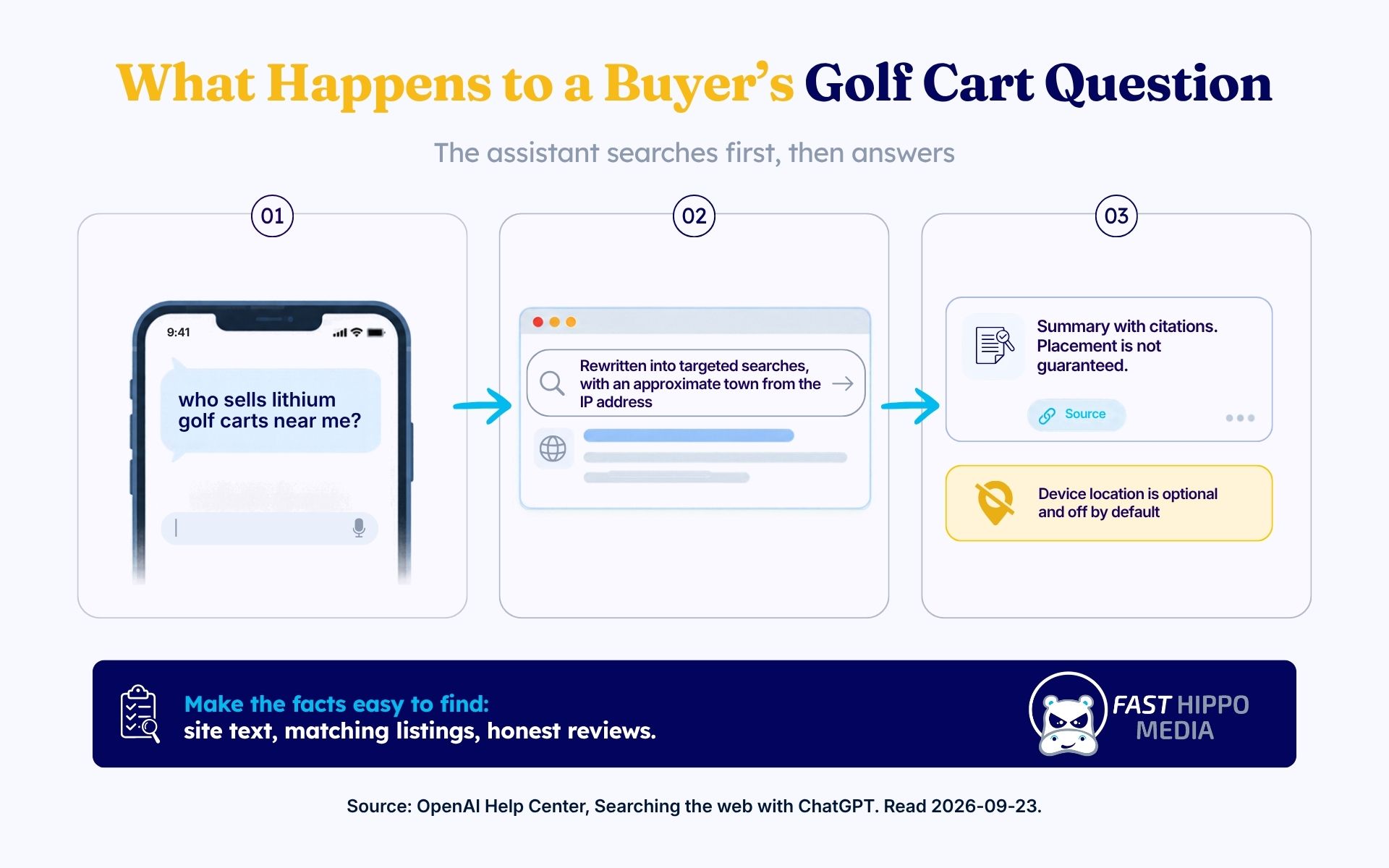
The assistant turns a conversational question into ordinary searches, runs them, and writes a summary from the pages it trusts. OpenAI’s own help article on searching the web with ChatGPT describes exactly this: ChatGPT “typically rewrites your query into one or more targeted queries” and sends them to its search partners. Its example is a person asking for good restaurants near them in the San Francisco area, which becomes the search “top restaurants San Francisco”.
Swap restaurants for golf carts and the mechanics are identical. A buyer in Frisco asking for “a dealer near me that services lithium carts” may be searching, behind the curtain, for something as plain as “lithium golf cart service Frisco TX”. The same help page says ChatGPT “may use an approximate location based on your IP address”, and that precise device location is optional and off by default. So the town in the rewritten query is usually a guess from the network, not a pin on the buyer’s driveway.
Google’s AI features work on a similar idea with a different name. Its guide to AI features and your website says AI Overviews and AI Mode “may use a ‘query fan-out’ technique”, issuing several related searches across subtopics before writing a response. One question about a cart can quietly become separate searches about price, battery type, street use, and service.
| Step | ChatGPT search | Google AI Overviews and AI Mode |
|---|---|---|
| Question arrives | Conversational, often with “near me” | Typed or spoken into Google |
| Rewriting | Turned into one or more targeted queries | Fanned out into related searches by subtopic |
| Location | Approximate, from the IP address, unless the user shares device location | Google’s normal local signals |
| Sources read | Results from search partners, plus listings from third-party providers | Indexed pages eligible for a snippet |
| What the buyer sees | A summary with citations, sometimes a map on mobile | A summary with supporting links |
The practical upshot is that your store only gets considered if it shows up in the ordinary searches the assistant runs.
There is no side door.
Three Places the Assistant Looks for a Dealer
The material an assistant can draw on falls into three kinds of sources. None of them is exotic, and a dealer already controls two of them.
The text on your own website
An assistant can only repeat what it can read. If your site says “we carry the best brands” and shows a logo strip, there is nothing to quote. If a page says in plain sentences what makes you sell, whether you convert or service lithium carts, which towns your delivery truck reaches, and whether you rent, the assistant has a fact to lift.
The list of SEO basics Google says still apply to its AI features includes “making sure that important content is available in textual form”. That line matters for dealers more than most. Inventory tools often hide the useful details inside images, sliders, or a booking widget, and a sentence locked inside a JPG is a sentence nobody can cite.
Your business listings
The listing is where an assistant checks the boring facts: name, address, hours, phone, category. The same Google guide tells site owners to check that their “Business Profile information is up-to-date”. Microsoft says something similar about its own surfaces. In the February 2026 announcement of AI Performance in Bing Webmaster Tools, Bing suggests local businesses register with Bing Places for Business so that address, hours, and contact information “remain current and eligible for inclusion in AI-generated responses”.
That second listing is the one dealers forget. ChatGPT’s help page links the Microsoft privacy statement among the search providers ChatGPT can use, and it says ChatGPT may share location with “trusted third-party providers” that supply nearby business listings. We cannot say which listing feeds which answer on a given day, and nobody outside those companies can. What we can say is that a store with matching details on Google and Bing gives every assistant the same story.
What other people publish about you
Reviews, local news stories, HOA newsletters, club directories, and forum threads all count as outside confirmation. A dealer named in a Colorado Springs neighborhood newsletter for sponsoring a cart parade has a mention that no amount of on-site copy can replace.
Here is the part that trips people up. Asking customers for genuine reviews is fine, but Google’s Business Profile policy prohibits offering incentives for them, asking for specific content, or filtering who gets asked. A thin, honest review count beats a padded one that puts the profile at risk.
Can a Golf Cart Dealer Pay or Tag Its Way Into the Answer?
No, and both Google and OpenAI say so in writing. Google’s AI features guide states: “There are no additional requirements to appear in AI Overviews or AI Mode, nor other special optimizations necessary.” It adds that you do not need new machine-readable files or special schema.org markup. On the ChatGPT side, the help page says results are ranked using multiple factors and that “Placement is not guaranteed.”
That clears away a lot of what gets sold to dealers under new labels. The table below sets the common pitches against what the platforms themselves publish.
| What a dealer gets told | What the platform’s own page says |
|---|---|
| You need an AI text file or special markup | Google: no new machine-readable files or special schema needed |
| A tool can guarantee you get recommended | OpenAI: placement is not guaranteed |
| Structured data alone gets you cited | Google: structured data should match the visible text, which still has to exist |
| AI answers ignore normal search | Google: a page must be indexed and snippet-eligible, the same bar as Search |
There is one technical gate worth checking, and it takes five minutes. For ChatGPT eligibility, the same help page says a site must allow OpenAI’s OAI-SearchBot crawler, and the host or content delivery network must not block OpenAI’s published search IP addresses. Some sites blocked every AI crawler during the training debates and shut the search crawler out along with the rest. Ask whoever manages your site to open robots.txt and confirm it.
Run the Prompt Test Before Changing Anything
Guessing is expensive.
Before a dealer rewrites a page or hires anyone, we suggest a plain test that shows what the assistants say about the store today. It needs a phone, a laptop, and a spreadsheet.
- Write the questions your buyers actually ask. Use their words, not marketing words: who services lithium carts near me, where can I buy a street-legal cart in Frisco, who rents carts for a weekend in Colorado Springs, is there a Club Car dealer near Plano.
- Ask each question in ChatGPT with search on, in Google’s AI Mode, and in Microsoft Copilot. Use a signed-out browser window so saved memories do not color the answer.
- Run each question twice: once with a town named, once with only “near me”. The ChatGPT help page notes that naming your city or postal code changes local results, so the gap between the two runs is worth seeing.
- Record who is named, in what order, and which source the answer cites. The citation is the most useful column, because it tells you which page or listing the assistant trusted.
- Repeat the same questions a month later, from the same place, and compare.
A simple sheet keeps it honest:
| Question | Assistant | Town named? | Dealers named | Source cited for us | Anything wrong? |
|---|---|---|---|---|---|
| who services lithium golf carts near me | ChatGPT | No | |||
| lithium golf cart service Frisco TX | ChatGPT | Yes | |||
| golf cart rental weekend Colorado Springs | Google AI Mode | Yes |
The last column is where the work usually starts. When an assistant gets your hours wrong, says you do not rent, or places you in the wrong town, the error almost always traces to a listing or page that says the wrong thing, and that is fixable this week.
Reading the Results Without Fooling Yourself
Answers change from one run to the next, so treat a single screenshot as an anecdote. OpenAI is candid about this: its help page warns that “search results and citations can be incomplete, outdated, or incorrect”. A dealer that shows up once and vanishes the next day has not been penalized. The assistant simply searched a little differently.
Two free reports give steadier numbers than screenshots. Bing Webmaster Tools now carries the AI Performance report from that same Microsoft announcement, which counts how often your pages are cited across Copilot and Bing’s AI summaries and lists the grounding phrases the AI used to find them. Google folds AI Overviews and AI Mode traffic into the ordinary Web totals in Search Console, according to its AI features guide, so you will not see those clicks split out there.
Read the grounding phrases closely. If Bing shows a cited page being found for “golf cart battery replacement Denver” and you only sell in Colorado Springs, that page is attracting the wrong town and probably needs its service area stated more clearly.
What Should a Golf Cart Dealer Fix First?
Fix the facts an assistant gets wrong about you, then fill the gaps where it has nothing to say. That order matters because a wrong answer costs a sale today, while a missing answer only costs the chance of one. For a single-location store in Dallas or Colorado Springs, the first two rows are usually an afternoon’s work.
| Priority | What to fix | Why an assistant cares |
|---|---|---|
| First | Crawler access for OAI-SearchBot and normal search bots | Blocked pages cannot be read or cited |
| First | Name, address, hours, and phone matching on Google and Bing Places | Listings are where local facts get checked |
| Second | A page stating which brands you sell and service, in text | Brand questions need a sentence to quote |
| Second | Delivery and service area written as real town names | “Near me” questions get rewritten with a town |
| Third | Plain answers to the buyer questions from your prompt test | Fan-out searches hit these subtopics |
| Ongoing | Genuine reviews, asked for without incentives or scripts | Outside confirmation that you exist and deliver |
The listing work overlaps heavily with what we already do in day-to-day Business Profile management, since the profile is the single record most assistants check first. The page work is ordinary search work, the same thing that ranks a dealer in regular results, which is why we fold it into our broader search program for dealers and rental fleets rather than selling it separately.
A real example helps here. When we worked with a Colorado Springs dealer that sells, customizes, and rents carts, one of the steps in the Lifestyle Golf Carts write-up was reformatting service and product pages so a direct answer sits at the top. That is the kind of change an assistant can use, and it helps human readers on a phone just as much.
If the prompt test shows competitors named across every question and your store nowhere, that is the point where outside help pays for itself. Our golf cart AI SEO work starts from that same test and moves through the list above in order. We will not promise a recommendation, because nobody honestly can.
Why the Same Question Gets a Different Answer in Frisco and Colorado Springs
Location changes the rewritten query, and the rewritten query changes who gets named. A buyer on a Frisco network asking for a street-legal cart is likely to trigger searches about Texas dealers and Texas rules. The same words typed in Colorado Springs pull Colorado stores and Colorado pages.
Season shifts the question too. Late September is still prime cart weather around Dallas, when buyers ask about lifted carts and neighborhood use. In Colorado Springs, the same month brings questions about winter storage and battery care. A dealer who answers the local, in-season question in plain text gives the assistant something current to cite, and that is a better use of an October afternoon than chasing a tool that claims to game the answer.
Run a Golf Cart Dealer Prompt Test This Week
Pick ten questions your customers ask, run them through ChatGPT, Google AI Mode, and Copilot, and write down who gets named and what gets cited. Then fix anything the assistants state wrongly about your store, starting with your listings and your crawler settings. Those two steps cost nothing, and they show you where you really stand.
If you want a second pair of eyes on the results, Fast Hippo Media runs this same test for dealers and rental fleets and tells you plainly which fixes are worth doing and which are not. Bring the spreadsheet, even half-filled in.
Frequently Asked Questions
They rewrite the buyer’s question into web searches, often adding an approximate town, then summarize the stores whose facts they can confirm. Clear text on your site, matching listings on Google and Bing, and outside mentions give them something to cite.
Not in its organic answers. OpenAI’s help page says ChatGPT ranks search results using multiple factors and that placement is not guaranteed. Paid ad placements are a separate product and are labeled apart from the answer itself.
Usually roughly. OpenAI says ChatGPT may estimate a general location from the IP address, such as the city, and uses precise device location only when the person chooses to share it. Naming a town in the question changes the local results.
No. Google states that you do not need new machine-readable files, AI text files, or special schema.org markup to appear in AI Overviews or AI Mode. Structured data you already use should match the visible text on the page.
Ask the questions your buyers ask in ChatGPT, Google AI Mode, and Copilot, with and without a town name, and record who is named and cited. Bing Webmaster Tools also reports how often your pages are cited in Copilot answers.