(214) 272-7034
  info@fasthippomedia.com



Colorado attorney advertising rules are shorter than most lawyers assume and stricter in the places that matter online. Rules 7.1 and 7.2 of the Colorado Rules of Professional Conduct govern what a firm can say about itself, whom it can pay for a recommendation, and whether it can call anyone a specialist. In 2026, the state added two more layers: a Supreme Court comment on lawyers using AI, and a new law that treats most paid lead generation for legal services as a deceptive trade practice. For a firm a block from the El Paso County Judicial Building, all of it lands on the website, the Google listing, and the review strategy.
TL;DR
Colorado rewrote its lawyer advertising rules in September 2020: Rule 7.1 bars false or misleading communications, Rule 7.2 governs advertising, and the old Rules 7.4 and 7.5 are now reserved, so guides citing 7.4 for specialist claims are out of date. Rule 7.2 bars giving anything of value for a recommendation, limits specialist claims to approved certifying bodies, and requires every communication to name at least one responsible lawyer or firm. A January 2026 rule change says a lawyer using AI may be disciplined for any resulting violation. And SB26-174, signed in June 2026, makes paying third parties for legal leads a deceptive trade practice under the Colorado Consumer Protection Act, with narrow exceptions. This is a marketing guide, not legal advice; confirm specifics with ethics counsel.
Which Rules Actually Apply, and Why Old Guides Get Them Wrong
The Colorado Supreme Court amended and adopted the current Rules 7.1 through 7.5 in Rule Change 2020(29), effective immediately on September 10, 2020. The same change marked Rules 7.4 and 7.5 as reserved. Their subject matter now lives inside Rule 7.2.
That sounds like housekeeping. It is not. One of the pages ranking for Colorado lawyer advertising rules still cites Rule 7.4 for specialist claims, six years after it was emptied. A firm that copies advice from a stale page can end up following a rule that no longer exists while missing the one that does.
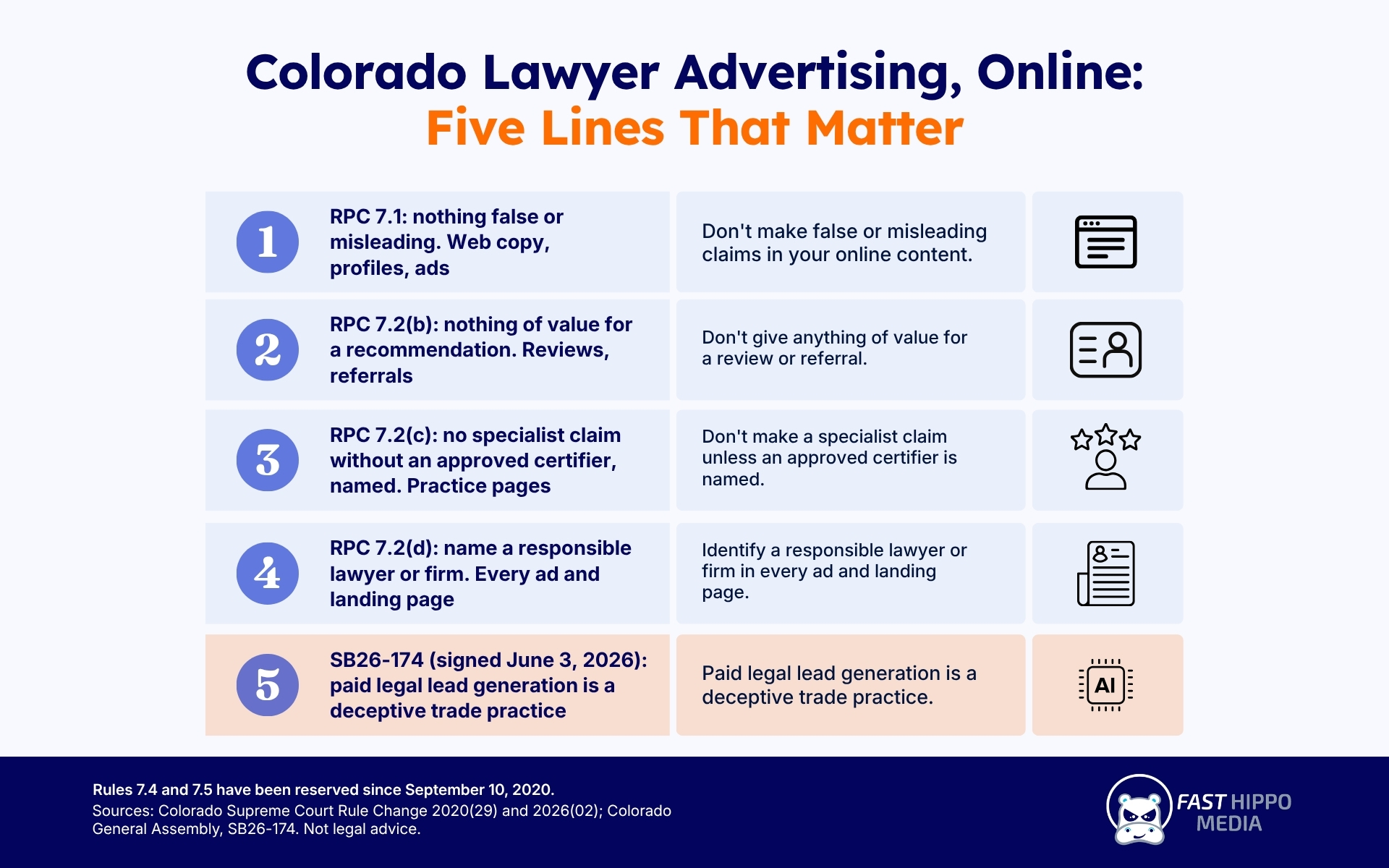
Here is the current map, reduced to what touches online marketing:
| Rule or law | What it says, in brief | Where it bites online |
|---|---|---|
| RPC 7.1 | No false or misleading communication about the lawyer or the lawyer’s services | Website copy, profile descriptions, ad text, AI-drafted pages |
| RPC 7.1, comment 3 | An unsubstantiated comparison with other lawyers may be misleading | “Best”, “top”, “number one” claims |
| RPC 7.2(b) | No giving or promising anything of value for recommending the lawyer, with narrow exceptions such as nominal gifts | Review requests, referral programs, paid directories |
| RPC 7.2(c) | No stating or implying specialist certification unless the certifier is approved or ABA-accredited and clearly identified | Practice area pages, titles, profile names |
| RPC 7.2(d) | Every communication must name at least one lawyer or firm responsible for its content | Landing pages, ads, social posts |
| Rule Change 2026(02) | A lawyer using AI may be disciplined for a resulting violation of the rules | Content written with AI tools |
| SB26-174 | Paying a third party for legal leads is a deceptive trade practice, with limited exceptions | Pay-per-lead vendors and lead marketplaces |
Rule 7.1 and the Words on Your Website
Rule 7.1 is one sentence: a lawyer shall not make a false or misleading communication about the lawyer or the lawyer’s services. Comment 3 to the rule adds that an unsubstantiated comparison of the lawyer’s services with other lawyers’ may be misleading.
Online, that sentence reaches further than most firms expect. It covers the homepage, every practice page, the Google Business Profile description, the About page, social bios, and anything a chatbot on the site tells a visitor.
Phrases we would remove from a Downtown firm’s site on sight:
- “The best criminal defense attorney in Colorado Springs”, unless something objective and verifiable backs it
- “We win”, “guaranteed results”, or any outcome promise
- Settlement figures presented without the context a reader needs to avoid expecting the same result
- “Top-rated” with no statement of who rated you, when, and on what basis
What works instead is specific and checkable: years in practice, the courts you appear in, the kinds of matters you handle, bar admissions. A firm that can say it appears regularly in the Fourth Judicial District courts, a short walk from the office, has said something true, local and useful.
Can a Colorado Lawyer Call Themselves a Specialist?
Only in a narrow case. Rule 7.2(c) says a lawyer may not state or imply certification as a specialist unless the certifying organization is ABA-approved or accredited and clearly identified in the communication. A comment to the rule states that Colorado does not certify lawyers as specialists in any field.
This is where search habits collide with ethics. People type “DUI specialist Colorado Springs” and “family law specialist near me” every day, and firms want to match the language. The safe path is to use the searcher’s words in a way that does not claim a credential:
| Instead of | Try |
|---|---|
| “Colorado Springs DUI specialist” | “Our practice focuses on DUI defense in El Paso County” |
| “Certified divorce specialist” | “Family law is all we do” (only if true) |
| “Estate planning specialists” | “We handle wills, trusts and probate for Colorado families” |
If one of your lawyers does hold a certification from an approved or ABA-accredited body, the rule allows saying so, with the certifying body named clearly. Put the full name of the organization right next to the claim.
Reviews, Referrals and the Value Rule
Rule 7.2(b) says a lawyer shall not compensate, give, or promise anything of value to a person for recommending the lawyer’s services. The rule lists narrow exceptions, including nominal gifts.
That line settles most review questions. Asking a satisfied client for an honest review is not giving anything of value. Offering a gift card, a discount on future fees, or an entry into a drawing for a review is. Google’s own review policy lands in the same place, so a firm that offers anything for reviews risks both a disciplinary complaint and its Business Profile.
A clean review process for a Downtown firm looks like this:
- Ask after the matter is concluded, not while the client still depends on you.
- Send the same plain request to every client, not only the happy ones.
- Never suggest what to write, and never ask a client to mention a practice area or a lawyer by name.
- Reply to reviews without confirming or revealing anything confidential about the representation.
The fourth point deserves emphasis. A lawyer’s duty of confidentiality does not pause because a former client posted something unfair online. A short, courteous reply that discloses nothing is the defensible default.
The 2026 Law on Paid Lead Generation
This is the newest and least understood piece. SB26-174, which the Colorado General Assembly’s site lists as signed on June 3, 2026, establishes that lead generation marketing for legal services is a deceptive trade practice subject to enforcement under the Colorado Consumer Protection Act.
The act defines lead generation legal marketing as a lawyer, law firm, or licensed legal paraprofessional paying money or other compensation to a third party to receive information about a potential client or case. Under the bill summary, a person may solicit or market for legal services in Colorado only if they are authorized by the Colorado Supreme Court to practice law, are working on behalf of such a person who is clearly identified in the advertising, or are a nonprofit that engages in legal services. The summary also says violators may face civil and criminal penalties.
For a firm’s marketing budget, three practical questions follow:
- Does any vendor you pay deliver names, contact details, or case information about potential clients? If so, review that arrangement with ethics counsel now.
- Does your advertising agency market on your behalf with your firm clearly identified in every ad? That is a different arrangement from buying leads from an unidentified network.
- Do you use a directory or marketplace that charges per inquiry? The label on the invoice matters less than what you are paying for.
We are an agency, so we have an interest here, and we will say plainly what that interest is: we do not sell leads, and we run advertising in the firm’s own name. That is how we read the statute’s permitted path, but your ethics counsel’s reading is the one to rely on.
Google Listings for a Firm and Its Lawyers
Google’s Business Profile guidelines name lawyers as individual practitioners. A lawyer may have a profile if they are public-facing and can be contacted directly at the verified location during stated hours. When several practitioners share a location, the firm has its own profile, and each lawyer’s profile should carry only the lawyer’s name. A solo lawyer practicing under a firm brand gets a single profile named in a “firm: lawyer” format.
Two Downtown specifics matter. Many firms here sit on upper floors of Tejon and Cascade buildings, so the suite number belongs on the second address line and should match everywhere. And the profile description is a communication under Rule 7.1, so the same rules on comparisons and specialist claims apply to that short description as to the website.
Rule 7.2(d) adds one more line to the website side: every communication must include the name and contact information of at least one lawyer or law firm responsible for its content. A landing page built for an ad campaign, with no firm name on it, fails that test. So does a social post from an account that does not identify the firm.
AI-Written Pages and the 2026 Comment
In January 2026, the Supreme Court adopted Rule Change 2026(02), adding a scope comment that a lawyer using artificial intelligence may be subject to discipline for a resulting violation of the rules. The accompanying comment to Rule 1.1 lists Rule 7.1 among the rules AI use can implicate.
For marketing, the takeaway is simple. A practice page drafted by an AI tool is still the firm’s communication. If it invents a statistic, promises an outcome, or calls a lawyer a specialist, the firm owns that. Every AI-assisted page needs a lawyer’s read before it goes live, with particular attention to claims, numbers, and anything that sounds like a comparison.
Why Downtown Is Worth Getting Right
The courthouse district is getting busier, not quieter. The Downtown Partnership’s 2026 State of Downtown report, covering 2025, counts about 4,860 residents downtown, 712 new housing units delivered in 2025, 37 new businesses opened, roughly 21,400 people working downtown, and 15.5 million non-resident visits, up 4.3 percent. It also reports office vacancy at 9.5 percent in the fourth quarter of 2025, which it calls the highest since 2011.
The El Paso County Judicial Building, at 270 South Tejon Street, is the Fourth Judicial District’s courthouse, and it anchors a dense cluster of firms. More residents and visitors mean more local legal searches. More vacancy means more firms moving between buildings, with all the listing and address problems that follow.
We work with firms in this district through our Downtown Colorado Springs digital marketing program, and our dedicated law firm marketing around the Judicial Building service puts the rules above into practice page by page.
Audit Your Firm’s Pages Against Rule 7.2 This Week
Open your homepage, one practice page, your Google profile description, and your most recent ad. Read each against the table at the top of this post. Look for comparisons you cannot prove, the word “specialist”, any page without a responsible lawyer or firm named, and any vendor invoice that pays for leads.
If you would like a second pair of eyes, our list of questions worth asking any agency that pitches a law firm, us included, is a good starting filter. For why this city searches differently from Denver, see why the Springs is a misunderstood search market. Firms with a second office on the Westside can compare notes with our page on Old Colorado City and the Westside. Or talk to Fast Hippo Media about a compliance-first marketing plan built with your ethics counsel in the loop.
Frequently Asked Questions
Colorado Rules of Professional Conduct 7.1 and 7.2, as rewritten in September 2020. Rule 7.1 bars false or misleading communications. Rule 7.2 governs advertising, payments for recommendations, specialist claims, and naming a responsible lawyer. Rules 7.4 and 7.5 are now reserved.
Only if certified by an organization that is approved or ABA-accredited, and that body is clearly identified. Rule 7.2(c) sets the limit, and a comment to the rule states that Colorado does not certify lawyers as specialists in any field.
Yes, if nothing of value is offered. Rule 7.2(b) bars giving or promising anything of value for recommending a lawyer, and Google’s policy bars review incentives. Ask every client the same plain way, and never disclose confidential details when replying.
SB26-174, listed as signed on June 3, 2026, makes lead-generation marketing for legal services a deceptive trade practice under the Colorado Consumer Protection Act, with limited exceptions. Firms paying per-lead vendors should review those arrangements with ethics counsel.
It can, but the firm owns the result. Rule Change 2026(02) says a lawyer using AI may be disciplined for a resulting violation, and Rule 1.1’s comment names Rule 7.1 among the rules affected. A lawyer should review every AI-drafted page.