(214) 272-7034
 info@fasthippomedia.com


Seasonal content for golf cart dealers is the pages, videos, emails, and profile posts a dealership publishes to answer what buyers and owners are asking at that point in the year, so your name is the one they already trust when they are ready to buy or book service. It is the part of content marketing for golf cart dealers that follows the weather, because the questions change with it. A plan that follows the seasons in your own town beats a plan that follows a generic posting schedule.
TL;DR
Seasonal content for golf cart dealers works best when it is planned around the local seasons rather than a weekly posting quota. Buyers and owners ask different things in fall, winter, spring, and summer: storage and cold-weather battery care as the first freeze approaches, research and comparison while the lot is quiet, getting carts back on the road in spring, and heat, battery life, and community riding in summer. Those seasons do not arrive on the same date everywhere. NOAA’s climate normals put the typical first freeze at Colorado Springs in early October and at Dallas-Fort Worth in late November, so a dealer in each market should publish winter content about seven weeks apart. Each season needs one substantial anchor piece, a few short pieces cut from it, one owner email, and a handful of Business Profile posts, all refreshed each year with real changes rather than a new date.
Why Plan Golf Cart Content by Season Instead of by Week?
Because golf cart questions are seasonal and your buyers’ seasons are set by local weather, not by the calendar on the wall. An owner searches for battery storage advice in the weeks before the first hard frost, and a first-time buyer starts comparing models when evenings get long again. A weekly schedule with no seasonal logic publishes the right post at the wrong time and then wonders why nobody read it.
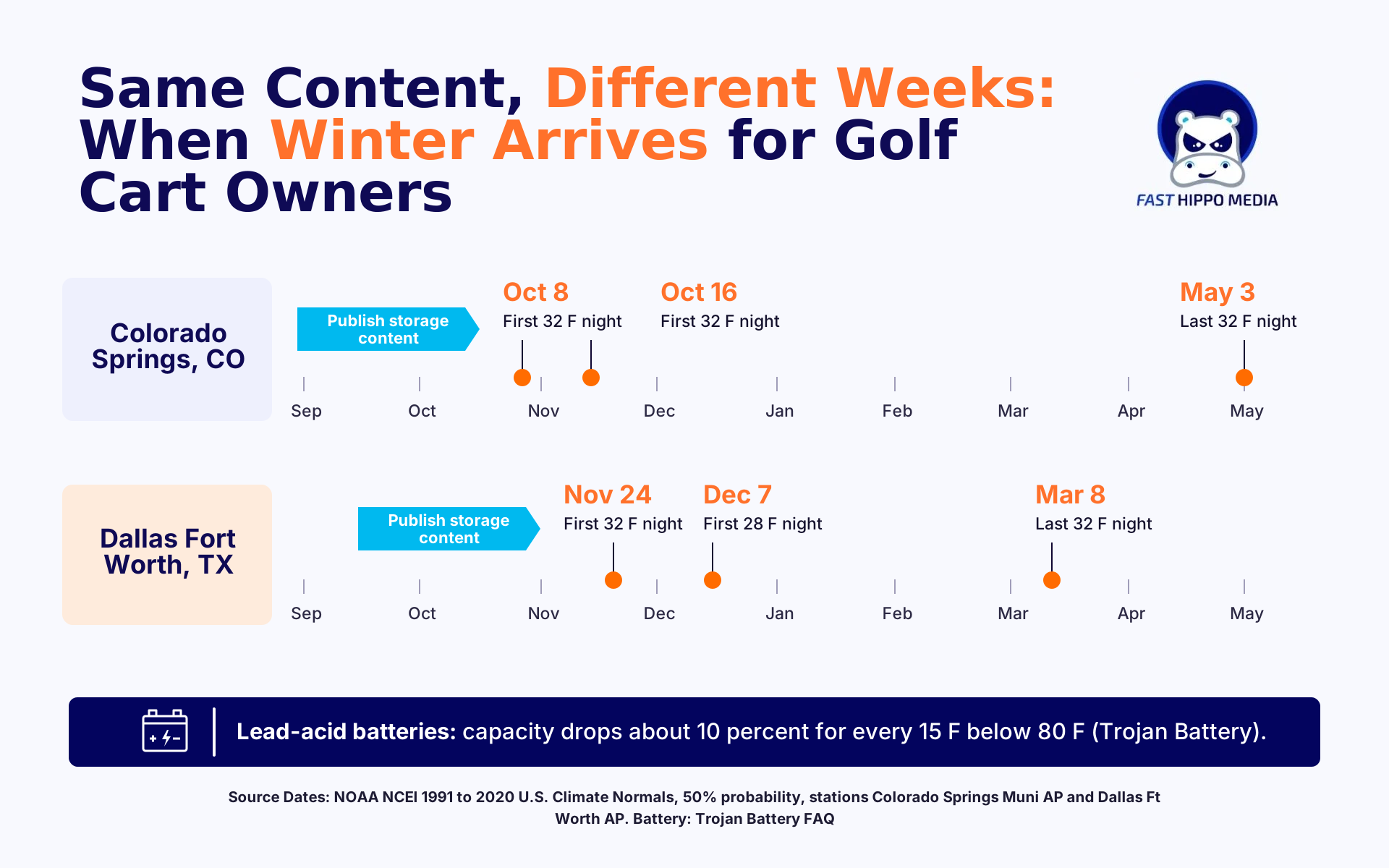
The timing gap between our two home markets makes the case better than any argument. NOAA’s 1991 to 2020 U.S. Climate Normals give, for each weather station, the date by which there is a 50 percent chance the first 32-degree night of fall has arrived, and the matching date for the last one in spring.
| Station (NOAA 1991 to 2020 normals) | Typical first 32 F night in fall | Typical first 28 F night | Typical last 32 F night in spring |
|---|---|---|---|
| Colorado Springs Municipal Airport, Colorado | October 8 | October 16 | May 3 |
| Dallas Fort Worth Airport, Texas | November 24 | December 7 | March 8 |
Read the table as a publishing schedule. A Colorado Springs dealer’s storage content has to be live by mid-September. The same piece published by a dealer in Frisco or Dallas can wait until late October, about seven weeks later, and a Texas dealer’s spring “back on the road” content can go out roughly eight weeks before a Colorado dealer’s. One national content calendar serves neither market well.
Two Audiences, Two Clocks
Every dealer publishes for two groups at once, and they want different things in the same month.
| Audience | What drives their questions | Content that serves them |
|---|---|---|
| Shoppers who have not bought yet | Life plans: a move, a new neighborhood, retirement, a kid’s first summer with a cart | Comparisons, buyer guides, what a cart costs to own, what is legal where they live |
| Owners who already bought | The weather and the cart itself | Storage, charging, tires, service reminders, accessories, where they can ride |
Owners are the easier audience to reach on time, since the weather tells you what they will ask next. Shoppers matter more to revenue, and they respond to content that is still useful long after it was published. So the seasonal plan mixes both: owner content that goes out on a date, and shopper content that gets built during the slow months and refreshed each year.
Fall: Publish Cold-Weather Content Before the First Freeze
Fall is the season where timing matters most, because the owner question has a deadline. Once a cart sits in a cold garage with a half-charged battery, the damage has already happened, and your post is too late.
The best source for this content is the battery maker’s own documentation, quoted instead of paraphrased. Trojan Battery’s maintenance guide, written for the flooded lead-acid batteries still found in many used carts, gives owners four facts worth building a post around:
- A battery can only freeze if it is left partly or fully discharged. The electrolyte in a fully charged battery freezes at minus 92 F, while at a 40 percent state of charge it freezes at about 16 F.
- Lead-acid batteries self-discharge 5 percent to 15 percent a month, depending on the storage temperature.
- A battery in storage should get a boost charge when it shows 70 percent charge or less.
- Charge completely before storage, and charge completely again before putting the cart back into service.
The same maker’s frequently asked questions page adds the rule of thumb owners notice first: for every 15 F below 80 F, battery capacity drops by about 10 percent. That is why a cart that ran all afternoon in August feels short on range in November, and it is a question your service desk is about to hear.
One caution keeps this content honest. Many newer carts run lithium packs, and their storage rules come from their own manuals, not from a lead-acid guide. Say so in the post, and point owners to the manual for their model rather than applying one maker’s figures to every cart on your lot.
What to publish in fall
- An anchor article on winter storage in your climate, battery facts quoted, lead-acid and lithium kept apart
- A short owner email linking that article, timed two to three weeks ahead of your local freeze date
- A service desk post offering winterizing appointments, written as a plain offer
- A shopper piece on what a winter purchase means for delivery and storage
We plan and write the owner emails that carry this kind of content through the email program we set up for golf cart dealerships, segmented by climate so a Colorado owner and a Texas owner never get the same storage reminder on the same day.
Winter: What Should a Golf Cart Dealer Publish When the Lot Is Quiet?
Winter is for the shopper content that takes real time to write: model comparisons, buyer guides, cost of ownership pages, and honest answers to the questions your sales staff hears every week. Fewer carts leave the lot, so the team has hours to spare, and a page written in January has months to earn trust before spring buyers show up.
Start with the questions buyers ask your staff, not with keyword lists: gas or electric, lead-acid or lithium, new or used, two seats or four. Add whether a cart can be made street legal where they live, which we covered as a marketing idea earlier in this series and which deserves a full page on your own site.
Each one is a winter anchor article.
Winter is also when last year’s seasonal posts get their yearly rework. Google’s guide to creating helpful, reliable, people-first content asks site owners directly whether they are “changing the date of pages to make them seem fresh when the content has not substantially changed.” That is the trap with seasonal content. A fall storage post with a new year in the title and nothing else changed is exactly what the question describes.
So the yearly refresh should change something real:
| Refresh step | What counts as a real change |
|---|---|
| Check every quoted source | New wording, a new manual edition, a dead link replaced |
| Update the inventory examples | Current models and model years you actually stock |
| Add what customers asked last season | New questions from the service desk and sales floor |
| Cut what no longer applies | Discontinued models, old prices, expired local rules |
| Change the date only after all of the above | Never as the only edit |
A holiday gift post can also run in December for families buying a cart for someone else. Keep it practical: delivery timing, storage until the big day, and what the recipient will need to register or insure it.
Spring: Content for the Buying Rush and a May Championship in Frisco
Spring is when shopper content pays off, and when owners need help getting carts back on the road. Texas dealers start earlier: the typical last freeze at Dallas-Fort Worth falls on March 8 in the NOAA normals, against May 3 at Colorado Springs. Time the “back on the road” email to your own station, not to a date you read somewhere else.
The owner piece writes itself from the same Trojan guide quoted in the fall section: charge fully before reactivating, and equalize flooded batteries before putting them back into service, following the procedure in the maker’s guide. Pair it with a simple checklist for tires, brakes, lights, and charger cords, and invite owners to book a spring service before the rush.
North Texas dealers have a dated local hook in spring 2027. The PGA Championship is scheduled for May 17 to 23, 2027 at Fields Ranch East at PGA Frisco in Frisco, Texas. A championship week brings golf to the front of local conversation, and a Frisco or Dallas dealer can publish around it without pretending to be part of it.
Event content that stays on the right side of the line
- Write about your customers, not the tournament: getting around a busy week, where carts are allowed in your city, and which neighborhoods sit closest to the venue.
- Never imply a sponsorship, partnership, or official role you do not have, and leave the tournament’s logos off your pages.
- Check your city’s own rules for event weeks before publishing anything about where carts can go, and link the city page rather than restating it from memory.
- Publish in April, so the page exists before people start searching.
Rental operators feel spring differently from dealers, since their season starts with the first warm weekend. Renters search with a town in the query, and pages that answer them belong alongside the rental listing. That is the side of the work we cover under golf cart local SEO, where town pages and the map listing are built together.
Summer: Heat, Long Evenings and the Community Around Your Carts
Summer content leans on owners.
They ride the most, have the most photos, and are the ones asking about heat.
Heat has its own battery story. Trojan’s FAQ notes that above 80 F battery capacity generally rises, “usually at the cost of battery life,” and that higher temperatures also speed up self-discharge. A short owner post on parking in the shade, charging habits in July, and why range feels better while the battery ages faster is useful, specific, and quick to write from the source.
Summer is also community season. If your town allows carts in a holiday parade or a neighborhood event, publish the city’s route rules and a link to its own page before the event, not a recap afterward. Owner stories work too, with permission: where people ride, how they use a four-seater with grandkids, what they added after the first month.
| Summer content type | Who it serves | Where it gets reused |
|---|---|---|
| Heat and battery care post | Owners | Owner email, service desk handout |
| Community event rules page | Owners and shoppers | Business Profile post, social |
| Owner story with photos | Shoppers | Inventory page for that model, social |
| Accessory guide for summer riding | Owners | Parts counter, email |
How Much Should a Dealer Publish Each Season?
Less than most schedules suggest, and more consistently. For a single-location dealer, we recommend this rhythm per season:
| Piece | Per season | Purpose |
|---|---|---|
| Anchor article on your site | One | The substantial answer to the season’s main question |
| Short pieces cut from it | Two or three | Social clips, a checklist, a short video |
| Owner email | One | Timed to your local weather, not the national calendar |
| Business Profile posts | A handful | Service offers, event notes, seasonal reminders |
The anchor article carries the weight.
Everything else points back to it. That is the core of the approach we describe as golf cart dealer content everywhere: one well-researched piece, spread across search, social, video, email, and AI answers, instead of a dozen thin posts that each say a little.
Four seasons of this adds up to four solid articles a year plus their spin-offs. After two years, a dealer has eight anchor pages, each refreshed with real changes, and a library that answers most of what a buyer asks before they call.
Is Seasonal Content Actually Working?
Search Console tells you.
Compare each anchor article’s impressions and clicks against the same weeks last year, not against the previous month, since a storage post will always look weaker in May than in October. A year-over-year comparison shows whether the refresh helped or whether the page is fading.
Two more checks keep the plan honest:
- Ask the service desk and sales floor what customers mentioned. A post someone quotes back at the counter is working, whatever the traffic says.
- Watch which pages people reach from the owner emails. If a seasonal email gets opened and the article doesn’t get visits, the email promised something the subject line didn’t deliver.
Content by itself rarely closes a sale. It earns the visit, and the visit still depends on an inventory page, a phone that gets answered, and a showroom worth driving to. Our earlier piece on the ways digital marketing grows golf cart sales covers how the rest of that chain fits together.
Plan Your Next Two Seasons of Golf Cart Content Now
Look up your nearest weather station in NOAA’s climate normals and write down two dates: the typical first freeze and the typical last freeze. Those two dates set your year. Count back three weeks from the first freeze and schedule the storage article and owner email there. Put two winter comparison articles on the list for December and January, while the lot is slow.
Then pull last year’s seasonal posts and decide, one by one, what real change each one needs before it runs again. If you would like a team to research, write, and spread that plan across your site, email, and Business Profile, Fast Hippo Media builds seasonal content programs for golf cart dealers in Texas, Colorado, and beyond, and we are happy to start with the season you are about to enter.
Frequently Asked Questions
Seasonal content for golf cart dealers means articles, videos, emails, and profile posts timed to what buyers and owners ask at each point in the year, such as storage before the first freeze. It makes the dealership the trusted source before a buyer purchases.
About three weeks before the typical first freeze at the nearest weather station. NOAA’s normals put that date around October 8 in Colorado Springs and November 24 in Dallas-Fort Worth, so the right week differs by market.
No. Lead-acid guidance, such as Trojan Battery’s advice to store fully charged and boost below 70 percent, does not automatically apply to lithium packs. Owners should follow the manual for their specific cart and battery.
Only after making real changes. Google’s helpful content guidance asks whether dates are changed to make pages seem fresh without substantial updates. Refresh sources, models, and customer questions first, then update the date.
Yes, if the content serves your customers and implies no official role. Cover getting around, where carts are allowed, and local rules; link to the city’s own pages; and leave out the event’s logos and any suggested sponsorship.