(214) 272-7034
  info@fasthippomedia.com



Good dental SEO wins your city’s map pack, your treatment searches, and now AI answers, wherever your practice is. Expect foundation fixes in month one, movement by month three, and consistent new-patient calls by month six. Judge any agency on three things: dental results they can show, reports in patients rather than rankings, and a real answer on AI search.
Around a quarter to a third of American dental practices are not busy enough to fill their days. That is not a marketing claim, it is the : roughly one in three dentists reported being under-booked in the first quarter of 2026, up from one in four two years earlier, easing back to about a quarter by Q2.
The chairs exist. The patients exist. What is missing, for a lot of practices, is the connection between someone searching and someone booking.
This guide covers what dental SEO should actually include, what it reasonably costs, how long it takes, and the one question that separates agencies who have kept up from agencies who have not. It applies whether your practice is in Frisco or Fresno; the buyer is national, and the outcome is local.
What are dental SEO services, and why do they matter?
Dental SEO is the work of making a practice findable at the moment someone nearby decides they need a dentist.
That happens in three places now. The map pack, where most local decisions get made. Treatment searches, where someone is comparing implants or Invisalign before they pick a provider. And AI answers, which is new and where most practices have no presence at all.
The work behind all three is the same: a complete Google Business Profile, pages for the treatments you actually want to sell, reviews that are recent as well as good, and a site a machine can read.
How does dental SEO bring in more local patients?
By being present at the three moments a patient is choosing.
The emergency moment: Broken tooth, abscess, and pain on a Sunday. These searches convert within the hour and go to whoever is visible and answers the phone. This is a map pack and hours problem more than a website problem.
The treatment moment: Someone researching implants, veneers, or clear aligners over several weeks. They compare four or five practices. This is where treatment pages and prices earn the shortlist spot, and where most practices go quiet because pricing feels uncomfortable.
The switch moment: New to the area or unhappy with their current dentist. This is the most review-sensitive of the three, because there is no urgency forcing a decision.
A practice that is only visible for one of the three has a much smaller problem than it thinks and a much smaller pipeline than it needs.
What is included in professional dental SEO services?
At minimum: a technical audit, Google Business Profile management, treatment and location pages, review strategy, content that answers real patient questions, schema markup, and reporting.
The part worth scrutinizing is the reporting. Rankings are an input; patients are the output. If a monthly report leads with keyword positions and never mentions calls or booked appointments, you are buying a report rather than a pipeline.
The question most dental SEO companies go quiet on
Ask any agency you are considering: what happens when patients stop clicking?
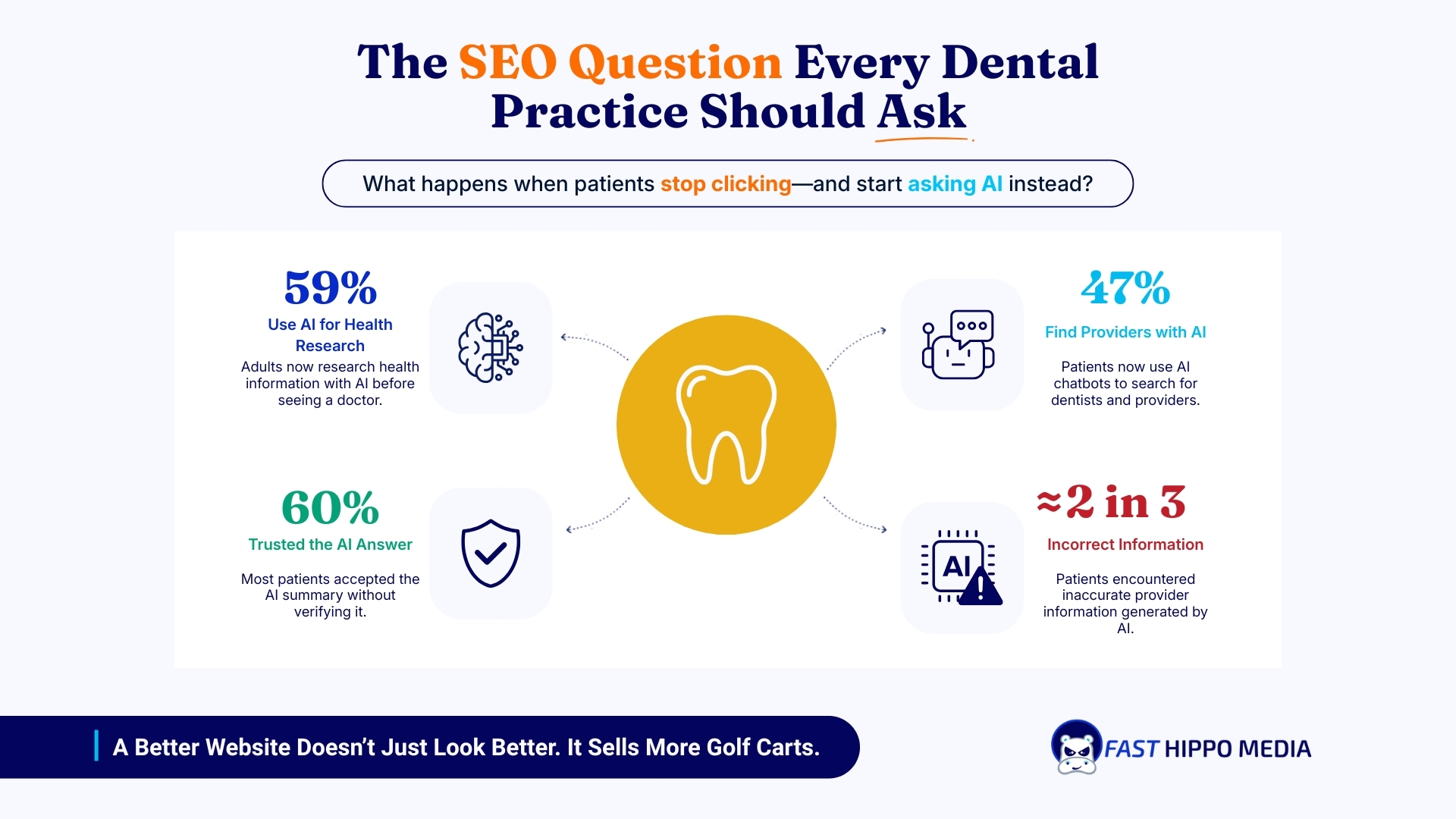
Gallup found in April 2026 that 59% of US adults now use AI tools to research health information before seeing a doctor. Separate survey reporting puts the share of patients using AI chatbots to find a provider at 47% in 2026, up from 31% at the end of 2025.
Here is the part that should concern any practice owner and the reason this is a problem rather than an opportunity. Among patients who used AI to research a provider, around two-thirds encountered incorrect information about that provider, and roughly 60% trusted the AI summary without verifying it.
Read that twice. If your hours, services, insurance, or location are wrong or missing in the places AI reads, patients are being told the wrong thing about your practice, and most of them are believing it. That is happening now, whether or not you market at all.
Classic dental SEO still matters, and the map pack is still the battleground. But the practices pulling ahead are the ones whose profile, reviews, and treatment pages are structured so AI engines read them accurately.
Ask your current or prospective vendor how they handle that. If the answer is a blank look, you have learned something useful. It is the center of how we build dental campaigns, and it is why our approach distributes each practice’s information across every surface an AI reads rather than only the ten blue links.
How long does dental SEO take to work?
Honest answer, in three stages.
Months one to two: Foundation. Profile rebuild, technical fixes, citation cleanup, and treatment page structure. You will see impressions move before you see calls.
Months three to four: Movement. Map pack positions shift, treatment pages start ranking, and review volume builds. First measurable increase in calls.
Months five to six: Compounding. New-patient calls become consistent rather than sporadic, and the content published in month two starts producing.
Competitive metros run longer. Any agency promising page one in weeks is describing ads or is not being straight with you.
What should dental SEO cost?
Most agencies will not answer this, which is exactly why it is worth answering.
Pricing scales with market competitiveness, the number of locations, and how much needs rebuilding versus maintaining. A single-location practice in a mid-size market is a different engagement from a three-location group in a major metro.
Rather than a number, here is how to judge a quote. Ask what is actually delivered each month and whether that list includes profile management, treatment pages, review systems, and technical work, or whether it is four blog posts and a report. Ask what happens in month one specifically. And ask what the reporting measures.
A cheap retainer that produces rankings without patients is more expensive than a larger one that produces patients. The only number that matters is cost per new patient, and any agency that cannot discuss that is selling activity rather than outcomes.
How does dental SEO support your Google Business Profile?
The profile is where most local decisions happen, so it is the centre rather than an accessory.
Categories, listed services, accurate hours including holidays, real photographs of the practice and the team, and reviews that are recent. Google’s own guidance names relevance, distance, and prominence as the local ranking factors; distance you cannot change, and the other two are exactly what profile work moves.
The connection to the section above matters here: your profile is also the primary source AI tools read about your practice. Getting it right fixes both problems at once, which is the single highest-return job on this list. We cover the whole method in our guide to .
How is dental SEO different from general SEO?
Three ways.
The searches are compressed: A dental emergency does not comparison shop. A general business might have a three-week consideration window; a patient in pain has ninety minutes.
The trust bar is higher: People are choosing who puts instruments in their mouth. Reviews, credentials, and the team page do more work than they would for almost any other local business.
The treatments are the keywords: Implants, Invisalign, veneers, root canals, pediatric, and sedation. Each is a different search with different intent and a wildly different value. A practice ranking well for “dentist near me” and invisibly for “dental implants [city]” is leaving the highest-value patients on the table.
The local mechanics are shared with any service business, and we go deeper on those in our guide to .
What mistakes should dental practices avoid?
Treating the profile as a setup task: Claimed in 2023, untouched since, competing against practices posting weekly.
Letting reviews go stale: Recency matters more than total count, and a four-star average built two years ago reads as a practice that stopped caring.
Offering anything in exchange for a review: Discounts, whitening, and entry into a draw. All are prohibited by Google’s review policies, and the penalty lands on your profile rather than the patient’s.
One page for every treatment: “Our Services” competes for nothing. Each treatment you want more of needs its own page.
Buying rankings instead of patients: Covered above, and it is the most expensive mistake on the list.
How dental SEO supports long-term growth
The compounding effect is real and slow. A treatment page published in March is still producing in December. A review pipeline that adds four a month looks like nothing in week three and like a moat in month eight.
That is the actual argument for organic over paid: not that ads do not work, but that ads stop the moment you stop paying, and this does not. Most growing practices run both and shift the balance as organic takes over. If you want the paid side handled too, that is what our is for.
Where to start
If your practice is not filling its schedule, the ADA data says you are not alone, and the fix is usually narrower than it feels.
Check three things this week. Is your Google Business Profile complete and current, including hours? Is your newest review from the last three months? And do you have a page for the treatment you most want more of?
Whichever of those three comes back weakest is where the work starts. If you would rather have someone run that check against your practice and your market, that is the conversation to have before anything else gets bought.
Frequently Asked Questions
By winning the moments patients choose: the map pack, the top local results, and now AI answers. The work combines Google Business Profile optimization, treatment pages patients actually search for, reviews, and technical fixes, all pointed at your city.
Foundation fixes show movement in 60 to 90 days; consistent new-patient calls typically build by months four to six. Competitive metros run longer. Any agency promising page one in weeks is describing ads.
A technical audit, Google Business Profile management, treatment and location pages, review strategy, content answering patient questions, schema markup, and reporting tied to calls and booked appointments rather than rankings alone.
They answer different problems. Ads buy immediate visibility and stop when spend stops; SEO builds visibility that keeps producing. Most growing practices run both, then shift budget toward organic as it takes over.
Ask three things: can they show dental results, do they report calls and patients or just rankings, and do they optimize for AI answers as well as Google. The third question is where most dental SEO vendors go quiet, which matters because most patients researching a provider through AI encounter incorrect information about them.