(214) 272-7034
  info@fasthippomedia.com


Google still owns search volume; AI answers increasingly own the decision. Since February 2026, ChatGPT has shown ads too, so both channels are commercial now. The playbook is one strategy with two emphases: clean structure, real answers, and reviews feed both, while third-party mentions and citable claims carry extra weight in AI results. Show up in both, and note that the businesses getting named started early.
If you run a business, one question has probably crossed your mind recently: is Google still enough?
Search behaviour changed faster than most marketing budgets did. People stopped typing keywords and started asking full questions, expecting an answer rather than a list. Some of them now ask an AI first and never open a search engine at all.
This guide covers what actually differs between the two, where each one wins, and where your business should put its effort. It is written for owners rather than marketers, and it assumes you want an answer rather than a lecture.
Update, August 2026: ChatGPT now has ads, and it changes this comparison
When we first published this piece, the trade-off looked simple. Google was the commercial channel; ChatGPT was the organic one.
That ended on 9 February 2026, when to ChatGPT’s Free and Go users in the US. Entry pricing was around $60 CPM with a $200,000 minimum commitment, which kept it enterprise-only for about twelve weeks. By 5 May the minimum was gone and the platform went self-serve, opening it to businesses of any size.
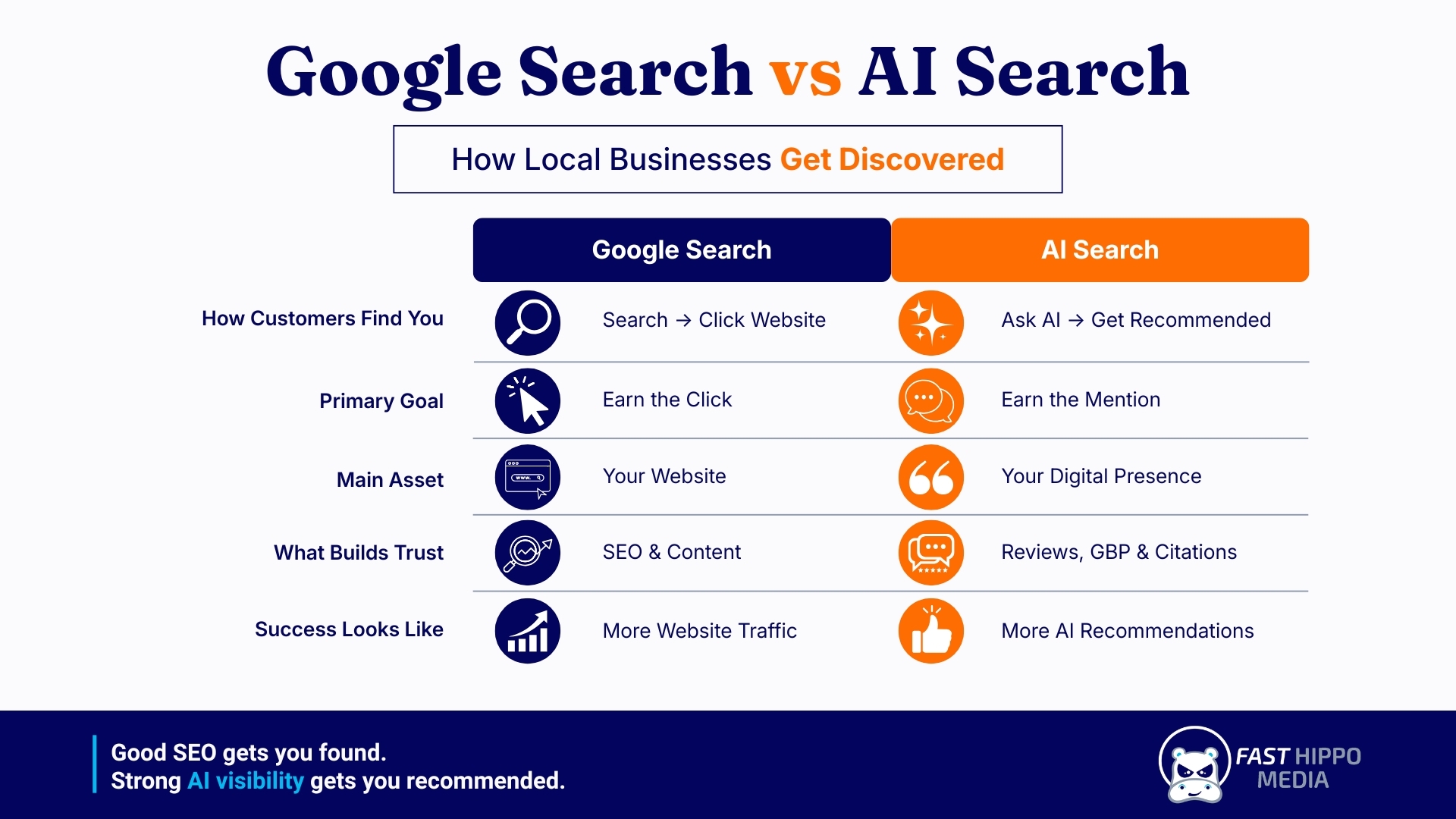
So this is no longer organic versus commercial. It is two commercial channels with different physics. Google auctions your position on a page of options. ChatGPT sells placement around a single composed answer.
Here is the part that matters for your budget: the organic citation inside an AI answer just became more valuable, not less. Paid slots sit around the answer. The answer itself still goes to the business the model trusts, and that trust is built with structure, reviews, and consistency. It is the one placement on either platform that money does not buy.
We covered in more detail separately.
What is ChatGPT Search?
It is an answer engine rather than a search engine. You ask a question in normal language, and it returns a composed response, usually with a handful of sources cited underneath, rather than ten links for you to evaluate.
Three things follow from that. It reads context rather than matching keywords. It pulls from several sources at once and reconciles them. And it usually gives one answer rather than a set of options.
For a business, the consequence is blunt: visibility stops being about ranking a page and becomes about being the name inside the answer.
How does it work differently from Google?
The difference is indexing versus interpretation.
Google crawls and indexes pages, ranks them on relevance, authority, and technical signals, and hands you a list to choose from. You do the comparing.
ChatGPT interprets the question, pulls from multiple sources, and composes a response. It does the comparing, and it tells you the conclusion.
That is why the optimisation work diverges. Google rewards pages that are well-built and well-linked. AI answers reward information that is clear, consistent, and easy to extract, because a model that cannot confidently summarise you will summarise someone else.
Is one better than the other?
Neither, and the honest answer is that they are good at different questions.
AI answers win on quick explanations, how-to guidance, comparisons, and anything where the person wants a conclusion rather than a reading list.
Google wins on deep research, local intent, anything with maps and reviews attached, and situations where somebody genuinely wants to see the options and choose.
Scale is not close, and pretending otherwise helps nobody: Google still handles , with every other engine sharing single digits between them. ChatGPT, meanwhile, reports roughly 900 million weekly users.
Those are different measurements, which is the point. Google owns the volume of searches. AI tools increasingly own the moment a decision gets made, because a composed answer settles the question instead of offering ten more. A business needs to be present in both, for different reasons.
What does this change for your business?
On Google, the mechanic is traffic. You rank, someone clicks, they arrive on your site, and you convert them there.
In an AI answer, the mechanic is mentioned. There may be no click at all. You are either named, with a reason attached, or you are absent from a conversation you never saw happen.
That changes what counts as an asset. On Google your website does most of the work. In AI answers, your Google Business Profile, your reviews, your third-party mentions and your structured data do at least as much, because those are the things a model can verify.
The upside for smaller businesses is real: being relevant and verifiable beats being large, and neither of those requires a national budget.
What are the limitations of AI search?
Three that matter, and any agency telling you otherwise is selling something.
You have less control: You cannot choose your position in a composed answer the way you can bid for a position on a results page.
Fewer clicks: An answer that satisfies the question does not produce a visit, which makes attribution harder and makes brand mention more valuable than traffic.
Local intent is still weaker: For a service business, Google’s map pack still drives the calls, the bookings, and the directions. That gap is closing, but it has not closed.
For anyone selling locally, that last point is the reason this is not an either-or decision.
Should you optimize for AI search?
Yes, and not at Google’s expense.
The practical version is one programme with two emphases. Keep the Google fundamentals: technical health, page experience, links, local presence. Then add the things AI answers weight more heavily: clear direct answers near the top of a page, consistent facts everywhere your business appears, structured data, and third-party mentions on surfaces a model reads.
Most of that work serves both. The method is covered in full in our guide to .
How does AI search optimization differ from SEO?
Google leans on keywords and backlinks, page speed and experience, and technical structure.
AI answers lean on clarity of the answer itself, structured content such as headings and FAQs, topical consistency, and whether your claims hold up across the sites a model cross-checks.
The overlap is larger than the difference, which is why this is a shift in emphasis rather than a second budget. It is also why the discipline sits closer to than to classic SEO.
What are the ranking signals for AI answers?
A necessary caveat before the list.
Nobody outside OpenAI has the algorithm, and OpenAI does not publish one. What follows is the pattern we see across client work and published citation studies: the businesses that get named tend to share these traits. Treat it as an observation rather than a specification, and be suspicious of anyone who presents it as anything firmer.
With that said, the pattern is consistent. Expertise that shows up repeatedly on the same topics rather than scattered across everything. Content is organized so a single clean answer can be lifted from it. Business facts that match wherever they appear, because a model that finds three versions of your hours trusts none of them. And mentions on sources other than your own website, which read as corroboration rather than marketing.
None of that is exotic. It is the same work that made a business findable before AI existed, applied with more discipline.
What does this mean for a small business?
More opportunity than for large brands, and one genuine risk.
The opportunity is that relevance beats budget. An AI answer recommending a plumber is not weighing ad spend; it is weighing whether it can confidently say who is good at this, nearby, right now. A small business that is well-reviewed and easy to verify can be named ahead of a national chain.
The risk is control. You do not write the summary, and if your information is thin or inconsistent, the model fills the gap with whatever it finds. That is not a reason to stay out. It is a reason to make sure what it finds is accurate.
The practical starting point is unglamorous: complete your , keep reviews recent, and publish clear answers to the questions customers actually ask.
How should you adapt your marketing?
Four things, in order.
Write content shaped like the questions people ask, and answer them in the first two sentences rather than the fifth paragraph.
Add summaries to the pages that matter, so there is a liftable answer near the top.
Publish FAQs that mirror real customer questions rather than invented ones. Your inbox and your Google Business Profile messages already contain the list.
Keep the Google fundamentals in place while you do it, because they are the foundation both channels stand on. Our take on covers the production side.
Do you need help with this?
Some of it, honestly, no. Completing your profile, collecting reviews, and answering customer questions in plain language are things any business can do without an agency.
Where owners tend to stall is distribution and consistency: getting one piece of expertise onto a dozen surfaces, month after month, and keeping every business fact identical across all of them. That is the part that compounds and the part that gets dropped first when the week gets busy.
If that is the constraint, it is worth a conversation. If it is not, take the list above and run it yourself.
Where should your business show up in 2026?
Both, and that is not a hedge.
Google remains where discovery and local intent happen, at more than nine in ten searches worldwide. AI answers are increasingly where the decision gets made, and since February they carry ads as well.
The businesses that will do well are not choosing a platform. They are building one set of clear, consistent, verifiable information and making sure it is readable everywhere. That work was worth doing when Google was the only game; it is worth more now, and the businesses already named in AI answers mostly started before their competitors believed it mattered.
If you want a read on where your business currently stands in both, that is the conversation worth having before any budget moves.
Frequently Asked Questions
Google returns ranked options and lets you choose; ChatGPT composes one answer and chooses for you. For a business that means Google visibility is about position, while AI visibility is about being the name inside the answer.
Not yet, and the smart bet is both. Google still handles more than nine in ten searches worldwide, but a growing share of high-intent research now starts in AI tools. The same clean structure and consistent facts feed both channels.
One strategy, two emphases. The foundations are shared: real answers, schema, reviews, consistency. AI answers add weight on third-party mentions and citable claims; Google keeps weight on links and page experience. Build once, tune per channel.
Be easy to verify: a complete Google Business Profile, consistent citations, recent reviews, machine-readable pages, and mentions on surfaces AI reads such as directories, local press, and forums. AI tools recommend what they can confirm.
It builds trust and authority well, but Google remains stronger for local intent, calls, and appointment-based searches. A service business should treat AI visibility as an addition to local search rather than a replacement for it.
Content that answers one question directly, near the top, in plain language, with clear headings and consistent facts. Long preambles and keyword-padded pages give a model nothing clean to lift.
The businesses winning AI visibility in 2026 started before their competitors believed it mattered. The work is not exotic: structure, evidence, and distribution. Starting now costs little; catching up later costs the head start.