(214) 272-7034
  info@fasthippomedia.com



When website structure is unclear, everything downstream breaks. SEO cannot stabilize, ads convert inconsistently, and content never builds into authority. Fix hierarchy first, then internal links, then structured data. Spend on ads and content after the foundation holds.
If your website structure is unclear, SEO struggles to stabilize, ads fail to convert consistently, and content never compounds into authority. This happens even when the strategy looks correct on paper. Search engines, AI systems, and users all rely on structure to understand relevance. When that structure breaks, visibility breaks with it.
The Invisible Problem Behind Most Marketing Failures
Many growing businesses assume they have a marketing problem, so they invest in SEO retainers, paid campaigns, content, and social management. Yet the results stay unpredictable.
Rankings move but never settle. Ads drive traffic but not trust. Content gets published but does not build authority. AI search tools overlook the brand completely.
In most cases the issue is not effort or budget. It is that the website was built for an earlier stage of the business and never evolved. As services expand, content grows, and competition tightens, the original structure stops supporting growth. Everything else sits on top of a weak foundation.
What Website Structure Actually Means (Beyond Design)
Website structure has nothing to do with colors, fonts, or layout. It is about how information is organized and connected: page hierarchy, URL structure, navigation flow, internal linking, topic clusters, service grouping, schema markup, and the technical foundations underneath all of it.
Search engines and AI systems do not read a website the way a person does. They map relationships. They are working out what the business is known for, which services matter most, how pages support each other, and where real expertise shows.
If those relationships are unclear, no amount of fixes it. This is why a site with forty well-organized pages routinely outperforms one with four hundred.
The Four Structural Fail Points That Hurt Visibility
Most visibility problems fall into four predictable failures.
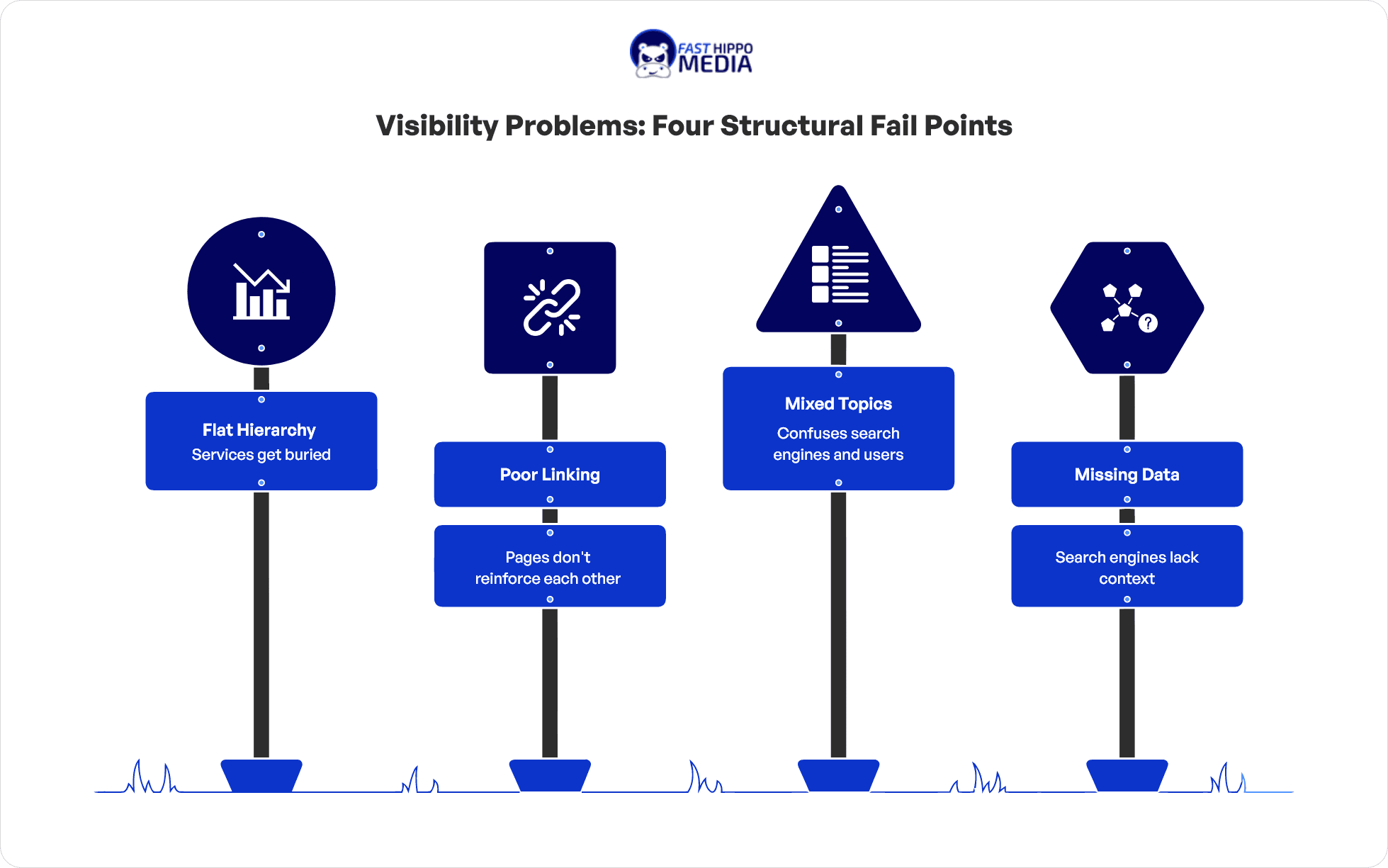
Flat or Confusing Page Hierarchy
Important services get buried or duplicated. A plumbing company ends up with one page for water heater repair, another for hot water heater replacement, and a third for emergency water heater service. All three chase the same intent.
Search engines cannot tell which page is primary, so rankings split between them and none of the three ranks as well as one strong page would have. The business did three times the work for less than one page’s result.
A clear hierarchy tells search engines and buyers what matters most and what supports it.
Poor Internal Linking
Pages exist but do not reinforce each other. Blogs do not link to services. Services do not connect to the content that explains them. The pages that make money sit isolated.
Internal linking is not an SEO trick. It is how authority moves around your site. Without it, every page has to earn trust alone, which is a much harder job than being introduced by a page that already has some.
Mixed or Overlapping Topics
Many service businesses blur topics together. A dental practice publishes implant content, cosmetic content, and general hygiene content into one undifferentiated blog feed. Service pages cover several unrelated treatments at once. FAQs mix new-patient questions with clinical ones.
That confuses search engines, answer engines, and the people trying to decide whether you do the specific thing they need. Clear topic separation builds clarity, and clarity is what gets you shortlisted.
Missing or Weak Structured Data
Without schema markup, search engines have to infer your services, service areas, business type, and expertise from prose. Sometimes they infer correctly. Often they do not.
Worth being precise here, because most guides are not. Google states that Schema earns rich results and keeps your business facts consistent from page to page. It is not a back door into AI answers. What actually helps is the thing Google names next: building a clear technical structure and creating unique, valuable content.
Which is the argument of this entire article, stated by the company that runs the search engine.
One more thing on this section, since we are asking you to take our word for something. Run your own pages through Google’s Rich Results Test before believing anyone about structured data, this article included. It takes two minutes, and it settles the question.
Individually these four issues look small. Together they build a system that fails quietly, which is the hardest kind of failure to diagnose. Fixing them is work rather than content work, and that distinction is why content teams often cannot solve it alone.
Why SEO Is the First Channel to Break
SEO depends on clarity before it depends on optimization. When structure is weak, search engines cannot identify primary expertise, pages compete against each other, technical improvements hit a ceiling, and rankings fluctuate without ever settling.
This is why so many owners say some version of “SEO worked before, and now it doesn’t. ” Search stopped being mostly about keywords and became mostly about interpretation.
The margin for error shrank as well. SparkToro and Similarweb found that in early 2026, with only 276 of every 1,000 reaching the open web at all. When fewer searches produce a visit in the first place, a structural problem that costs you a third of your visibility costs more than the same problem did two years ago.
Why Paid Ads Amplify Structural Problems
Paid advertising does not fix weakness. It magnifies it.
When ads send traffic to unclear landing pages, pages disconnected from the rest of the site, or pages that do not reinforce trust, conversion rates drop regardless of how good the targeting is. The usual response is to increase spend, which buys more traffic for the same broken destination.
Strong paid performance depends on clear intent per page, logical content flow, and structural alignment with the rest of the site. Ads work best when the structure is doing the heavy lifting and the budget is only buying attention.
Why Content Stops Compounding
Content builds authority only when it connects. When structure is weak, blog posts live in isolation, topics fail to reinforce expertise, authority resets with every post, and AI systems cannot summarize the brand.
Publishing more without structure usually makes it worse. You end up with hundreds of posts, no clear topical authority, and very little long-term growth to show for the effort.
Content should compound. Structure decides whether it does, which is the argument we make at length in . The two problems are halves of the same problem: this post is the foundation; that one is what you build on it.
How AI and Answer Engines Interpret Your Website
AI search tools do not rank pages the way traditional search does. They look for clear specialization, consistent topic signals, structured relationships between pages, and trust reinforced across the site rather than asserted on one page.
When structure is unclear, an AI cannot confidently summarize your business, services blur together, and a competitor with a cleaner structure gets cited instead.
That is a clarity problem, and it is fixable.
The gap between ranking and being cited is measurable now. Ahrefs found that for that query, down from 76% earlier in the year. Two in three citations come from pages a searcher would never see on page one.
Read that carefully, because it changes the job. A site organized purely around rankings is optimized for the smaller half of the opportunity. Being findable and being cite-able have come apart, and structure is what serves both. That is the discipline behind .
Why This Problem Shows Up More at the $1M+ Stage
Smaller businesses can get away with simple sites. Growing ones cannot.
In our client work the pattern is consistent: somewhere around $1M in revenue, the website that got a business there stops carrying it. Pages added over the years start overlapping, internal links point everywhere and nowhere, and the structure that was fine at two hundred pages breaks quietly at five hundred. From that size on, search engines and buyers both expect a specialist, and the site has to be organized like one.
What changes is everything at once. Services expand. Content volume rises. Ad spend scales. Competition tightens. If the site does not evolve structurally alongside all of that, performance flattens.
This is why so many seven-figure businesses feel stuck. They are doing more marketing, spending more money, and publishing more content, and the results have gone sideways. The foundation stopped keeping up with the business, and every additional pound of marketing lands on it. At that point the right conversation is rather than another campaign.
How Content Everywhere℠ Aligns Structure and Visibility
At Fast Hippo Media, we do not treat structure, SEO, content, and ads as separate projects with separate owners.
aligns website architecture, search authority, content clarity, paid amplification, and AI readability into one connected system. The point is that structure supports growth rather than limiting it, content builds authority over time, ads amplify strengths instead of exposing weaknesses, and machines can describe your business accurately.
It is not about doing more marketing. It is about fixing the thing all the marketing depends on.
What to Fix First (Before Spending More)
Before increasing ad spend or publishing anything else, start here.
Audit the structure before you audit the output. Clarify your service hierarchy and map each page to one buyer intent. Fix internal linking and group content into real topic clusters. Align technical SEO with clarity rather than only with speed. And treat ads as amplification rather than correction.
Most businesses skip this step because it produces nothing to show at the end of the month. That is exactly why most campaigns stall.
SEO, paid, and content do not fail randomly. They fail predictably when the structure underneath them stops supporting visibility, trust, and understanding. Fix the foundation, and SEO stabilizes, ads convert better, content compounds, and AI systems start recognizing the authority that was always there.
If your SEO feels unstable, your ads are not converting the way the numbers say they should, or your content does not seem to build momentum, structure is often the limiting factor even when everything else looks right. The next step is not more tactics. It is finding out whether the foundation is supporting the work or quietly capping it.
Frequently Asked Questions
Website structure is how your pages, services, and content are organized and linked together. It helps search engines understand what your business does and which pages are most important. When the structure is clear, SEO rankings are more stable and easier to maintain.
Yes. Paid ads often fail when landing pages are unclear or disconnected from the rest of the website. Even with good targeting, weak structure reduces trust and lowers conversion rates, making ads more expensive and less effective.
Content stops compounding when blog posts and service pages are not connected by clear topics and internal links. Without structure, each piece of content stands alone, which prevents long-term authority growth in search engines and AI results.
AI search tools look for clear specialization, consistent topics, and structured relationships between pages. If your website lacks a clear hierarchy or structured data, AI systems may struggle to understand your services and favor competitors with better structure.
Start by auditing your website structure. Clarify your main services, improve internal linking, and group content by topic. Fixing the structure first ensures SEO, content marketing, and paid ads can actually perform as intended.