(214) 272-7034
  info@fasthippomedia.com


Google’s AI assembles local answers from what it can read and verify, and your Business Profile is the first thing it reads. Google says plainly that complete, accurate profiles are more likely to show up. What the AI layer adds is that being incomplete no longer costs you a position, it costs you the mention entirely, and nobody tells you. Test it monthly: ask Google and an assistant what your customers ask, and see who gets named.
Google’s AI already stands between you and your customers
Not coming. Standing there now.
AI Overviews answer the question at the top of the results page. AI Mode answers it in a conversation, with follow-ups. Both decide what to say by reading sources they trust, and for a local business the most important of those sources is not your website. It is your Google Business Profile.
That profile stopped being a listing some time ago. It is now the structured record a machine reads to decide whether it can describe you confidently, and the difference between a complete record and a partial one has stopped being a ranking penalty. It has become a filter.
If you want the wider argument about being cited rather than ranked, that is our guide to . This page is narrower and more practical: what the machine reads on your profile, why it skips people, and how to find out if it is skipping you.
What AI actually reads when it answers a local question
Less than people assume, and more precisely than people assume.
When somebody asks for a plumber in a specific area, or the best dentist for a specific procedure, the system is not reading your website’s prose and forming an impression. It is assembling an answer from structured facts it can verify: your category, your service area, your hours, your services, your attributes, your photos, your review text, and whether those things agree with what it finds elsewhere.
Google is direct about the underlying mechanic in its own . Three factors decide local results: relevance, which is “how well a Business Profile matches what someone is searching for”; distance; and prominence, “how well-known a business is.”
Two of those you cannot change much. Distance is geography. Prominence builds slowly. Relevance is the one you control directly, and relevance is a data problem. A profile that describes what you do precisely matches more questions than one that describes it vaguely, and there is no amount of good copywriting on your website that compensates for a category field left on the default.
Why incomplete profiles get skipped
Because a machine assembling an answer has to choose what it can state without hedging.
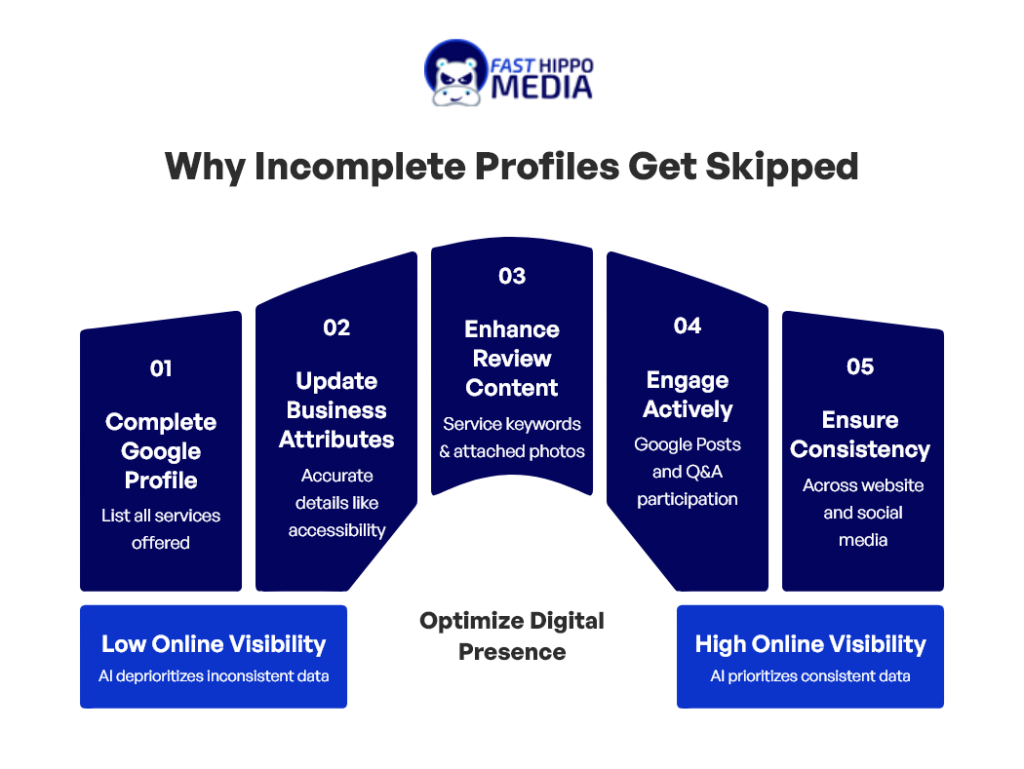
Google’s own guidance says it in one line: “Businesses with complete and accurate info are more likely to show up in local search results.”
Read that with the AI layer in mind and it gets sharper. In classic search, an incomplete profile ranked lower. You were still on the page. Somebody scrolling could still find you. In an AI answer there is no scrolling and no page two. The system names two or three businesses and stops. Incomplete is not a lower position, it is absence.
The failure is also silent, which is what makes it dangerous. Nobody calls to tell you they were shown three competitors and you were not among them. There is no notification, no drop in a report you are already reading, and your rankings can look unchanged while the answer above them names somebody else.
That is why the check in the next section matters more than any single optimization. You cannot fix a problem you have no signal for. Where you sit across all the surfaces, not just this one, is covered in our guide to .
How to test whether AI is skipping you
Twenty minutes, once a month, no tools required. This is the most useful thing on this page.
Step 1: write down the five questions your customers actually ask before they buy.
Not your services. The questions. “Who should I call for a burst pipe in Frisco”, “best dentist near me for implants”, “how much does X cost in Y”. If you are not sure, ask the person who answers your phone; they hear them all day.
Step 2: ask Google, signed out. Use an incognito window so your own history does not flatter the result. Type each question. Note whether an AI Overview appears, and whether you are cited in it. Note who is.
Step 3: ask an assistant the same five questions. ChatGPT, Gemini, Perplexity. These reason differently from Google and often name a different set. Write down every business that appears.
Step 4: compare the lists. The businesses that appear in both are your real competitive set, and it is frequently not the one you assumed. If the same competitor appears in every answer and you appear in none, that is your answer.
Step 5: work backwards from the gap. If you are absent, check the usual causes in this order, because they are ordered by how often they turn out to be the problem: an incomplete profile, particularly the primary category and services; no recent activity; thin or old reviews; and business facts that disagree between your profile, your website and your listings.
Do this monthly and log it. Four data points across a quarter tell you more about your AI visibility than any dashboard currently sold, because you are measuring the actual output rather than a proxy for it. If you would rather have it run for you, that is part of our work.
What changes when the reader is a machine
The optimization checklist itself has not changed much, and we are not going to repeat it here. The full playbook, category selection, services, photos, hours, attributes, posting, reviews, lives in our .
What changes is the standard each item is held to.
Complete used to mean “filled in”. It now means “unambiguous”. A services list reading “plumbing services” satisfies the field and answers no question. A list naming water heater replacement, repiping, slab leaks and emergency callouts matches four different searches.
Accurate used to mean “not wrong”. It now means “agrees with everywhere else”. A machine reconciling your profile, your website and three directories will discount all of them if they disagree. One wrong phone number does not just misdirect a caller, it lowers confidence in the whole record.
Current used to mean “not embarrassing”. It now means “recently verified”. Which brings us to the next two sections, because activity and reviews are where most local businesses lose this quietly.
What “fresh” means to a machine
Not new content. Evidence that the business is still operating as described.
A profile that has not been touched in a long time presents a machine with a question it cannot resolve: is this current? Photos from three years ago, no posts, no recent reviews, hours that were never updated for the seasonal change. None of that is wrong exactly, and all of it reduces confidence.
Regular posting is the cheapest signal available here, and it is worth being clear about why it works. Posts are not a social channel and nobody is scrolling them. They are proof of life. A profile with something added this month reads as maintained; the same profile untouched for a year reads as possibly closed.
The same applies to photos, to hours including holiday hours, and to answering the messaging feature if you have it enabled. Enabling a feature and then ignoring it is worse than not enabling it. Where this feeds through to actual map placement is covered in our work.
Review language is what AI repeats
This is the part almost nobody optimizes for, and it is the highest-leverage thing on the page.
Google says “more reviews and positive ratings can help your business’s local ranking.” That has been true for years. What is new is that AI systems do not just count your reviews, they read them, and the language in them becomes the language used to describe you.
A review reading “great service, highly recommend” contributes to your rating and gives a machine nothing to say. A review reading “replaced our water heater the same day we called, and explained the warranty properly” hands it a sentence. When somebody asks which plumber handles emergencies well, that is the review that gets paraphrased into the answer.
So the question worth asking is not how to get more reviews. It is what your reviews currently say. Read your last twenty. If they are generic, your AI description will be generic, and generic loses to specific every time.
What you can and cannot do about that. You can ask happy customers for a review, and you can make it easy. You can reply to reviews, which Google notes “shows that you value their feedback.” What you cannot do is tell people what to write, offer anything in exchange, or ask staff to solicit mentions of specific services. Those breach Google’s review policies and put the profile itself at risk, which is a real cost against a marginal gain.
The workable version: ask at the moment the specific thing went well, and ask in a way that reminds them what it was. “Would you mind mentioning the same-day turnaround?” is scripting. “We’re glad we could get to it today” said before you ask is not.
What we do differently
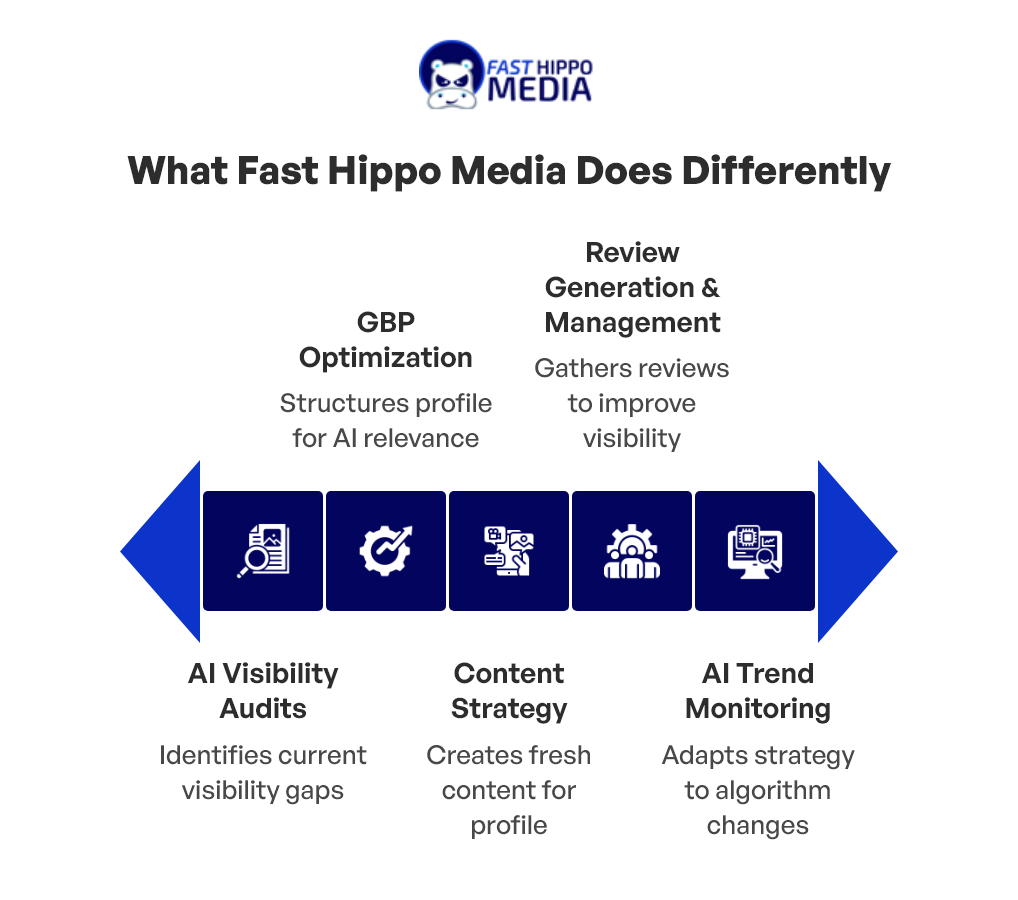
We treat the profile as the machine-readable record it has become rather than a marketing asset, and we measure the output rather than the inputs.
That means running the skip test above on a schedule instead of reporting on profile views, fixing categories and services against the questions customers actually ask rather than against a keyword list, and reconciling the facts across every place they appear before optimizing anything. The optimization work itself is not exotic. The discipline of checking whether it produced a mention is what most local SEO does not include.
Where to start this quarter
Three moves, in order.
Run the skip test. Five questions, Google signed out, two assistants, written down. You will know more in twenty minutes than a month of reports would tell you.
Fill the gaps it reveals, starting with your primary category and your services list, because those two decide what questions you match at all.
Read your last twenty reviews and decide whether they describe what you actually want to be known for.
If you would rather have that run properly, our team starts with exactly those three and reports on whether you get named, not on how many people viewed your profile.
Frequently Asked Questions
AI-generated summaries at the top of Google results that answer the question directly, assembled from sources Google trusts, including business profiles, reviews and structured content. For local queries they often decide the outcome before anyone scrolls.
Ask Google signed out, and ask an assistant, the five questions your customers ask before buying. If competitors are named and you are not, check the usual causes in order: an incomplete profile, no recent activity, thin or old reviews, and business facts that disagree across your website, profile and listings.
Yes, as activity signals rather than as a social channel. Nobody is scrolling your posts. What they do is tell Google the business is open, active and current, which supports both map placement and AI summaries. Think of them as proof of life.
Specifics. AI systems read review text and reuse its language, so reviews naming the service, the area and the outcome give a machine something concrete to repeat. You cannot tell customers what to write or offer anything in exchange, but you can ask at the moment the specific thing went well.
Profile completeness and activity fixes can show up within weeks, because these systems read live data. Review depth and prominence build over months. The order that works is complete first, then consistent, then active.
No, it extends it. The same foundations of completeness, accuracy, consistency and reviews feed classic map rankings and AI answers alike. Treat AI visibility as the front end of the same system rather than a separate programme.