(214) 272-7034
  info@fasthippomedia.com


Search stopped being one place. Your business now either appears or does not appear in Google’s AI Overviews, in AI Mode, inside ChatGPT and other assistants, and in voice answers, and each surface has its own switch. Some of those switches are settings you already chose years ago for good reasons. This is a tour of where you show up, what turns you off, and how to check.
Search is not one place any more
A customer looking for what you sell in 2026 might never see a list of ten blue links.
They might get an AI Overview above the results. They might be in AI Mode, asking follow-up questions. They might be inside ChatGPT, which searches the web and names two or three businesses. They might ask a speaker in the kitchen and get exactly one answer. Or they might get a classic results page and click something.
Those are five different surfaces with five different mechanics, and a business can be strong on one and completely absent from another without ever knowing. Most businesses have never checked more than the first.
This page is a tour of the surfaces. If you want the mechanics of how machines decide rankings, that is our guide to . If you want the category explained properly, that is our guide to . This one is narrower: where you appear, and what quietly turns you off.
The setting that removes you from AI Overviews
Start here, because it is the one nobody checks and it is a five-minute fix.
Google publishes advice on , and one section is worth reading twice:
“Search enables site owners to control what appears in our listings, including in our AI formats. Make use of
nosnippet,data-nosnippet,max-snippet, ornoindexto set your display preferences. More restrictive permissions will limit how your content is featured in our AI experiences.”
Read that as a warning rather than a feature list. Plenty of sites added nosnippet or a tight max-snippet limit some years ago, usually because somebody argued that Google showing an excerpt cost them a click. That was a defensible position when the only thing at stake was a snippet under a blue link.
It is a different decision now. The same restriction limits how your content can be featured in AI Overviews and AI Mode, which means a rule set to protect clicks can be removing you from the surface where the answer is formed.
Google is also explicit that the basics cover the new formats: “Meeting the technical requirements covers you for search generally, including AI formats.” There is no separate AI checklist to complete. There is a set of switches, and some of yours may be in the wrong position.
What to check this week: your robots meta tags and any max-snippet directive, site-wide and on templates. If somebody set them and left the company, nobody has revisited them since the surface changed.
The setting that removes you from ChatGPT
Same class of problem, different platform, and it catches even more sites.
OpenAI runs separate crawlers for separate jobs. GPTBot is about model training. OAI-SearchBot is what decides whether ChatGPT can surface and cite you. They are configured independently, which means a business can be fully visible in ChatGPT search while opting out of training, or, far more commonly, can block both without meaning to.
A great many sites added blanket AI-crawler blocks to robots.txt during 2024 and 2025. The reasoning was sound: nobody wanted their content training a model for free. The side effect was not obvious at the time, and for a lot of those sites the block is still there while the marketing team wonders why ChatGPT never mentions them.
What to check: open your robots.txt and read it. If it blocks OAI-SearchBot, that is your answer.
Where your business actually appears
Six surfaces, and they behave differently enough to be worth separating.
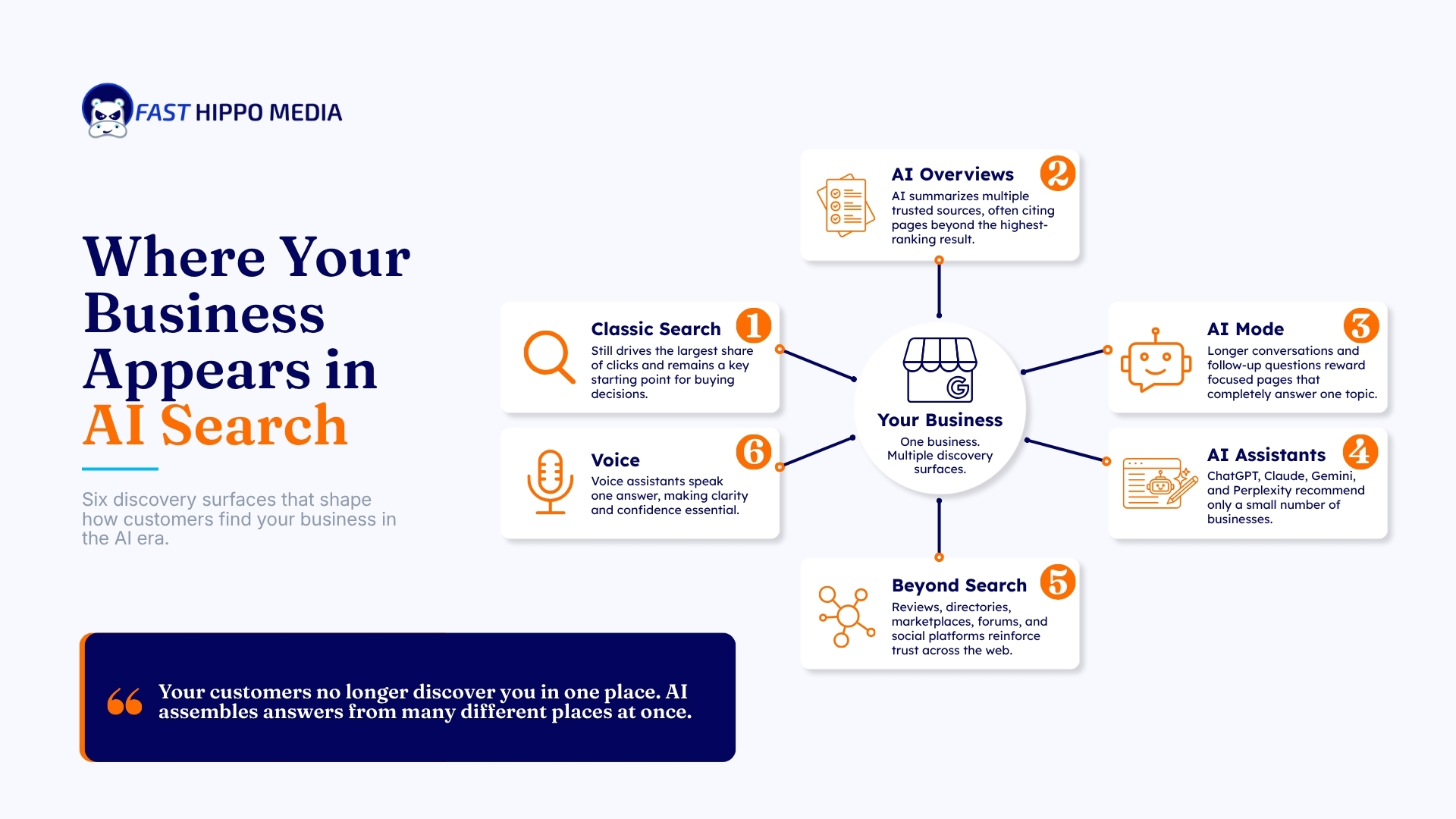
Classic search results: Still the largest single source of clicks for most businesses, still where a lot of buying decisions start. Not going anywhere, and not the whole picture any more either.
AI Overviews: The summary above the results. You appear as a cited source or you do not appear. Google notes that its AI features surface “a wider and more diverse set of helpful links” than classic results, using a technique that issues multiple related searches across subtopics rather than one, which means the pages that get cited are often not the pages that rank first.
AI Mode: The conversational version, where somebody asks, reads, then asks a better question. Longer and more specific queries, follow-ups, and comparisons. Pages that answer one thing completely do better here than pages that cover a topic broadly.
AI assistants: ChatGPT, Claude, Gemini, Perplexity. Each searches, reads, and names a short list. The gap between being on that list and not being on it is total; there is no page two in a sentence.
Voice: One answer, spoken, no list. The strictest surface, and the one where ambiguity is most expensive, because an assistant that is not certain will simply use somebody else.
Everywhere that is not a search engine: Review sites, marketplaces, forums, social search, industry directories. These matter twice: as places customers find you, and as the third-party corroboration every AI system uses to decide whether it can trust what your own site claims.
About the statistics you are being quoted
A short warning, because this page previously carried an example of the problem.
You will read that some specific percentage of Google searches now end without a click, or that AI Overviews appear on some specific share of searches. Those numbers get repeated with great confidence and they disagree with each other enormously. Published estimates of AI Overview prevalence in 2026 range from around a quarter of searches to over half, depending entirely on which keyword set was measured, in which country, on which devices, and how the tracker detected the feature.
None of that is dishonest. It means the number is a property of the methodology rather than a fact about search, and anyone quoting you one figure without the methodology is quoting a headline.
Two practical consequences. Do not build a business case on a single prevalence statistic, because the next study will contradict it. And when a vendor leads with a number, ask what was measured and when, because the answer tells you more than the number does.
The version worth acting on needs no statistic at all: a meaningful and growing share of the questions your customers ask now get answered without a visit, and being the source of that answer is worth more than ranking below it.
How to check where you actually stand
Four checks, in order, none of which needs a subscription.
1. Search your own category the way a customer would: Not your brand name. The question somebody asks before they buy. Do it signed out. Note whether an AI Overview appears and whether you are cited in it.
2. Ask the assistants the same question: ChatGPT, Perplexity, Gemini. Write down which businesses get named. That list is your real competitive set, and it usually contains at least one name you did not expect.
3. Read your own robots.txt and meta directives: Both switches from the sections above. This is the highest-value ten minutes on the list, because it is the only one where you might find a fixable cause rather than a gap to fill.
4. Turn on the reporting that exists: Google Search Console shows impressions and positions for search generally. Bing Webmaster Tools now reports citations in Copilot and Bing’s AI summaries specifically. Neither covers ChatGPT or Perplexity, so the honest position is that this is partially measurable, which is still a long way from guesswork.
What makes a page work across all of them
The surfaces differ. What they reward does not, and Google’s own advice on its AI experiences is unusually blunt about it: focus on making “unique, non-commodity content that visitors from Search and your own readers will find helpful and satisfying.”
In practice that means four things.
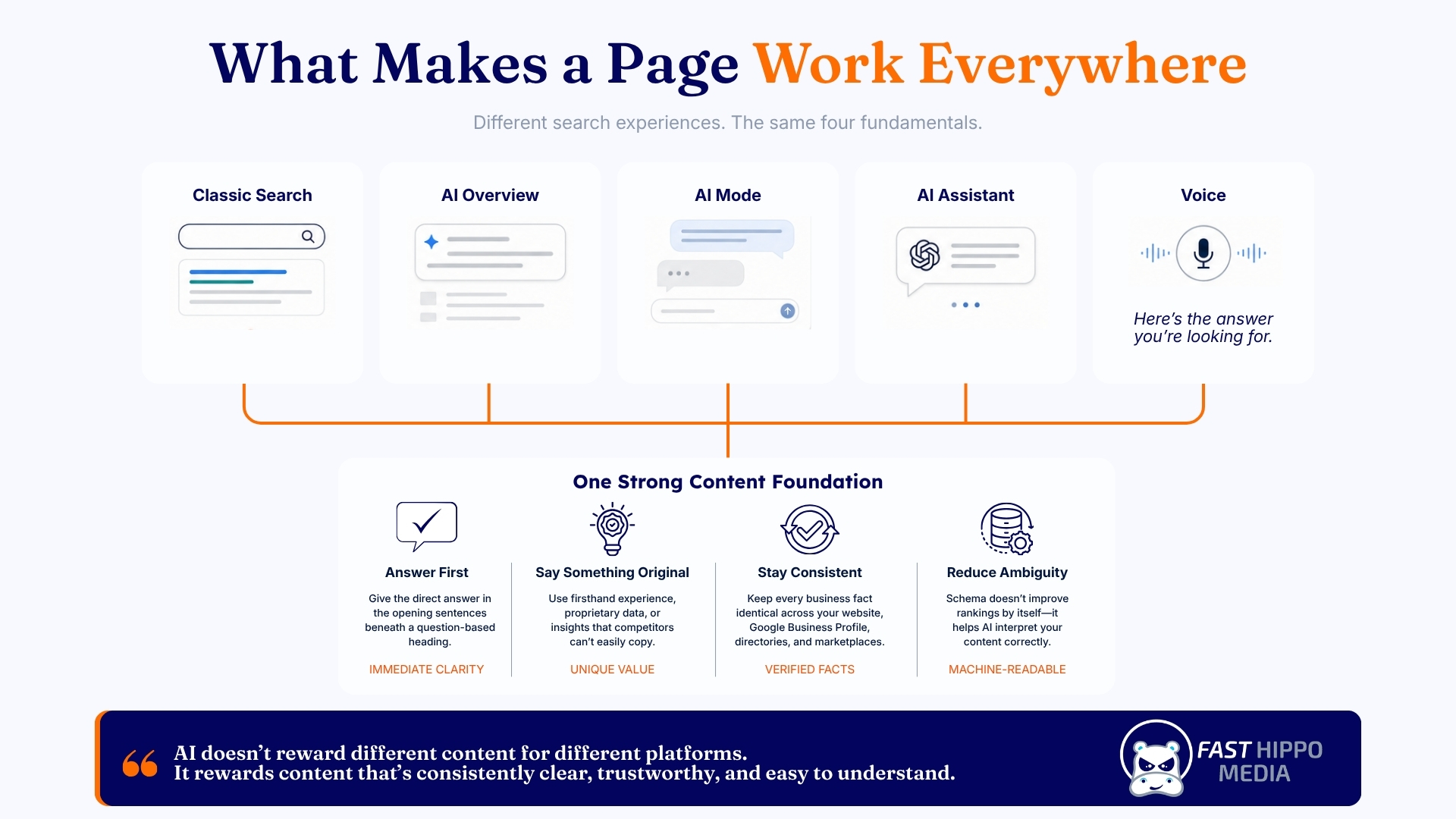
Answer the question in the first two sentences: under a heading phrased the way somebody would ask it. Everything else can follow.
Say something only you can say: Your data, your cases, your correction of something your industry repeats wrongly. A page assembled from the current top five results is the current top five results with less authority.
Keep your facts identical everywhere: Site, profile, listings, marketplaces. Where they agree a system has a fact. Where they conflict it has a reason to use somebody else.
Mark up what is on the page: Structured data does not buy you a place in an AI answer, and Google says as much. What it does is remove ambiguity about your facts, and ambiguity is what gets you skipped. Which types still earn rich results and which quietly stopped is in our guide to .
Where to start this quarter
Three moves, in order.
Check your switches. robots.txt and snippet directives. If either is restricting you, nothing else on this list matters until it is fixed.
Run the four checks above and write down where you appear and where you do not. That document is your baseline, and almost nobody has one.
Fix the surface where the gap is biggest, not the one you find most interesting. For most local and service businesses that is AI answers and their Google Business Profile, not another blog post.
The order to do the work in, once you know where you stand, is in our guide to . If you would rather have somebody run the audit and the fixes, our starts with exactly the four checks above, and the first deliverable is usually a list of switches somebody set years ago and forgot.
Frequently Asked Questions
Check your robots.txt first. OpenAI runs separate crawlers, and the one that decides whether ChatGPT can surface and cite you is OAI-SearchBot, not GPTBot. Sites that blocked AI crawlers to opt out of model training often blocked the search crawler at the same time and removed themselves from the answers without meaning to.
Yes, and you should understand the cost before you do. Google says nosnippet, data-nosnippet, max-snippet and noindex control what appears in its listings including its AI formats, and that more restrictive permissions will limit how your content is featured in AI experiences. Restricting snippets to protect clicks also removes you from the surface where the answer gets built.
No. Google states there are no additional requirements and no special structured data needed to appear in AI Overviews or AI Mode. A page needs to be indexed and eligible to be shown with a snippet. Structured data is still worth shipping, for clarity rather than eligibility.
Published estimates for 2026 range from roughly a quarter of searches to over half, because each tracker measures a different keyword set, country, device mix and detection method. Treat any single figure as a property of that study rather than a fact about search, and ask for the methodology before you plan around it.
The one where you are absent for a question customers actually ask. Search your category signed out, ask two AI assistants the same question, and note where you do not appear. Fix that gap before adding a new channel.
Yes, but as a discipline rather than a channel. A voice assistant returns one answer with no list to fall back on, so it rewards exactly what every other AI surface rewards: a direct answer, unambiguous facts, and consistency. There is no separate voice strategy to build.