(214) 272-7034
  info@fasthippomedia.com


TL;DR
Your Google Business Profile is your real storefront now. It decides your map pack position, feeds AI recommendations, and hosts the reviews that close the sale. Complete every field, pick specific categories, keep hours accurate, post weekly, and answer every review. Track calls and direction requests rather than impressions.
When someone nearby searches for what you sell, your Google Business Profile decides whether they find you and, increasingly, whether an AI recommends you.
It is the highest-return marketing asset most small businesses own, and most of them leave half of it blank. Here is what a fully optimized profile actually does, what to fix first, and how to tell whether the work is paying off.
Understanding your profile’s role in local marketing
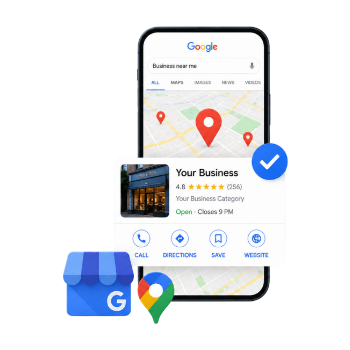
Your Google Business Profile is the storefront most customers see before they see anything else. It appears in local results and on Google Maps, and for a large share of local searches it is the entire interaction. No website visit, no homepage, no navigation. Someone searches, reads the profile, and calls.
That makes it the first impression, whether you manage it or not.
The field’s own research backs the emphasis. survey, which polls 47 local search experts, puts Primary GBP Category as the single highest-scoring local pack ranking factor at 227 points, ahead of proximity to the searcher at 225.
Read that ordering carefully, because it is genuinely surprising. The category you pick from a dropdown outranks how close you physically are. Most small businesses set that field once, during setup, and never look at it again.
The profile does not work in isolation, though. It sits inside your wider local SEO footprint, and the
Citations, service pages, and reviews around it are what make the profile credible to the systems reading it.
Your profile is now your AI storefront
When someone asks Google’s AI or ChatGPT who to call, the answer gets assembled from live local data, and no source carries more of that load than your business profile.
Categories tell the machine what you do. Services and products tell it what to recommend you for. Reviews give it the words it repeats back to customers, in your favour or not. Hours and attributes decide whether you survive the “open now” filter at the exact moment somebody needs you.
There is a concrete example of the shift. Google discontinued the Business Profile Q&A feature in November 2025 and replaced it with AI-generated answers drawn from your profile, your reviews, your photos, and your website. The old version let you write the answers yourself. The new version writes them from whatever you have published. If your services list is thin and your reviews are two years old, that is what the answer is built from.
That changes the stakes of every field you have been meaning to fill in. An incomplete profile used to cost you a ranking position. Now it removes you from answers you never see, because nobody clicks page two of a conversation.
The same logic drives every vertical we work in. A dental practice, a restaurant, and a golf cart dealership are answering different questions, but all three are answered from the same profile fields.
The optimization work in this guide has not changed much. What changed is what it buys: visibility inside the answers people actually read.
What optimization actually gets you
Local pack visibility: The three-business block at the top of local results is the most valuable real estate in local search, and Google Maps ranking is decided by the same signals your profile carries. It costs nothing but attention to compete for.
Trust before contact: A profile with current hours, real photos, listed services, and recent reviews reads as a business that is open and running. An abandoned one reads as a business that might not exist any more.
Direct engagement: Messaging and review replies are a live channel to customers, and both feed the signals that decide rankings.
Cost: This is free. The only input is consistency, which is precisely why so few businesses do it well and why the opportunity persists.
The optimization work, in the order that matters
Categories first, and specifically
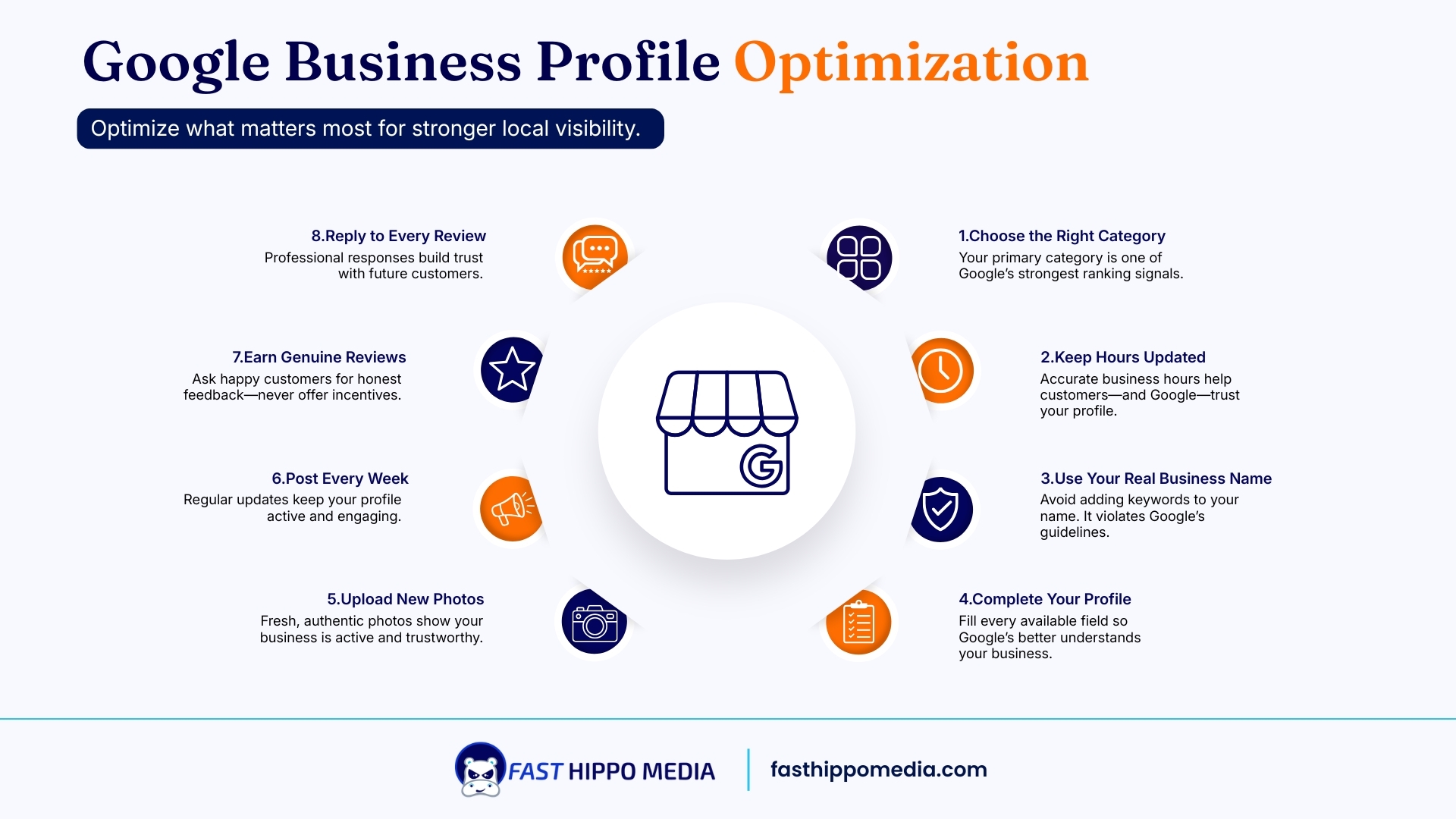
Your primary category is the highest-scoring ranking factor in the field’s benchmark survey. Choose the most specific one that genuinely describes your business, not the broadest one that feels safest. Add secondary categories only where you truly offer that service.
This is a ten-minute job that most businesses have never revisited since the day they claimed the profile.
Hours, because they are a ranking factor
Whitespark ranks Business is Open at Time of Search fifth overall, noting that whether you are open or closed at the moment of the search “will have a huge impact on your rankings.”
That means holiday hours, seasonal changes, and early closes are not administrative housekeeping. They are ranking inputs. A business showing as closed on a Saturday it is actually open has removed itself from Saturday.
The business name and the trap in it
Here is where the field’s research and Google’s rules point in opposite directions and where most GBP advice quietly gets businesses into trouble.
Whitespark’s survey ranks keywords in the GBP business title as the third most powerful local pack factor. It works. And Google’s guidelines prohibit it: business names may not contain marketing taglines, location information, or service and product descriptors. Google states plainly that
So the third most effective lever available is one you can lose the entire profile for pulling.
Our position, and we will put it in writing: do not do it. Use your real business name, the one on your signage and your invoices. A suspension takes down the reviews, the photos, the ranking history, and the phone calls, and reinstatement is slow and uncertain. Trading a permanent asset for a temporary ranking gain is a bad trade at any odds.
If a competitor in your map pack has stuffed their name, that is reportable through the profile, and it is a faster route to the position than copying them.
Complete every field
Services, products, attributes, service areas, the description, and the booking link. Each one gives the ranking systems and the AI more to work with, and each empty field is a question somebody else’s profile answers.
Where paid placement makes sense on top of this, the profile is still the foundation: Local Services Ads draw on the same business information, so an incomplete profile raises the cost of both.
Photos, regularly
Real photos of your premises, your team, your work, your products. Add them on a schedule rather than in one batch at setup. Activity is itself a signal, and stale photography reads as a stale business.
Posts, weekly
Offers, events, updates, and new stock. Weekly is enough. This is the lowest-effort way to look active to both customers and ranking systems.
Reviews and how to ask
Ask at the moment the work is done and the customer is happy, and make it one tap with a direct link.
Never offer anything in exchange, and never tell a customer what to write. Both breach Google’s review policies, and the penalty lands on your profile rather than on the customer. The same applies to only asking the people you expect to leave five stars.
Reply to everything, including the negative ones, and write the reply for the next reader rather than the one complaining.
Measuring what matters
Profile views and impressions feel like progress and tell you almost nothing.
The numbers that matter are the ones with intent behind them: calls, direction requests, website clicks, and messages. Those are people choosing you. Track them monthly and compare against what changed on the profile, because that is the only way to learn which of these levers works in your market.
The mistakes that cost the most
Inconsistent information: Name, address, and phone that differ between your profile, your website, and the directories. Machines cross-check before they trust.
Set-and-forget: A profile claimed in 2023 and untouched since is competing against businesses posting weekly. This is the same failure pattern we cover in why publishing more content doesn’t increase visibility activity without structure produces motion rather than progress.
Ignoring reviews: Both the collecting and the replying. Recency matters more than total count.
Keyword-stuffed names: Covered above. It works until it does not, and then it takes everything with it.
Wrong or overly broad categories: The highest-scoring factor in the survey, set carelessly at setup and never revisited.
Where to start this week
Open your profile and check three things.
Your primary category: Is it the most specific, accurate option, or the one you picked in a hurry? This is the highest-scoring ranking factor there is.
Your hours, including the exceptions: Holiday hours, seasonal changes, anything unusual coming up. Being wrongly listed as closed removes you from that day’s searches entirely.
Your newest review: If it is more than three months old, that is the gap costing you customers right now, and it is fixable this week.
If you want the profile working as part of an answer-engine strategy rather than a standalone listing, that is what answer engine optimization covers.
If you would rather have someone run the whole checklist against your profile and your market, our team does exactly that, and it starts with telling you which of the three above is actually your weakest.
Frequently Asked Questions
It is your free business listing on Google Search and Maps: hours, services, photos, reviews, and the buttons customers use to call or visit. For local businesses it is usually the first impression, and increasingly it is what AI tools read before recommending anyone.
Map rankings run on relevance, distance, and prominence. A complete profile with specific categories, listed services, accurate hours, fresh photos, and active reviews raises relevance and prominence, the two you can control, and that is what moves you into the map pack.
Categories first, since the primary category is the highest-scoring local ranking factor in Whitespark’s 2026 survey. Then services, accurate hours, real photos added regularly, products where relevant, weekly posts, and review replies. Consistency with your website and directories seals it, because machines cross-check before they trust.
No. It does influence rankings, which is why the practice persists, but Google’s guidelines prohibit marketing taglines, location information, and service descriptors in the business name, and state that unnecessary information there can result in suspension of the profile. Losing the profile costs you the reviews, photos, and ranking history along with it.
Weekly for posts and photos, immediately for hours changes, and every review answered within a couple of days. An active profile signals a business that is open, busy, and paying attention, to customers and to ranking systems alike.
Yes. The profile is where local intent converts: calls, direction requests, bookings, and website visits all start there. Optimization turns more of the people already searching into contacts, which is the cheapest growth available to a local business.